WITHIN a period of two weeks, news came of the first British and American commercial jet crossings of the Atlantic. These events only serve to underline the fact that today the man in the middle of Africa and the man in the middle of Australia, the woman cooking a meal in an Eskimo igloo and the woman setting the automatic stove in her New York apartment can no longer live in blissful unconcern for one another. Their centuries-old ways of life no longer run parallel courses. They intersect—and not once, but again and again. How the French African colonies voted on whether to remain within the French Union or strike out on their own may well vitally affect the market for our hemp and copra. A change in the Middle East situation may easily affect the availability of farming supplies in a Mindanao barrio.
But our life, besides being altered in an economic or military sense by the unincreased international dependence, will be even more seriously affected in a cultural sense. We will be exposed more and more to cultural currents from countries of a very different background, historically and racially. It is well for us to consider what attitude we should adopt.
We have entered into the arena of independent national existence. This is something of which we should justly be proud. It is the result of the efforts of Filipinos, not a gift handed to us on a silver platter, as some would have us believe. Together with the acquisition of a recognized international individuality, we like to think of ourselves as also possessing an individual national culture. Do we possess such a thing? I would unhesitatingly say that we do. We possess a culture and a way of life distinctly and unmistakably Filipino.
Some say that what we call our culture is not our own, that it is something mainly imported from outside. But has there ever been an advanced civilization of any sort, which viewed nothing from the outside? Rome, Greece, China, India all underwent influence to a greater or lesser extent. What makes a culture one’s own is not being all home grown. A culture becomes one’s own when the elements entering into it, be they foreign or native, are amalgamated and given a distinctive stamp by the national genius. Certainly the elements of our culture, be they originally Malay or Chinese or European, have formed a combination stamped very distinctly by the Filipino character. Just as so many of us have a mixture of the blood of different races running in our veins, yet such people are Filipinos, and not the nationalities that entered into the mixture, so the elements of our culture may be amalgam, but the result is Filipino.
To wish to eradicate all foreign traces from our culture is to destroy what is so characteristically and wonderfully Filipino—the pleasant blending of the old and the new, the East and the West. It is to destroy our peculiar position as a bridge between East and West, belonging to both partly, yet not entirely either, and therefore able to sympathize with both and to disagree with either.
We should be proud rather than ashamed of what some disdainfully call our hybrid culture. All great cultures have to a large extent been hybrid. And the tendency towards cultural blending is growing stronger all over the world. It is a natural result of the growing together of peoples.
No, we must take culture as it is, basically a blend of East and West, distinctively stamped as our own. Remember, truth and beauty are the rightful heritage of all men—and when we possess them, they are our own, no longer alien. We must not be ashamed of our cultural heritage, although naturally we must be willing to change what is undesirable, while clinging to the eternal values, which we are fortunate enough to possess. Wit this firm hold on the unchangeable moral and spiritual values of our past, we must face the cultural changes of the future unafraid, eager to take the good and the beautiful, while uncompromisingly rejecting the rest. We may be sure that addition to our culture, even if they should come from outside, will be assimilations, not mere juxtapositions, and the end result will still be decidedly Filipino.
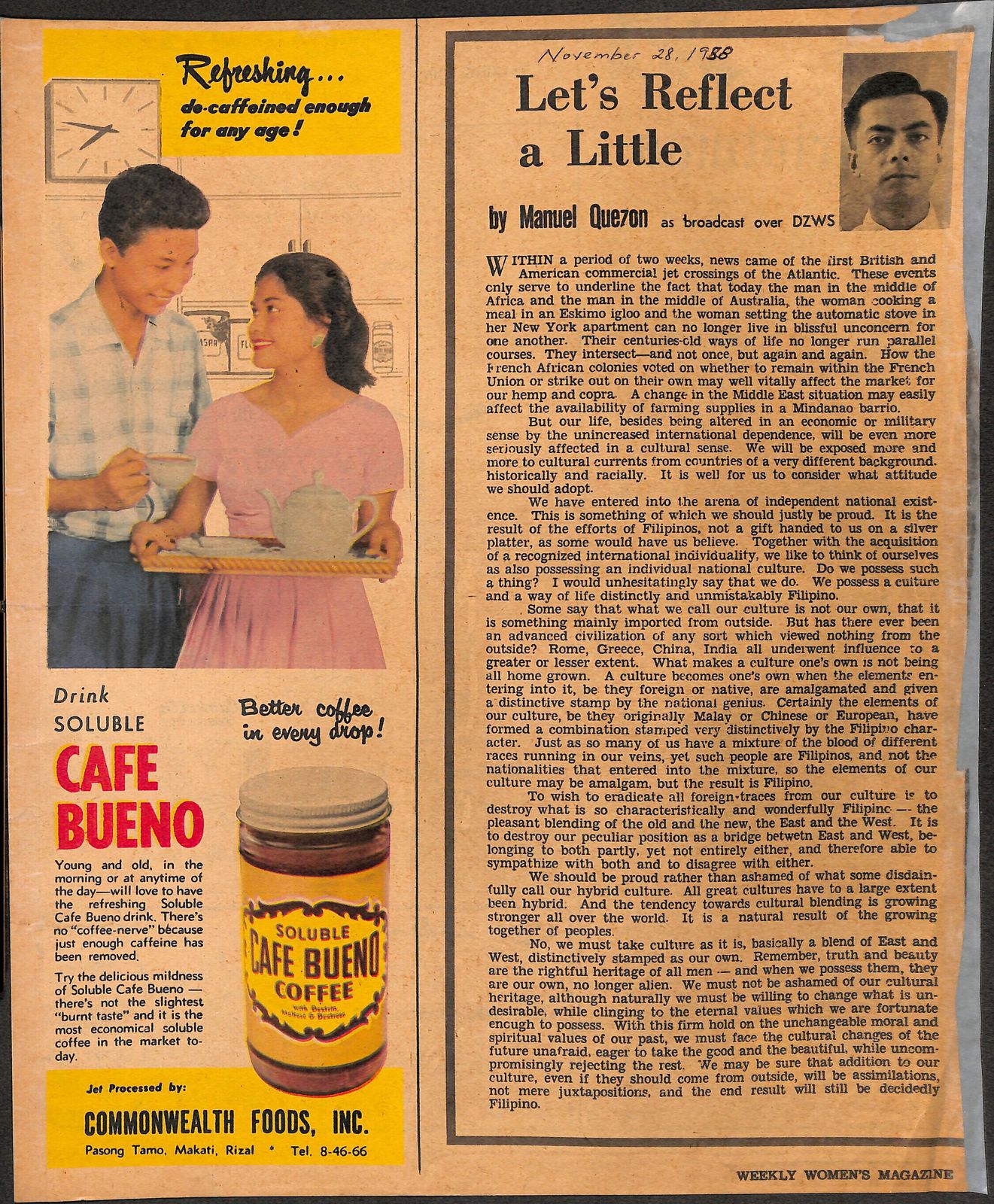
Broadcast over DZWS and printed in the Weekly Women’s Magazine, November 28, 1958.
Text checked against the scanned clipping.
The original clipping