DO WE really want democracy? I sometimes wonder. We talk enough about it. We are certainly vocal enough about our rights and prerogatives as free citizens of a free republic. We talk about our individual rights and how the government cannot do this that or the other to us. The government cannot deprive us of this, that or the other thing. Our constitutional rights…and so on and so forth.
Well and good. But that alone will not ensure democracy. The general affirmation of rights alone will lead not to democracy, but to anarchy. After all, democracy is a form of government—and any government must maintain unity. If we give weight exclusively to individual rights, which tend to pull society apart, we shall not have democracy, because we shall not have even government, or at best we shall have weak, ineffective government, which is almost equivalent to having no government at all.
In life we do not get anything truly worthwhile for nothing. If we want democracy we must be willing to do what democracy requires. We must be as deeply convinced about our duties as about our rights.
Some of those duties are difficult to identify, because they are not marked out by legislation. Such is the obligation to be well informed about issues of common interest, to form an intelligent judgment on them and, if necessary, to express that judgment—in other words, to form a sound and vigorous public opinion.
Public opinion is vital to a democracy. In fact, democracy has on occasion been defined as government by public opinion. The idea of democracy is that the whole people should have some part in government. In a representative, democracy, such as ours, the part of the people consists in choosing their representatives who shall govern in exerting influence on those representatives so that the latter, once elected, will govern according to the mind of the people and for the benefit of the people. The process of choosing elective officials will be a failure if the people are not well informed about the character, the record and the platform of each individual running for office. Above all, the process will be a failure if the people do not have a sound set of principles against which to measure candidates and public issues. And the people will not be able to influence those who are elected to govern unless the people know the facts and have sound principles—and unless the elected officials realize that public opinion is a force to be reckoned with.
We must confess that if our government and our way of life suffer from marked defects, we must lay the blame largely on the lack of a strong and sound public opinion. There is as yet too much apathy in the citizens—even on issues of vital public interest.
True, we cannot expect a well-formed public opinion in the large uneducated section of the citizenry. But we do not get the response we should—even from those in a position to form a judgment on public affairs.
Perhaps people are just too lazy to gather facts and draw conclusions. Perhaps disappointment over the obvious blemishes on politics is to blame. But, whatever the cause, we must take an interest in the affairs that concern us all. It must be an interest kept free as much as possible from passions and inconsideration.
We are seriously remiss in the fulfillment of our civic duty if we do not take part in public life at least to the extent of forming a sound opinion on public issues and expressing that opinion if need be. Is it too much to ask that we put some of our time into acquiring sound principles to be used as criteria for judging public issues? Is it too much to ask that we gather the facts and see how they measure up to those principles? If it is too much to ask, it is also too much to expect our democracy survive in anything but name.
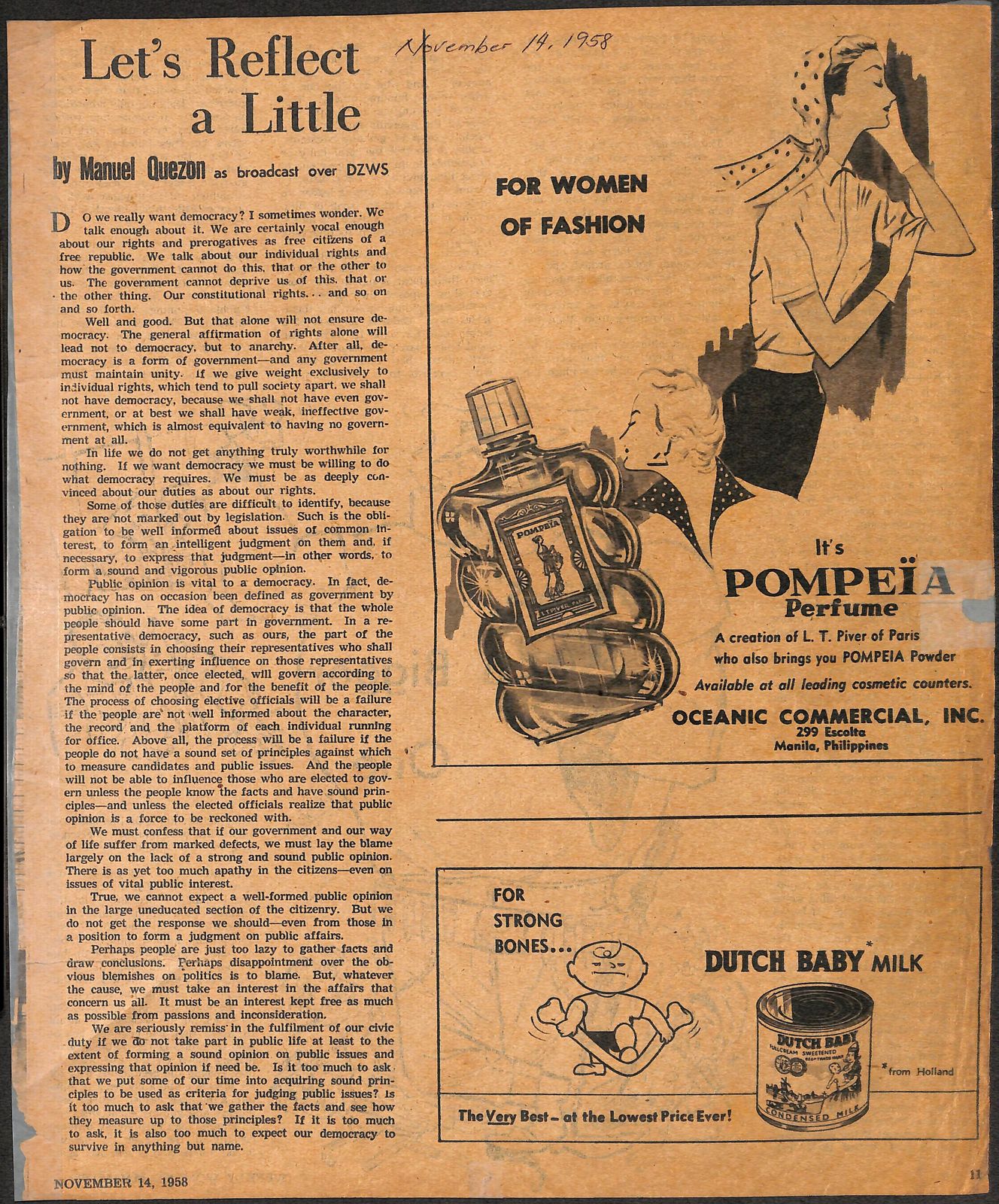
Broadcast over DZWS and printed in the Weekly Women’s Magazine, November 14, 1958, p. 11.
Text checked against the scanned clipping.
The original clipping