ONE of the greatest contributions possible to the stability and progress of any country is the intelligent use of the ballot. There are many important factors that work in favor of the ballot and many that work against it. Among those that work in favor of it are the citizens’ active interest in public affairs, a firm grasp of sound political principles and of the country’s or the locality’s needs, accurate information on the candidates qualifications, absence of blinding passions and certainly not the least in importance, the voter’s conviction that they are answerable to Almighty God for the way they exercise their vote. With this list we have, by no means, exhausted all the positive factors.
On the other hand there are the negative factors: apathy regarding public affairs, ignorance of the country’s or the locality’s needs, biased sources of information (which make it well impossible to know the truth about the candidates) and, again by no means the least in importance, failure to see the necessary connection between careful voting and one’s duties to God and one’s fellow men. Again we have not exhausted the negative factors.
I would like to discuss a very important factor in Philippine affairs which nullifies very important positive factors from the outset. I refer to the excessively personal quality of Philippine politics.
During elections we invariably hear remarks like the following: “I shall vote for Mr. X because he is a friend or relative of myself or my wife, or because he comes from the same locality or linguistic group, or works in the office.”
Let us here make two of the many possible observations on these remarks. The first is that the underlying principle in the choice of a candidate is made to consist in his relation to the private individual, to “me,” because he has done “me” a favor, because he is from the same region as “mine.” The second consideration is that the really important factors to be taken into account are either outweighed or entirely overlooked, so that the definitive decision stems from the personal factor–”me.”
Now, to make the choice of a candidate depend on his relationship to oneself is to invert the whole procedure of choice. Officials are logically elected, not because of any relationship to any particular individual or group. The purpose of electing people to government office is to provide for the common temporal welfare, which includes the peace and security in which families and individual citizens may have the free exercise of their rights and at the same time enjoy the greatest spiritual and temporal prosperity possible in this life through the mutual union and coordination of the work of all. The central consideration, therefore, should not be “What personal ties exist between the candidate and myself?” but “How qualified is he to serve the common welfare?” I refer not to mere legal qualifications… these can be met by almost anyone. I refer to concrete qualities and abilities which give us assurance that the candidate, if elected, not only can, but will serve the public interest. Certainly the mere personal connection of the candidate with myself gives no such guarantee. How logical does this sound: “Mr. X will propose good laws because his grandmother and mine are sisters.”
Let us repeat: Government had for its purpose the public welfare, which does not exclude the private welfare, but is far nobler. Therefore those who will exercise the powers of government must be chosen with reference to the public good.
Does this mean that any personal consideration must be completely excluded? No. When there are two or more fully qualified candidates, we are entirely justified in preferring one to the other on the basis of personal relationship. The mistake consists in giving a predominant position to the personal factor. This distorts the whole process of selection. It subordinates the good of all to fortuitous circumstances of friendship or relationship. It gives weight to matters of small importance to the public, while ignoring the purpose of government-the good of all, not only as individuals but as forming a community. It is like considering the good of the human hand or foot as paramount-and the rest of the man-mind and body-solely from a consideration of the hand or foot. Such a view is obviously way off the mark. Just consider the abnormal life procedures to which it would give rise.
Let us not lose our sense of proportion. First things first. The public good is the purpose of government and therefore, in the choice of candidates, the public good must also come first.
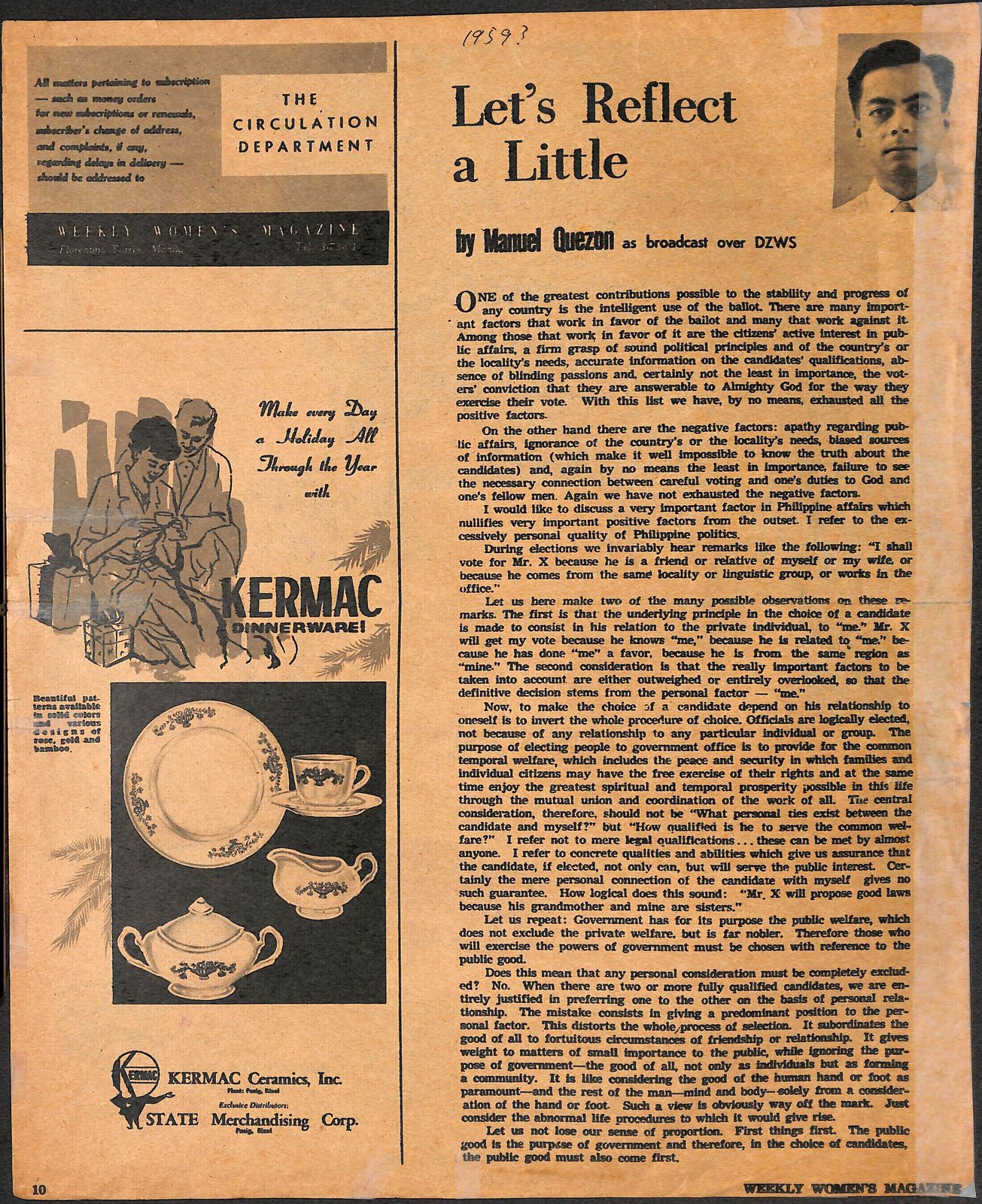
Broadcast over DZWS and printed in the Weekly Women’s Magazine, December 5, 1958, p. 10.
Text checked against the scanned clipping.
The original clipping