“The patient man is better than the valiant; and he that ruleth himself than he that taketh cities.”—The Holy Bible
PATIENCE is one of the virtues easiest to preach and one of the most difficult to practice. In Spanish and English, it is preached with one word: “Paciencia,” “Patience,” in colloquial Tagalog, with two: “Kaunting pasiensia.” Everyone understands exactly what it means—or so it seems.
We make an appeal for it under all sorts of conditions and for all sorts of reasons. The noble man and the virtuous demands it, the good man and the saintly pleads for it, and for the same reason: nobility, virtue, genuine goodness, and that highest point achievable by man—authentic sanctity—cannot exist without it. The mature man expects patience because maturity without patience is impossible. Patience is in fact a true test of character.
Patience can, however, be a subterfuge for less laudable sentiments. A coward may disguise his cowardice as patience when it is his duty to act—a man who fails to defend his daughter who is being unjustly attacked, an official who does not crack down on the misbehavior of his subordinates, an influential citizen who fails to speak out against wrong, a priest who fails to rise in defense of religion. In these cases, we are dealing, not with patience, but with its perversion. A plea for patience can also be a means for the perpetration of injustice and oppression. It is the latter with which I am presently concerned.
Anyone with eyes and ears and a conscience only needs to look about him to see that there is something seriously wrong with our society. Our principles, our ideals, and the legal apparatus to support them are fine.
Democracy, equal opportunity for all, equality before the law, freedom of this, that, and the other. Fine, fine in theory, beautiful in speeches, resplendent in writing. But does not the reality of life make a mockery of all these things?
Democracy, when a landlord may control the votes of all his tenants—or else? Equality of opportunity, when “pull” may place an incompetent at the head of the line and never even allow the fully qualified but backer-less individual a distant glimpse of the post to which he aspires? Equality before the law, when an influential politician can effectively block the operation of justice, to the chagrin of the law-enforcement agencies, while a poor citizen pays the full penalty for his crimes?
Taking a broader view of our society, does not the chasm between rich and poor, between the educated and the barely literate masses operate to nullify whatever legal and democratic safeguards our system takes such pains to safeguard? In a word, do not the blatant economic and social inequalities of our country tend to make our free and just democratic society a farce instead of a reality? And what, all too often, is the sop we throw to the unfortunate members of our society? A sermon on patience.
Well, to a large extent that is the only virtue that our badly situated fellow citizens can practice to meet such conditions—patience.
Patience, so that they will not take the law into their own hands and only make matters worse, not better. Patience, so that they will not be guilty of the same injustice of which they are the victims, for an injustice is never righted by committing another injustice. Patience, in the exercise of self-restraint, so that the bounds of moral and legal justice may not be exceeded. True, interior patience, so that their consciences may remain clean, although their hands and bodies may be dirty, with the dirt of poverty and humiliation.
But there is a broad area within which patience would not be patience—it would be apathy at best, at worst, cowardice. That is the area of the exercise of legal and political rights. It is the use of the law and the ballot, the peaceful but forceful expression of public opinion, to bring about an equitable state of affairs, to dethrone corruption at the polls and support intelligence, integrity, and dedication.
I am not one to use the United States of America as the perfect model of democracy, since it is not. There is one American habit, however, which we could imitate very profitably. It is the habit of writing to one’s representative in Congress. The courts of law exist for the redress of legal grievances, but Congress is a resort, not just a last but often a first or only resort, for the remedying of ills. Let a measure of importance, if not for the country as a whole, at least for a section of the country, be contemplated, and Senators and Congressmen are deluged with letters from their constituents.
It is not merely the United States Congress, which is subjected to this sort of democratic pressure from the people—any and all public authorities are bombarded with mail as occasion may demand. Indeed, even private companies and organizations are subjected to the same treatment. Open letters to the press are a very common vehicle for expressing satisfaction or dissatisfaction with a situation.
Such a procedure serves more than one useful purpose: it is a safety-valve for pent-up emotions, it allows authorities and private groups to feel the public pulse, and above all it serves warning on the authorities that the ultimate human repository of civil authority—the people—is keeping a sharp eye on goings-on and will not tolerate a cynical disregard of public opinion. It would take a calloused person indeed to disregard an avalanche of letters for or against a measure. And all this is done democratically, completely within the pale of the law, and without a trace of that attitude fatal to the democratic process: “After all, what can I do about it?”
Certainly, if the average poor and underprivileged Filipino citizen (and the average citizen is poor and underprivileged) were to take to the mails, as it were, we could look forward to a marked improvement in our society, an improvement which would be felt where it is needed most—among those who lead a hand-to-mouth existence, or little better.
But the question of patience has special relevance for the upper crust of our society. The preaching of patience to the depressed classes comes with very poor grace from those who are in a position to do something to alleviate the lot of the poor and fail to do so.
Not A Matter Of Contributions
Actually, it is not merely a matter of giving contributions to charity. Many good souls do so, not only among the wealthy but also among those belonging to the middle and even lower income bracket. Some do so from unworthy motives, no doubt, but it would take a most unjust mind to attribute other than worthy motives to the immense majority—a genuine sympathy for the suffering and a desire to alleviate their lot.
However, economic inequalities have grown so great that something more than individual help is required. Individual help must not stop—God forbid! Over and above individual help, however, a true conversion, a true change of heart, a new outlook is required, productive of a concerted effort to solve our problems through heroic efforts if need be. The every-man-for-himself attitude, the child of laissez-faire economics, has got to go. The notion of free enterprise must be, not destroyed, but subordinated to the most fundamental concept of society and public authority, which is the common good.
It is considered a truism that, in the last analysis, it is not so much the type of government or economy, as the men who run it; not so much the laws as the men who administer them, that make for a good or bad society.
In a sense, of course, it is true: no matter how perfect the form of government, no matter how perfect the laws, if the people in control are wicked, dull of conscience, or not capable, the outcome will be a disaster. Society may blunder through such a situation and survive—it often does—but a frightful cost.
But supposing that we have a good type of government (which we do) and good men to run it, supposing that those who largely control the economy are capable men, are we assured of the necessary good results? I seriously doubt it—at least, if we mean by good and capable men those who are such solely according to the excessively individualistic model of the old free enterprise, dog-eat-dog system.
The classical free enterprise system exists today only in countries where democracy is a farce and progress the privilege of a few rather than the birthright of all. The freest and also most progressive democracies today have a directed economy in one form or another, much as they may dislike the term “directed economy.” Modern economy is so complex and its various elements are so intertwined, both within each country and in relation to the economy of the rest of the world, that it has been found necessary to introduce a degree of planning and direction, in accordance with the particular needs of each country.
In the Social and Christian Democratic countries of Europe, the fact is obvious; less obviously, the United States of America, with its clarion-call of free enterprise, has found an increasing amount of government vigilance and regulation necessary for its economy. Notwithstanding Barry Goldwater and Company, the effect has been to strengthen, not weaken, the free enterprise system by protecting it from the excesses, which have threatened to destroy it in the past.
Some experiments in planned economy have not been entirely successful and in some instances governments have gone too far or moved too fast and had to move back in certain respects, but by and large, the movement has been a success.
It may surprise some well meaning but not very well-informed Catholics to hear that the Church, which has time and again condemned Communism, has had very harsh things to say about classical Capitalism.
Leo XIII, who exposed and condemned Marxism in his encyclical “Quod Apostolici Muneris” (On the Evils of Socialism) was the same Pope who wrote “Rerum Novarum” (On the Condition of the Working Class), which pilloried the old style capitalism in no uncertain terms. Pius XI around half a century later wrote a seething condemnation of “Atheistic Communism” and also brought up to date Leo’s encyclical on the laboring classes with his “Quadragesimo Anno” (On Reconstruction of the Social Order).
Pope John XXIII in two encyclicals, “Mater et Magistra”(Christianity and Social Progress) and “Pacem in Terris” (Peace on Earth) again brought up to date, not the principles taught by his predecessors for they are timeless, but their application to contemporary conditions. What are those timeless principles?
If I may be so bold as to put them in capsule form, they are the central fact that the world is meant to serve man so that man may serve God. Both materialistic Communism and materialistic old style Capitalism contradict that fact. Any social system, any governmental system which grinds some or most men into the dust instead of lifting them up is destructive of the very order of nature and of things and contrary to the teaching of the Church and of sound reason. Any system which fails to respect this true order of things, or which is not oriented toward it, needs to be changed to the degree and extent that nature is violated.
The particular form and speed of change must of course avoid any violation of justice, and avoid the haste, which precludes careful study.
Patience in making a careful study, yes; patience in those who must bear with seeming delay which is in reality the avoidance of ill-considered haste, yes. But patience as a refuge for a social conscience which refuses to search itself and face facts and needs honestly, even at the cost of human misery to others—never!
A patient, careful study of our present social and economic system so that the needs of the people, not just of a segment of the population, may be met, is our duty in conscience.
Support of reform within the framework of our democratic system, involving some economic planning and direction freely discussed and freely adopted seems to me an inescapable necessity. Let those who imagine the Communist demon to be lurking under the chair of everyone who favors the elimination of extreme social and economic inequalities beware: some day they may imagine the Communist demon to be lurking under the Chair of St. Peter.
Published in the Philippine Graphic, October 5, 1966.
Text checked against the scanned clipping.
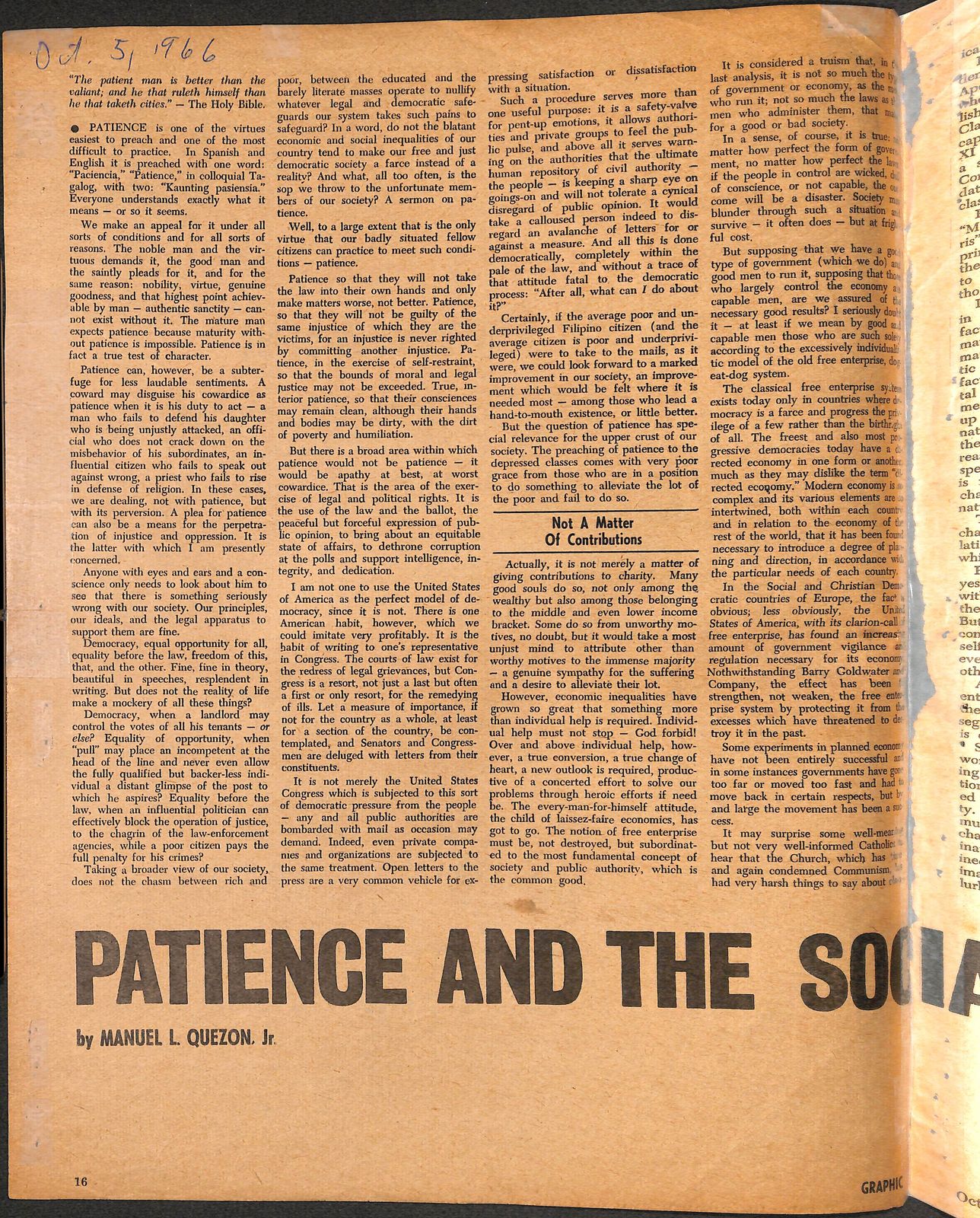
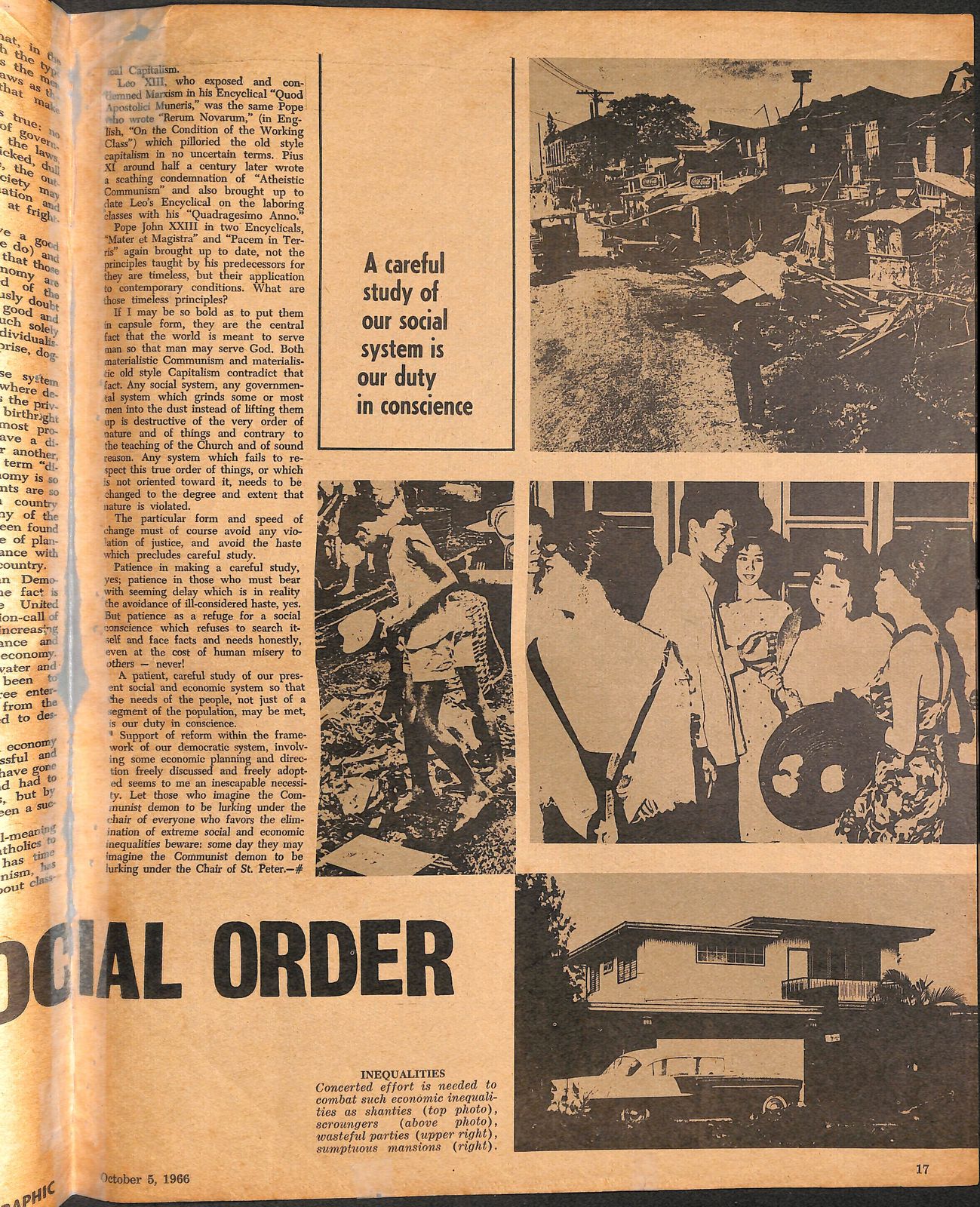
The original clipping