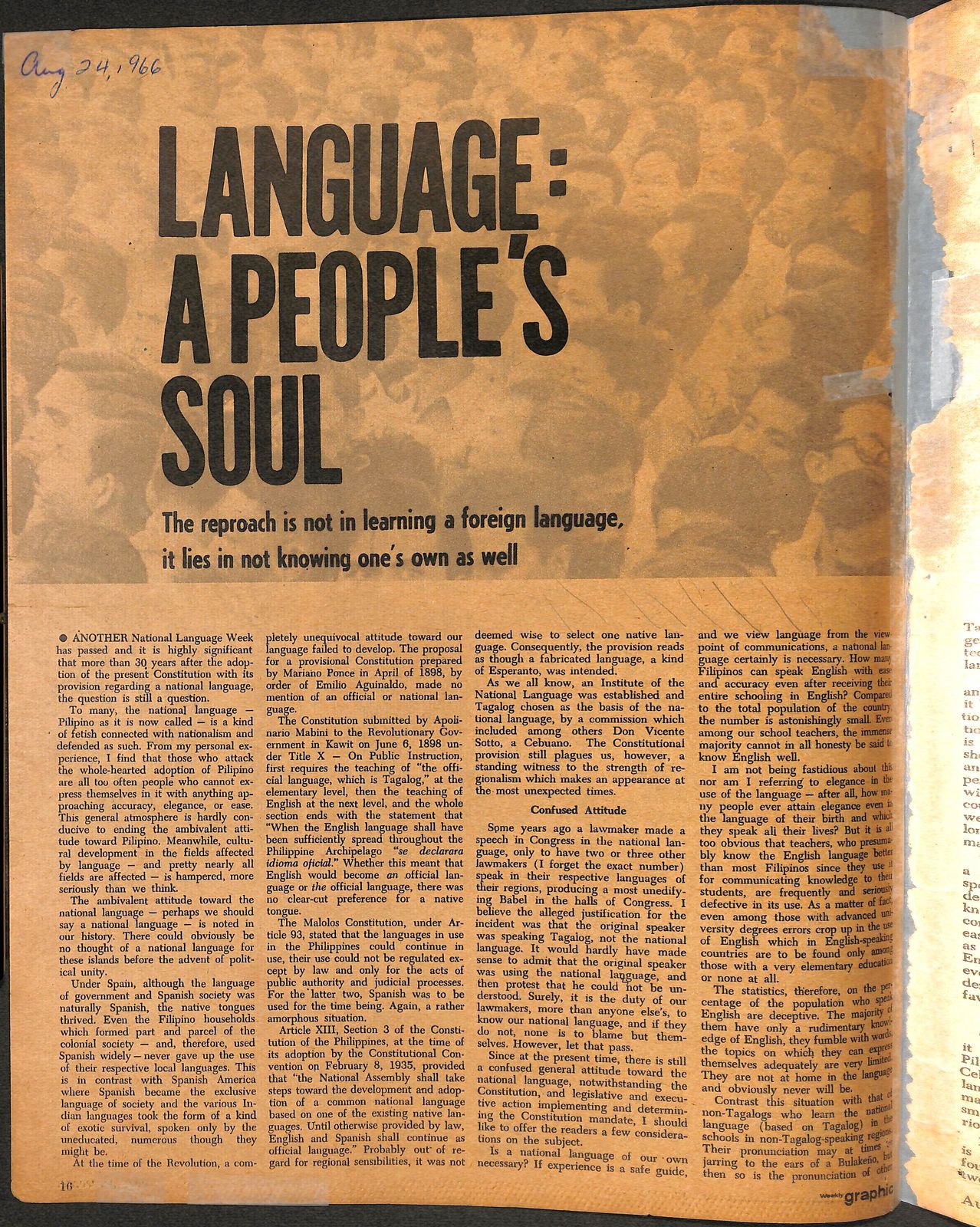
ANOTHER National Language Week has passed and it is highly significant that more than 30 years after the adoption of the present Constitution with its provision regarding a national language, the question is still a question.
To many, the national language—Pilipino as it is now called—is a kind of fetish connected with nationalism and defended as such. From my personal experience, I find that those who attack the whole-hearted adoption of Pilipino are all too often people who cannot express themselves in it with anything approaching accuracy, elegance, or ease. This general atmosphere is hardly conducive to ending the ambivalent attitude toward Pilipino. Meanwhile, cultural development in the fields affected by language—and pretty nearly all fields are affected—is hampered, more seriously than we think.
The ambivalent attitude toward the national language—perhaps we should say a national language—is noted in our history. There could obviously be no thought of a national language for these islands before the advent of political unity.
Under Spain, although the language of government and Spanish society was naturally Spanish, the native tongues thrived. Even the Filipino households which formed part and parcel of the colonial society—and, therefore, used Spanish widely—never gave up the use of their respective local languages. This is in contrast with Spanish America where Spanish became the exclusive language of society and the various Indian languages took the form of a kind of exotic survival, spoken only by the uneducated, numerous though, they might be.
At the time of the Revolution, a completely unequivocal attitude toward our language failed to develop. The proposal for a provisional Constitution prepared by Mariano Ponce in April of 1898, by order of Emilio Aguinaldo, made no mention of an official or national language.
The Constitution submitted by Apolinario Mabini to the Revolutionary Government in Kawit on June 6, 1898 under Title X—On Public Instruction, first requires the teaching of “the official language, which is Tagalog,” at the elementary level, then the teaching of English at the next level, and the whole section ends with the statement that “When the English language shall have been sufficiently spread throughout the Philippine Archipelago ‘se declarara idioma oficial.’” Whether this mean that English would become an official language or the official language, there was no clear-cut preference for a native tongue.
The Malolos Constitution, under Article 93, stated that the languages in use in the Philippines could continue in use, their use could not be regulated except by law and only for the acts of public authority and judicial processes. For the latter two, Spanish was to be used for the time being. Again, a rather amorphous situation.
Article XIII, Section 3 of the Constitution of the Philippines, at the time of its adoption by the Constitutional Convention on February 3, 1935, provided that “the National Assembly shall take steps toward the development and adoption of a common national language based on one of the existing native languages. Until otherwise provided by law, English and Spanish shall continue as official language.” Probably out of regard for regional sensibilities, it was not deemed wise to select one native language. Consequently, the provision reads as though a fabricated language, a kind of Esperanto, was intended.
As we all know, an Institute of the National Language was established and Tagalog chosen as the basis of the national language, by a commission which included among others Don Vicente Sotto, a Cebuano. The Constitutional provision still plagues us, however, a standing witness to the strength of regionalism, which makes an appearance at the most unexpected times.
Confused Attitude
Some years ago, a lawmaker made a speech in Congress in the national language, only to have two or three other lawmakers (I forgot the exact number) speak in their respective languages of their regions, producing a most unedifying Babel in the halls of Congress. I believe the alleged justification for the incident was that the original speaker was speaking Tagalog, not the national language. It would hardly have made sense to admit that the original speaker was using the national language, and then protest that he could not be understood. Surely, it is the duty of our lawmakers, more than anyone else’s, to know our national language, and if they do not, none is to blame but themselves. However, let that pass.
Since at the present time, there is still a confused general attitude toward the national language, notwithstanding the Constitution, and legislative and executive action implementing and determining the Constitution mandate, I should like to offer the readers a few considerations on the subject.
Is a national language of our own necessary? If experience is a safe guide, and we view language from the viewpoint of communications, a national language certainly is necessary. How many Filipinos can speak English with ease and accuracy even after receiving their entire schooling in English? Compared to the total population of the country, the number is astonishingly small. Even among our schoolteachers, the immense majority cannot in all honesty be said to know English well.
I am not being fastidious about this nor am I referring to elegance in the use of the language—after all, how many people ever attain elegance even in the language of their birth and which they speak all their lives? But it is all too obvious that teachers, who presumably know the English language better than most Filipinos since they use it for communicating knowledge to their students, are frequently and seriously defective in its use. As a matter of fact, even among those with advanced university degrees errors crop in the use of English which in English-speaking countries are to be found only among those with a very elementary education or none at all.
The statistics, therefore, on the percentage of the population who speak English are deceptive. The majority of them have only a rudimentary knowledge of English, they fumble with words, the topics on which they can express themselves adequately are very limited. They are not at home with the language and obviously never will be.
Contrast this situation with that of non-Tagalogs who learn the national language (based on Tagalog) in the schools in non-Tagalog speaking regions. Their pronunciation may at times be jarring to the ears of a Bulakeño, but then so is the pronunciation of other Tagalogs. But those non-Tagalogs often get to speak the language with greater technical perfection and a purer vocabulary than the Tagalogs themselves.
If those who come to Manila without any knowledge of Tagalog and just learn it by hearing and practice are an indication, the great practicality of the national language as a common language is beyond doubt. It takes a remarkably short time for them to speak fluently and with an accuracy which only a fussy person could criticize. Ordinarily, one without any knowledge of Tagalog could start speaking in two or three weeks, in a little over a month he no longer finds much difficulty and in a matter of months is at home in it.
When, therefore, statistics claim that a certain percentage of the population speaks Tagalog, the statistics are not as deceptive as those on English. I do not know just exactly how the statistics are compiled, but I believe that if being at ease with the language were included as a criterion, the relative statistics on English and Tagalog or Pilipino (whatever you may want to call it) would demand a considerable readjustment in favor of the latter.
Nothing Mysterious
This phenomenon—I have no doubt it would be the same if the basis of Pilipino were Ilocano, Pampanga, Bicol, Cebuano, Ilongo, Waray, or any of the languages of the Muslim area, or for that matter any of the languages of the smaller minorities—is nothing mysterious.
No mystique of the blood or the race is involved. The explanation is to be found in the linguistic relationship between the languages and their parallel development over a span of centuries. These factors are entirely missing when it is a question of learning English. In fact, for some reason I have not troubled to investigate, Spanish would actually be less unsuited to our native linguistic abilities than English.
It is a fact that Filipinos who know Spanish well express themselves “Spanish-ly,” whereas Filipinos who know English well in its American form do not in general express themselves “American-ly.” The Filipino mentality and psychology are too far removed from the American for a language developed for the latter (we are taught American English, which is different from British English) to be an effective medium of expression of the Filipino. Whatever the region and the language of a Filipino, he can more easily adjust to Pilipino than to English.
We have, of course, Filipinos who are at home in English. They know English better than the average American, have a wider vocabulary and wield it more accurately. They are the more vocal portion of the population and exert an influence in intellectual circles out of all proportion to their numbers. They commonly use English among themselves precisely because they do know the language well. This is not a reproach to them, it is all to their credit that they should know a foreign language so well. (It is a reproach, however, when some are unable to express themselves reasonably well in our own language). But it would be absurd to require the immense majority of Filipinos, who cannot acquire the same familiarity with English, to adjust themselves to the convenience of a small minority. It should be the other way around.
Let it be borne in mind that even those at home in English are not usually the products of an American environment: they belong to the Filipino environment like everyone else and thus would not require a change in mentality—unless a colonial mentality be involved—to express themselves better in the national language, it is just a matter of expanding their Pilipino vocabulary and kaunting tiyaga. Surely it is not too much to ask. It is high time that Pilipino was given its proper place in literary, intellectual, and technical circles.
But has it, can it have, a proper place in such circles? Many would answer in the negative. They charge Pilipino with poverty. If they are referring to non-technical fields, their accusation is excusable only on the ground of inculpable ignorance. Let him open the Diccionario Tagalog-Hispano por Pedro Serrano Laktaw published in 1914.
The volume I have, which is Tagalog-Spanish without a Spanish pot, has 1392 pages of pure vocabulary, apart from the introduction. It is enough to make the average Tagalog educated in English feel that it is presumption for him to speak Tagalog or claim to know it. The wealth of synonyms and the precision of the meanings of words, the richness of their connotations, is positively staggering. For literary purposes, I doubt if more could be desired. There are probably more words than a writer could need or use in a lifetime.
Scientific Terms
Of course, there are those who, with an air of irrefutable wisdom will ask: “How do you say ‘automobile,’ ‘telegram,’ ‘hydraulic,’ or ‘atomic’ in Tagalog?” (These people will seldom use the word Pilipino.) Well, how do you say them in English? As a matter of fact, you don’t at least not in the sense in which these people demand that we say them in Pilipino or else admit that Pilipino is a hopeless thing.
Scientific terms are, or have been in the past, commonly produced by taking Greek and Latin words, sticking them together, usually with some degree of mutilation, and tacking on an ending in keeping with whatever language is involved.
The scientific term, originally thought up in accordance with the language of the country in which it is involved, is taken over by other languages, modified or not as the case may be. Anyone who does not already know and is interested in learning the origins of the words I cited as examples can look them up in a dictionary. He will see that not one can be called native English.
As to philosophical terms, it should be noted that philosophical terminology develops as philosophy itself develops, terms are coined or given a new meaning as the need arises.
English has become a rich language through unashamed borrowing from other languages and was correspondingly poorer before those borrowings, which have become permanent acquisitions. I am not insinuating that our language is an impoverished one. I recall that when I studied high school German (which I never learned), I found words, which I could not translate accurately into English and had to translate in my notebook by using Tagalog terms or phrases.
I am merely pointing out that the adoption of foreign words is perfectly natural development of any language and the outstanding flexibility of our language makes it possible to a degree and in a manner impossible in the foreign languages that Filipinos learn.
We have a national language beautiful in the extreme, rich in vocabulary except for some technical terms, we have an Institute of National Language, and a population quick at learning Pilipino if they do not already know it. What do we lack? Basically, a proper appreciation of the language.
Many Tagalogs, whose native language is the basis of Pilipino, treat the national language like a poor relation or even a skeleton in the closet. The non-Tagalogs sometimes treat Pilipino as though it were a strange import, instead of something which is just as much their own, national language that it is, as it is the Tagalogs’.
Such attitudes on the part of Filipinos, whatever linguistic group they may be, coupled as they are with a preference for English as opposed to the national language, is a clear indication of a colonial mentality. It is a continuation of the mentality which caused native peoples to cooperate with foreign conquerors against their own kind and made the maxim of divide and rule a success.
On the part of the government, the lack of appreciation of Pilipino is shown by the budget starvation of the Institute of National Language. The much-criticized Institute, ridiculed and caricatured as it is, is expected to accomplish its mission on an appropriation ridiculously small for its needs. The lack of appreciation is shown by the use Pilipino by our officials. When they use it in public addresses, they use it more for palabas than as the proper means of communication.
Those who write and, in general, those who belong to intellectual circles would be doing a great service to the people if they were to start using Pilipino, even at the cost of some effort. Unless they believe in establishing a kind of intellectual foreign-oriented elite from which the generality of the population are to be excluded, they must logically use Pilipino more and more both to reach those who already know it well and to help spread if among those who do not.
They may have some difficulty in expressing in Pilipino what they can easily reel off in English. What they turn out may not meet the highest standards of purism—whatever those standards may be. Those disadvantages should, in my opinion be outweighed by the possibility of reaching people they have never reached before. They would be saving Pilipino readers from dependence on translations of foreign works. They would be helping to integrate large segments of the population into true cultural and intellectual life of the country. There is, also, the consideration that they would be molding the language as a common vehicle of thought and action at all levels, and that is where our writers and other intellectuals would stand, if they were to use Pilipino more.
Language Barrier
We cannot go on being two or more nations linguistically without damaging or paralyzing any higher cultural development of the nation as a whole. The highly educated circles may well develop more and more culturally, but the rest of the population will be left out, because of a language barrier. What T. S. Eliot calls the culture-making minorities would not be exercising their functions in relation to the rest of the people because the medium of communication—a language in which both would be articulate—would be missing or at any rate severely limited. The spectacle of the majority of the population picking up bits and pieces of culture—or unculture, such as Beatlemania, etc.—would continue at an accelerated pace and the present danger of our Filipino culture flying apart altogether would be immeasurably increased. A split culture, which I believe is actually in its initial stages, would almost inevitably be the result.
That a limited group should develop a high culture which would be inaccessible to the immense majority of the population, not because of any inborn incapacity of individuals but because of a language barrier, should be an intolerable prospect for a democracy. The development of Pilipino as a true medium of the communication of thought is, after all and in the last analysis, linked with the possibility of developing a genuine democracy in which one moves up or down politically, financially, and even culturally not because of artificial barriers but because of ability and qualifications.
If we want all Filipinos to be able to participate in the life of the country at all levels, we had better support Pilipino to the full.
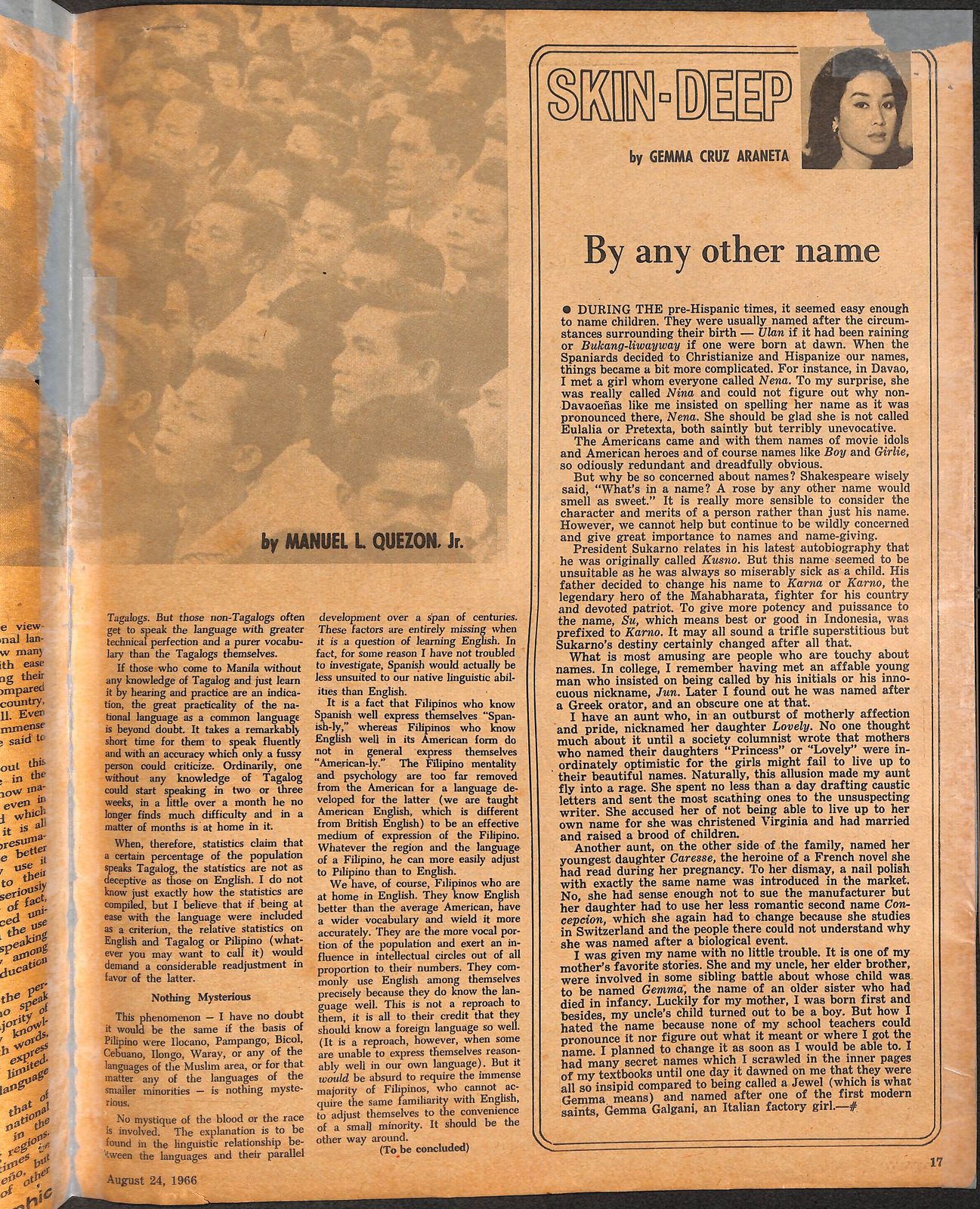
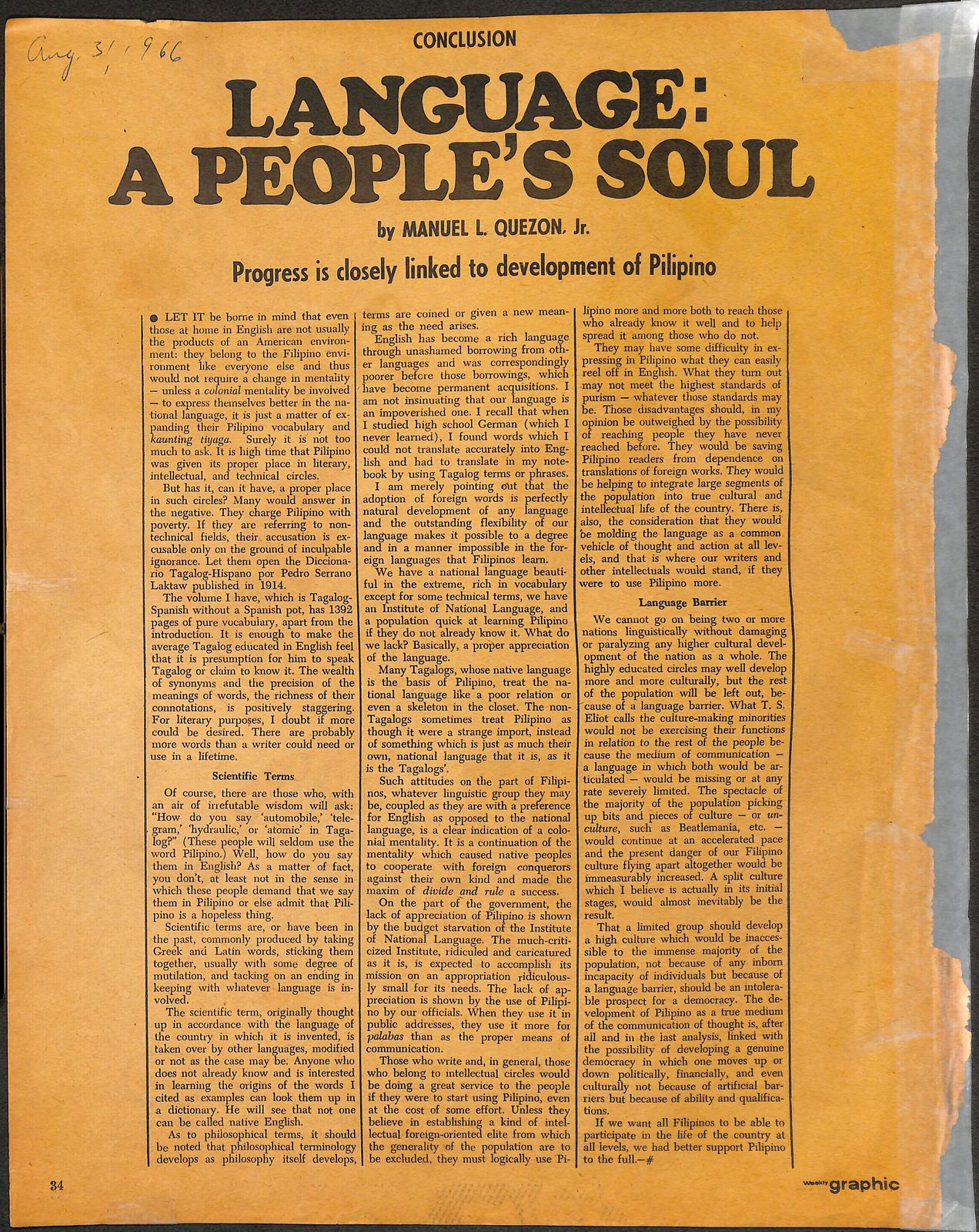
Published in two parts in the Philippine Graphic, August 24 and August 31, 1966.
Text checked against the scanned clipping.
The original clippings