“IN POLITICAL and philosophical theories, as well as in persons, success discloses faults and infirmities which failure might have concealed from observation. The notion that the people have no need to limit their power over themselves, might seem axiomatic when popular government was a thing only dreamed about, or read of as having existed at some distant period of the past.” These words of John Stuart Mill in his essay “On Liberty” may not be quite opposite to the theme I intend to develop, and his essay can hardly be accepted without many distinctions and reservations, since his main point in the thesis has itself broken down in practice, but they do point out this fact: practice often reveals flaws which could not be foreseen in theory.
This fact underlies the persistent demand for constitutional amendments, a demand which is generally acceptable to those who know of it, is favored by the Philippine Constitution Association, and has been endorsed, at least in principle, by the new Administration. I need make no apologies for desiring changes myself, being in such excellent company. While I lay claim to no intimate knowledge of constitutional law, or any law for that matter, I can rightfully venture to think about the subjects, like any other citizen, since we ordinary citizens will ultimately have to approve or disapprove any proposed amendments.
An ancient Greek once said that war is far too important a matter to be left to the generals, and it would seem that constitutional change is far too important to be left solely to specialists, particularly as the Constitution is supposed to be—to use the high-sounding phrase—“the expression of the sovereign will of the people.” All of us should participate in discussion, considering that important changes in our government will be involved.
The original Constitution provided for amendments in the following manner: “Article XIV—AMENDMENTS. Section 1. The National Assembly (read Congress today), by a vote of three-fourths of all its Members, may propose amendments to this Constitution or call a convention for that purpose. Such amendments shall be valid as part of this Constitution when approved by a majority of the votes cast at an election at which the amendments are submitted to the people for their ratification.” There are, therefore, two ways in which constitutional amendments may be proposed, either by a constitutional convention expressly called for the purpose, or by Congress itself. Any amendments must be ratified or approved by us the people in order to take effect.
Since the original drafting of the Constitution, all amendments have been proposed by the legislature, never by a convention. The change from a unicameral to a bicameral legislature, the change of the President’s term of office from six years with no reelection to four years with one reelection, the parity amendment, all were the work of the legislature, approved of course by a subsequent plebiscite. How the first two amendments would have fared if they had been proposed in a convention rather than in the legislature is difficult to judge, but I will hazard the guess that parity would have fared badly. However, even in the latter case, in view of the relatively naïve mentality of post-liberation days and the probable ease with which the Administration then in power could have arranged to pack the convention, who knows?
Partisan Considerations
Dwelling on the subject of how amendments should be proposed at present, I think a constitutional convention is preferable to Congress. Congress, whether we like it or not, is a highly partisan body. Although we have (more or less) a two-party system, which is considered by many as indispensable for a working democracy, although every successive election has increasingly shown that the electorate cares less and less about electing a party and more and more about electing qualified individuals and, lastly, although theoretically elective officials are intended to consider the public interest first and foremost, relegating partisan considerations to a secondary position, ahead only of personal ones, in fact and in practice the public interest all too often is subordinated to personal and party considerations.
In other words, Congress is a highly partisan body. Many of its members are chosen for their personal integrity and abilities and are expected by the people to exercise their influence and cast their vote in Congress for the public interest, irrespective of party considerations. Performance does not often measure up to expectations. Furthermore, the general trend away from party voting has by no means eliminated the practice of electing a candidate merely because he or his party has an unusual hold on the constituents, apart from any personal qualifications. It is not unknown that constituents have to make a choice between equally or almost unacceptable candidates because those for whom the people would like to vote have been eliminated by intra-party maneuvers, frequently of the most unsavory sort.
The Sensible Course
While party discipline and a certain consistency in an Administration program may at times be a rationalization for this unfortunate state of affairs, lawmaking and implementation of Administration programs are one thing, constitution making and changing are another. The consideration and proposal of amendments should be removed as far as possible from the more shortsighted goals of a short-lived Administration.
It seems to me that the most sensible course of action would be to summon a constitutional convention. While the choice of members for a convention would not automatically eliminate unworthy persons, a convention could, and doubtless would, include persons eminent for their knowledge, integrity, and selflessness who otherwise could not take active part in promulgating constitutional amendments. Retired politicians, whose health no longer permits active political life, lawyers who cannot or will not involve themselves in politics, educators and other highly qualified men and women whose ways and lives are far removed from partisan struggle—all these people could form part of a convention and contribute tremendously to the wisdom of the process. To deprive the nation of their services in a matter as serious as the fundamental law of the land is a moral injustice, even if not a legal one.
And I say this, not as an abstract statement, but taking into account the truly critical situation in which we find ourselves, a situation too critical and deeply rooted to be attributable to any one man, Administration, or party. To take an instance, the members of the Philconsa, the organization which has battled and continues to battle so bravely and strenuously for the Constitution and for morality in government action—for all of us, in other words—these members could take active part in the convention, whereas if amendments are to be the work of Congress, Philconsa could only air its views at hearings—and be ignored.
The mere fact that one is chosen to sit in a constitutional convention which will establish fixed norms for all legislation, rather than in a partisan Congress elected to make laws which can easily be revoked by the next Congress, or by the same Congress in a subsequent session—this in itself must imbue the members of a convention with a seriousness and a sense of responsibility far beyond that of an ordinary member of Congress. That a man or woman is entrusted with the basic law of the land, and this alone, allows for far greater concentration in considering constitutional problems. The perspective is by nature different. A lawmaker is chosen to face the problem of laws within the framework of the Constitution, a member of a constitutional convention is faced with the Constitution itself, a far more awesome prospect.
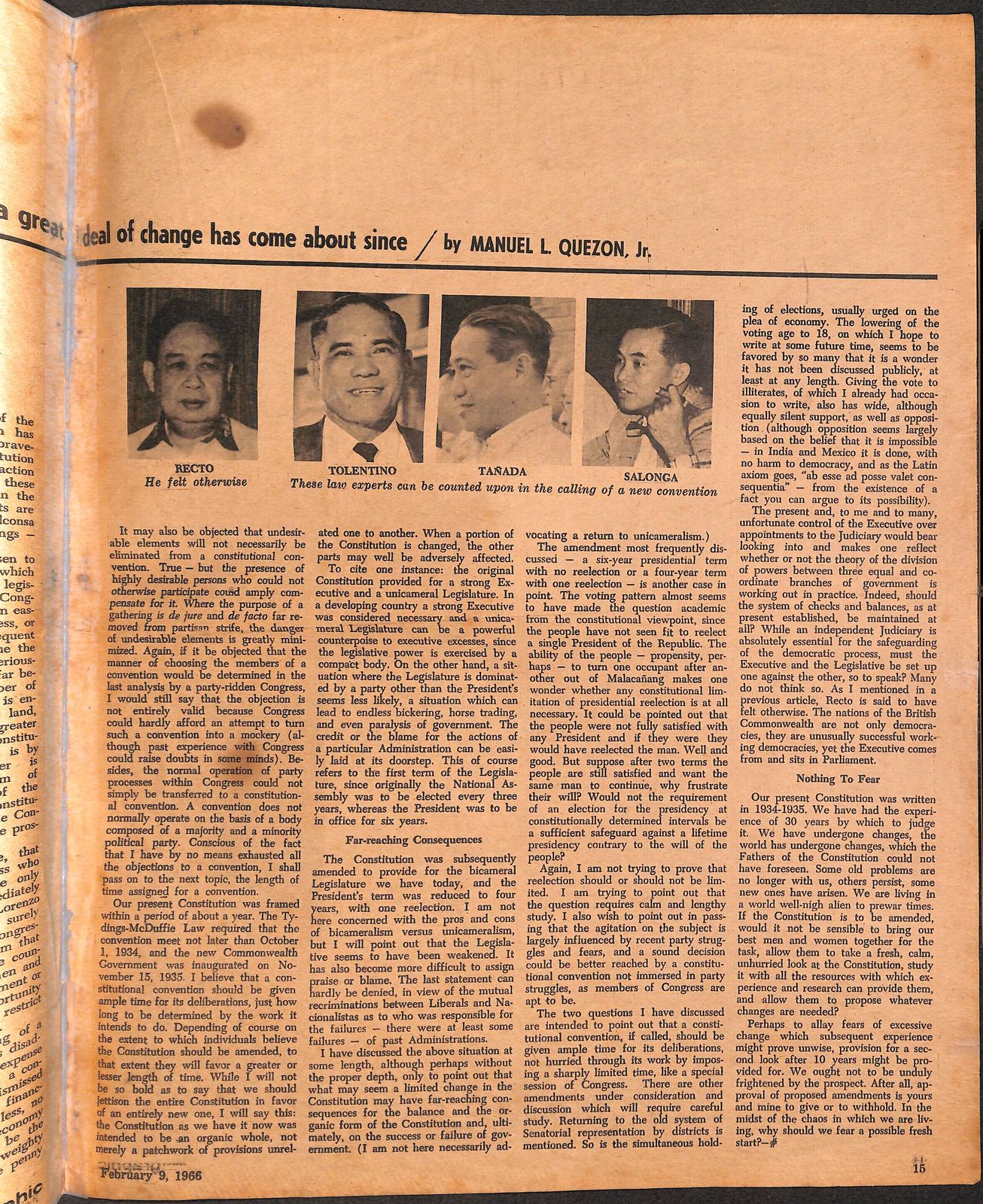
I am not implying, of course, that we do not have men in Congress who are authorities on law. To name only a few who come to mind immediately—Senators Arturo Tolentino, Lorenzo Tañada, and Jovito Salonga. But surely they could be part of an extra-congressional convention. It would seem that justice and the great need of the country demand that they very best men and women—whether in the government or out of it—should have an opportunity to take active part, rather than restrict the process to those in Congress.
I cannot deny that the calling of a constitutional convention involves disadvantages. Possibly, considerable expense would be involved. If so, this is a consideration not to be lightly dismissed at present, in view of the shaky finances of the government. Nevertheless, no matter how serious the need of economy at this time, economy cannot be the prime consideration in such a weighty matter. We cannot afford to be penny wise and pound foolish.
It may also be objected that undesirable elements will not necessarily be eliminated from a constitutional convention. True—but the presence of highly desirable persons who could not otherwise participate could amply compensate for it. Where the purpose of a gathering is de jure and de facto far removed from partisan strife, the danger of undesirable elements is greatly minimized. Again, if it objected that the manner of choosing the members of a convention would be determined in the last analysis by a party-ridden Congress, I would still say that the objection is not entirely valid because Congress could hardly afford an attempt to turn such a convention into a mockery (although past experience with Congress could raise doubts in some minds). Besides, the normal operation of party processes within Congress could not simply be transferred to a constitutional convention. A convention does not normally operate on the basis of a body composed of a majority and a minority political party. Conscious of the fact that I have by no means exhausted all the objections to a convention, I shall pass on to the next topic, the length of time assigned for a convention.
Our present Constitution was framed within a period of about a year. The Tydings-McDuffie Law required that the convention meet not later than October 1, 1934, and the new Commonwealth Government was inaugurated on November 15, 1935. I believe that a constitutional convention should be given ample time for its deliberations, just how long to be determined by the work it intends to do. Depending, of course, on the extent to which individuals believe the Constitution should be amended, to that extent they will favor a greater or lesser length of time. While I will not be so bold as to say that we should jettison the entire Constitution in favor of an entirely new one, I will say this: the Constitution as we have it now was intended to be an organic whole, not merely a patchwork of provisions unrelated one to another. When a portion of the Constitution is changed, the other parts may well be adversely affected.
To cite one instance: the original Constitution provided for a strong Executive and a unicameral Legislature. In a developing country, a strong Executive was considered necessary and a unicameral Legislative can be a powerful counterpoise to executive excesses, since the legislative power is exercised by a compact body. On the other hand, a situation where the Legislature is dominated by a party other than the President’s seems less likely, a situation which can lead to endless bickering, horse trading, and even paralysis of government. The credit or the blame for the actions of a particular Administration can be easily laid at its doorstep. This, of course, refers to the first term of the Legislature, since originally the National Assembly was to be elected every three years, whereas the President was to be in office for six years.
Far-reaching Consequences
The Constitution was subsequently amended to provide for the bicameral amended to provide for the bicameral Legislature we have today, and the President’s term was reduced to four years, with one reelection. I am not here concerned with the pros and cons of bicameralism versus unicameralism, but I will point out that the Legislative seems to have been weakened. It has also become more difficult to assign praise or blame. The last statement can hardly be denied, in view of the mutual recriminations between Liberals and Nacionalistas as to who was responsible for the failures—there were at least some failures—of past Administrations.
I have discussed the above situation at some length, although perhaps without the proper depth, only to point out that what may seem a limited change in the Constitution may have far-reaching consequences for the balance and the organic form of the Constitution and, ultimately, on the success or failure of government. (I am not here necessarily advocating a return to unicameralism.)
The amendment most frequently discussed—a six-year presidential term with no reelection or a four-year term with one reelection—is another case in point. The voting pattern almost seems to have made the question academic from the constitutional viewpoint, since the people have not seen fit to reelect a single President of the Republic. The ability of the people—propensity, perhaps—to turn one occupant after another out of Malacañang makes one wonder whether any constitutional limitation of presidential reelection is at all necessary. It could be pointed out that the people were not fully satisfied with any President and if they were they would have reelected the man. Well and good. But suppose after two terms, the people are satisfied and want the same man to continue, why frustrate their will? Would not the requirement of an election for the presidency at constitutionally determined intervals be a sufficient safeguard against a lifetime presidency contrary to the will of the people?
Again, I am not trying to prove that reelection should or should not be limited. I am trying to point out that the question requires calm and lengthy study. I also wish to point out in passing that the agitation on the subject is largely influenced by recent party struggles and fears, and a sound decision could be better reached by a constitutional convention not immersed in party struggles, as members of Congress are apt to be.
The two questions I have discussed are intended to point out that a constitutional convention, if called, should be given ample time for its deliberation, not hurried through its work by imposing a sharply limited time, like a special session of Congress. There are other amendments under consideration and discussion, which will require careful study. Returning to the old system of Senatorial representation by districts is mentioned. So is the simultaneous holding of elections, usually urged on the plea of economy. The lowering of the voting age to 18, on which I hope to write at some future time, seems to be favored by so many that it is a wonder it has not been discussed publicly, at least at any length. Giving the vote to illiterates, of which I already had occasion to write, also has wide, although equally silent support, as well as opposition (although opposition seems largely based on the belief that it is impossible—in India and Mexico it is done, with no harm to democracy, and as the Latin axiom goes, “ab esse ad posse valet consequentia”—from the existence of a fact you can argue to its possibility).
The present, and to me and to many, unfortunate control of the Executive over appointments to the Judiciary would bear looking into and makes one reflect whether or not the theory of the division of powers between three equal and coordinate branches of government is working out in practice. Indeed, should the system of checks and balances, as at present established, be maintained at all? While an independent Judiciary is absolutely essential for the safeguarding of the democratic process, must the Executive and the Legislative be set up one against the other, so to speak? Many do not think so. As I mentioned in a previous article, Recto is said to have felt otherwise. The nations of the British Commonwealth are not only democracies, they are unusually successful working democracies, yet the Executive comes from and sits in Parliament.
Nothing To Fear
Our present Constitution was written in 1934-1935. We have had the experience of 30 years by which to judge it. We have undergone changes, the world has undergone changes, which the Fathers of the Constitution could not have foreseen. Some old problems are no longer with us, others persist, some new ones have arisen. We are living in a world well nigh alien to prewar times. If the Constitution is to be amended, would it not be sensible to bring our best men and women together for the task, allow them to take a fresh, calm, unhurried look at the Constitution, study it with all the resources with which experience and research can provide them, and allow them to propose whatever changes are needed?
Perhaps to allay fears of excessive change which subsequent experience might prove unwise, provision for a second look after 10 years might be provided for. We ought not to be unduly frightened by the prospect. After all, approval of proposed amendments is yours and mine to give or to withhold. In the midst of the chaos in which we are living, why should we fear a possible fresh start?
Published in the Philippine Graphic, February 9, 1966.
Text checked against the scanned clipping.
The original clipping