DEMOCRACY has been defined in many ways. It has been called government by public opinion. If this is the sole and adequate definition of democracy, then we have in our country not a full-blown democracy, but its pale beginnings, and our pride in our system is sadly misplaced. But democracy is also described as a system of government in which those who govern are freely chosen by the people and may be freely charged by the people at legally determined times. By this standard, we do have a democracy and let no one doubt it.
Democracy, again, is defined as self-government, not in the sense of being independent of foreign rule, but in the sense of the people governing themselves, in a fashion more or less direct, to a greater or lesser degree, but effectively. This seems to me the most acceptable of the three chosen at random, expressing as it does, more explicitly than the other two, the democratic spirit and the broad way it is to be realized. It stresses continuity in the process of self-government, rather than the sporadic activity of elections.
There is, however, an intimate relationship between the last definition of democracy and the first. The continuing process of self-government is possible only if public opinion exercises a decisive influence on the government. I invite the reader to consider the effectiveness of public opinion on the classical ancient example, Greek democracy, and on the Philippines, today.
The Greek Consensus
In a primary or direct democracy such as ancient Athens, the citizens were all entitled to gather together, discuss issues, and pass laws together. Due to the closely knit character of Greek society and the very small territory and population of the Greek polis or city-state—about the same as our smallest province, as well as the simplicity of issues and problems in ancient times—it was easy for the entire body of citizens to be familiar with issues and policies, and the character and mood of individuals eligible for public office. Under such conditions, it was possible for public opinion to crystallize into a consensus or into clean-cut points of view, to be given effectiveness by the assembly of citizens, or these modified or even reversed in the course of free discussion. Although it is unlikely that all or even a majority of Athenian citizens attended the full year assembly—we have a record of an instance in which of 34,000 odd citizens, roughly one-tenth or about 3600 attended—nevertheless it was most unlikely that the assembly would legislate or determine on policies contrary to the people’s desires.
This was due to the previous crystallization of opinion and to the small total population, so that those who did go to the assembly consciously or unconsciously, but almost necessarily, reflected the views of their fellow-citizens who failed to attend. In a small community in which everyone’s life was considered everyone else’s affair, it would have required a degree of individualism and, above all, hard-headed courage—perhaps the word should be brazenness—far beyond the average, for a man to go back to his neighbors, knowing that he had worked against their desires and convictions and, worse, knowing that they would know it. Even if the assembly discussions modified or reversed his views, it is highly probable that the modified or reversed views would reflect, almost instinctively, what would have happened to his neighbors’ views, had they attended, and consequently what would be acceptable to them.
The crushing weight of neighborly sentiment, with its effect on the individual, is known only too well to those who live in villages today. While it would be going too far to assert that such a state of affairs guaranteed legislation and policy-making in conformity with public opinion in an absolutely foolproof manner, we are here very close to such an arrangement.
Today’s Complexities
The system undoubtedly had its drawbacks. When the individual is so immersed in his community, original thought will hardly be at a premium, and is unlikely to be effective. Witness the political theories of Plato and Aristotle, influential only to the extent that they accorded with the pre-existent Greek spirit, and perhaps only in the less democratic states when they could be imposed. Nevertheless, if democracy is the rule of public opinion—enlightened or otherwise—democracy there undoubtedly was.
We find ourselves living not in a primary, or direct, but in a representative democracy. With few exceptions, today’s representative democracies cover areas from thousands of square miles to millions, and count their citizens by the millions, tens of millions and even hundreds of millions. Contemporary society is extremely complex. The average citizen is hardly in a position to understand the immense majority of the laws, much less take an active hand in their formulation. Although the concept of the person, individualistic and sacred, over and against an all-absorbing community, has undergone development and refinement (not all authentic or balanced), in actual fact we are thoroughly enmeshed in the multitudinous tentacles of the all-powerful modern state.
The Athenian farmer could go to the assembly, participate effectively, then go home and work his land, supporting himself and his family in almost complete economic self-sufficiency. Today’s farmer may or may not be able to support himself and his family, depending not only on weather, soil, and the presence or absence of pests, but also on the interplay of economic and political factors, from within and without the local and national community, factors tightly interrelated, with a relationship possibly unknown and even unimaginable to the simple farmer.
In these circumstances, it is perhaps inevitable that the average citizen should have a growing feeling of unimportance, of inadequacy, of helplessness in the face of the modern state, democratic though it may profess and intend to be. He easily feels that he is just another statistic to the millions of his fellow citizens outside the immediate circle of his friends and acquaintances. In such an environment, what becomes of government by public opinion? What becomes of the desire to form and express opinions seemingly doomed to disappear in the ocean of anonymity? Who can indulge in discussion vital to the formation of public opinion without a sense of futility or a sardonic smile?
Importance of Public Opinion
And yet, it is precisely in the modern representative democracy that effective public opinion is of the highest importance. Modern representative democracy without strong public opinion may exist in name, in legal formularies and machinery, it cannot exist in fact, except in a sickly state, far from the democratic ideal. In the complexities of modern life, where to all practical purposes the business of legislation and governing must be left in its concrete realization in the hands of a comparative few, only a nationwide public opinion, enlightened, highly vocal and militant, can safeguard the democratic process. It alone can guarantee that those who make policies and laws shall do so, not for personal gain or out of caprice, but for the good of all and—for a conscientious dictator can also do that—in accordance with what we might call the “public sense,” the convictions of the citizenry, their aspirations and needs.
The full choice of public officials in free elections does not in itself guarantee all this. We elect public officials for a fixed term, and once elected they are well nigh free to do as they please, short of criminal acts (if so). Nor is it enough that we can turn those officials out on the street and elect others when their term of office expires. They must feel constrained by public opinion during their incumbency. They must feel obligated to respond to public opinion, even when legal resorts are not available. Only thus can we claim that we are governing ourselves through our representatives.
If the last two elections have been indicative of public opinion at all, they have been indicative of a negative opinion and a reaction of despair. A negative opinion, because the very divided vote partywise shows that the citizens do no see their salvation in any of the political parties. A reaction of despair because the changes of administration indicate a groping for one who offers hope of a change from prior ills. Surely negation and despair are unsatisfactory bases for a genuine, healthy democracy. They cannot be equated with public opinion as a dynamic factor in democratic government.
Certain Examples
If public opinion is so important, it remains for us to evaluate our system in terms of its relation to public opinion. How does our democracy measure up to the standard of effective public opinion? Rather poorly, it seems.
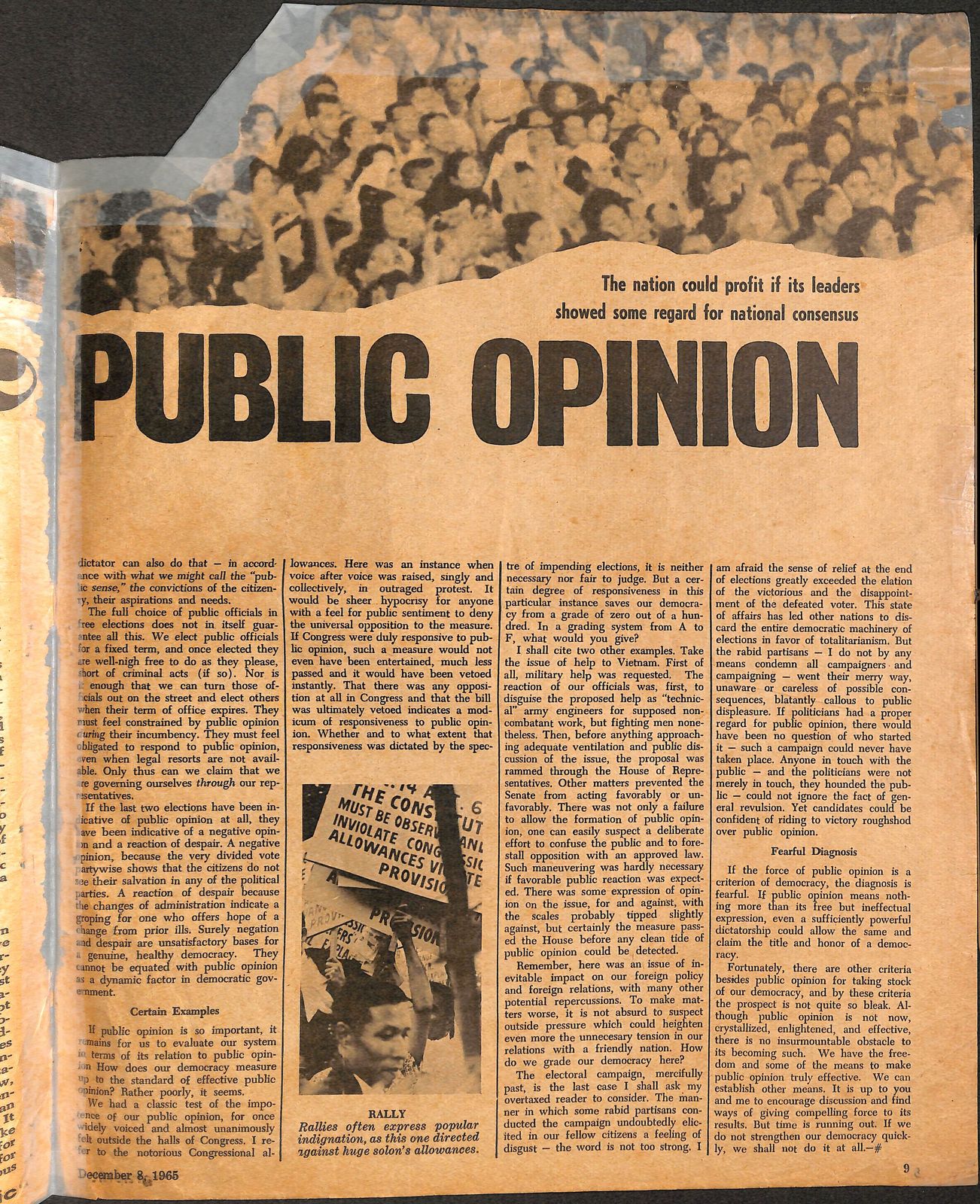
We had a classic test of the impotence of our public opinion, for once widely voiced and almost unanimously felt outside the halls of Congress. I refer to the notorious Congressional allowances. Here was an instance when voice after voice was raised, singly and collectively, in outraged protest. It would be sheer hypocrisy for anyone with a feel for public sentiment to deny the universal opposition to the measure. If Congress were duly responsive to public opinion, such a measure would not even have been entertained, much less passed and it would have been vetoed instantly. That there was any opposition at all in Congress and that the bill was ultimately vetoed indicate a modicum of responsiveness to public opinion. Whether and to what extent that responsiveness was dictated by the spectre of impending elections, it is neither necessary nor fair to judge. But a certain degree of responsiveness in this particular instance saves our democracy from a grade of zero out of a hundred. In a grading system from A to F, what would you give?
I shall cite two other examples. Take the issue of help to Vietnam. First of all, military help was requested. The reaction of our officials was, first, to disguise the proposed help as “technical” army engineers for supposed noncombatant work, but fighting men nonetheless. Then, before anything approaching adequate ventilation and public discussion of the issue, the proposal was rammed through the House of Representatives. Other matters prevented the Senate from acting favorably or unfavorably. There was not only a failure to allow the formation of public opinion, one can easily suspect a deliberate effort to confuse the public and to forestall opposition with an approved law. Such maneuvering was hardly necessary if favorable public reaction was expected. There was some expression of opinion on the issue, for and against, with the scales probably tipped slightly against, but certainly the measures passed the House before any clean tide of public opinion could be detected.
Remember, here was an issue of inevitable impact on our foreign policy and foreign relations, with many other potential repercussions. To make matters worse, it is not absurd to suspect outside pressure, which could heighten even more the unnecessary tension in our relations with a friendly nation. How do we grade our democracy here?
The electoral campaign, mercifully past, is the last case I shall ask my overtaxed reader to consider. The manner in which some rabid partisans conducted the campaign undoubtedly elicited in our fellow citizens a feeling of disgust—the word is not too strong. I am afraid the sense of relief at the end of elections greatly exceeded the elation of the victorious and the disappointment of the defeated voter. This state of affairs has led other nations to discard the entire democratic machinery of elections in favor of totalitarianism. But the rabid partisans—I do not by any means condemn all campaigners and campaigning—went their merry way, unaware or careless of possible consequences, blatantly callous to public displeasure. If politicians had a proper regard for public opinion, there would have been no question of who started it—such a campaign could never have taken place. Anyone in touch with the public—and the politicians were not merely in touch, they hounded the public—could not ignore the fact of general revulsion. Yet candidates could be confident of riding to victory roughshod over public opinion.
Fearful Diagnosis
If the force of public opinion is a criterion of democracy, the diagnosis is fearful. If public opinion means nothing more than its free but ineffectual expression, even a sufficiently powerful dictatorship could not allow the same and claim the title and honor of a democracy.
Fortunately, there are other criteria besides public opinion for taking stock of our democracy, and by these criteria the prospect is not quite so bleak. Although public opinion is not now, crystallized, enlightened, and effective, there is no insurmountable obstacle to its becoming such. We have the freedom and some of the means to make public opinion truly effective. We can establish other means. It is up to you and me to encourage discussion and find ways of giving compelling force to its results. But time is running out. If we do not strengthen our democracy quickly, we shall not do it at all.
Published in the Philippine Graphic, December 8, 1965.
Text checked against the scanned clipping.
The original clipping