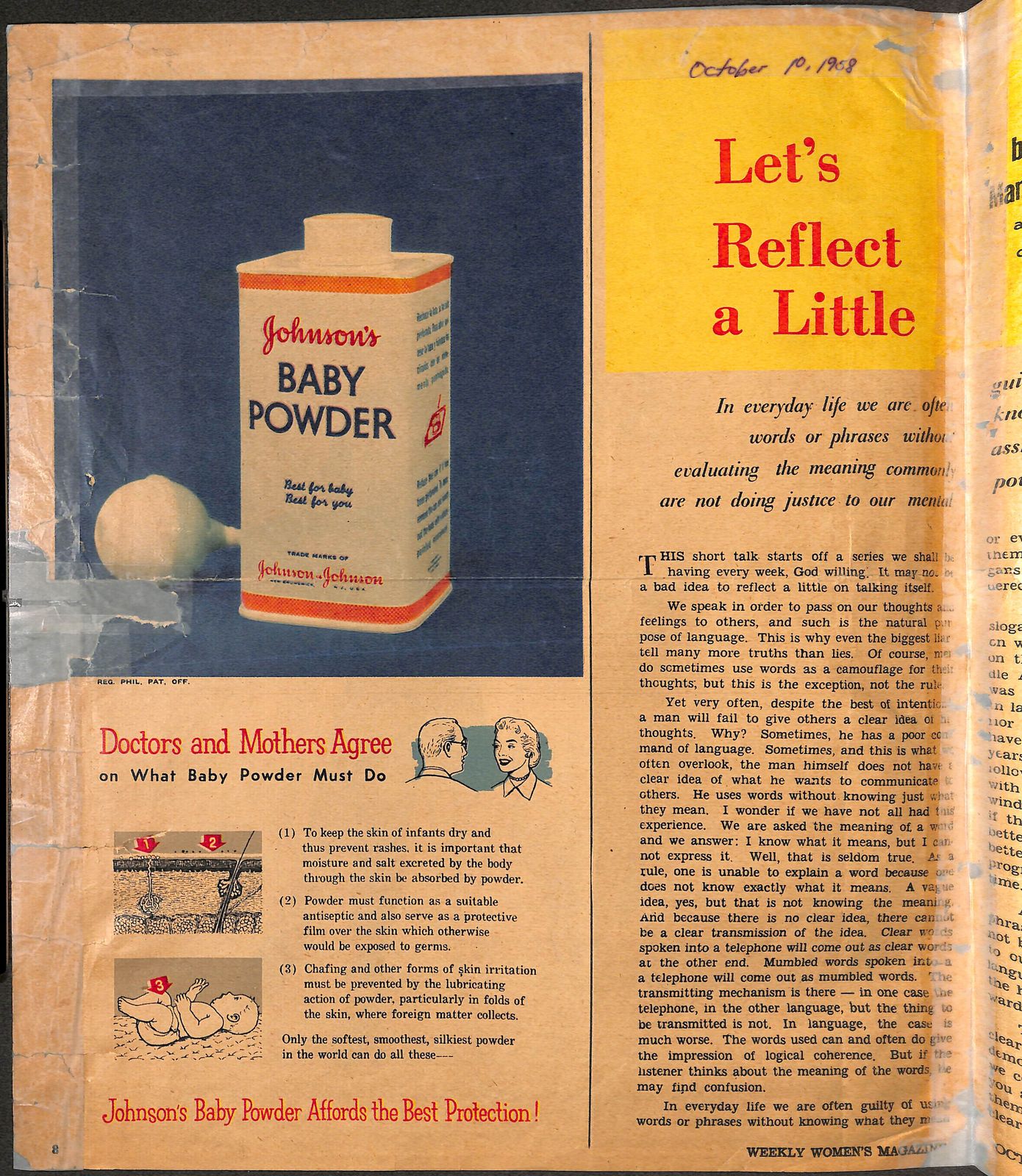
Magazine’s introduction (contemporary; printed with the article in the Weekly Women’s Magazine, October 10, 1958)
In everyday life we are often guilty of using words or phrases without knowing what they mean or evaluating the meaning commonly assigned to them. This way we are not doing justice to our mental powers, so we must fight the habit.
THIS short talk starts off a series we shall be having every week. God willing. It may not be a bad idea to reflect a little on talking itself.
We speak in order to pass on our thoughts and feelings to others, and such is the natural purpose of language. This is why even the biggest liar tell many more truths than lies. Of course, men do sometimes use words as a camouflage for their thoughts, but this is the exception, not the rule.
Yet very often, despite the best of intention, a man will fail to give others a clear idea of his thoughts. Why? Sometimes, he has a poor command of language. Sometimes, and this is what we often overlook, the man himself does not have a clear idea of what he wants to communicate to others. He uses words without knowing just what they mean. I wonder if we have not all had this experience. We are asked the meaning of a word and we answer: I know what it means, but I cannot express it. Well, that is seldom true. As a rule, one is unable to explain a word because one does not know exactly what it means. A vague idea, yes, but that is not knowing the meaning. And because there is no clear idea, there cannot be a clear transmission of the idea. Clear words spoken into a telephone will come out as clear words at the other end. Mumbled words spoken into a telephone will come out as mumbled words—in one case the telephone, in the other language, but the thing to be transmitted is not. In language, the case is much worse. The words used can and often do give the impression of logical coherence. But if the listener thinks about the meaning of the words, he may find confusion.
In everyday life we are often guilty of using words and phrases without knowing what they mean or evaluating the meaning commonly assigned to them. We live in an age of advertising when slogans are coined and repeated, but too seldom pondered upon.
In this connection, I remember hearing this slogan years ago. “Progress means off with the old, on with the new.” It is a very catchy phrase and, on the surface, true. But is it? During the Middle Ages the art of making stained-glass windows was brought to perfection, but the secret was lost. In later centuries stained glass windows have again been made only in relatively recent years. No, during the centuries that immediately followed the Middle Ages, was it right to apply “off with the old and on with the new” to stained-glass windows? Progress means off with the old, only if the old is undesirable, and on with the new is better, and at times the new must be a great deal better than the old for the change to constitute progress. But we shall talk about this some other time.
As I was saying, when we toss words and phrases around without understanding them, we are not being very rational. We are not doing justice to our own mental powers. Nearly all of us use language in this way at times, but we must fight the habit. I believe that the effort will be well rewarded and will give us a great deal of satisfaction.
The list of words bandied around without a clear idea of their meaning is almost endless. “Undemocratic,” “antisocial,” “free,” “the masses”,—we could go on and on. During the coming weeks you and I will take some of these words and study them together and see whether we cannot get a clearer idea of what they mean.
Broadcast over DZWS and printed in the Weekly Women’s Magazine, October 10, 1958, pp. 8–9.
Text checked against the scanned clipping.
The original clipping