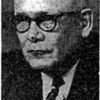
Manuel Quezon, a fiery patriot, has often been quoted in his dramatic statement that he “would rather live under a government run like hell by Filipinos than under one run like heaven by Americans.” That is good, and orthodox, nationalism. But what is often overlooked is that Mr. Quezon, at that point, had lived all of his adult life in a political position to which he was freely elected and in which he had assumed large responsibilities…
Most chroniclers of the 1907 election give especial at- tention to the fact that it brought into the forefront of the Philippine political scene the two men who were to be the leaders of Philippine nationalism and Philippine political thought for almost forty years. They were Manuel Quezon and Sergio Osmeña. Both were sent into that first legislature and they continued in office until the death of Mr. Quezon in 1944 and the retirement of Mr. Osmeña after the advent of independence. They made an interesting contrast and a steadily successful political team. Mr. Quezon was small and fiery. He was a magnificent orator, a shrewd politician and often a ruthless one, a tough fighter and sometimes an unscrupulous one, a “leader” in the Philippine sense of the word. Mr. Osmeña, with some mixture of Chinese blood, was more reserved. He early won a deserved reputation for high integrity and for balanced judgment. He accepted the post of second to Quezon with good grace and rarely chal- lenged the leadership of his colleague. On the few occasions when they split, such as in 1933, their differences were composed quickly and they could again present a united political front. They were joined later by a younger man, Manuel Roxas, who became the speaker of the lower house with Mr. Quezon’s blessing. Mi. Roxas was also a gifted orator, but he was above all else a parliamentarian. In this role he was an invaluable third member of the triumvirate that dominated the legislative and political scene for a quarter of a century.
…The first independence act to be adopted in Congress, the Hare-Hawes-Cutting Bill of 1932, had been vetoed by President Hoover and then enacted over his veto in 1933. When it was submitted to the Filipino electorate they rejected it. They were led, in this case, by Senate President Quezon, in opposition to Osmeña and Roxas, who had worked for the bill. Mr. Quezon’s ground for objection was that the economic provisions were too onerous and the provision for the retention of American bases in the Phil- ippines so vague as to compromise eventual Philippine sovereignty. Quezon easily won a test in the legislature–which was interpreted as a rejection of the measure—went to Washington himself, and returned with the new legislation, the Tydings-McDuffie Act, that was not materially different from its predecessor in substance but that made occasional changes in phraseology, some of them more advantageous to the Philippines. Quezon promptly took the bill to the country as the paramount issue in a further contest against Osmeña and Roxas. He won a smashing victory, and it was correctly interpreted as approval of the American legislation. This may not have been a “plebiscite” in the strict legal definition of the term, but it was certainly an expression of popular will, freely given. It was another instance of genuine government by consent. No further election or “plebiscite” was required to demonstrate that the Filipinos were solidly behind the course that was outlined…
The physical transition to the Commonwealth took place with barely a perceptible ripple. High Commissioner Murphy moved into a suite at the Manila Hotel until a suitable residence could be found or built, and Mr. Quezon moved into Malacañang Palace. On November 16, government business went on as usual. The same men did the same jobs in much the same way, except for the air of fiesta that lasted for several days. This, also, soon evaporated, for the Com- monwealth had some big problems to meet and their solu- tion was neither obvious nor easy. These were problems of life and death. First was economic survival; second was national defense. The projected closing of the American market precipitated the first; the militant expansion of the Japanese Empire made the second a grim reality. It was hard for the Filipinos to realize the extent of the threat to their economy that they had so enthusiastically accepted. Their orators had always said: “If there are dangers and difficulties to be faced, we will face them.” But few of those orators had ever thought to spell out, in detail, just what those dangers and difficulties were. “Quotas” were al- ready a reality, but they were generous. “Progressively increasing export taxes” was a vague term that had never been translated in the popular mind into a matter of pesos and centavos. Besides, the taxes would not even begin for an- other five years, and when they did the revenue collected would be returned to the Philippine government. Mañana would take care of itself.
On the other hand, the existing prosperity was real and obvious. The law provided that 850,000 long tons of sugar annually could go into the duty-free market in the United States, that 200,000 long tons of coconut oil could be freely marketed in the United States each year, and that 3,000,000 pounds of cordage would enjoy yearly, for another five years, that protected outlet. These quotas could be respected, and they were, without hardship. Exports continued to rise. Even the collapse of the mining boom did not make a dent in the economy as a whole. Early in 1937 Mr. Quezon had suggested that he was prepared to order a sweeping in- vestigation of all mining stock transactions and had even intimated that he was ready, if necessary, to nationalize the mining industry under the natural resources clause of the Constitution. What collapsed as a result was the mining stock market, not the industry. Paper profits were lost by the million. One exchange went out of business. Scores of dubious “mines” were taken off the other boards and what had been called “the promotion of cow pastures and golf courses as gold mines” was stopped. But the sound properties were sounder than ever. Production in both gold and base metals continued to rise. The speculative profits on the exchange had never been an honest part of the gross national product. The production of gold, chromite, iron, manganese, and copper was a part of that product—a real, not a speculative one-and it continued.
If most of the Filipinos were inclined to sustain their mood of optimism, the United States certainly did nothing to dispel it. On the contrary, American policy contributed to an artificial prosperity that was divorced from anything that the Filipinos could ever hope to continue indefinitely. The terms of American agricultural legislation were applied to the Philippines and Filipinos were paid to keep land out of cultivation. Agents of the United States Department of Agriculture toured the Philippine provinces handing out checks to sugar planters who had reduced their acreage, in spite of the fact that the quota limitation on sugar was itself designed to keep Philippine production within the proper bounds. Even more importantly, the United States had adopted a processing tax of two cents a pound on vegetable oils. As a matter of conscience it was determined that the proceeds of the tax, when applied to coconut oil from the Philippines, should be returned to the Philippine govern- ment. This procedure itself was not a novelty. The United States had, for many years, levied the customary Federal excise tax on Philippine cigars in the American market and then returned the proceeds to the Philippines. But the processing tax on oils was on a larger scale in total income. No challenge could be made to the thesis that the United States action was honorable and high-minded. Its net result, however, was to channel back into the Philippine economy a sum roughly equivalent to the expectable government revenue from all other sources in any given year. This was the “wind- fall” to which reference has been made. It enabled the Philippine government to embark on ambitious programs of public works, to build needed roads, schools, and hospitals, and to give the legislature a “pork-barrel” holiday with specific sums allocated for each district. It contributed to the sense of economic well-being. In so far as the additional revenue was directly translated into a change for the better in the lives of the poorer Filipinos it served a good purpose. In so far as it created an artificial sense of a prosperity that could not be sustained it was deceptive. As one American writer put it: “The United States was preparing the Filipinos for a beer income by sending them on a champagne spending spree.”
Among the more thoughtful of the Filipino economists and political leaders, on the other hand, there was a ready realization that this condition could not last indefinitely. There was also the realization that the imposition of the terms of the legislation, beginning with the progressively increasing export taxes to be levied in 1941, would bring immediate hardship. Within a year after the Commonwealth was inaugurated, therefore, a new slogan came into being. There was a demand for a “realistic re-examination” of the terms of the Tydings-McDuffie Act. Some Americans misinterpreted this as a demand for a re-examination of the whole question of Philippine independence. This was not accurate. The Filipinos still wanted their independence, but some of them were beginning to be concerned with economic survival. Their case was subsequently presented to Washington and it fell on sympathetic ears. Economic depression pressures in the United States had lessened somewhat by 1938 and attention was being fixed upon other dangers. The Tydings-McDuffie Act was re-examined and amended. It was provided that the quotas should continue but that the more onerous provisions should not come into effect until 1961. The basic economic problem was not solved. The evil day was merely put off. There was business as usual –and it was good business…
Much more than that, President Quezon made national defense the first order of business of the Commonwealth. The first measure to be enacted by the new legislature was the National Defense Act. It reaffirmed the declaration in the Constitution that national defense was the first responsibility of the state and of its citizens and undertook to set up the machinery through which it could be provided. It became the Quezon-MacArthur defense plan. In fairness to the Filipinos and to General MacArthur it must be remembered that there was a rigid limitation on this plan. That limitation was economic. It was assumed that once the Philippines became independent it would be obliged to take over the full burden of national defense, previously carried by the United States. Means had to be devised, therefore, that were within the fiscal possibilities of the Commonwealth and the forthcoming republic. A further assumption, and this one was mistaken, was that the program would have a full ten years in which to come into operation. The costs, accordingly, were made as light as possible and the time schedule was generous. The Defense Act provided for an annual draft of 40,000 men. They were to receive five and a half months’ training, after which they would go into a “citizen reserve,” and be recalled at the end of five years for a refresher course. In this way, by the end of the ten-year period there would be a trained citizen army of about 400,000. It was obvious that the Philippines could not build and maintain a first-class navy. Accordingly it was decided to rely upon a fleet of fast motor torpedo boats, numbering between thirty and forty. Thinking along this line was obviously influenced by the story of the Italian “mosquito fleet” in the Mediterranean and it was assumed that such torpedo boats could be an effective deterrent to invasion. Also, they were within the financial possibilities of the new Commonwealth. The first ones were put on order in Great Britain. Two had actually been delivered when the Japanese struck. This “navy” was to be backed up by a fleet of medium bomber planes that could presumably intercept any invader well ofishore. It must be remembered that this was in 1935 and 1936 when it is stated that this bombing fleet was expected eventually to reach as many as sixty planes and that the defense plan called for the training of up to one hundred Filipino pilots by 1946. At that time General MacArthur–and a great many others—had an inadequate conception of how large a part the air arm was to play in future warfare. General MacArthur had stated that in his view the air arm was a logical extension of the cavalry and that its major function was reconnaissance. Manila was to learn that the Japanese air arm was an extension of the artillery and that its function was bombardment. But that was in the future. Meanwhile, the Philippine draft went into operation. It functioned reasonably well, but it did not reach the set goals at any point. At the end of six years, roughly 130,000 men had actually received training. There were several reasons for this. Physical facilities were inadequate. Materials were costly and some experiments with providing various items of equipment from local manufacture were unsuccessful. There was also a critical shortage of trained officers and noncommissioned officers to carry the load of the training of recruits. As many officers as possible were brought from the Constabulary and the Philippine Scouts, but there were not enough. A “West Point of the Philippines” was established, and it was good, but it took time. Money was also a factor. The Commonwealth was trying to live within a budget and the legislators kept a sharp rein on expenditures for defense. They even went so far as to suggest an investigation of General MacArthur’s emoluments and his dual status as an officer of both the United States Army and the Philippine Army. General MacArthur retired from the United States Army at the end of 1937 and continued in the service of the Philippine Army, only, until he was recalled to United States Army duty on July 6, 1941.