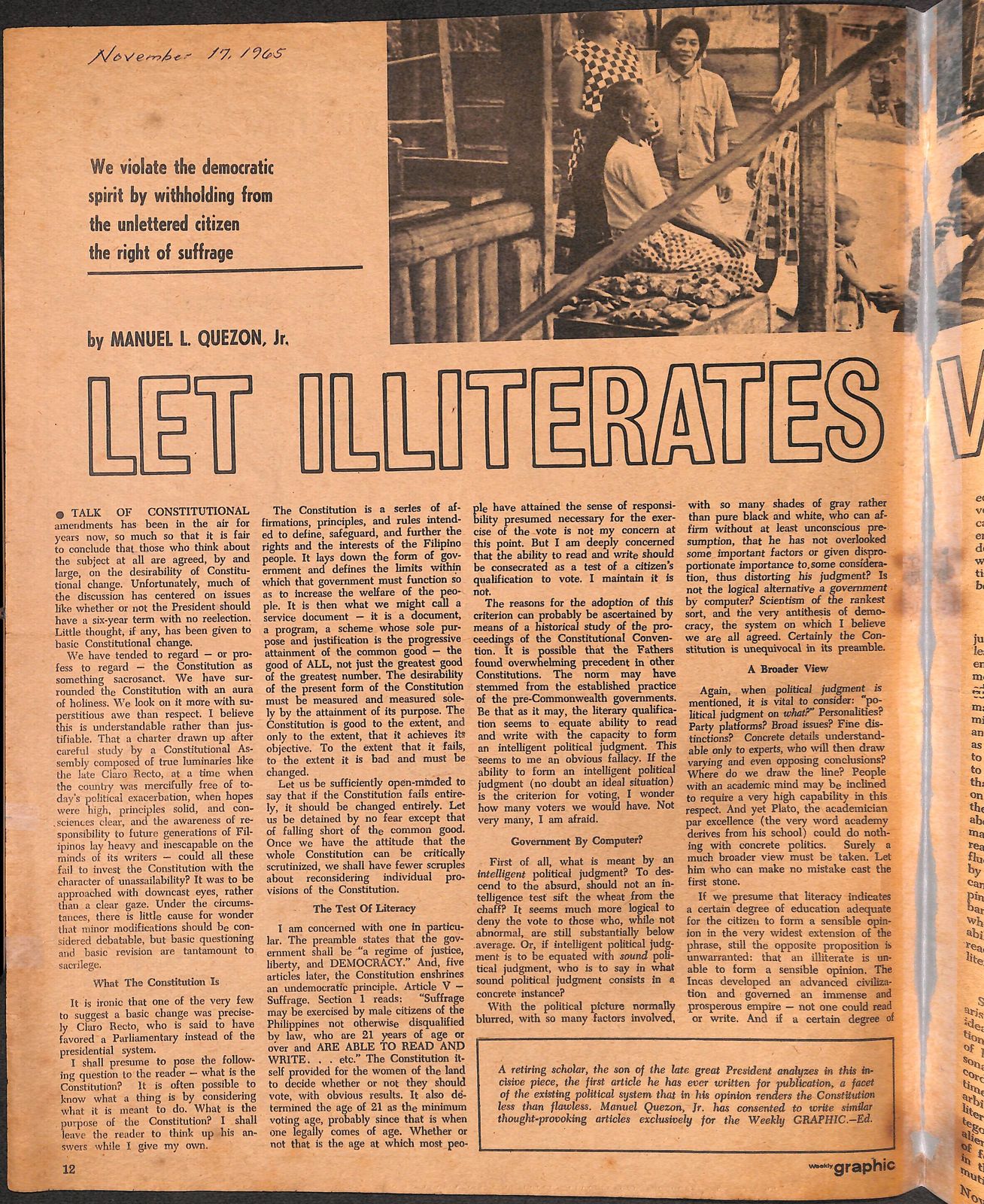
TALK of constitutional amendments has been in the air for years now, so much so that it is fair to conclude that those who think about the subject at all are agreed, by and large, on the desirability of Constitutional change. Unfortunately, much of the discussion has centered on issues like whether or not the President should have a six-year term with no reelection. Little thought, if any, has been given to basic Constitutional change.
We have tended to regard—or profess to regard—the Constitution as something sacrosanct. We have surrounded the Constitution with an aura of holiness. We look on it more with superstitious awe than respect. I believe this is understandable rather than justifiable. That a charter drawn up after careful study by a Constitutional Assembly composed of true luminaries like the late Claro Recto, at a time when the country was mercifully free of today’s political exacerbation, when hopes were high, principles solid, and consciences clear, and the awareness of responsibility to future generations of Filipinos lay heavy and inescapable on the minds of its writers—could all these fail to invest the Constitution with the character of unassailability? It was to be approached with downcast eyes, rather than a clear gaze. Under the circumstances, there is little cause for wonder that minor modifications should be considered debatable, but basic questioning and basic revision are tantamount to sacrilege.
What The Constitution Is
It is ironic that one of the very few to suggest a basic change was precisely Claro M. Recto, who is said to have favored a Parliamentary instead of the presidential system.
I shall presume to pose the following question to the reader—what is the Constitution? It is often possible to know what a thing is by considering what it is meant to do. What is the purpose of the Constitution? I shall leave the reader to think up his answers while I give my own.
The Constitution is a series of affirmations, principles, and rules intended to define, safeguard, and further the rights and the interests of the Filipino people. It lays down the form of government and defines the limits within which that government must function so as to increase the welfare of the people. It is then what we might call a service document—it is a document, a program, a scheme whose sole purpose and justification is the progressive attainment of the common good—the good of ALL, not just the greatest good of the greatest number. The desirability of the present form of the Constitution must be measured and measured solely by the attainment of its purpose. The Constitution is good to the extent, and only to the extent, that it achieves its objective. To the extent that it fails, to the extent it is bad and must be changed.
Let us be sufficiently open-minded to say that if the Constitution fails entirely, it should be changed entirely. Let us be detained by no fear except that of falling short of the common good. Once we have the attitude that the whole Constitution can be critically scrutinized, we shall have fewer scruples about reconsidering individual provisions of the Constitution.
The Test Of Literacy
I am concerned with one in particular. The preamble states that the government shall be “a regime of justice, liberty, and DEMOCRACY.” And, five articles later, the Constitution enshrines an undemocratic principle. Article V—Suffrage, Section 1 reads: “Suffrage may be exercised by male citizens of the Philippines, not otherwise disqualified by law, who are 21 years of age or over and ARE ABLE TO READ AND WRITE…etc.” The Constitution itself provided for the women of the land to decide whether or not they should vote, with obvious results. It also determined the age of 21 as the minimum voting age, probably since that is when one legally comes of age. Whether or not that is the age at which most people have attained the sense of responsibility presumed necessary for the exercise of the vote is not my concern at this point. But I am deeply concerned that the ability to read and write should be consecrated as a test of a citizen’s qualification to vote. I maintain it is not.
The reasons for the adoption of this criterion can probably be ascertained by means of a historical study of the proceedings of the Constitutional Convention. It is possible that the Fathers found overwhelming precedent in other Constitutions. The norm may have stemmed from the established practice of the pre-Commonwealth governments. Be that as it may, the literary qualification seems to equate ability to read and write with the capacity to form an intelligent political judgment. This seems to me an obvious fallacy. If the judgment (no doubt an ideal situation) is the criterion for voting, I wonder how many voters we would have. Not very many, I am afraid.
Government By Computer?
First of all, what is meant by an intelligent political judgment? To descend to the absurd, should not an intelligence test sift the wheat from the chaff? It seems much more logical to deny the vote to those who, while not abnormal, are still substantially below average. Or, if intelligent political judgment is to be equated with sound political judgment consists in a concrete instance?
With the political picture normally blurred, with so many factors involved, with so many shades of gray rather than pure black and white, who can affirm without at least unconscious presumption, that he has not overlooked some important factors or given disproportionate importance to some consideration, thus distorting his judgment? Is not the logical alternative a government by computer? Scientism of the rankest sort, and the very antithesis of democracy, the system on which I believe we are all agreed. Certainly the Constitution is unequivocal in its preamble.
A Broader View
Again, when political judgment is mentioned, it is vital to consider: “political judgment on what?” Personalities? Party platforms? Broad issues? Fine distinctions? Concrete details understandable only to experts, who will then draw varying and even opposing conclusions? Where do we draw the line? People with an academic mind may be inclined to require a very high capability in this respect. And yet Plato, the academician par excellence (the very word academy derives from his school) could do nothing with concrete politics. Surely a much broader view must be taken. Let him who can make no mistake cast the first stone.
If we presume that literacy indicates a certain degree of education adequate for the citizen to form a sensible opinion in the very widest extension of the phrase, still the opposite proposition is unwarranted: that an illiterate is unable to form a sensible opinion. The Incas developed an advanced civilization and governed an immense and prosperous empire—not one could read or write. And if a certain degree of education is a prerequisite in a simple voter, surely a far higher level of education is needed in one who is to govern; yet our Constitution make no such demand, neither do any laws passed within the framework of the Constitution. In fact, such laws would probably be tantamount to class legislation.
Misinformation As Well
The last argument I can think of to justify the literacy requirement (doubtless there are others) is that literacy enables the citizen to read the mass media of information and acquire knowledge as a basis for his judgment. But mass media can be excellent sources of misinformation as well as information, and therefore of misjudgment as well as sound judgment. The citizen has eyes to see with as well as read and ears to hear. The general public is unaware that much of the influence of the press on the non-urban areas (the bulk of the nation) is due to what people hear about what is in the newspapers and magazines, rather than to what they read themselves. The tremendous influence of the spoken word is attested by the exhausting campaigning of all candidates and on the great hopes pinned by one political group on the barrio transistors. As to those who read, who is to say that they exercise their ability sensibly when so much of that reading is concentrated on comics and literature of similar ilk?
Democracy Of The Mind
Some intellectuals may sigh for an aristocracy of the mind. I believe the ideal is a democracy of the mind, a nation universally educated to the point of being able to weigh issues and personalities at least broadly, and vote accordingly. But unless and until such a time has arrived, we are drawing an arbitrary line between literates and illiterates, placing the latter in the category of the child, the insane, and the alien. We are depriving a vast number of fellow citizens of the right to a say in the vital choice of officials. We are mutilating democracy.
Published in the Philippine Graphic, November 17, 1965.
Text checked against the scanned clipping.
The original clipping