THE DESTRUCTION caused in our country by World War II and our failure thus far to get firmly on our feet economically have focused our attention on the problem of unemployment and wages as never before. Just now, the President and Congress are looking for ways to control the skyrocketing prices, even of essential products like food. The danger is mainly that those in the low-income brackets will be unable to buy what they need. As things stand, many barely manage to keep body and soul together with what they earn, to say nothing of the millions who do not earn at all—the unemployed. History teaches us that when such a state of affairs continues for a long time, society is rocked to its foundations. We all have reason to worry about the present and the future. We cannot close our eyes to the sufferings, which inadequate wages cause so many people. All too many do not have enough to eat. All too many do not have enough to eat. They live in hovels and are inadequately clothed. When they get sick, they cannot get proper medical attention.
To solve this difficulty some would make a mathematical computation of what the wage earner should get. They assign so much for food, so much for clothing, so much for housing, so much for medicine. Well, first of all, conditions sometimes make it impossible to pay even the resulting sum. But even when it is possible to pay a salary enough for all of a man’s bodily needs and those of his family, that salary is not enough. Does this sound paradoxical? It should not—“Not by bread alone does man live.”
Remember that man is a rational animal. When you provide a man with his bodily needs, you are only supplying him with part (the less important part) of his needs. Man has a right to a human life, and a human life, as distinguished from the life of the brutes, has to give the place of honor to things of the mind. A man must be able to give some satisfaction to his unquenchable thirst for knowledge. He must have time to devote to the contemplation of beauty—the fine arts. He must have time to devote to social interchange with other human beings, so that from the mutual exchange of ideas his mental powers may be stretched and perfected. He must have ample time for his religious duties. For all these and more, a man must have more than a mere subsistence wage, so that he will have the indispensable leisure time.
If then you give a man just what he needs to live and keep his family alive, if you make him work so much that he has no time or energy left for anything else, you are frustrating human nature itself. You are treating man like a brute beast.
We have to beware, therefore, of a state of affairs in which so many of our fellow humans are living a life barely above that of the brutes. We have to work towards the goal—even though it be a long-range goal—of a truly human life for all. We must do so not only to avoid physical suffering and the danger of unrest and violence. We have to do it so as not to deprive man of the life of the mind, that life which in the order of nature is like the life of God.
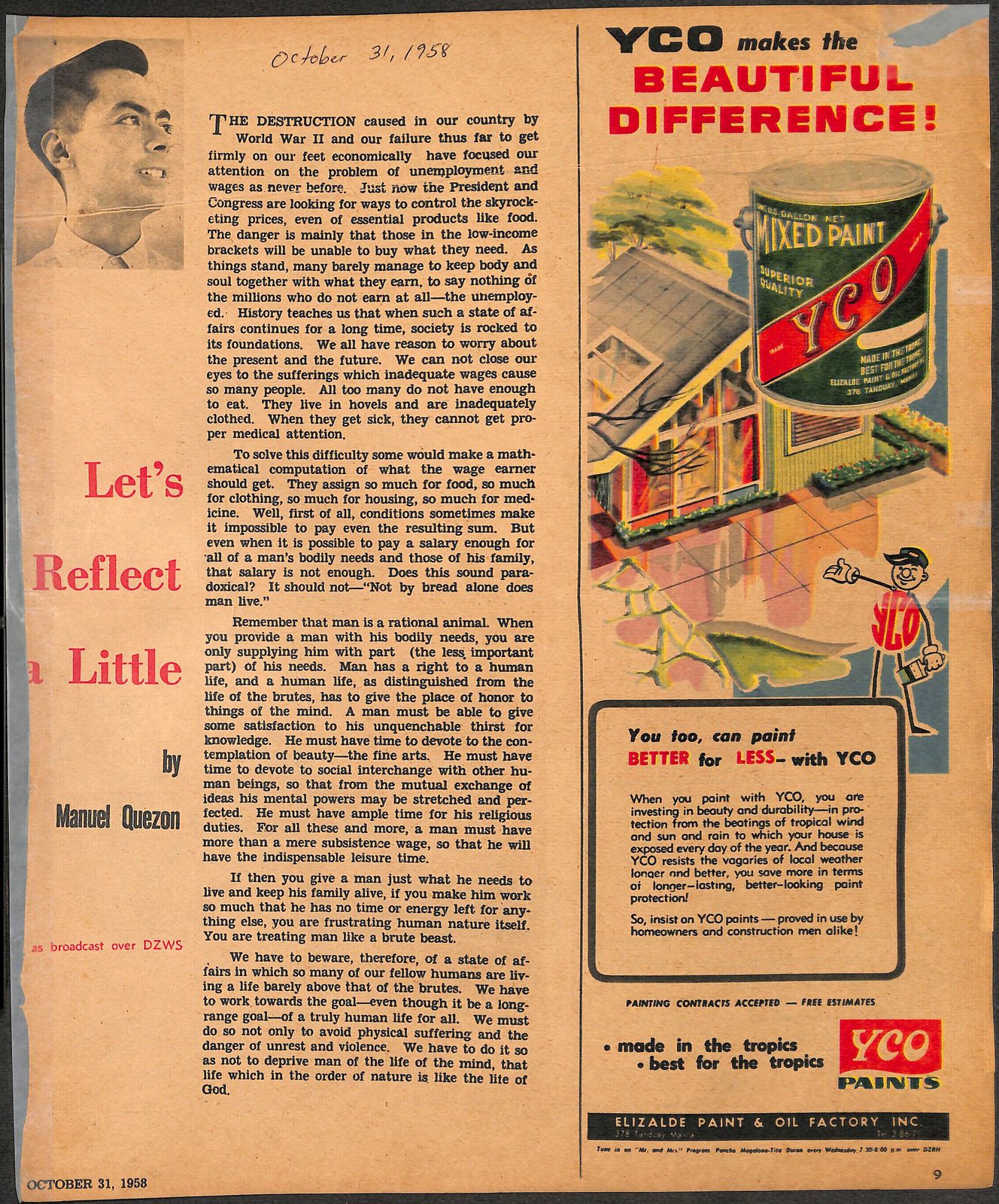
Broadcast over DZWS and printed in the Weekly Women’s Magazine, October 31, 1958, p. 9.
Text checked against the scanned clipping.
The original clipping