I THOUGHT we might use our time just trying to answer this question: When is a man most truly free? To begin with, I would like to bring up the words of a wise man many centuries ago. He said that to do wrong is a sign of freedom, but only in the sense that sickness is a sign of life. Now, what do you suppose he meant by that? I would say he meant this: for you to do wrong, you have to be free, just as for you to be sick you have to be alive. If you are dead, you are not sick, you cannot get sick, you are just dead. So, if you are sick, it is a sure sign that you are alive.
In the case of freedom, we have the same situation. If you are not free, you cannot do wrong. Take the example of a brick. If a brick is dislodged from a building and falls on a pedestrian’s head, no one says the brick did wrong. It cannot do wrong, because it is not free. Or take an earthquake; even if it should wipe out an entire city and every one in it, the quake does no wrong. It does harm, but not wrong, because it is not free.
Now, take a man who deliberately and out of pure spite hurts someone’s feelings. He does wrong, because he is free. Notice the difference. In the examples we gave of non-free courses the amount of harm done, objectively speaking, is very much greater—a cracked skull and vast human misery, as against hurt feelings, but we cannot blame the brick or the quake, at least not in the sense that we can blame the man. The whole difference lies in the nature of the cause of the harm, in the first two cases, not free, in the last, free. To do wrong, therefore, is a sign of freedom.
But it is only a sign. It is not part of freedom as such. Let us get back to our parallelism between sickness and wrongdoing. Today, thank God, medical science constantly turns out new inoculations against all sorts of diseases. Now, let us suppose that a time were to come when a man could be inoculated against every disease, so that he could not get sick. Would he be less alive? Biologically speaking, he would be enjoying the fullness of life. Sickness, therefore, is more accurately a sign of defective, imperfect life, rather than of life as such. In fact, the greater the disease, the less life, until the disease progresses to the point where it destroys life altogether. So the best proof of life is normal, perfect functioning of the living being.
To do wrong is the disease of freedom. When a man does wrong, he merely proves that human freedom is imperfect—we can use it to choose evil rather than good. But imperfection does not constitute the essence of a thing. We do not say that a knife is an instrument that cuts poorly, or that a camera is a mechanism for taking blurred photographs. Or better still, we do not say that John’s camera is better than Peter’s, because John takes bad photographs as well as good.
If I use my freedom to do wrong, I am like the knife, which cuts poorly, or the camera, which takes poor pictures. I am not doing the job well. I am most truly free when I use my freedom to choose the good, because that is when my will works unhindered by the imperfections, the disease, of wrong.
You may well ask: when precisely does the will choose the right and when does it choose the wrong? We shall talk about that later.
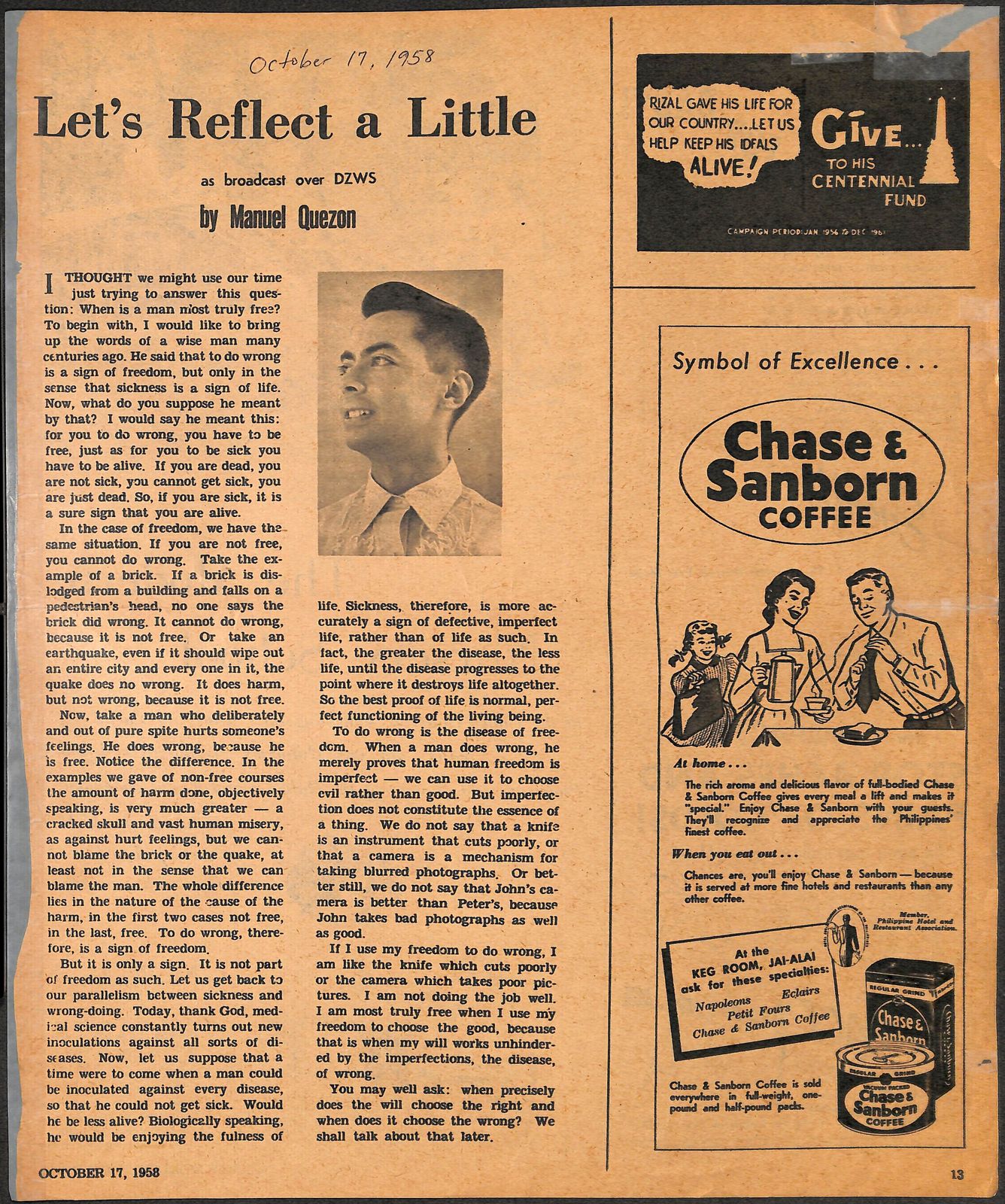
Broadcast over DZWS and printed in the Weekly Women’s Magazine, October 17, 1958, p. 13.
Text checked against the scanned clipping.
The original clipping