George Malcolm of the eponymous hall fame in U.P., once quipped that Emilio Aguinaldo was the only man incomprehensible in three languages: Spanish, English, and Tagalog. But in his time, he was the personification of the country, the “Filipino Garibaldi,” as a British historian once put it. Honored by former foes and friends alike.
From The Explainer: The Many Faces of Aguinaldo:
J. Ralston Hayden, former American colonial official in his book recounted that he believed Aguinaldo’s giving up the security –financially and politically- that he enjoyed for the first few decades of American rule for the viciousness of the new politics of the 20s and 30s may have been a case of succumbing to flattery. During a visit to Malacañan, someone is said to have whispered that it would be nice if the General, once held prisoner there, would someday occupy the palace as president. Aguinaldo supposedly was entranced by the idea.
This transformed him from elder statesman to a politician, and a competitor with his onetime subordinate who also wanted to become president.
The early years of Quezon’s association with Aguinaldo are in his memoirs, The Good Fight, see Chapter III: I Join the Revolution, where he describes serving in Aguinaldo’s HQ, the assassination of Luna, and his encounter with Aguinaldo when he was already a prisoner of the Americans.
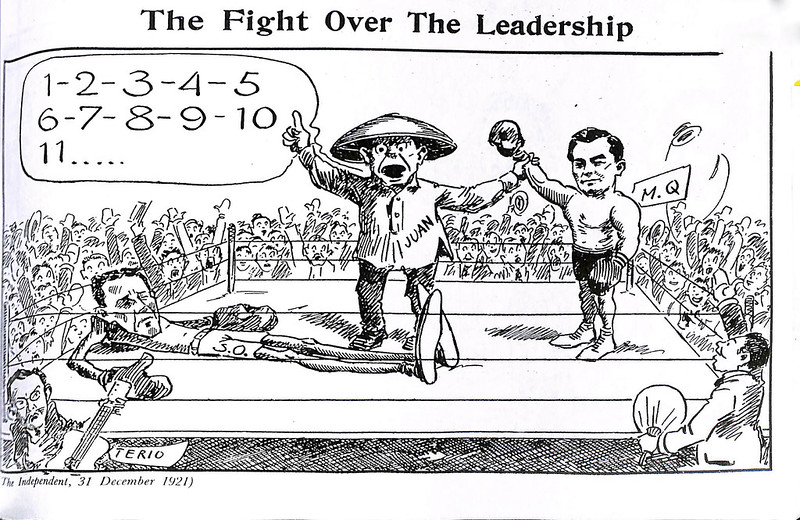
The period 1922-1925 featured a showdown then a reconciliation between Quezon and Osmeña; in 1939 Quezon himself described what set them apart from each other to an American diplomat Claude Buss in an oral interview, who also gave an interesting observation of Quezon’s on Leonard Wood:
I warmed up to President Quezon as an individual. I liked his way of doing things, his ability to dispense with formality when the occasion called for it. And his ability to make a quick decision and to act on it. Very much a person of impulse. One time in commenting on the differences between himself and his Vice President, Osmeña, he was explaining his own character. He said, “When I meet, watch my eyebrows dance.” And he would say something and you could see those eyebrows dance up and down.
He said, “I can explode. I can’t hold it very long. I don’t keep any records.” He said, “I don’t know what I said, what I did, five minutes ago.” “Now,” he says, “contrast that with the scholar in office who’s my Vice President. He can tell you everything that happens. And he’s so close in holding his decisions that he won’t let his heart know what his own head thinks.” He says, “this is just the difference in the way that we work.”…
…President Quezon was a very complex person and to try to make any generality which would cover the Quezon of 24 hours a day would be misleading because he could change as fast as the Manila weather. And toward the United States, this was equally true. There were times when he felt that we were doing things which were not right in his view. And he would say very much what he thought about the United States. And on other times, he would be unstinted in his praise of what … the United States had done for the Philippines.
I don’t know if you’ve ever heard it quoted that he wished that we had been harsher in our treatment because it would have made his fight for independence much more credible because what he wanted, he didn’t have to fight for. If he could establish its reasonableness, the United States conceded it to him. Sometimes those whom he looked upon as his most bitter American enemies, he considered as his staunchest American friends. Let me illustrate by two anecdotes. Both of these are as he told them to me and some other persons might have different interpretations. I once asked him which of our officials that he admired and respected the most. And without a moment’s hesitation, he said General Leonard Wood and Henry Stimson… And everyone knew the fights that he had had with General Wood.
And yet he felt that General Wood stood for American principles and he had to stand for the Philippine side. He said, “When we fought,” as he put it one day, he said, “it was a hell of a fight.” He said, “It sent General Wood to his grave and sent me to a sanatorium,” In Monrovia (that was in Southern California where he entered the sanatorium to recuperate in his health). And the other incident that he recalled was, he said that, “Governor-General Stimson and I used to make the air blue with our curses. But not after one o’clock, because at one o’clock it was lunchtime. And we’d take the time for lunch and then after lunch we would continue whatever it was that we would argue about.” But no matter how bitter the argument, the thing that impressed me was that he felt he was doing his duty and I’m sure that our representative felt the same way.
Quezon’s own brief summary of his political life can be found in a privilege speech from 1933. What is interesting is that the 1920s –the “critical decade,” in the words of historian Samuel K. Tan– echoes down to the present though the present-day players in politics do not realize it (with the public and media being equally unaware).
We have Quezon and Osmeña talking about each other and the fights they had, in 1939.
It has been the irony of fate that it fell to my lot to have to fight his leadership after a long, continuous, and delightful association; but there had never been on my part, nor I think on his part, any ill-feeling in any political struggle in which we were engaged. Each did what he thought was right and his duty. As I look back to the days when for the first time the Vice President and I, loving each other as much as we did, found ourselves in opposite camps, the only explanation that I can find is the fact that we are temperamentally opposite. He is by nature an evolutionist, and I have been all my life a revolutionist. He always built upon the past, while I always wanted to jump. That and that alone was the cause of our misunderstandings. Inspired by a rebellious spirit, I always moved in a hurry,—never satisfied; I always wanted to go on without looking back; while he, ever measuring the distance, always looked ahead but without forgetting what was behind. It was only for this reason that we clashed; and so you find that at the end of every struggle, since there were never fundamentally serious differences in our aims and purposes, it has always been possible for us to join hands again.
President Quezon, with his great heart and the analytical power that is peculiarly his, has a theory to explain the disagreements we had—disagreements which never involved fundamental objectives. I wish to say in truth to you that during my leadership, there was not a single instance in which the President and I were not in accord on the fundamentals. It was remarkable indeed that throughout the long period of time during which we labored jointly and with the many problems that arose, we were in agreement not only when he was here and served as my right hand in the Philippine Assembly, but also when he was in the United States as Resident Commissioner and gave me the benefit of his counsel on public problems.The main cause of our divergence of views at one time was the situation created by the Jones Law. When that law was approved, he showed his clearness of political vision and at the same time his personal disinterestedness when he suggested that I should present my candidacy for the Senate with a view to heading the upper chamber of the Philippine Legislature. Believing, however, in certain political theories which I entertained, I thought that the right place for me was not the Senate but the House of Representatives, because the leader of the majority party, in my opinion, should be in the chamber which is more representative of, and more sensitive to, the fluctuations of public opinion. This was an error. From the first day of the opening of the Senate, it was felt that sooner or later there would be a clash in the ranks of the majority for the simple reason that the political structure of the country had been changed by the creation of two new organs which were both responsible for, and representative of, the Filipino participation in the government matters. The Senate, as the upper chamber of the legislature, wished to affirm its personality, its prerogatives, and the House of Representatives in turn was not inclined to surrender its position of leadership. And this, I believe, was the basic reason for our disagreement. I always said to him afterwards: “Neither you nor I, but political circumstances, were responsible for the issue.”
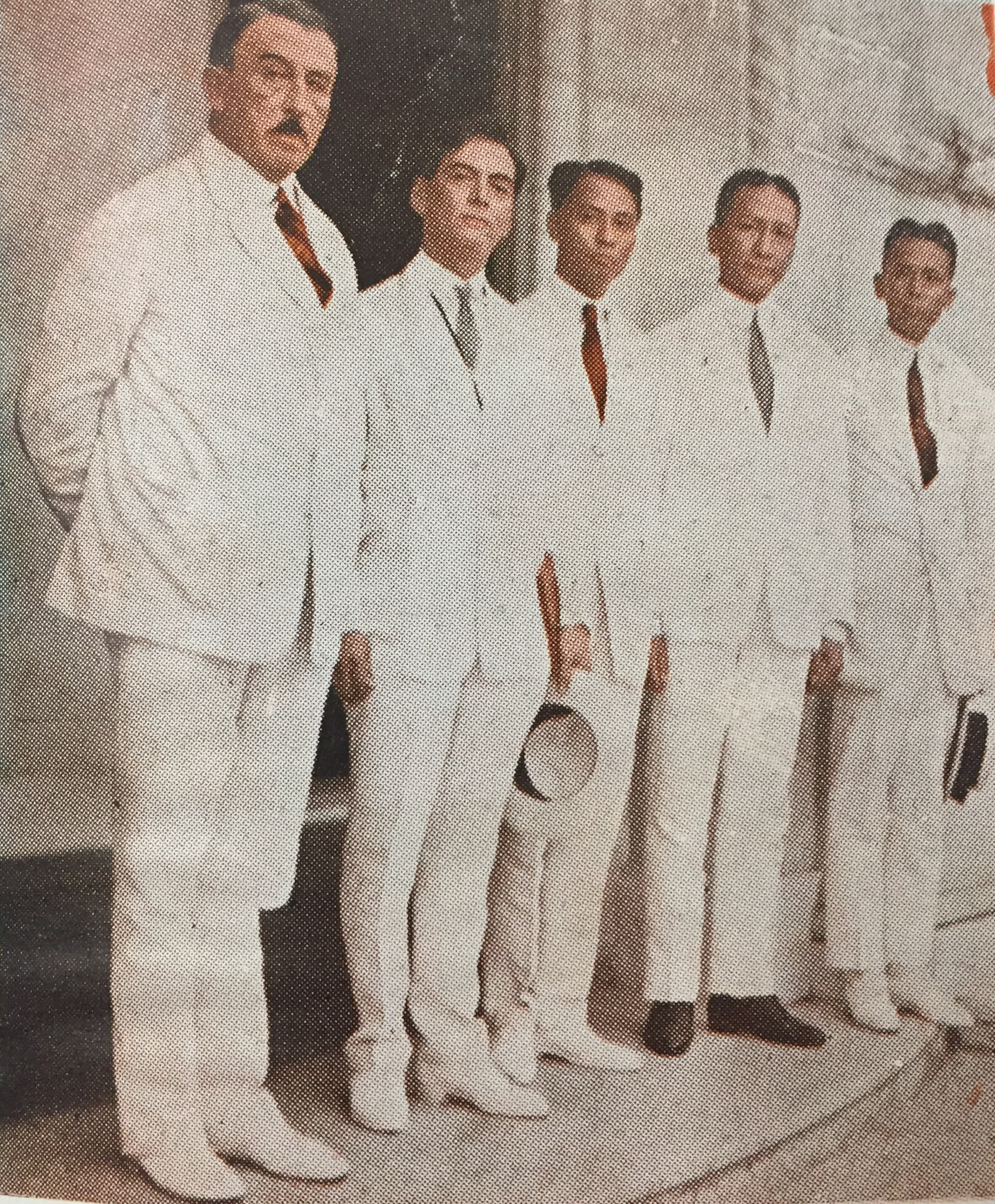
For a comprehensive review of the Filipino case, see Maximo M. Kalaw’s 1919 book, Self government in the Philippines, and what can be considered a follow-up taking it to the period of the conflict with Wood, in Ideals of the Philippines, from 1925.
The Cabinet Crisis
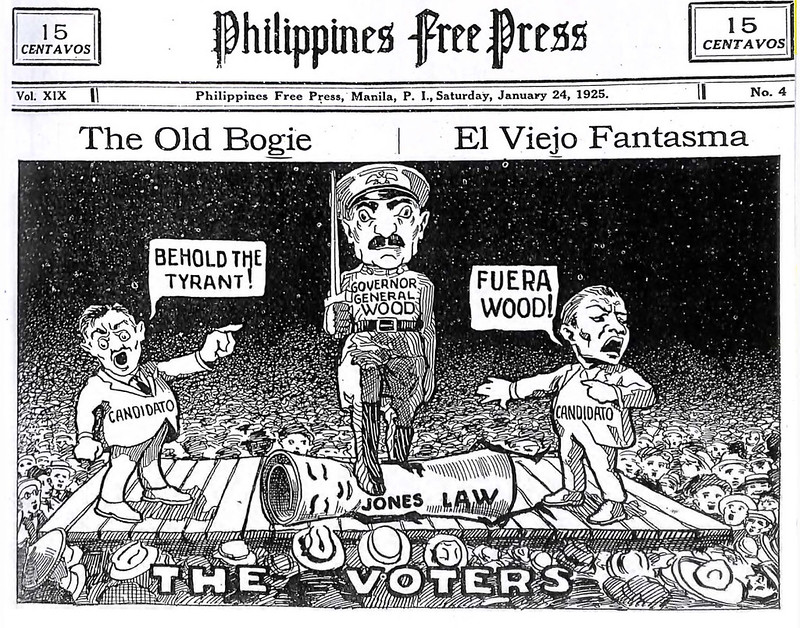
The Cabinet Crisis of 1923, was a major political standoff during the American colonial period under Governor-General Leonard Wood. It stemmed from tensions over executive authority, economic reforms amid the 1919–1922 Philippine financial crisis (caused by post-World War I commodity price collapses, bank mismanagement, and government bailouts), and Filipino demands for greater autonomy under the Jones Law (1916). The crisis highlighted clashes between Filipino nationalists (led by Manuel L. Quezon and Sergio Osmeña) and Wood’s centralized control, culminating in the mass resignation of the Filipino cabinet.
The flavor of the times can be captured in a three-part article by the American historian Michael Onorato (who is pro-Wood), in Philippine Studies: Leonard Wood as Governor General: A Calendar of Selected al: A Calendar of Selected Correspondence see Part 1, Part 2, and Part 3. He lists correspondence between leading figures and their associates at the time, and summarizes what they wrote to each other.
An American official’s summary of issues and events helps provide an introduction to the period leading to the Cabinet Crisis, beginning with Leonard Wood’s predecessor and his relationship with Filipino leaders:
Mr. Harrison, long before the passage of the Jones Bill, had shifted the emphasis from good government to self-government; had transferred the responsibility for good government from American to Filipino shoulders; had discarded the means which his predecessors had considered indispensable for guaranteeing that the people of the Philippines should enjoy a reasonably good government of the American type while they were preparing for self-government. He had, in short, almost completely turned the government of the Philippines over to the Filipinos.
Shortly before he left office, and already a lame duck, President Woodrow Wilson sent a message to the U.S. Congress that the Philippines was ready for independence. Not believing him, the Wood-Forbes Mission was sent to the Philippines and produced a report stating the Philippines was not ready for independence (see the Filipino response). The Republicans, upon assuming power, then sent Leonard Wood, who had been defeated by Warren Harding for the presidential nomination, to be the new Governor-General. Wood’s authority, however, in the eyes of Filipinos, was limited by a policy pronouncement from Washington:
President Harding officially declared to the Filipino people: ‘No backward step is contemplated, no diminution of your domestic control is to be sought.’ Whatever Mr. Harding may have meant by this statement, his words were accepted at their face value by the Filipinos… Americans and Filipinos thoroughly acquainted with local conditions and residing in widely separated parts of the Islands have informed the writer that this promise perceptibly eased the tension in Filipino-American relations which developed in their localities immediately after the appointment of Mr. Harrison’s successor. As the policies of the Wood administration developed, accompanied by startling repercussions in Filipino politics, President Harding’s declaration became one of the outstanding factors of the situation in the Islands.
Filipino opposition to the Wood administration, culminating in the resignation of the native members of the Council of State in July 1923, was based chiefly upon two grounds. It was asserted, first, that General Wood’s policy violated President Harding’s promise and resulted in a curtailment of the autonomy enjoyed under Governor-General Harrison; second, that the Governor-General’s policy and many of his specific acts were tyrannical, arbitrary, illegal, subversive of the best interests of the country, or all four of these things.
The political draw shifted when Harding died and Calvin Coolidge succeeded to the presidency, giving full support to Wood, and sending his adviser Carmi Thompson to report on conditions in the Philippines (see the Filipino rebuttal). There it remained, until Wood died and a more acceptable governor-general, Henry Stimson, was appointed.
Timeline
| Date | Event |
|---|---|
| 1919–1921 | Onset of financial crisis in the Philippines: Post-WWI commodity price bubble bursts, leading to massive losses at the Philippine National Bank (P38 million deficit) and government bailouts exceeding P70 million. Floods exacerbate a rice shortage, forcing tax hikes and economic discontent. This erodes support for the ruling Nacionalista Party and sets the stage for political fractures.
As background, see Patricio Abinales, Re-constructing Colonial Philippines: 1900-1910 |
| April 1921 | U.S. President Warren G. Harding dispatches the Wood-Forbes Mission to assess Philippine readiness for independence. The report (released November 1921) criticizes Filipino governance as corrupt and unprepared, recommending continued U.S. oversight—fueling nationalist backlash against perceived American interference.
|
| November–December 1921 | Wood-Forbes report sparks a legislative leadership crisis. House Speaker Sergio Osmeña faces accusations of autocratic control; he resigns on December 17, 1921, fracturing the Nacionalista Party.
|
| January 10, 1922 | Senate President Manuel L. Quezon resigns in solidarity, deepening the rift. Quezon accuses Osmeña of monopolizing power and publicly campaigns against him, citing the economic crisis and U.S. report as evidence of failed leadership. |
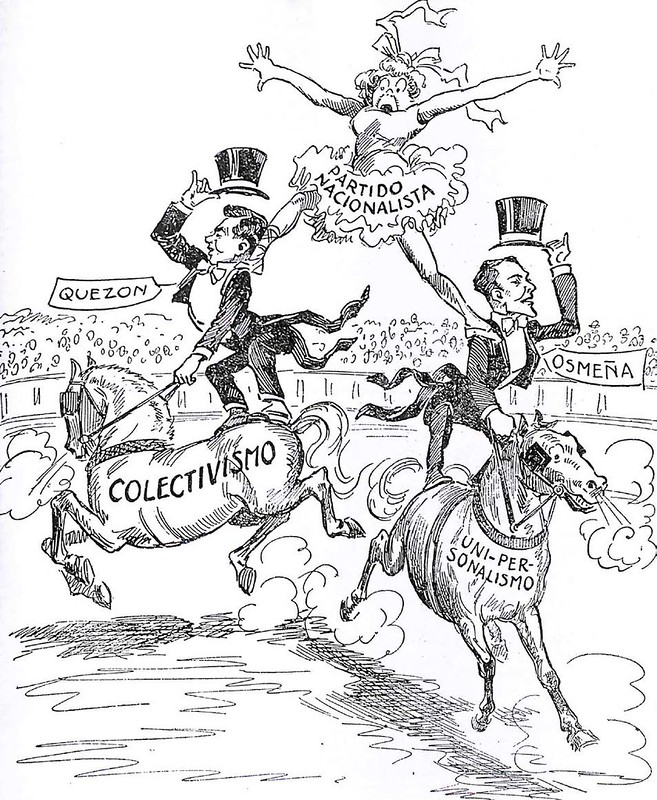
| February 17, 1922 | Quezon forms the rival Partido Nacionalista Colectivista Liberal (Collectivist Nationalist Liberal Party –this was, incidentally, the origin of the concept of the Liberal Party when it formed out of a split in the Nacionalistas in 1945) in Manila, splitting the Nacionalista Party into Osmeñista and Quezonista factions. This political realignment intensifies debates over autonomy and economic policy. Read Quezon’s speech, “My loyalty to party ends where my loyalty to my country begins,”delivered at the Manila Grand Opera House. |
| June 6, 1922 | Legislative elections: From the Philippine Electoral Almanac: The 1922 Legislative Elections marked a watershed in Philippine politics: a split in the Partido Nacionalista, which had enjoyed an overwhelming majority in the Philippine Legislature since 1907. It manifested itself as a confrontation between the leadership of the House of Representatives, personified by Sergio Osmeña, and the leadership of the Senate, personified by Manuel L. Quezon. Both Quezon and Osmeña were Nacionalista stalwarts. On February 17, 1922, the Partido Nacionalista Colectivista (Liberal) was launched, and Quezon was its president. Tensions could be traced to the passage of the Jones Law in 1916, before which Sergio Osmeña’s leadership had gone unquestioned. It began when, after 1916, Senate President Manuel L. Quezon insisted that he, the Senate President of the newly created Senate, should outrank Osmeña, who was the Speaker of the House of Representatives. They managed, at first, to keep their discontent with each other low key. But by 1921, the two factions had their first open conflict in the form of the Judiciary Reorganization Bill, which passed in the Senate but not in the House: The bill would have granted the Senate the power to transfer judges; the House wanted this authority lodged in the Supreme Court, which was by then still half Filipino and half American. Osmeña, on the other hand, denied these charges of dictatorial unipersonalism, arguing that leadership within the party and the government was necessary, because a leader’s role was to guide, advise, and direct, not to dictate, command, or dominate. He stressed the importance of responsible, centralized leadership in order to achieve independence. Furthermore, he declared that even as a leader, he was acting in a representative capacity: he was not immune to the control of both the majority party and public opinion. Yet, from the time of the split of 1922 until today, Osmeña and his faction have always been considered unipersonalist, indicating a failure in the competition of political branding. and the House should elect a group of persons to assume leadership of the government to ensure proper representation of all elements. Quezon also attacked Osmeña’s faction for not consulting public opinion in its decisions. In 1922, Speaker Osmeña left the House of Representatives to run for the Senate. By so doing, he directly challenged the position of Senate President Quezon, while acknowledging Quezon’s view that the Senate was the more prominent chamber. The elections, which took place on June 6, 1922, was a defeat for the Nacionalistas: it marked the first time the party lost its majority in the Philippine Legislature since 1907. The House and Senate were fragmented, and the three parties came out of the fight with relatively equal strength. The balance of power in the House of Representatives was thus held by the Partido Democrata, the opposition party formed after the defeat of both the Progresistas and the Terceristas in the 1916 elections. The two parties had decided to merge themselves to form a single opposition party on April 22, 1917. Their principles were similar to those of the old Partido Democrata Nacional By 1922, the Partido Democrata had become a solid opposition party. The 1922 elections also marked the end of Osmeña’s long period of preeminent leadership. While he succeeded in being elected to the Senate, he lost the Senate presidency to Quezon. His old position as speaker of the House, meanwhile, was taken by Manuel Roxas. The Democratas initially approached Osmeña and offered a deal to have their senators vote for him as Senate president if the Nacionalistas in the lower house supported the Democrata candidate Claro M. Recto as speaker. Osmeña refused, and instead allied with Quezon and the Colectivistas. By April, 1924, the Nacionalistas and Colectivistas reunited as the Nacionalista Consolidado, until they once again split in the next crucial election, that of December 1934. |
| 1922–July 1923 | Governor Wood implements reforms (e.g., vetoing “politically motivated” bills, closing mismanaged bank branches, and suspending land tax penalties), but these are seen by Filipinos as overreach. Tensions build over cases like the suspension of detective Ray Conley (accused of bribery), symbolizing Wood’s direct interventions. Ray Conley, a detective in the Manila Police Department, was accused of accepting bribes from gambling operators, specifically in connection with illegal gambling activities like jueteng. The allegations surfaced in 1922, during a period of heightened scrutiny of governance following the 1919–1922 Philippine financial crisis and the critical Wood-Forbes Mission report (1921). The Manila Police Department, under Filipino oversight (specifically Manila Mayor Ramon Fernandez), investigated Conley. Evidence suggested corruption, and Fernandez suspended Conley pending further inquiry. This action aligned with Filipino efforts to assert control over local administration under the Jones Law of 1916, which granted partial autonomy. Governor-General Leonard Wood, appointed in 1921, viewed the suspension as politically motivated and an overreach by Filipino officials. On July 13, 1922, Wood ordered Conley’s reinstatement, arguing that the evidence was insufficient and that the suspension undermined his executive authority. Wood’s decision was seen as protecting an American official and disregarding Filipino administrative decisions. The reinstatement sparked outrage among Filipino leaders, particularly Senate President Manuel L. Quezon and other Nacionalista Party figures. They saw it as an example of Wood’s “autocratic” governance and a violation of the cooperative spirit of the Jones Law. The case became a symbol of American overreach, intensifying nationalist sentiments. On July 17, 1923, the entire Filipino cabinet (including key figures like Finance Secretary Manuel Roxas) and Council of State resign en masse, protesting Wood’s “dictatorial” style and undermining of the Jones Law. Wood refuses to accept the resignations immediately, appointing interim officials and asserting executive control. July 25, 1923: New York Times: In the controversy between General LEONARD WOOD and the Philippine Legislature, which has adopted a resolution asking President Harding to recall the Governor General, a note of warning has been struck by EMILIO AGUINALDO, the former revolutionary leader. He urges the people to “show equanimity, heeding nothing else “but the dictates of peace and order.” The question is one, he adds, “which can be settled at the conference table.” |
| June 6, 1925 | From the Philippine Electoral Almanac: The 1922 elections left the Colectivistas, Democratas, and Nacionalistas in a stalemate. All three parties came out of the polls approximately equal in strength. If you included appointed representatives and holdover senators, the Colectivistas had a plurality in the House of Representatives and a majority in the Senate. However, if the Nacionalistas would decide to ally with the Democratas, the Colectivistas would then have been outnumbered. The three-party stalemate ended when, spurred by the fear of what they considered despotism in the form of Governor-General Leonard Wood’s backward policies, Manuel L. Quezon and Sergio Osmeña decided to join forces once again: in April 1924, the Colectivistas and the Nacionalistas held a joint convention and formed the Partido Nacionalista Consolidado. One of the major campaign issues was the Fairfield Bill, which provided for independence after a 30-year commonwealth government (later shortened to 20 years); the election of a Filipino chief executive; U.S. control over foreign relations, debt, and national defense until the end of the commonwealth; the maintenance of U.S. army bases in the Philippines; and an American High Commissioner in Manila. Quezon was reluctant to support the bill, stating that the commonwealth period was too long. He later told Secretary of War John W. Weeks that if the commonwealth could be reduced to 15 years, he could get support for the Fairfield Bill in the Philippines, and he would not support a longer period unless the bill was sure to pass. When Quezon returned from the independence mission, he spoke of the mission’s refusal to support the Fairfield Bill. Recto, who was part of the same mission, refuted Quezon’s account: the mission was actually prepared to accept the Fairfield Bill because it appeared that the Republican administration was not inclined to yield more. The exposure of the mission’s deal with Weeks was a cause for embarrassment on the part of the Nacionalista Consolidado leaders, who seemed to have accepted something less than “absolute, complete, and immediate independence.” Recto, who believed that immediate independence was impossible under the Republicans, professed his support for the bill. Thus, the issue during the general elections of 1925 was not so much whether the Fairfield Bill should be approved, but whether or not the Nacionalista Consolidado leaders actually supported the bill during their independence mission. The Democratas, who were upfront about their support of the bill, could be seen as defenders of principle against the double-dealing Nacionalista Consolidados. The Democratas also accused the Nacionalista Consolidados of costing the country millions of pesos through their business enterprises, and of not having a concrete plan for carrying out the campaign for independence. The Nacionalista Consolidados, on the other hand, accused the Democratas of conspiring with Governor-General Wood to stifle Philippine autonomy. Despite the initial advantage of the Democratas, the elections on June 2, 1925, were a victory for the Nacionalista Consolidados, who captured 70 percent of the seats in the House. They also had a majority in the Senate, with eight of the elected senators against the three Democrata senators and one independent (former Democrata) senator.
|
V. Aftermath
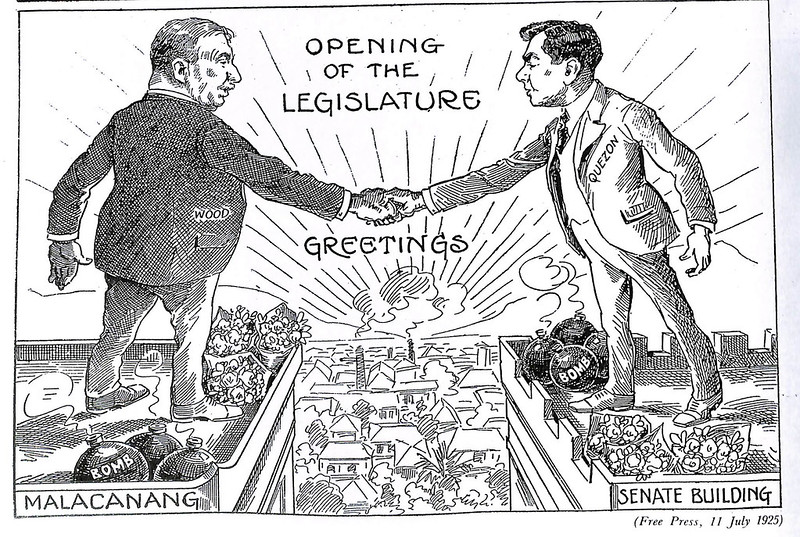
- The crisis temporarily halts Filipino self-governance progress, with Wood ruling more autocratically until 1927. He died in office.
- It featured the increasing political activity of Aguinaldo, and his antagonism to Quezon, which would continue until 1931-34 when Aguinaldo would side with Quezon versus Osmeña and Roxas.
- May 4, 1925:Aguinaldo Praises Wood; Time for Independence Not Yet Come, He Tells Filipinos. In practically the only political utterance since his capture a quarter of a century ago, General Emilio Aguinaldo urged all veterans of the revolution to rally to the support of Governor General Wood. This advice was made in a speech at Baguio yesterday and has had an extraordinary effect throughout the islands, as General Aguinaldo still exerts tremendous influence over the Filipinos and this is the first time the leading Filipino has publicly supported Governor General Wood.
- 1926: The Bacon Bill proposes detaching Mindanao from the Philippines, see Today’s Weekender: Repulsion and Colonization:
The fear, that the Americans would dispose of Mindanao as they pleased since they had waged a separate campaign to subdue it, expressed so early on during the American regime by Kalaw, refused to go away -it actually increased as time went by, particularly during the term of that old Moro-subduer, Leonard Wood, as Governor-General of the Philippines. Even as Filipino officials had a fit over Wood’s thoroughly Republican plan to “run the government out of business,” Kalaw wrote that “There was also talk of separating from the Philippine archipelago the island of Mindanao, and subsequently Americanizing it.” The American chamber of commerce of Mindanao and Sulu had even sent a telegram to President Calvin Coolidge proposing Mindanao’s conversion to an unorganized territory under the American flag.
Matters came to a head when a Republican Congressman, Robert L. Bacon, filed a bill in the US. Congress (H.R. 12772, June 11, 1926), which sought to separate Mindanao, Sulu, and Palawan from the jurisdiction of the Philippine Government, establishing a separate and distinct form of government in those areas directly under American sovereignty. The first bill lapsed, and King filed it during the next session. justifying it on the grounds that,
“1….the Moros are essentially a different race from the Filipinos, that for hundreds of years there has existed bitter racial and religious hatred between the two and that complete union of the Filipinos under one government is distasteful to the Moros, who would prefer a continuance of American sovereignty;
“2. The terms of.. the Bates Treaty…
“3. The lack of true representation on the part of the Moros in the Philippine Legislature, their judges, prosecutors and Constabulary being at the present time Filipinos, in contrast to conditions existing prior to 1913;
“4. …[E]specially since 1916, ill feelings between Moros and Filipinos has increased, leading to frequent conflicts and bloodshed.”
Mass meetings were held in Manila to denounce the Bacon Bill. The Philippine Legislature condemned the bill; even General Aguinaldo, still in retirement, sent a telegram to Coolidge asking him to reject the Bill. The brouhaha died down, but King’s justification for his bill would rankle in the memory of Filipino leaders.
April 10, 1926: “Aguinaldo’s Appeal,” in the New York Times: From the time of his surrender to 1923, when “he he came out of retirement to organize posts of the Veterans’ Association. He then made a tour of the Visayas. ‘Before we disappear from the earth,’ he said, ‘I desire to embrace all my brothers who fought with me for liberty.’,” Aguinaldo “has kept his own counsel and refrained from criticism of the politicians who have made war on the Governor General, for he has considered himself out of public life.” Speaking to the Veterans of the Revolution, “My personal feeling is that the country would gain more and show more capacity for existence and independence in winning WOOD over to our side instead of antagonizing him.”
- February 7, 1927:Quezon is Expelled by Filipino Veterans; Aguinaldo, Re-elected as Their President, Bitterly Assails the Non-Cooperation Leader. Emilio Aguinaldo was today re-elected President of the Filipino Veterans’ Association by the 700 delegates. The expulsion of “undesirable” members, including Manuel Quezon, President of the Philippine Senate and leader of the Independence Party, was voted unanimously. Aguinaldo, in a speech, bitterly denounced Quezon, vowing to fight him until he is ousted from power. Governor General Wood sent a message to the convention praising Aguinaldo as “one who holds the confidence and esteem of the American people to a degree never enjoyed before by any Filipino.
- February 13, 1927: Outburst Against Aguinaldo Staged by Filipino Students The controversy between General Emilio Aguinaldo, who headed the revolt against the United States from 1899 to 1901, and Manuel Quezon, President of the Philippine Senate, over the question of independence for the Philippines resulted in a student demonstration against Aguinaldo last night. The old-time insurgent wishes independence to come gradually, and is friendly to policies of Governor General Wood, while Quezon desires immediate independence and is antagonistic to Wood’s policies. Aguinaldo’s speech was an explanation of his side of the heated controversy with Quezon, which is overshadowing all other insular political squabbles at present. The student outburst occurred when Aguinaldo attacked the Senate President for his policies.
The best source is the monumental work of Alfredo Saulo, Manuel Luis Quezon on his Centenary Part 1 (1978):
