My father’s 80th birth anniversary is today, I’d hoped to have been able to put together, and publish, his essays from the 1950s to the 1990s (he died in 1998) by today; but the effort remains far from finished. Let me reproduce, instead, one of his essays from the 1960s, perhaps his most productive period, intellectually.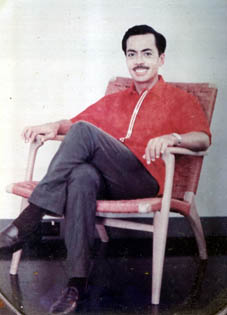
Note: First part of this article was published on July 27, 1966 and the concluding article on August 3, 1966
Culture in the Nationalist Struggle:
A Sense of National Identity
By Manuel L. Quezon, Jr.
SOME years ago, I was asked to define nationalism and I declined, feeling incapable of doing justice to the term on such short notice. I shall not attempt to define it now, but I will say that it involves basically the assertion and defense of identity, the identity of a people conscious of itself as a people. If my reader will grant me so much, it follows that official recognition of the independence of a nation does not of itself mean that the goals of nationalism have been fulfilled.
In fact, nations or states have been created to satisfy the needs or conveniences of international power politics, with the corresponding recognition according to international law. Those political creations have broken apart as soon as circumstances permitted, because the citizens had no consciousness of being a people.
We need not go deep into history to find an example.
Malaysia fell apart almost as soon as it was formed, with Singapore choosing to go its own way and the Bornean territories still undecided whether to remain definitely within the Federation. This has happened because of the absence of any feeling of national identity thus far which would make it possible for those territories to be incorporated fairly easily into a political unit largely Malay. This sense of identity is something which, at the time of the Spanish conquest of the Philippines, could have enabled the Visayas to be as easily incorporated into a political system centered on Menado, in the Celebes, as into a political system centered in Manila. Given such a historical development, Visayans today would be proud of being Indonesians instead of Filipinos.
The international recognition of the sovereign status of a territory, therefore, does not create a national identity. The former presupposes the latter, and if that national identity does not already exist, it must be created if the state is to survive the centrifugal forces which tend to blow it apart.
The identity of a people is not something simple. Even identity of race is not the determining factorâ€â€at least not necessarily the determining factor. France is a perfect example. I doubt if there is a country in the world where differing, and even contradictory, political opinions have been carried to their logical extremes as in France. Yet the consciousness of French nationality has overridden all divisions.
We commonly think of France as a Latin countryâ€â€I shall leave the accuracy of this idea to the judgment of those better qualified than I, but there is no doubt that there are very large non-Latin strains: Brittany is Celtic, Normandy is Nordic (at least there is a large Nordic element), part of the South is Basque. Nevertheless, every Frenchman is first and foremost a Frenchman, and being of an ethnic strain different from the majority of Frenchmen makes no one feel less of a Frenchman for it, nor do the rest consider him less of a Frenchman.
One of the strongest elements making for this sense of identity, possibly the strongest, is the sense of community in French culture. In other words, cultural identityâ€â€not to be confused with cultural monotony or uniformityâ€â€imbibed in the very soul of the French people, is a cement which makes any thought of a French breakup unthinkable. Even if every single state in the world were to withdraw recognition of France, France would still be France.
Concept of Culture
I have dwelt on the case of France at some length to emphasize the role which cultural nationalism should play in our nationalist struggle, which has by no means been won. Speaking of “the Philippine soul,†the outcome of Philippine culture, will sound hopelessly intellectual, or romantic to some, and just plain stupid to others, so we had better steer clear of such phraseology. Let us be satisfied with trying to answer two questions, by no means simple, but at any rate more down-to-earth:
Is there a Filipino culture?
What is it?
Any answer we give will necessarily be challenged (at least in their own minds) by those whose lines is the study of culture, since space does not permit anything approaching an adequate treatment of the subject. But never mind.
The modern sociological concept of culture is that of “a way of life common to a particular people and based on a social tradition which is embodied in its institutions, its literature and its art.†This view of culture is attributed to T.S. Elliot by Christopher Dawson (both among the most eminent students of culture in our age), and he agrees.
Taking this definition on the strength of the authority of the aforementioned authors, and using it as a standard, can we say that there is such a thing as Philippine culture? I believe we can answer yes.
The negative proof of this reply should be obvious to anyone who has traveled abroad or had extensive contact with foreign communities in our own land. Those Filipinos who have been to Spain (most have liked it) have found it definitely foreign, “different,†despite many similarities in our customs and attitudes. Those who have been to the United States (many have disliked it) have also found it foreign, “different,†despite some similarities (not very many) in our customs and attitudes. This strangeness persists, notwithstanding our continual exposure to the “American way of life†through the press, movies, and television and the continuing close national relationship with the United States, a relationship which does not exist with Spain.
I have used Spain and the United States as examples, because they are the two countries which have had the strongest, because most recent and politically dominant, influence on us.
Lest the Filipino’s feeling of strangeness be dismissed as due to the white faces and to the contrast between Occidental and Oriental, let us consider those who are close to us geographically and in physical appearance, the Indonesians, the Malaysians (those of them who are Malays) and the Thais.
The similarity in physical appearance and in certain social characteristics which seem to be common to tropical peoples masks the differences to a considerable extent, nevertheless the differences are there, and no matter how the Filipino may like those peoples, he will still find their ways foreign to him. If the Filipino finds himself different from all those peoples mentioned, despite all sorts of similarities, it can only be because there is a certain “hard core†of culture which makes him different, something a good deal more basic and permanent than a passport.
The Filipino’s consciousness of the different way of life of other nations can only be explained by the existence of a standard with which he can compare it, namely, his own, the Filipino way of life.
The positive proof of the existence of a Philippine culture shades almost imperceptibly into the identification and description of Philippine culture, at least in some of its principal outlines.
For the positive proof, or, at any rate, one positive proof, we must appeal to our own experience.
The family is the life-cell of the social organism and certainly there is a common pattern of family life among Filipinos. The almost universal protest against certain patterns of behavior among some of the younger generationâ€â€in their extreme manifestations, they are what is lumped under the general term “juvenile delinquency,†new and unfamiliar to the older generationâ€â€are an unmistakable sign that they jar the sensibilities of the rest of the population because they do not fit in with what has come to be considered the normal course of family life.
Pakikisama, whose nearest English equivalent is the now rather stilted-sounding word “comradeshipâ€Ââ€â€not “fellowship†because it allows for a certain amount of insincerity, nor “public relations,†because it has an unmistakable ring of commercialism and both degrade the very conceptâ€â€is so much a part of Philippine social tradition that gang-ism has stolen its credentials and is thus all the more difficult to expel from our midst.
The word “mabait,†which I hesitate to translate because of its complex connotations, but which is commonly and most infelicitously rendered “good,†magaan ang dugo, which cannot be translated at all; both are universally admired qualities inseparably connected with our social tradition.
With these three instances, significant instances, pervading as they do our lives, I believe the case for the existence of a Philippine culture is sufficiently established.
Now, what is Philippine culture? A culture ordinarily is the outcome of many factors, and as such is a complex thing. It is the product of the interplay of many influencesâ€â€climate, geography, the meeting and mingling of different ethnic and racial groups, religion, the development of a native civilization and the impact of other civilizations, etc.
A “pure†culture almost necessarily is an impoverished culture. A remarkable case in point is the hillbillies of the United States. I think we are justified in treating them as a cultural unit because, up to recently at any rate, they lived in a world apart. The unfortunate situation of the hillbillies requires no comment.
Petrified Culture
Egypt and China seem exceptions to the general rule of the necessity of external contactsâ€â€significant contacts, that isâ€â€for the development of a great culture, since both civilizations appear to have been almost entirely of indigenous, localized origin. But perhaps the petrification and death of both civilizations are the outcome of the absence of streams of renewal.
But the general rule holds: a rich culture requires the concurrence of many factors, and presumably the potential for growth and vitality is greater the more complex the factors involved. However, the process of formation and development of a culture does not take place through a mere putting together, a mechanical juxtaposition of factors.
The cultural process is an assimilative process, an organic process similar to that of nutrition, whereby a living body takes in external elements, of which some are discarded and others become a living part of the living body so that they cease to be externalâ€â€they become part and parcel of the body, and in turn take part in the process of further assimilation.
Philippine culture has a background so rich that potentially we have one of the greatest cultures possible. What it is, even a thick book could hardly define adequately, certainly not a brief article. I shall limit myself to indicating some of the materials that have gone into the process of its formation, and possibly an idea of what will emerge.
The racial composition of the Filipino people merits serious and extensive study.
Presumably the original inhabitants of these islands were the Negritos. We should be indignant that these, our original Filipinos, are living an existence so completely on the margins of the mainstream of Filipino life. The fact that they are today relegated, as it were, to the status of an exotic plant that has managed to survive should not lead to the conclusion that they have not left definite contributions and influences on our present-day life.
If the touching friendliness of today’s Negritos, to the point of their being easily taken advantage of, was characteristic of them in ages past, that may well be the origin of the same trait, although somewhat reduced, in today’s Filipinos.
To describe the various pagan tribesâ€â€those of the Mountain Province, Palawan, and Mindanao and their possible cultural influences is not here possible, but I imagine that many beliefs which affect our daily lives are due to them and their animistic religion, beliefs which we do not even suspect we owe to them. The very limited territorial extension of each of those groups would naturally limit the extent of their influence on the subsequent inhabitants, except where their various cultures coincided, as in the example cited.
The various waves of Malay immigration are an entirely different matter. The Malays occupied pretty well all areas of the archipelago, and their customs seem to be almost universal in all Malay lands. We may, therefore, consider the Malays and their culture as constituting the raw materials of our present Philippine culture, the basic organism which underwent the cultural process of meeting, impact and assimilation, with its inevitable modification of the original organism.
It is the original Malay population, which has mainly undergone the influences of the East, first of all, the stream of culture and civilization and race. One stream came from China, fairly constant and unchanging through the ages, the other from India, through Indonesia, modified by Indonesia in a very significant manner, since in Indonesia itself the influx of Indian culture had become Indonesian and yet continued to undergo influences that changed as India itself changed, from Brahmanism, to Buddhism to Islam.
A Unique People
It was these influences, which undoubtedly underwent modifications in the Philippines, which had already modified the original Malay way of life, which, assimilated in varying ways and degrees, constituted the way of life of these Islands, when the impact of the West was felt, an impact which has made us a people unique in the world.
I say unique in the world, because we are of the East and the West, but not the East and not the West, we are of the North and the South and yet not the North nor the South: we are ourselves, Filipinos, through a beautiful and also unique process of assimilation of foreign influences to that we were originally.
This process, imperfect as all human processes must be, has given us today’s Philippine culture, with a considerable degree of stability, necessary for a process of development and assimilation rather than disintegration, yet blessed with a degree of flexibility which alone can make further progress possibleâ€â€a culture rich in variety without irreducible or violently conflicting streams, so that we can agree to disagree, yet with an underlying unity which binds the whole fabric together, so that we are definitely one people, with the consciousness of a common national destiny.
How to recognize this basic unity, in what it consists, and how to protect the necessary minimum of stability to enable us to deal with the modern world and its influences in such a way that the result is a healthily assimilative rather than disruptive and destructive, is a very serious problem with which we are faced.
Our survival as a nation depends on our success in dealing with the problem. I honestly believe that failure will turn into a common phenomenon what we find more and more often in individual casesâ€â€the faceless Filipino.
All over Asia, Africa, and Latin America today, there is a tremendous surge of nationalism at a time when in Europe, the homeland of nationalism, there is a marked trend in the opposite direction. Perhaps a partial explanation lies in the contrasting experiences of nationalism in those areas.
In Asia, Africa, and Latin America, we view nationalism as a constructive force, a movement absolutely indispensable if the developing nations are to survive and grow in freedom, dignity, and self-respect. Our nationalism has already performed one functionâ€â€the attainment of independenceâ€â€but a great many tasks remain undone.
On the other hand, the Europeans have found in the course of two World Wars that, unless their nationalism is considerably toned down, it would end by destroying those very nations which it is intended to serve.
The European attitude toward General De Gaulle points up this attitude very clearly. While there is widespread admiration for De Gaulle as a leader and statesman who saved France and reestablished her as a force to reckon with in international affairs, there is even more widespread opposition, to his strong French nationalism as being a stumbling-block to the unification of Europe, which alone can save the various nations that comprise Europe.
If nationalism, which for so long amounted to a frenzy of the European nations, has brought those same nations to the sorry pass where it threatens to destroy them, while nationalism has been such a potent force for good in other parts of the world, it can only be because the term nationalism conceals both a constructive and a destructive force.
As a Destructive Force
It is destructive as it is jingoistic, insofar as it involves a crude belief in the innate superiority of one nation over another or over all others, insofar as it sets itself up against any others and, by implication and potentially, against all others. It is destructive when it reposes on falsehood, fiction, and irrational emotion, especially hate and greed; when its basic attitude is “against†as much as, or even more than, “forâ€Â.
These qualities grew increasingly prominent in Europe as the 19th century drew to a close and the 20th century dawned. The increasing obsession with national aggrandizement, for a place in the sun, not in conjunction with others but to the exclusion of others or at any rate to an exaggerated overshadowing of others, led to a paranoic self-centeredness and fear of other nations, which in turn led to the build-up of armaments on a scale inconceivable in any previous age.
The “Concert of Europe,†instead of producing harmony, degenerated into a Babel in which each participant tried to drown out the rest. The inevitable explosion cameâ€â€World War I.
It is tragic that Europe had not learned its lesson. The end of the War, and the uneasy peace that followed, merely served to give a respite for the same old tensions to build up to an even greater explosionâ€â€World War II.
European Nationalism
From all indications, Europe has at last learned its lessonâ€â€that war solves nothing if its objective is national vengeance rather than justice, and that nationalism, in its European form, is the breeding ground of yet more wars. Thus, the impatience with the anti-foreign type of nationalism; thus the willingness to co-exist with communism, not out of approval for communism but in the hope of avoiding another war which, due to the advance weaponry, would end, not in victory or defeat but the peace of common worldwide graveyard. Thus, a general suspicion, whether justified or unjustifiedâ€â€I believe it is the latter rather than the formerâ€â€of De Gaulle and his actuations. As far as jingoistic nationalism is concerned, the Europeans “have had it,†and want no more of it.
The emerging nations are only now able to participate as actors on the stage of world affairs. They see how nationalism built up Europe. They see the positive, constructive aspect of nationalism and are perhaps less conscious of the disastrous effects of its perversion.
National Dignity
Conscious or not, the newly independent nations of Africa and Asia are, by and large, not building toward the old destructive nationalism of Europe. They are aiming at the condition of national dignity and relative self-sufficiency long since attained by European nations and already taken for granted, like the air we breathe, a condition which would have been attained and which would have been even more widespread in Europe had the unfortunate aspects of nationalism been kept within bounds.
To us, nationalism is a force for the attainment in the future of what Europe attained long ago. If our nationalism at times manifests some of the symptoms of old-style, European nationalism, it is unfortunate, but it is within our power to apply the remedy. The disastrous experiences of other nations should serve as a strong corrective and surely we are not so blind as to fail completely to read and learn the lessons of history.
After such a lengthy warning against the perverted brand of nationalism, it will doubtless sound inconsistent for me to advocate cultural nationalism.
The very term “cultural nationalism†brings echoes of precisely the kind of stupid jingoism which I strongly condemn. It spontaneously brings memories of the Nazi claims to a superior “Aryan†(that is to say, German) culture, the proof of Aryan superiority and the justification for the subjugation and even extermination of lesser breeds. I readily grant the objection to the term “cultural nationalism,†but there is no more reason to reject the term because of its connotations in other lands than there is for rejecting the term nationalism itself for the same reason.
At this point, I cannot think of a better term and perhaps the term will be less objectionable if we clarify and delimit it in the same way as nationalism itself and exclude from its idea the same perversions that we excluded from genuine nationalism.
What then do I mean by cultural nationalism? First and foremost, it must be something positive, constructive, and realistic. It must be rational and logical, not excluding sentiment but keeping it firmly under control. It involves caution, but not cowardly fear of anything foreign or new merely because it is foreign or new.
Cultural nationalism demands as unprejudiced mind, so that we may be able to take stock of ourselves and act accordingly, be able to appraise foreign influences so that that contact with foreign cultures may be a process of selective, enriching, assimilation rather than indiscriminate acceptance or rejection, with inevitable cultural disintegration or arrest. We want cultural preservation and growth, but not petrifaction or a loss of identity. The process must be an organic one, as the word assimilation indicates, not one of mere external addition, as one dumps more stones on a pile of stones to make the heap grow.
We speak of preservation and growth, butâ€â€is there anything to be preserved or to grow? Is there a Philippine culture at all? Only ignorance or stupidity can deny it.
Competent students of culture have not, to my knowledge, denied the existence of our culture, of “a way of life common to [Filipinos] based on a social tradition and manifesting itself in [their] institutions, literature, and art.†(Christopher Dawson). It is not surprising that our fellow-countrymen who have made cultural investigations should realize its existence with relative ease, but that foreign sociologists and cultural anthropologists inevitably come to the same conclusion and recognize our culture even better than the average Filipino places the conclusion beyond dispute.
Just what our culture consists of, I am not competent to say. I can say, however, that it is extremely complex. It is that very complexity which often leads Occidentals to classify us either as Occidentals with brown skins or Orientals with a very superficial Western veneer.
It is that same complexity which leads some Asians to say that we are not Asian at all, although Indians, Chinese, Japanese, Indonesians, Nepalese, Syrians, etc. do not deny it of each other, much as they differ among themselves.
It is that same complexity which bewilders us and drives us to attempt a total identification with West or East (in the sense in which Asians sometimes exclude us from it), an attempt impossible in one case, meaningless in the other.
It is the same complexity from which some try to escape by taking refuge in an imaginative reconstruction, more or less accurate as the case may be, of Philippine culture at the time of Magellan’s arrival, setting up that culture as the only true Philippine culture and de-Filipinizing all subsequent generations, including our own.
In my opinion this attitude is untenable. It separates the pre-Spanish from subsequent cultural developments, considering the former as wholly indigenousâ€â€they were not, in the narrow sense of the wordâ€â€and the latter as spurious. The attitude gives too much credit to the ability of Spanish and American culture to supplant our previous culture and replace it with something different; the attitude also gives no credit whatsoever to our ancestors for any capacity to transform and assimilate foreign influences, giving them a distinctively Filipino character.
One who holds such a view turns his back to the most significant and most remarkableâ€â€I would say most admirableâ€â€fact about our culture and ourselves: that complexity has not prevented unity, nor unity led to monotonous uniformity. Instead of our being proud of our unique cultural achievementâ€â€it is our achievement, not the Spaniards’ or the Americans’â€â€we are ashamed of ourselves, see only the faults and dangers of our culture and see them magnified out of all proportion.
Pride In Our Culture
I can think of few worse threats to a vigorous nationalism than a nation despondent over its culture. The Filipino culture is a monument to our ability through the centuries to master the influences which outwardly seemed solely to master usâ€â€for to be transformed mechanically is to be mastered, but to modify, to transform, to assimilate, and to give a distinctive character is also in the best, non-destructive sense, to master.
Can we continue to do so? In the past, we had two powerful allies, distance and time. The jet age has nullified distance. Mass media of communications and daily contact with foreigners at all levels of society have robbed us of time, time to transform and assimilate, time to weighâ€â€for selective acceptance or rejectionâ€â€the avalanche of influences which press on us and threaten to bury us.
Only a strong cultural nationalism, a pride in our culture and heritage and the determination that we shall not be stampeded into change by anything foreign, that whatever changes we make, of native or foreign origin will be through our own well-considered judgment, through an organic process which will not shatter our culture but strengthen and improve itâ€â€only such a strong cultural nationalism can save us and serve as a firm anchor for our nationalism.â€â€#
Technorati Tags: Philippines

“Evolutionary psychology is based on the recognition that the human brain consists of a large collection of functionally specialized computational devices that evolved to solve the adaptive problems regularly encountered by our hunter-gatherer ancestors. Because humans share a universal evolved architecture, all ordinary individuals reliably develop a distinctively human set of preferences, motives, shared conceptual frameworks, emotion programs, content-specific reasoning procedures, and specialized interpretation systems-programs that operate beneath the surface of expressed cultural variability, and whose designs constitute a precise definition of human nature.†Author unknown
“To the natives, however, both of the East and the West Indies, all the commercial benefits which can have resulted from those events have been sunk and lost in the dreadful misfortunes which they have occasioned. These misfortunes, however, seem to have arisen rather from accident than from anything in the nature of those events themselves. At the particular time when these discoveries were made, the superiority of force happened to be so great on the side of the Europeans, that they were enabled to commit with impunity every sort of injustice in those remote countries. Hereafter, perhaps, the natives of those countries may grow stronger, or those of Europe may grow weaker, and the inhabitants of all the different quarters of the world may arrive at that equality of courage and force which, by inspiring mutual fear, can alone overawe the injustice of independent nations into some sort of respect for the rights of one another. But nothing seems more likely to establish this equality of force than that mutual communication of knowledge and of all sorts of improvements which an extensive commerce from all countries to all countries naturally or rather necessarily, carries along with it.” Adam Smith
Recently in a free wheeling discussion amongst friends most everyone did not know that then King George III was born in Hanover. The King of England during the American revolution by today’s critieria was German. England then used a lot of Hessian soldiers in their war against the colonials.
Economic and financial theorists make their assumptions based on a world of no nations or countries. A borderless world.
Take the world of the tribes of New Guinea, Borneo, Amazon and our own indigenous tribes.
Economics, politics and culture are all rooted with the struggle for food, clothing and shelter at the base.
MLQ3,
I really, really, really enjoyed reading this essay by Manuel L Quezon, Jr.
How extraordinary – his essay is so vividly modern, one would think it was written today.
Also, Manuel L Quezon, Jr understood the French well – a pervading culture forms the identity of a people. It’s not patriotism – it is the culture and the pride in that culture which will ultimately forge the people towards becoming a nation.
The French are not a “patriotic” people in the American or English sense of the word. It’s not “patriotism” that sets the French apart, it is their sense of cultural nationalism.
In France, we have a saying, “When everything else is lost, culture remains…”
Also, more appropriate perhaps for today’s Pinoys, “Chasser le naturel, il revient au galop…”
Great of you to re-publish your Father’s essay, MLQ3!
(I’ve just passed it on to my children to read and reflect on. My daughter, who’s one of her school’s 5 student awardees for Academic Excellence across the board, and incidentally, who received one of the top 4 highest scores in a UK state GCSC exams – in the subject that she took in advance – for the entire UK said, she’d like to use it next school year for one of her course works…)
Thank you for this MLQ3,
I really enjoyed reading it.National Identity is a very important prerequisite of loving your own nation.
btw off topic:I e-mailed one voice and decided to join afterall,the transcript of my e-mail is in the previous blog.
I have shared with you once ,that my dad did essays on the National Interests. I have not read it in its entirety but I am sure it would have been a lot better if it had exerpts from the writings of your dad.
The essay has withstood the test of time.
Salamat to 3Quezons,ML, may your tribe increase,
“only such a strong cultural nationalism can save us and serve as a firm anchor for our nationalism.” –MLQjr.
“Visions for the Nation and the Filipino
A vision of Restoration
Restoration of a nation in rediscovering its true identity and its mission to the rest of humanity;
Restoration of a people, liberated from the fear of change, to reform and transform our society;
Restoration of our leaders, free from the spell of power and wealth, to regain the people’s trust;
Restoration of the marginalized and the oppressed to the fullness and dignity of human life.”…
http://juan-dela-cruz.blogspot.com/
One’s culture is an evolving intangibles. you can not see them, but you developed it with time. It is something that people which interact together, do together and agreable to each other.
When Canada was confederated the prevailing cultures here were the French in Quebec and The British in the Rest of the Conferation. Our Natives and Aborigins who’s cultures up to this day remains, stayed in the shadows of both. Although, we reside in 10 different Provinces and 3 Territories, fully autonomous and independent of each other, we have adopted one National Identity that Keep us together. To make this thing Possible This Country is now Known to be the Leader or in the Forefront of The So Called “Multi Cultures” country, where every nationals from all over the world brought their cultures along with them, and later will be assimilited into the whole Culture which will eventually become the Canadian Culture. You can not see them, but it become part of you as you interact with your fellow citizen as you go along…
vic,
a Multi-cultural Canadian Nationalism ? What’s binds?
Yes, juan makabayan, we are a multi-cultured society that get along together. Unbelievable, but the one thing in common that bring us together is our sense of Nationalism. Ask any Canadian, black, white, chinese, filipino or whatever national their origins, what their main allegiance to and most if not all will say Canada.
The British Columbians, Albertans, Manitobans, Ontarians, Quebeckers, and others who are residents of each of the 10 provinces have nothing in common from one another, because each province is governed independently and as I said is fully autonomous from one another. The only thing that binds us is the Dominion or Confederation of these provinces and territories into one Nation and our National Identity that make us all Canadians. From the Atlantic to The Pacific and the Far North. Where multiculturalism fail in most other countries, it is succeeding in this country.
I recognize that the above essay has both a timeless and forward looking character, but i appreciate more the fact that it allows us to view the subject matter in the context of current events at the time it was written (in 1966).
We have seen how the aborted federation between Singapore and Malaysia has turned out two successful independent states each with its own national identity. We also are witness to how Chinese nationalism is making itself felt as an offshoot of its recent economic success. (I’m not sure if he would have considered China’s current brand of nationalism as benign or constructive. My worry is that mainland China’s nationalism is more like the jingoistic American variety as the demographic profile of both countries is similar.) As to the ‘nullification of distance’ and the lack of ‘time to weigh…the avalanche of influences’, we can now factor in the effects of the outward labor migration that has taken place since then. As a participant, it has served to strengthen my sense of being Filipino which why my favorite passage from the above is ‘Is there a Philippine culture at all? Only ignorance or stupidity can deny it.’
Right now, Filipino self-image veers from despondence to cockiness. We still have too little of that calm and self-assured sense of Filipino identity that your Dad’s article embodies.
MLQ3, pogi pala erpat mo. Tinik pa.
Mr. Quezon, III
Good read. Maybe a little outdated but the main ideas are still relevant. Perhaps someday you can enlighten us on your father’s perspectives 20 or 30 years later after he wrote these essays. He seems to have written with ample optimism at the time.
cvj,
Thank you for wishing me a happy holiday.
The Chinese in us
“It is the original Malay population, which has mainly undergone the influences of the East, first of all, the stream of culture and civilization and race. One stream came from China, fairly constant and unchanging through the ages, the other from India, through Indonesia, modified by Indonesia in a very significant manner, since in Indonesia itself the influx of Indian culture had become Indonesian and yet continued to undergo influences that changed as India itself changed, from Brahmanism, to Buddhism to Islam.
“It was these influences, which undoubtedly underwent modifications in the Philippines, which had already modified the original Malay way of life, which, assimilated in varying ways and degrees, constituted the way of life of these Islands, when the impact of the West was felt, an impact which has made us a people unique in the world.†(Italics mine)
Manuel L. Quezon, Jr. ,
To the bigot – first thought to be Art Bell – who had ruffled the sensibilities of many Filipinos on being challenged, among others, to “demonstrate how you use Confucianism or Taoism in your everyday life,†I reacted in the following:
The Hollywood, the Iberian and the Islamic cultures are as much a part of the Filipino identity as the Confucian. In fact the latter is so subsumed in the Filipino soul it is too hard to distinguish it from the core Malayo-Polynesian being of the Filipino. The cultivation of the self and centrality of the family as prerequisites for social order are Confucian philosophy now simply taken for granted in Philippine society. The enduring Filipino filial obedience and other familial terms of respect such as Kuya and Ate are directly traceable to Confucian values. The unwritten law Huwag mong gaw’in sa kapwa mo ang ayaw mong gaw’in saiyo (“Not to do unto others as you would not wish done unto yourselfâ€Â) had been a Filipino virtue probably handed down by our Confucian ancestors before the advent of Christianity to the Islands. So is the maintenance of distance in pedagogy, the master-student relationship, the continuing disappearance of which in America is playing havoc with its educational system. Perhaps of further relevance here are such historical accounts as, that the names of certain important places in the Philippines come from Chinese characters, namely: the largest land mass, Luzon, from Liu Sung; Manila probably from Ma-yi (a place known at that time, according to Rizal, not to be inferior to that of China); Palawan from Pa-lao-y; and Lingayen from Li-yin-tung.
The Chinese ancestors of the Filipinos, unlike the Anglo-Saxons or the Iberians counterparts, connected and blended with the “natives,†fell in love with them and brought into being the First Filipinos: Fr. Gomez, Aguinaldo, Mabini, Bonifacio, and of course Philippines’ national hero Jose Rizal, whose great ancestors were all Chinese. Certainly, Filipinos are also proud of their Malay heritage, of the great warrior Lapu-lapu who routed the forces of Ferdinand Magellan in the battle of Mactan, or the proud Raja Soleiman whose descendants have never been crushed by Spain, a world power then, by GI Joe despite vicious military campaign, or the surrogate Philippine army.
On another breadth, the Japanese, in almost similar vein as the modern Filipino, have the “white†(from the aboriginal Ainus), the Mongolian and the Malay strains and were first “civilized†by the Chinese. The proud Japanese enriched the Chinese culture, studied the white man’s society and surpassed both. By contrast, the Filipinos, subjected to the same cultural assault, danced to the prevailing tune, retained their core values but have yet to gain the confidence, owing to centuries of enslavement and subjugation, to surpass the strange ways of life forced on them.
In Build or Perish! I have written thus:
On his martyrdom, Rizal might have driven out the last Spaniard in the Philippines that the friar personified, and ushered in the conception of the First Filipino. And with the birth of the Filipino being, the Indio stigma was cast off in the course of time together with what today might be the equivalent of the ubiquitous hyphenated identities: Oriental-Europeans, with which Filipinos in Europe were lumped with other Asians; the appellations expatriates casually tagged themselves with, such as Tagalog-Filipino, Ilongo-Filipino, Ilokano-Filipino, Bikolano-Filipino; Malay-Tagalog by which Rizal was referred to by some of his European colleagues; or, for that matter, the still acceptable Spanish-Filipino or Chinese-Filipino.
And concluding posed the following:
So, Tisoy, Tsinoy, Pinoy rin, Moro, Amboy, Expat or simply Pinoy, does it really matter?
Following the example of the First Filipinos, the next generation of Chinese mestizos allowed their ancestral nativism eventually to evanesce and let what had remained of its essence to regenerate upon coalescing with the identities of the peninsulares (Spaniards from Spain) and the criollos (Spaniards born in the Philippines) and the Spanish mestizos. Hence, the descendants of the pariahs and the pirates, the proselytizers and the proselytized, the conquerors and the conquered, the colonizers and the colonized founded a nation of “natives.†And with the sinews of the fiber that knitted their newly found citizenship outdoing the accidental tendril of their ancient birthright and transcending their frittered roots, they forthwith consigned themselves to preserve, secure, and fulfill the Filipino being. This generation picked up from where the original First Filipinos had left off, proudly seizing the singular honor of calling themselves “Filipinos.†Whereupon, they squandered no time to begin laying the foundation of the Filipino nation.
….. please read on here: http://redsherring.blogspot.com/2006/06/chinese-in-filipino-identity.html
(pls. remove the first entry, mlq3, thanks)
mr. fred de la rosa writes that Filipinos are a happy lot and this is where our national identity could have emanated. the conclusion that we are among the world’s happiest people is a result from the world values survey released by the palace in february 2005. in the survey, Filipinos ranked number six among the top ten happiest nations.
i say, the bamboo-like resiliency deeply rooted in our system is one of the major factors that caused our survival as a happy nation…
but then again (pardon my injection of politics)…the survey was done long before we became unhappy??? for it was done long before we came to hear how gloria and garci each uttered hellos.
The piece was written in 1966. At that time the USSR was still solidly united. Yugoslavia was one. Czechoslovakia was intact. On the other hand, there were still two Germanies.
In our part of the world, Singapore was but a fledgling state trying to seek out its own identity from its Chinese, Malay and Indian influences. Timor and Macau were firmly under Portuguese control. Hong Kong was the British Pearl of the Orient, still to fulfill its role as the commercial hub of the Far East. Japan was still on the verge of becoming an industrial power, with its nationalism muted by defeat in WWII. Islamic fundamentalism was still largely unknown, while separatist aspirations in Mindanao, Kashmir and Bengal were only brewing beneath the surface. The Americans were still on the verge of escalating the war in Vietnam, which was still divided between North and South.
The PC had not yet been invented and the internet may have been just a figment of the imagination of some technicians at Bell Laboratories. There were no cellphones and the printed word was king.
At that time, the Philippines was among the leading economies in Asia and was still highly respected by its neighbors. Ferdinand and Imelda Marcos were still at the height of their popularity.
It is amazing that such an article can still be so relevant in such a radically different world!
Vic,
Thank you for your reply.
No wonder Filipinos who get there stay there.
“we have adopted one National Identity that Keep us together”
You’ve had good leaders too, I suppose. If there is one who did the most for Canadian multi-cultural nationalism, I wonder, who would it be?
medyo tungkol sa love for country.
paglumalaban sa Vegas si manny Paquiao bakit ang sigaw ng mga pinoy ay Manny,Manny! Bakit ang mga kababayan ni Morales o Barrera ang sigaw ay Mexico!Mexico!
Just asking if this have to do with National Identity?
Hi MLQ3,
Been bloghopping leisurely this morning – actually, fiddling with a new laptop (first time I had one, trying to understand how the darn thing works – ain’t got a mouse so it takes me forever to type a line coz I mix up the keys) while watching the dancing waves of the Atlantic Ocean from my veranda and sipping coffee. Almost as if I have no care in the world which is far from the truth but the peace and quiet here in the northwest of France makes one oblivious to the travails of the world.
Anyway, reason am posting is coz I am so thrilled to read Iloilo City Boy’s report that Ghana beat the US in Nuremberg (World Cup)!
Ghana, a 3rd world country, poor and tiny beating a Goliath nation of athletes!
If Ghana can produce first-class athletes, the nation has first-class people. Hurray for Ghana!
The Philippines should take football (soccer) seriously… If Ghana can produce world-class football players, I’m sure the Philippînes could too!
A national soccer league in the Philippines batting for Philippine glory could be a cohesive factor in forging national unity and cultural nationalism.
Get Zinedine Zidane to coach there; he’ll be retiring soon. Put that 1 billion peso war chest into developing the game and you’ll have the guys in the boondocks dropping their weapons to join in the fun.
Was it cvj or juan makabayan who broached the idea that the Philippines could be a football force to reckon with in the international arena?
Richard Gordon, I believe, will bat seriously for football! (Hmmm… bat for football?)
Yeah,
after basketball,boxing,badminton…why not football.
Badminton was the fastest growing sport last year but football is the largest followed sport in the world.
Yes, even the football players around are six footers,some above six foot six but we have a lot of them yun nga lang basketball pa din ang gusto.
Yun nga lang me internal problems ang nag hahandle nito sa Pinas.That is where we are good at, internal combustion!
Anna,
I like that ,using a bat other than for baseball or softball!
Football is a great sport for us. It is more inclusive because it has eleven players to a side instead of five or less. It can be played anywhere and on any surface. Even the ball need not be a real ball. Pele and other poor Brazilian kids made do with pieces of paper balled and stuffed into old socks. (Try using them as basketballs) Our original sport of sipa shows that we do have some latent dexterity with our feet. Of course the only drawback from someday becoming a football world power is our height and slight build. Any sport favors height and might. Nevertheless, who knows we might produce a nation of maradonas, saviolas and wright-philips. A few seasons back there was one or two Thais playing in the European leagues,I think Manolo’s presidential campaign slogan should be “Let us make a strong football republic”
karl, that’s the beauty of multiculturalism. The American pinoys will cheer for Manny and the American Mexican will cheer for their fighter, but ask anyone of them their nationalities and they will identify themselves as Americans.Same things here at the moment during the World Cup, you can see all the flags and banners of all countries contesting Football coveted crown flying in thousands of cars and worn in all kinds of apparrels. But when Canada is in the contest (can not qualify) we still will cheer for canada even against our own country of origin…
juan makabayan, I can not exactly remember specific govt. who started promoting multiculturalism. But now it is an official policy of the Federal and all provincial govt., but again I’m not sure about The Province of Quebec. As I have said, each of the provinces is autonomous and as long as not one province is enacting laws that are in contravention of The Charter of Canada, then one may have a different policy. Again thanks..
Again, It was Pierre Trudeau that “Expatriated” our constitution; (The process by which the “Constitution was brought Home From the Domain of Britain, so the Government of Canada can ammend the Charter without the formality of asking the permission of Britain) and it was his government who ammended the Charter in 1982 with the Charter of Rights and Freedom included and become the basis of our modern laws and the annulment and ammendment of old and archaics ones. And the Inclusion of the EQUALITY RIGHTS Was perhaps the crowning moment and the one the late Pierre Trudeau was the most proud of. So for the Leader that has a lot to do with our Multi-Cultural nationalism I’ll pick Trudeau..
Fabulous Vic! That’s true multiculturalism, indeed.
The UK is, by law, a multicultural society. People of all origins will cheer for Great Britain in a sports match opposing the UK against nanother nation but when it comes to pitting a nation member of the UK against the original country of someone who already is a bona fide Brit, you will find that they will bat for their former nation.
I’ve seen this often – Indians, Pakistanis, Chinese, Malays, etc. and other groups will support their “own” against England, Scotland, Wales or Northern Ireland in multinational competitions.
But it all happens a in jolly good atmosphere – there’s virtually no hostility, I mean not totally…
Well, it would’ve been alright if not for Tony Blair and his hypocritical politics. You see, up until 5 years ago, you would hardly hear an Englishman define himself as English in a multicultural setting and would speak up as British or a Brit but that has changed. If you ask an Englishman if he’s a Brit, nowadays, it’s likely he won’t say yes or no – he’ll simply say, “I’m English”. But the Welsh, the Scots and the Northern Irish go on saying they are “British” and won’t really explain their ethnicity further. Really quite an extraordinary modern phenomenon!
The Saint George Cross has never been more prominent and prouder than in the last 3 – 5 years. The English feel that they’ve been at the receiving end of a lot of unwarranted “flak”, browbeaten by the rest of the members of the Union, so they are starting “re-assert” their cultural identity.
What is also amazing really is that other countries that form the Union which were erstwhile enemies of England, have not quite forgotten their defeat in the hands of the English. It’s actually quite extraordinary that the Scots, for instance, haven’t quite forgiven the English for having defeated and subdued them 700 years years ago.
In a purely political context, the current Blair government policy has not made things easy either. It’s unfortunate but Blair has had a lot to do with the slowly “disintegrating” United Kingdom of Great Britain and Northern Ireland.
People blame Blair for this political “disintegration” or “dismembering” of the Union. Blair is a Scot while most of the members of his Labour cabinet are either Scots or Irish.
It’s as if muliticulturalism is a success in the UK if we speak only of non-Brits. That’s why I am impressed with how things work in Canada. You’ve got the best of both worlds – the old and the new!
Thanks anna, we can also thanks the thousands of public servants, provincials and federal without whose the Politician job is never done. And we are also lucky to have a succession of Governments that mostly work for the interest of the country. There is where the contradictions work for the common good. Meaning to say, we have separate provincial governments who work for nothing else but the interest of its province and will fight against one another in depending only its own interest. In between the Federal Government whose interest is the whole country and have to do the greatest balancing act, so as not to be accused by anyone province of favouring one over the others. Don’t you think maybe the reason why they don’t have much time to do some “monkey business”, every government busy working for their own interest. contradictory but seem to work just fine.. again thanks…
neocolonialism, or this odd cultural mixture of spanish-style feudalism and american-style/pro-american, is really a scourge on the nation. this damaged culture is spread through media, the schools, and other cultural outlets of the status quo simply because this is the culture of the status quo — repressive, anti-democracy, elitist, backward and yet rabidly pro-foreigner. scientific or progressive views are deemed subversive or terroristic.
nationalist or national-democratic culture is unfortunately being badmouthed by the globalists and apologists of the status quo. but what nation has survived and progressed without a nationalist or national-democratic culture? none. for a genuine philippine nation-state to secure authentic independence and attain substantive democracy, there is a need a revolution in outlook, in culture, in worldviews possessed by filipinos. we cannot progress (as we have not progressed since so-called independence) under the neocolonial setup and its equally neocolonial culture.
what is nationalist or national-democratic culture? read teodoro agoncillo, renato constantino sr. and jose maria sison. they are the standard bearers and purveyors of such type of culture. (requisite: pls temporarily remove the blinders, cast aside institutionalized anti-leftism)
About Canada . . .
There’s certain historical explanation to the multi-culturalist and social democratic traditions in Canadian society. Of fairly recent one – at the turn of the last century – was the Diaspora to Canada of what today could be considered the equivalent of “people power†practitioners in the U.S. These were the Midwest Americans who staged the agragrian revolts in the 1880s, incidentally a phenomenon which coincided with the rise of the Bonifacio’s Katipunan in the Philippines (our scholars have yet to find evidence whether Bonifacio and company were aware or in way inspired by this populist movement in America).
When the “Populists,†also called “popocrats†or “mobocrats†ultimately fizzled out in 1896, they opted out of American social contract and settled in Canada. Before this mass migration, many Negroes and Indians also had moved to Canada during the American revolutions fearful or unsure of their fate should the American revolutionaries triumph; along with them were massive number of white Americans, perhaps in the context of boat people or Mexican immigration, who fled the turmoil and uncertainty of the revolution.
What would have happened in the Philippines if were it not an island nation – a One Voice Republic north of Ilocandia or in Borneo?
“Get Zinedine Zidane to coach there; he’ll be retiring soon. Put that 1 billion peso war chest into developing the game and you’ll have the guys in the boondocks dropping their weapons to join in the fun.” — Could be a good idea, except that the crab mentality will surely raise its ugly head again. Know-it-alls will surely have their two-cents worth on this and, as usual, we will never be able to get our act together. Look at how we mess up our basketball program and almost any sports progra for that matter. We can’t get politics out of any undertaking, even sports.
As for the term “soccer” I think that is viewed as derogatory by the Europeans. The Americans use the term “soccer” to differentiate it from their own brand of American football, which is a travesty as far as “foot” ball is concerned since the ball is mostly carried with the hands. Football was invented by the English and, rightly, uses mainly the foot to carry the ball forward or to the net. Occasionally the head or chest may be used, but English football should be the more aptly termed “football”. Americans should find a different name for their brand of barbaric football and not denigrate football by calling it “soccer”.
Anna and Carl, soccer as a way to end the insurgency? I hope you two are kidding. Otherwise, people are gonna think that you two don’t take the communists, secession, or even poverty too seriously. The ancient romans, in their arrogance, tried to do with the gladiatorial games what you fellas are suggesting: “If you can’t feed the mob, entertain them.”
Vic,
Thank you, great, very informative.
Re: Leaders and Nationalism
Among our presidents and other leaders, I wonder who would be rated the highest (or least) for being a nationalist and for having the most significant achievement in promoting nationalism.
Our ‘Centennial’ 1998-Elected-President is Joseph Estrada. On the year of the 100th anniversary, his inauguration had all the trappings of nationalism. As senator, he authored the Carabao Law. Loved by the masses, he was voted by 11M Filipinos to the highest office of the land. On trial for plunder and other charges, he has been confined under house-arrest for 5 yrs now. He had projected himself as a nationalist champion of the masses. Whether the image is for real or for reel, the masses, and most other Filipinos, believed in him.
FVR was called an ‘Am-boy’. Cory Aquino campaigned for the retention of the U.S. bases. GMA, so far, is a nationalist’s nightmare.
How, I wonder, has history judged our leaders, in this regard, so far? Was there a nationalistic generation of Filipinos? Was there a golden age of Philippine Nationalism that we can ‘appreciate forward’, hoping for a revival, at a time when on it depends our survival as a nation?
“The ancient romans, in their arrogance, tried to do with the gladiatorial games what you fellas are suggesting: “If you can’t feed the mob, entertain them.â€Â
— All in the spirit of levity. We need to lighten up sometimes. Besides, excellence in sports cannot be underestimated in keeping nationalistic fires burning. Winning the 1954 World Cup was said to have been the stimulus for a despondent West Germany to rise from the ashes of WWII and unite behind its drive to industrial supremacy.
As for using the circus of sports to hide the fact of inadequacy to feed the people, the Communists are masters of this art. Witness Cuba, the former Soviet Union, the former East Germany and many other Communist countries who could ill afford to give their population basic necessities but lavished athletes and sports organizations with generous appropriations.
Tonyo,
what exactly is a neocolonial culture? And based on observable facts and not ideology, what is a national-democratic culture?
“Otherwise, people are gonna think that you two don’t take the communists, secession, or even poverty too seriously.”
Hahah! Moe, you are perhaps right but I go the way of Carl in both his previous posts. Carl is right when he said that politics will get in the way; too much politicking by pseudo-sports enthusiasts in the country is actually your biggest stumbling block towards the development of a down-to-earth, world-class football league/s or group sports where Filipinos could really excel and not football itself or other group sports.
With regard to “The ancient romans, in their arrogance, tried to do with the gladiatorial games what you fellas are suggesting: “If you can’t feed the mob, entertain them.†“, it’s true that despotic rulers tended and tend to do that but football is supposed to be sports of the people, by the people and for the people and should be and I mean it, SHOULD BE out of the stronghold of politicians. It should be the preserve of, ok, bona-fide but sports conscious businessmen and club supporters and totally beyond the reach of tradpols and pseudo sports enthusiasts.
If you look back in history, Roman circuses was all about dying whereas I would put football as sports for the living.
Like Carl, I strongly believe that sports have a way, particularly football, of driving a floundering economy back on its feet.
I say, give peace a chance and cultural nationalism a break, unite the nation by football…
Here are some interesting data from Wikipedia (http://en.wikipedia.org/wiki/Filipino_people)
Philippine Total population c. 100 million
Regions with significant populations:
Philippines: 87,857,473 (July 2005 estimate)
United States: 2,959,541 (2004)
Saudi Arabia: 966,542 (2005)
Malaysia: 822,910 (2005)
Japan: 432,425 (2004)
Canada: 392,120 (2003)
Australia: 212,516 (2003)
UAE: 193,144 (2003)
Hong Kong: 188,404 (2003)
Taiwan: 158,116 (2003)
Singapore: 130,263 (2003)
United Kingdom: 91,615 (2003)
Kuwait: 79,310 (2000)
Italy: 76,000 (2004)
South Korea: 72,000 (2005)
Germany: 53,896 (2005)
Greece: 53,115 (2005)
Qatar: 45,292 (2005)
Bahrain: 33,301 (2005)
Israel: 32,290 (2005)
France: 32,011 (2005)
Spain: 25,824 (2005)
A FilAm elected public official here in the San Francisco area estimates currently that there are as high as 500,000 more uncounted Filipinos staying here as not properly documented aliens (TNTs). Thus, the total number of Filipinos in the US is closer to four million currently.
But one observes sadly that when one reads the more popular Philippine-based blogs and their reader-authored commentaries, the USA is typically depicted in a bad light, fraught with many defects and shortcomings, whether in its history or contemporarily. Much like implying or inferring that it is an unworthy country, to be exposed and berated, or to be shunned.
Saudi Arabia above has almost one million Filipinos staying there. Surely, it has more shortcomings and defects that maybe need airing too.
Japan has more Filipinos than Canada, and the former has arguably a very homogeneous population that is not very receptive to dilution and outside migration.
Even tiny, war-torn, and bullied Israel can entice just as many Filipinos as a country that deservedly can boast of its gloried and grandiose history.
Should one read any more to this? Or that they are nothing more than random writings or innocent comments that just somehow collectively found expression in these sites?
Don’t the numbers register as votes from Filipinos for each country with regard to their accessibility and overall desirability?
And btw, the discussion above centered on the many flavors of nationalism, but I do not recall any emphasis on the more desirable trait of patriotism for country. Where does it figure in all this?
Just some thoughts.
On the issue why the US getting the most flaks; being a Superpower and an Economic Giant, sometimes, to keep and maintain Her Positions, the US policies toward other countries, are considered by them as detrimental to their own interest. Most often these become a permanent obsessions and sometimes taken as an excuse for their own shortcomings and failures. In some instances, these could be true. But overall, the U.S is fair in dealing with most, considering she has the upper hand, could easily abuse such power.
The Filipinos presence in the countries as enumerated above is somewhat misleading IF Taken literally. We must remember, that in few countries, the United States, Canada, Austalia and few others the number represent the IMMIGRANTS. Whereas in countries like Saudi Arabia, Kuwait, Japan, Malaysia, Singapore and others, the number represent mostly Temporary residents on contract. The number could Radically change depending on the host countries need for the services, or their ability to fill up the need locally or getting them from other countries much cheaper. And also the number of Filipino in US, Canada, Australia, majority are permanent residents or citizens, represent approximately the same percentage to the total population of each.
For better oppurtunity, I still consider the U.S. the destination of Choice. It’s governance is above board, despite what its critiques would say. Her Social services and benifits can not compare to Canada, but she recognized the Education from the Philippines, which are not yet given credence in Canada. My sister and her husband moved to the States after trying fo qualify as Physicians here. Now they
are both practitioner in the U.S. Nurses at present has to do a few courses upgrading and passing the Nursing board before qualifying, whereas in the U.S. hurdling the required Exams all they need. And I love to spend most of my time in some future with my sister and her Family who just moved to California from Manila Dec. 05. The kids just love their new Land.
Amadeo,
“the USA is typically depicted in a bad light, fraught with many defects and shortcomings”
First, the US government should be distinguished from the US of A as a whole, its people, culture, its land … Americans, themselves, feel victimized by their own government and understand why others would too. For one:
“Confessions of an Economic Hit Man”
“One of the most important stories of our time… a work of great insight, moral courage and transformational depth…a page turner about the ruthlessness with which the United States uses economic manipulation and political coercion to extend our power and control over other nations” – John E. Mack, M.D., Harvard Professor, Pulitzer prize-winning author
About patriotism, I’ve been thinking about it too. Side by side with nationalism, patriotism, I believe, should take the lead. Nationalism grows as it is cultivated by patriotism. Perhaps that is what binds the multicultural people of Canada, a host culture that nurtures patriotism in which good governance is a key factor.
Juan,
“About patriotism, I’ve been thinking about it too. Side by side with nationalism, patriotism, I believe, should take the lead. Nationalism grows as it is cultivated by patriotism.”
I am not too sure that it is the other way around – that patriotism grows when it is nurtured by cultural nationalism.
Or more precisely, a clear national identity – the firebrand of cultural nationalism – leads to patriotism.
Oops, …”I am not too sure – I think it is the other way around – that patriotism grows when it is nurtured by cultural nationalism.”
Although it is important to see how others, the emerging nations, do it too.
For instance, Canada, a great exception, quite exemplary really, have opted for multiculturalism as their national identity as Canadians and it seems to me that this identity is what feeds their sense of patriotism.
The Americans, on the other hand, have done it the other way around – a call to patriotism was the backbone of the American republic; it was patriotism that fed and continues to feed their various emigrant cultures (and sometimes to the detriment of some ethnic minority groups), hence we find the constant clashing of cultures (latinos, wasps, asians, Afro-Americans, etc) which, in order to stand out as one, America must always be bully or thug like even against its own. Sometimes, I am surprised why Americans need to scream “We are the most powerful nation in the world…”, stomp their foot and screech “I AM AN AMERCIAN”, belt out “You are either with me or against me…” or “Things must be black or white!”, etc. Clearly, there’s something wrong there somewhere.
I believe the Filipinos on the whole are ‘patriots’ but the nation’s lack of a clear national cultural identity seems to thrive on the clash of regional cultures which tends to defeat the very essence of patriotism, hence, I think it is important to identify a national culture and develop that into a cultural nationalism to serve as the backbone of patriotism. Perhaps, there will be more unity when that happens or less disunity.
juanmakabayan, true we should distinguish between the US Government and its people, but since they reelected George W Bush in 2004, i think the 52% of the American electorate who voted for him deserves its share of animosity.
Anna,
“I believe the Filipinos on the whole are ‘patriots’ but the nation’s lack of a clear national cultural identity seems to thrive on the clash of regional cultures which tends to defeat the very essence of patriotism, hence, I think it is important to identify a national culture and develop that into a cultural nationalism to serve as the backbone of patriotism.†… to overcome regionalism….
Filipinos are by nature, generally, characteristically ‘more heart than brains’, and I appreciate this in a very positive sense and without implying that Filipinos are lacking in the other. This trait underlies the proverbial Filipino hospitality and his adaptability in varied cultures, conditions and circumstances in different counties and, I think, best shown in the Filipinos’ ‘one moment in time’ on the world-stage, the EDSA1 uprising. So the feeling of ‘patriotism’ may be there even if there is a “lack of a clear national cultural identity.†Can the Filipinos’ latent(?) patriotism be both an agent and object of the evolutionary development of a national identity?
Well, on a more personal note, many times, when talking with the common tao on the streets, like the carinderia-waiter-boy whom I remember having a chat with one wonderful weekend morning, while I was eating lugaw, by the Manila Bay, I share my strong belief about who we are deep inside. “ Buhay at nananalaytay ang dugo ng ating mga bayani sa ugat ng bawat Filipino. Kailangan lamang gisingin ang dugong nananalaytay sa ugat ng bawat Filipino. Hindi natin kailangan ang isang pakete ng ideolohiya.†Sometimes I just want to be with my bro/sis Filipinos on the streets, the 5 yr-old picketlines, rallies, banketa, not to be too analyzing, but feel more sure about my being Filipino.
Cvj, on the 52% ‘s share of others’ animosity for Bush whom they voted in spite of or because of everything Bush had done so far, seems to me like you’ve drawn the line clear on that 2004 choice, has the 52% gone down to what % since then, most want Bush impeached just as much as we want GMA impeached.
juanmakabayan, point taken. i’m glad people in the US are finally coming to their senses. In a way, their 2006 mid-term elections are like our 2007 elections.
The above discussion IMHO on patriotism vs nationalism does not really address any definitive distinction between the two. Let me offer instead a succint and to the point distinction between the two attributed to George Orwell:
http://blogcritics.org/archives/2005/06/22/175803.php
“George Orwell wrote that nationalism was one of the worst enemies of peace. He defined nationalism as the feeling that your way of life, country, or ethnic group were superior to others. These types of feelings lead a group to attempt to impose their morality on any given situation. When those standards were not met, more often then not, war would result.”
“In contrast he stated that patriotism was the feeling of admiration for a way of life etc. and the willingness to defend it against attack. The obvious difference between the two is that while patriotism is a passive attitude, nationalism is aggressive by nature.â€Â
That said, I ran across one of the comments from a Parisian resident in a UK site (The Times) on a piece on the resurgence of patriotism brought about, of all things, by the World Cup competition:
http://www.timesonline.co.uk/article/0,,6-2239123,00.html
“On the subject of patriotism, I would like to compare Thailand and the Philippines. The Thais are very patriotic, whereas the Filipinos are ashamed of their country. The Thais want to make their country work, and the Filipinos want to leave it. And I think that Thailand has a good future, but not the Philippines. Growing up in Ireland during the horribly poor 70s and 80s, there was little national pride. Now of course, we think we’re the bees knees. In any case, in spite of the “Beneton PC brigade”, nationalism is a powerful and potentially very positive force. It would be nice to see a bit less self-flagellation from the French, who are uneasy with public expressions of patriotism at the moment. (And I hope Germany win the World Cup!).†Samuel Young, Paris, France
A very wise European saying which should apply to Americans who think they know it all: “when ignorance is bliss, ’tis folly to be wise”
Amadeo,
The distinction is distinctly Orwellian. I realize that some things so collective could be so subjective. On patriotism, at this time, perhaps Filipinos are not really ashamed of their country, not really. Filipinos are just disgusted about the kind of politics that makes a real big mess of everything. Maybe qualified OFW’s can come back and run for office. If he wins he can send some of these crookediles here overseas for good. Send them all as high-ranking ambassadors to Iraq. In 2007 we really need alternative politicians. Filipino patriotism that welled out to overflowing in many instances in our history is just in there, not seen but not lost.
ANG HABA