I wish to thank His Eminence, the Obispo Maximo, for inviting me, a Roman Catholic, to deliver the message on Independence Day.
Your Eminence, Most Reverend Bishops, Reverend Fathers, my fellow countrymen:
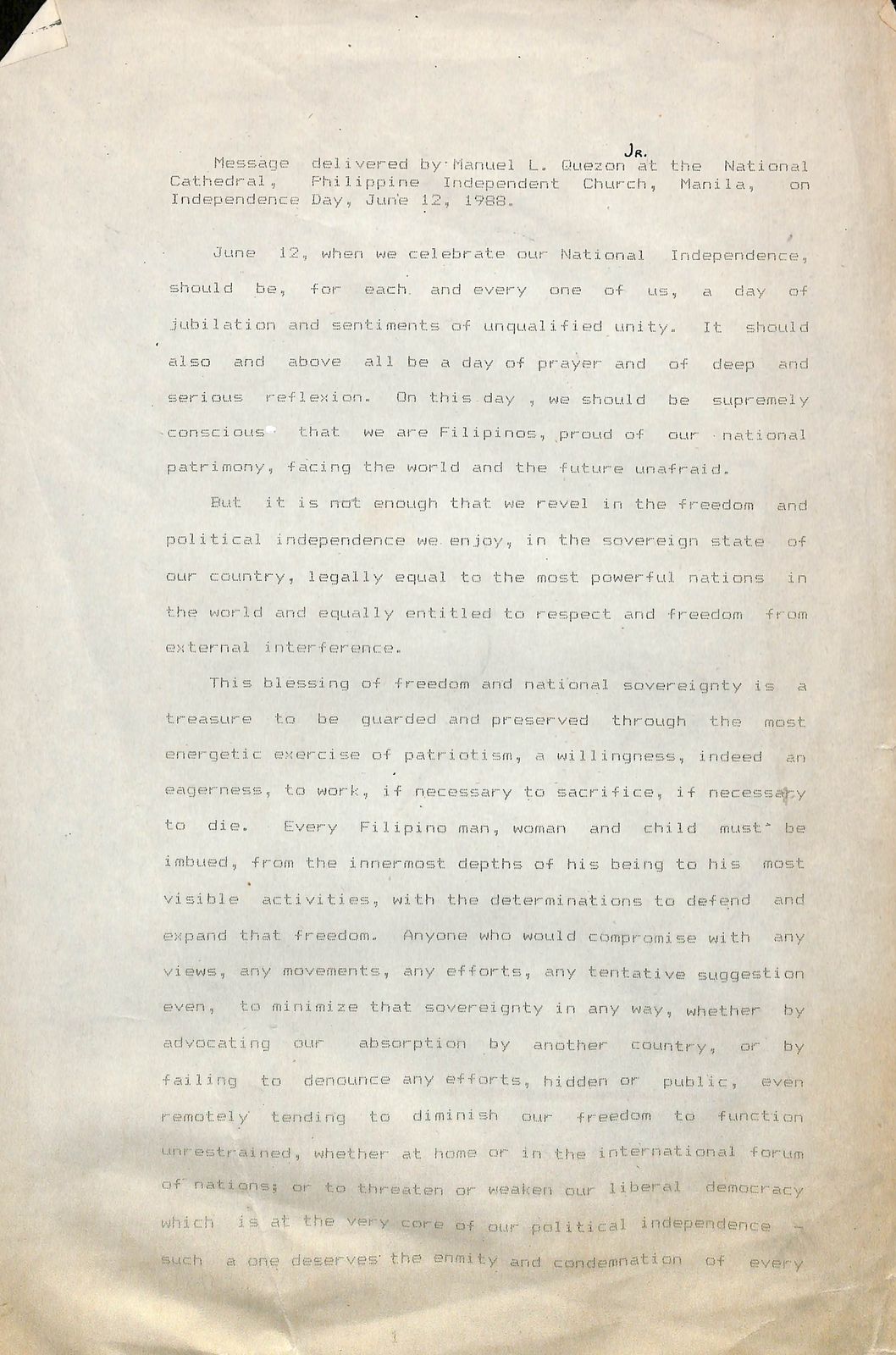
June 12, when we celebrate our National Independence, should be, for each and every one of us, a day of jubilation and sentiments of unqualified unity. It should also and above all be a day of prayer and of deep and serious reflection. On this day, we should be supremely conscious that we are Filipinos, proud of our national patrimony, facing the world and the future unafraid.
But it is not enough that we revel in the freedom and political independence we enjoy, in the sovereign state of our country, legally equal to the most powerful nations in the world and equally entitled to respect and freedom from external interference. This blessing of freedom and national sovereignty is a treasure to be guarded and preserved through the most energetic exercise of patriotism, a willingness, indeed an eagerness, to work, if necessary to sacrifice, if necessary to die. Every Filipino man, woman and child must be imbued, from the innermost depths of his being to his most visible activities, with the determination to defend and expand that freedom. Anyone who would compromise with any views, any movements, any efforts, any tentative suggestion even, to minimize that sovereignty in any way, whether by advocating our absorption by another country, or by failing to denounce any efforts, hidden or public, even remotely tending to diminish our freedom to function unrestrained, whether at home or in the international forum of nations; or to threaten or weaken our liberal democracy which is at the very core of our political independence—such a one deserves the enmity and contempt of every true patriot. Such a one should be ostracized from our social and political life.
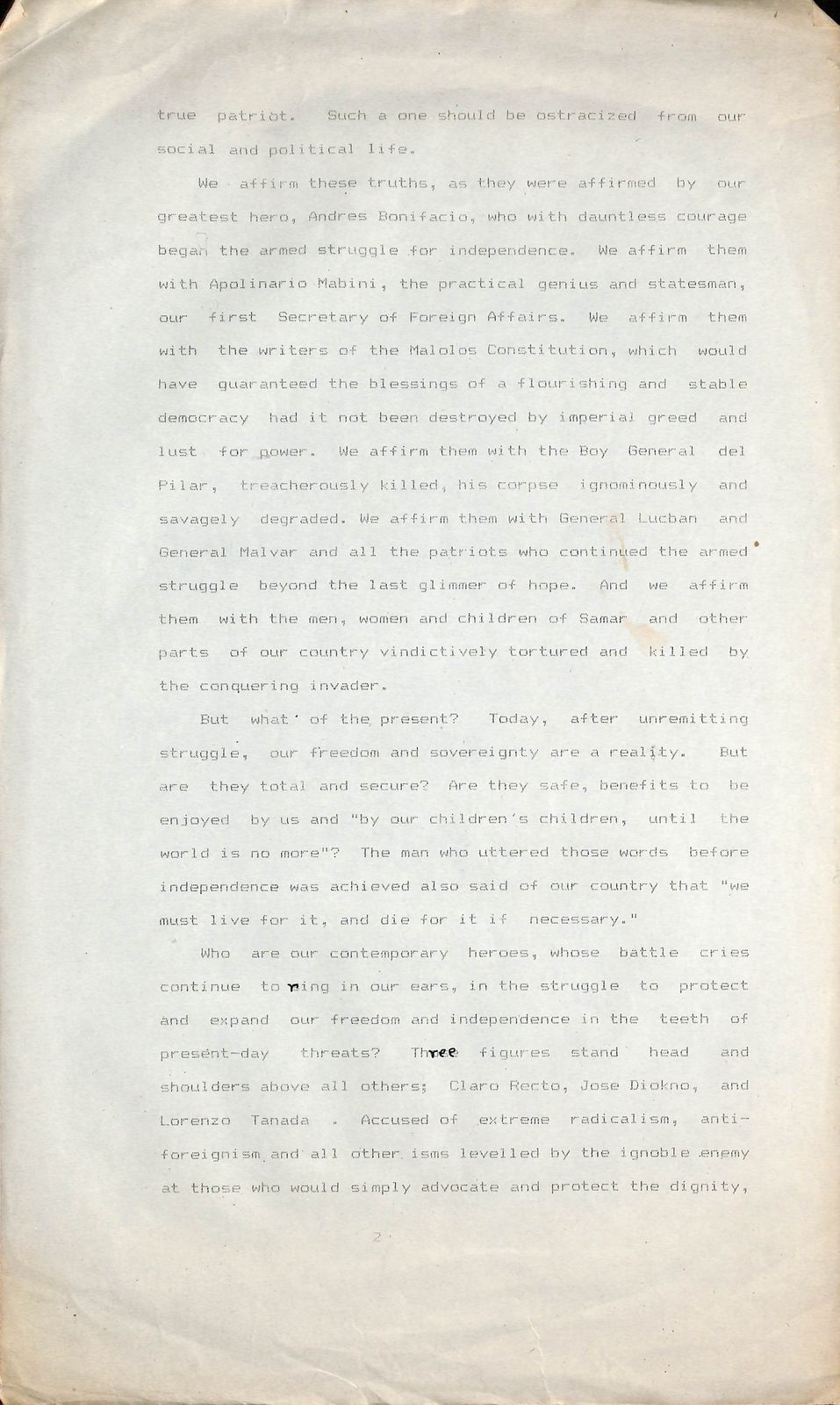
We affirm these truths as they were affirmed by our greatest hero, Andres Bonifacio, who with dauntless courage began the armed struggle for independence. We affirm them with Emilio Aguinaldo, our first President, who proclaimed our independence to the world. We affirm them with Apolinario Mabini, the practical genius and statesman, our first Secretary of Foreign Affairs. We affirm them with the writers of the Malolos Constitution, which would have guaranteed the blessings of a flourishing and stable democracy had it not been destroyed by imperial greed and lust for power. We affirm them with the Boy General del Pilar, treacherously killed, his corpse ignominiously and savagely degraded. We affirm them with General Lucban and General Malvar and all the patriots, who continued the armed struggle beyond the last glimmer of hope. And we affirm them with the men, women and children of Samar and other parts of our country, vindictively tortured and killed by the conquering invader.
But what of the present? Today, after unremitting struggle, our freedom and sovereignty are a reality. But are they total and secure? Are they safe, benefits to be enjoyed by us and “by our children and our children’s children, until the world is no more?” The man who uttered those words before independence was achieved also said of our country that “we must live for it, and die for it if necessary.”
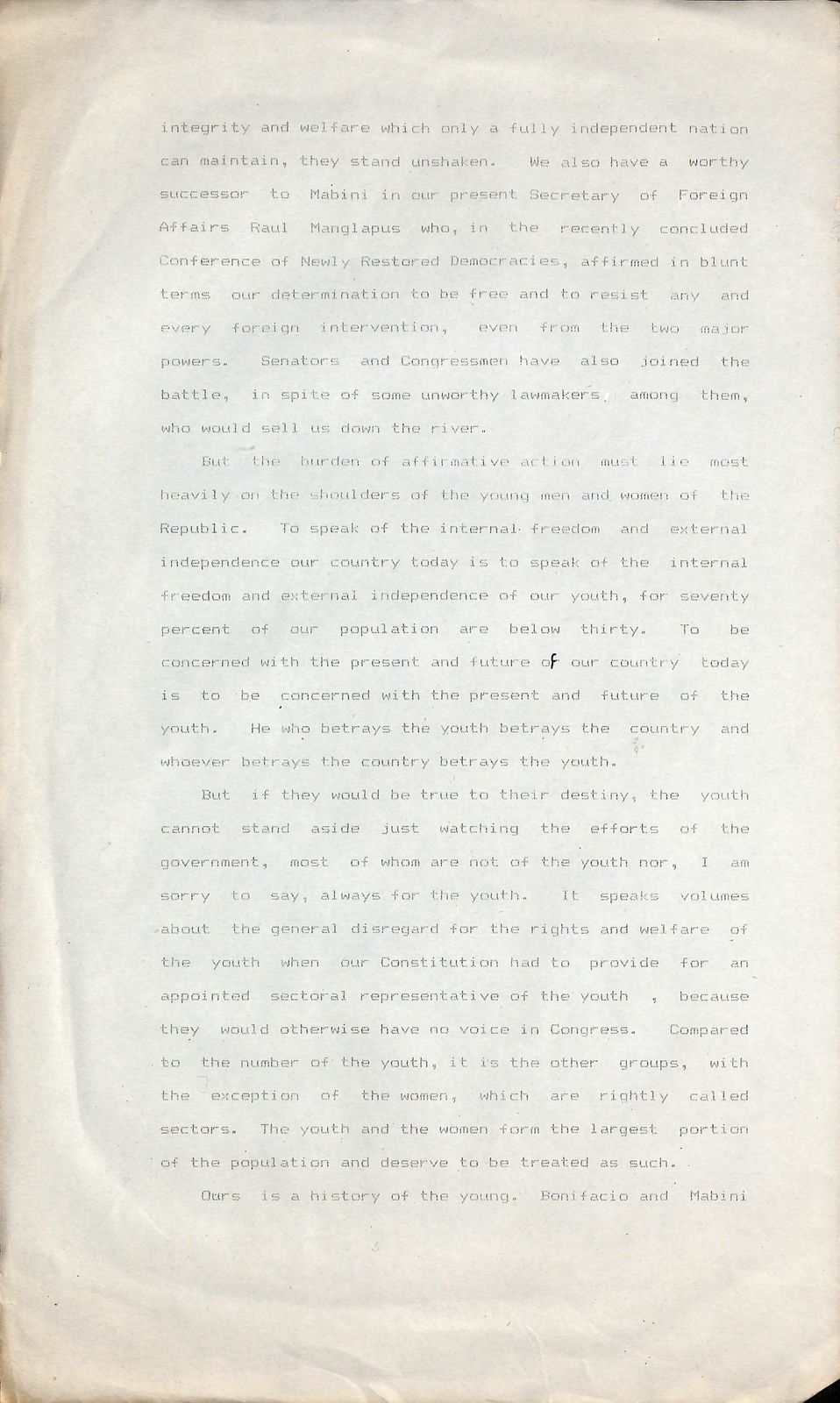
Who are our contemporary heroes, whose battle cries continue to ring in our ears, in the struggle to protect and expand our freedom and independence in the teeth of present-day threats? Three figures stand head and shoulders above all others: Claro Recto, Jose Diokno, and Lorenzo Tañada. Accused of extreme radicalism, anti-foreignism, and all other “isms” leveled by the ignoble enemy at those who would simply advocate and protect the dignity, integrity, and welfare which only a fully independent nation can maintain, they stand unshaken. We also have a worthy successor to Mabini in our present Secretary of Foreign Affairs Raul Manglapus who, in the recently concluded Conference of Newly Restored Democracies, affirmed in blunt terms our determination to be free and to resist any and every foreign intervention, even from the two major powers. Senators and Congressmen have also joined the battle, in spite of some unworthy lawmakers among them, who would sell us down the river.
But the burden of affirmative action must lie most heavily on the shoulders of the young men and women of the Republic. To speak of the internal freedom and external independence our country today is to speak of the internal freedom and external independence of our youth, for seventy percent of our population are below thirty. To be concerned with the present and future of our country today is to be concerned with the present and future of the youth. He who betrays the youth betrays the country and whoever betrays the country betrays the youth.
But if they would be true to their destiny, the youth cannot stand aside just watching the efforts of the government, most of who are not of the youth nor, I am sorry to say, always for the youth. It speaks volumes about the general disregard for the rights and welfare of the youth when our Constitution had to provide for an appointed sectoral representative of the youth, because they would otherwise have no voice in Congress. Compared to the number of the youth, it is the other groups, with the exception of the women, which are rightly called sectors. The youth and the women form the largest portion of the population and deserve to be treated as such.
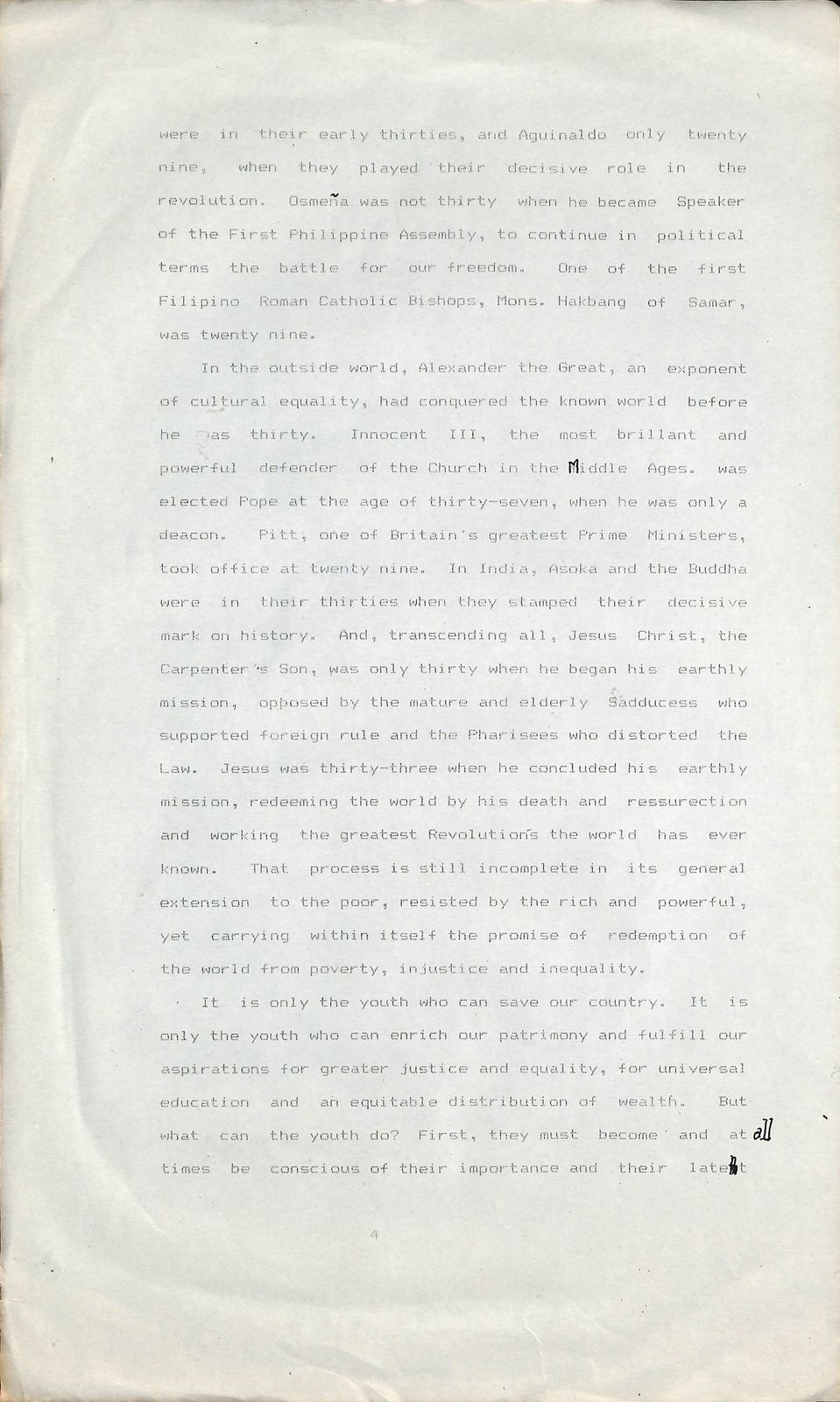
Ours is a history of the young. Bonifacio and Mabini were in their early thirties, and Aguinaldo, only twenty-nine, when they played their decisive role in the revolution. Osmeña was not thirty when he became Speaker of the First Philippine Assembly, to continue in political terms the battle for our freedom. One of the first Filipino Roman Catholic Bishops, Mons. Hakbang of Samar, was twenty-nine.
In the outside world, Alexander the Great, an exponent of cultural equality, had conquered the known world before he was thirty. Innocent III, the most brilliant and powerful defender of the Church in the Middle Ages, was elected Pope at the age of thirty-seven, when he was only a deacon. Pitt, one of Britain’s greatest Prime Ministers, took office at twenty-nine. In India, Asoka and the Buddha were in their thirties when they stamped their decisive mark on history. And, transcending all, Jesus Christ, the Carpenter’s Son, was only thirty when He began His earthly mission, opposed by the mature and elderly Sadducees who supported foreign rule and the Pharisees who distorted the Law. Jesus was thirty-three when He concluded his earthly mission, redeeming the world by His death and resurrection and working the greatest Revolution the world has ever known. That process is still incomplete in its general extension to the poor, resisted by the rich and powerful, yet carrying within itself the promise of redemption of the world from poverty, injustice, and inequality.
It is only the youth who can save our country. It is only the youth who can enrich our patrimony and fulfill our aspirations for greater justice and equality, for universal education and an equitable distribution of wealth. But what can the youth do?
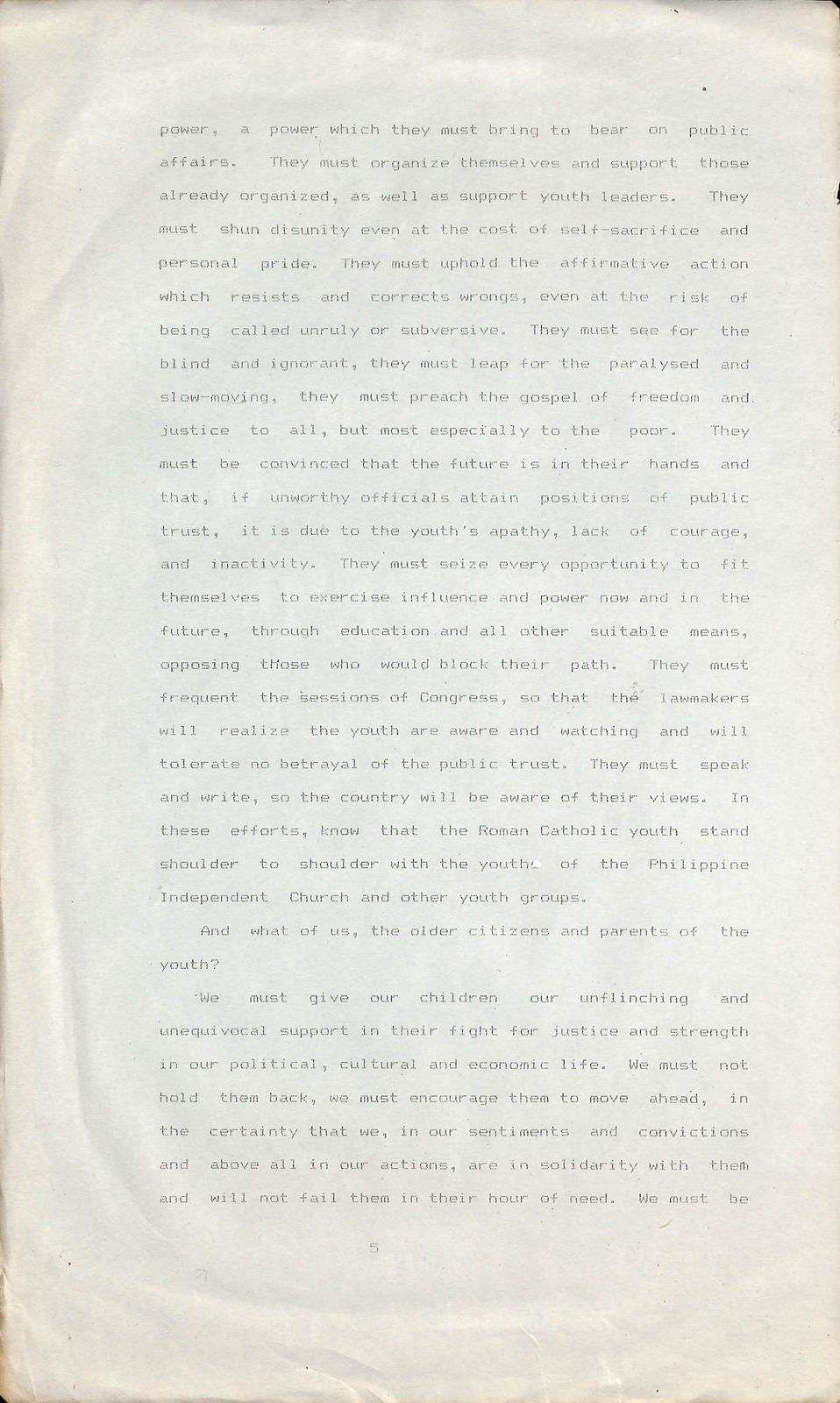
First, they must become and, at all times, be conscious of their importance and their latent power, a power which they must bring to bear on public affairs. They must organize themselves and support those already organized, as well as support youth leaders. They must shun disunity even at the cost of self-sacrifice and personal pride. They must uphold the affirmative action, which resists and correct wrongs, even at the risk of being called unruly or subversive. They must see for the blind and ignorant, they must leap for the paralyzed and slow moving, they must preach the gospel of freedom and justice to all, but most especially to the poor. They must be convinced that the future is in their hands and that, if unworthy officials attain positions of public trust, it is due to the youth’s apathy, lack of courage, and inactivity. They must seize every opportunity to fit themselves to exercise influence and power now and in the future, through education and all other suitable means, opposing those who would block their path. They must frequent the sessions of Congress, so that the lawmakers will realize the youth are aware and watching and will tolerate no betrayal of the public trust. They must speak and write, so the country will be aware of their views. In these efforts, know that the Roman Catholic youth stand shoulder with the youth of the Philippine Independent Church and other youth groups.
And what of us, the older citizens and parents of the youth?
We must give our children our unflinching and unequivocal support in their fight for justice and strength in our political, cultural and economic life. We must not hold them back, we must encourage them to move ahead, in the certainty that we, in our sentiments and convictions and above all in our actions, are in solidarity with them and will not fail them in their hour of need. We must be proud of their ideals and selflessness, and wary of dragging them towards a perversion of true practicality, so often a disguise for selfishness, cowardice, and lack of vision.
Any other attitude would be a betrayal of our God-given duties as their parents and fellow citizens.
So, on this day of our National Independence, my message to you and to all is this: be thankful for our blessings and firmly resolve that we will never betray our freedom.
Message delivered at the National Cathedral of the Philippine Independent Church, Manila, on Independence Day, June 12, 1988.
The opening thanks to the Obispo Maximo and the salutation come from the typed copy; they are not on the surviving typescript.
Text checked against the scanned typescript.
The original typescript