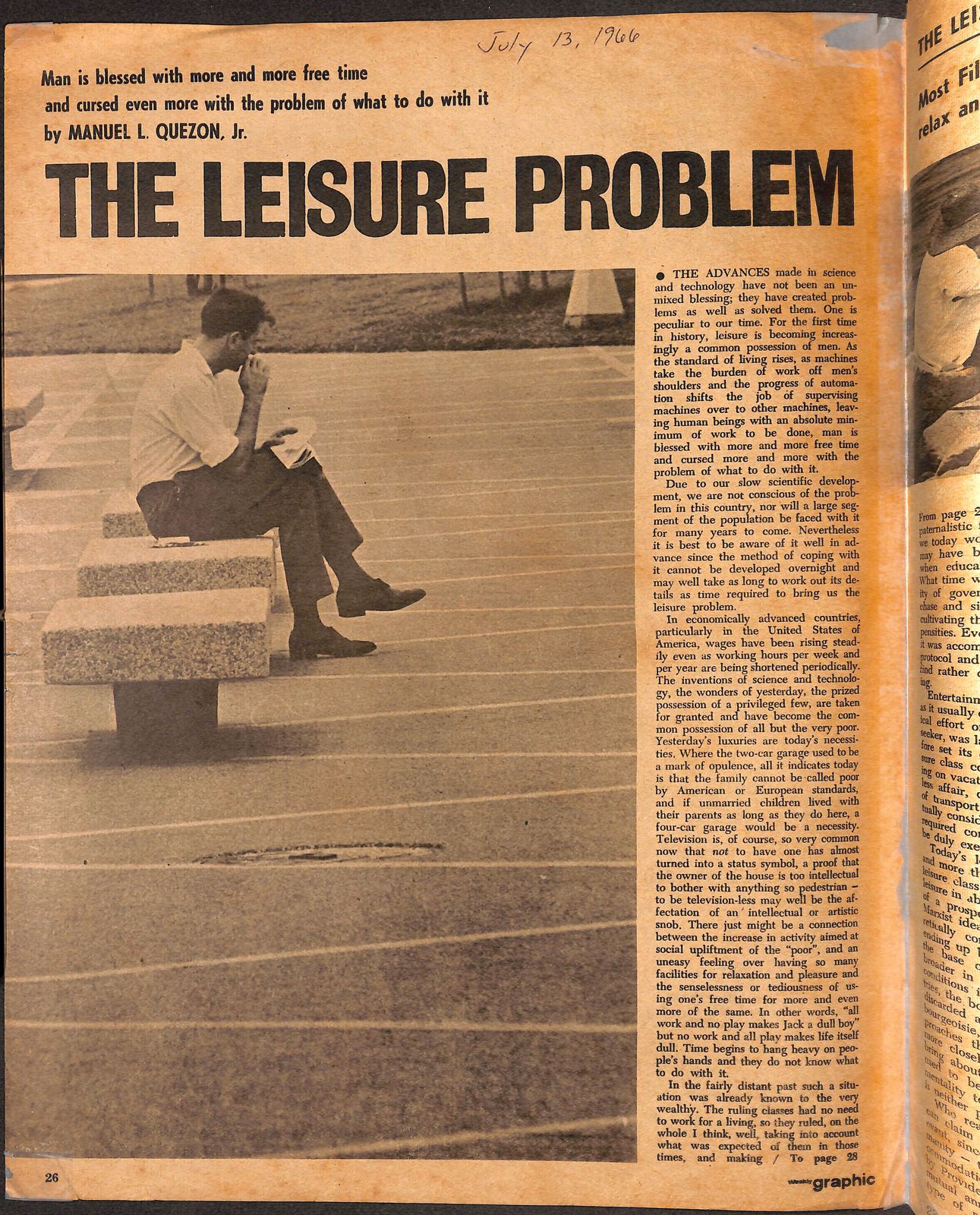
THE advances made in science and technology have not been an unmixed blessing; they have created problems as well as solved them. One is peculiar to our time. For the first time in history, leisure is becoming increasingly a common possession of men. As the standard of living rises, as machines take the burden of work off men’s shoulders and the progress of automation shifts the job of supervising machines over to other machines, leaving human beings with an absolute minimum of work to be done, man is blessed with more and more free time and cursed more and more with the problem of what to do with it.
Due to our slow scientific development, we are not conscious of the problem in this country, nor will a large segment of the population be faced with it for many years to come. Nevertheless it is best to be aware of it well in advance since the method of coping with it cannot be developed overnight and may well take as long to work out its details as time required to bring us the leisure problem.
In economically advanced countries, particularly in the United States of America, wages have been rising steadily even as working hours per week and per year are being shortened periodically. The inventions of science and technology, the wonders of yesterday, the prized possession of a privileged few, are taken for granted and have become the common possession of all but the very poor. Yesterday’s luxuries are today’s necessities. Where the two-car garage used to be a mark of opulence, all it indicates today is that the family cannot be called poor by American or European standards, and if unmarried children lived with their parents as long as they do here, a four-car garage would be a necessity. Television is, of course, so very common now that not to have one has almost turned into a status symbol, a proof that the owner of the house is too intellectual to bother with anything so pedestrian—to be television-less may well be the affectation of an intellectual or artistic snob. There just might be a connection between the increase in activity aimed at social upliftment of the “poor”, and an uneasy feeling over having so many facilities for relaxation and pleasure and the senselessness or tediousness of using one’s free time for more and even more of the same. In other words, “all work and no play makes Jack a dull boy” but no work and all play makes life itself dull. Time begins to hang heavy no people’s hands and they do not know what to do with it.
In the fairly distant past such a situation was already known to the very wealthy. The ruling classes had no need to work for a living, so they ruled, on the whole I think, well, taking into account what was expected of them in those times, and making due allowance for the paternalistic flavor of government which we today would find unacceptable, but may have been unavoidable at a time when education was not widespread. What time was left over from the activity of governing was devoted to the chase and similar genteel sports, or to cultivating the mind or one’s artistic propensities. Even courtship took time, since it was accompanied with a good deal of protocol and ceremony, which we would find rather quaint and extremely amusing.
Entertainment and pleasure involving as it usually did some intellectual or physical effort on the part of the pleasure-seeker, was largely homemade and therefore set its own limits on what the leisure class could want or use. Even going on vacation was not a wholly effortless affair, due to the primitive means of transportation. Conversation was actually considered an art, and like all art required concentration and expertise to be duly exercised!
Today’s leisure class comprises more and more the entire population. Today’s leisure class works, but it certainly has leisure in abundance. The bourgeois idea of a prosperous middle class and the Marxist idea of the working class, theoretically contradictory, are in practice ending up by being the same thing. As the base of middle class life grows broader in capitalist countries and the conditions improve in communist countries, the bourgeois mentality is actually discarded and actually despised by the bourgeoisie, while the proletarian life approaches that of the bourgeoisie ever more closely. This trend cannot but bring about a change away from what used to be considered the proletarian mentality toward something else, which is neither proletarian nor bourgeois.
Who really has the last word, who can claim the victory is, I think, irrelevant, since the ultimate gainer is humanity—this mutual approach and accommodation maybe the means devised by Providence to save mankind from mutual annihilation. Whether this third type of mentality will in itself, apart from its side effect of preventing war constitute a benefit for mankind in the long run, will depend on just what that mentality will be. At this point, we can only try to nudge it in what we consider the proper direction, then wait and see.
But, returning to the leisure time of today’s prosperous people . . . their entertainment is more and more of a passive variety. It is served up to them on a silver or, perhaps more appropriately, plastic platter—they need make no efforts beyond driving to the movies or switching on the television set or the stereo.
Digest Mentality
Walking, (a pastime of yesterday’s leisure class) more than two of three hundred yards is not done. If one goes on vacation, one does not mount a horse or climb into a rattling, swaying carriage to arrive hot and dusty or frozen and muddy, but in either case tired; one steps into a plane or air-conditioned train or ship, or drives out in a car on a superhighway, where the hardships are confined to a possible traffic jam, hard on the nerves rather than the body. The ease with which entertainment is had, the swiftness with which people travel, leaves people with more time on their hands than they can use. What Pitirim M. Sorokin in his book, The Crisis Of our Age described as our contemporary sensate culture has just about reached its final stage—all pleasures and all goals are for the satisfaction of the senses, and that sort of thing palls very quickly. One may tire of thinking, one does not get bored with it—pleasures of the senses can both tire and bore. And, in fact, people seldom do any serious, deep thinking; they are satisfied to let others do it for them and have it served to them in convenient, easy-to-digest morsels, hence the popularity of slogans, one-minute medications and all sorts of condensations of books and “Digests” of other magazines. The senses, their satisfaction, the “sensational”—that is the mad quest of the day, and those of us who still remember our schooldays will recall that sensation easily reaches saturation, as the phenomenon of sensory fatigue shows—we stop feeling and stop enjoying it.
Why Worry?
To increase the leisure time of people even more, although a good thing in itself, will harm them, actually infect them with an unsatisfiable restlessness, unless the idea of pleasures undergoes a radical change, as including pleasures of the mind, and the notion of leisure is changed, from that of time for the mad pursuit of the will-o-the-wisp of sensate pleasure to that of time to be used for something pleasant but also useful, although different and providing a change from one’s workaday activities.
I explained early in this article why the problem of excess free time should be considered by Filipinos now, although the conditions making it possible lie in the indefinite future. It must sound strange, even ironic, to the average working Filipino that we should start worrying now about the problem of how a worker should use spare time—he is content enough to be able to relax in a chair or drop off to sleep after an exhausting long day’s work, if indeed he is able to do that instead of doing some other extra work to supplement his inadequate salary. He would be quite satisfied with a peaceful Sunday at home or visiting friends and relatives, if indeed he does not have to work on Sunday also in order to eat on Sunday, or do the chores which exhaustion after work did not allow him to do during the week.
But there is an excellent reason for studying the problem of leisure now. Most Filipinos are not yet as sensation-mad as the people of other countries. They can still enjoy a quiet evening at home with the family, or peaceful conversation with friends, or even just sitting or lying in silence and relaxation, enjoying the very silence and absence of activity. There is still time, through all the means available to society, particularly education, through the schools, the mass media of communications, the pulpit, the home—to make them aware, or to keep them aware of those pleasures, those forms of leisure, which are not solely of the senses. They can still learn, as their education progresses—if they get the kind of education to which they are entitled—that the highest and most lasting pleasures are those of the mind and the spirit, and good art is also of these; and that leisure time can be put to better uses than the mad, and ultimately unsatisfiable pursuit of voluptuousness, and that for those better uses of leisure time, no amount of leisure time will ever be so excessive. But if we fail to take the necessary steps now, when the time of greater leisure is at hand it will not bring enrichment to the lives of our people—they will merely step from the treadmill of work to the treadmill of the insatiable, restless, mentally dulling pursuit of hedonistic pleasures. The first treadmill at least results in something worthwhile—the sustenance of life and the production of results. The second can only lead, sooner or later, to a despair-filled and pathetic sense of futility and emptiness.
Published in the Philippine Graphic, July 13, 1966.
Text checked against the scanned clipping.
The original clipping