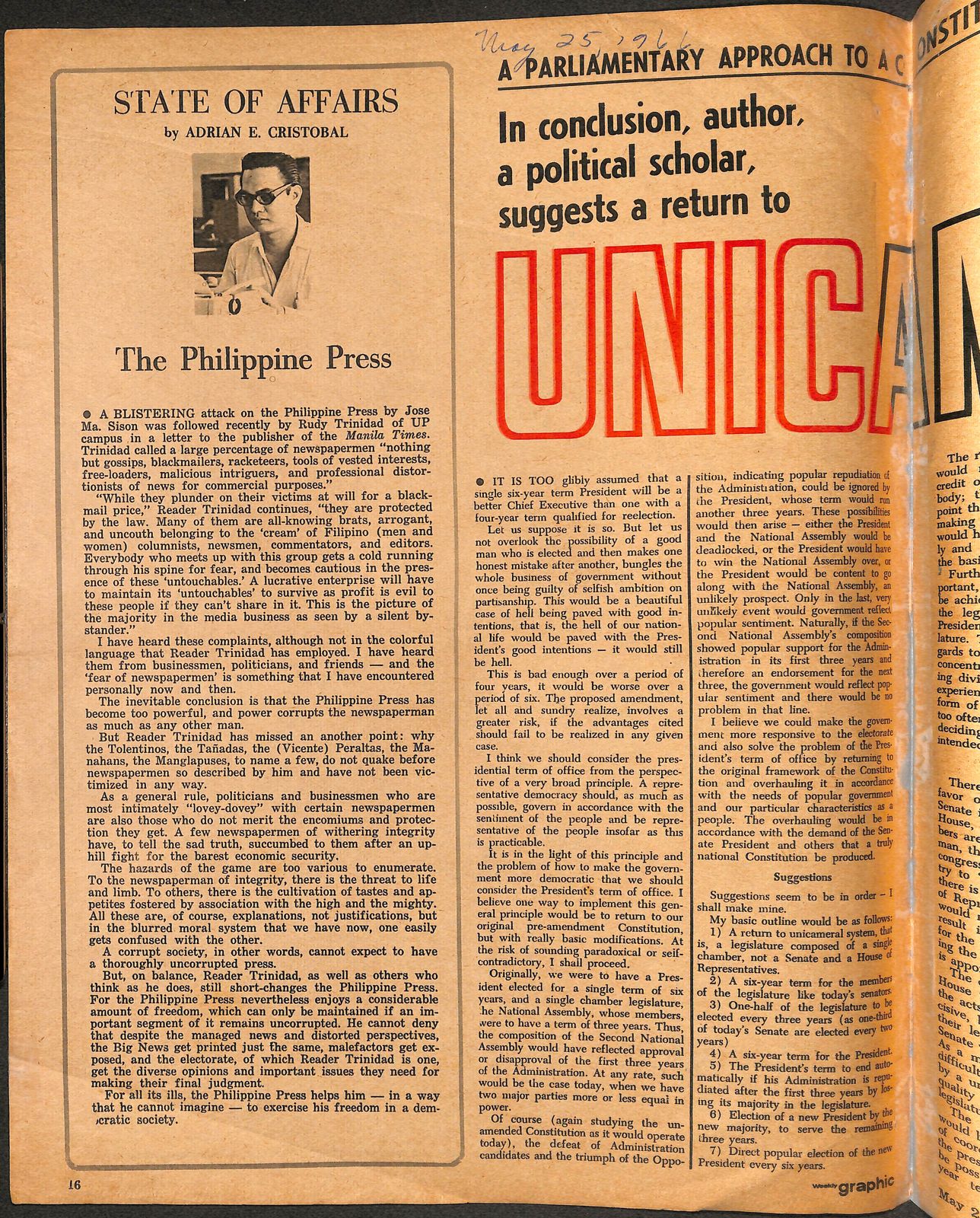
Editor’s note (contemporary; printed with the article in the Philippine Graphic, May 25, 1966)
In conclusion, author, a political scholar, suggests a return to unicameralism
IT IS TOO glibly assumed that a single six-year term President will be a better Chief Executive than one with a four-year term qualified for reelection.
Let us suppose it is so. But let us not overlook the possibility of a good man who is elected and then makes one honest mistake after another, bungles the whole business of government without once being guilty of selfish ambition on partisanship. This would be a beautiful case of hell being paved with good intentions, that is, the hell of our national life would be paved with the President’s good intentions—it would still be hell.
This is bad enough over a period of four years, it would be worse over a period of six. The proposed amendment, let all and sundry realize, involves a greater risk, if the advantages cited should fail to be realized in any given case.
I think we should consider the presidential term of office from the perspective of a very broad principle. A representative democracy should, as much as possible, govern in accordance with the sentiment of the people and be representative of the people insofar as this is practicable.
It is in the light of this principle and the problem of how to make the government more democratic that we should consider the President’s term of office. I believe in one way to implement this general principle would be to return to our original pre-amendment Constitution, but with really basic modifications. At the risk of sounding paradoxical or self-contradictory, I shall proceed.
Originally, we were to have a President elected for a single term of six years, and a single chamber legislature, the National Assembly, whose members, were to have a term of three years. Thus, the composition of the Second National Assembly would have reflected approval or disapproval of the first three years of the Administration. At any rate, such would be the case today, when we have two major parties more or less equal in power.
Of course (again studying the unamended Constitution as it would operate today), the defeat of Administration candidates and the triumph of the Opposition, indicating popular repudiation of the Administration, could be ignored by the President, whose term would run another three years. These possibilities would then arise—either the President and the National Assembly would be deadlocked, or the President would have to win the National Assembly over, or the President would be content to go along with the National Assembly, an unlikely event would government reflect popular sentiment. Naturally, if the Second National Assembly’s composition showed popular support for the Administration in its first three years and therefore an endorsement for the next three, the government would reflect popular sentiment and there would be no problem in that line.
I believe we could make the government more responsive to the electorate and also solve the problem of the President’s term of office by returning to the original framework of the Constitution and overhauling it in accordance with the needs of popular government and our particular characteristics as a people. The overhauling would be in accordance with the demand of the Senate President and others that a truly national Constitution be produced.
Suggestions
Suggestions seem to be in order—I shall make mine.
My basic outline would be as follows:
1) A return to unicameral system, that is, a legislature composed of a single chamber, not a Senate and a House of Representatives.
2) A six-year term for the members of the legislature like today’s senators.
3) One-half of the legislature to be elected every three years (as one-third of today’s Senate are elected every two years)
4) A six-year term for the President.
5) The President’s term to end automatically if his Administration is repudiated after the first three years by losing its majority in the legislature.
6) Election of a new President by the new majority, to serve the remaining three years.
7) Direct popular election of the new President every six years.
The return to a unicameral legislature would make possible the assigning of credit or blame within the law-making body; that is, the majority could not point the accusing finger at another law-making body, as is possible today—it would have to face responsibility squarely and face the electorate squarely, on the basis of that responsibility.
Furthermore, and perhaps most important, a better balance of power would be achieved between the President and the legislature, not by weakening the President but by strengthening the legislature. The legislature is stronger in regards to the President when its power is concentrated in one House instead of being divided between two Houses. Also, experience has shown that the present form of the Senate allows for deadlocks too often, and gives to the man holding a deciding vote, an amount of power never intended in single members of Congress.
A Drain Of Talent
There is yet another consideration in favor of a single House. Because the Senate is considered the more important House, inasmuch as its individual members are more powerful than a congressman, there is a natural tendency for any congressman who gains prominence to try to “graduate” to the Senate. Thus, there is a drain of talent from the House of Representatives to the Senate. This would not be so bad if it did not often result in an able congressman running for the Senate and losing—thus depriving the country of his services unless he is appointed as a “lame duck.”
The classical argument for an Upper House to act as a House of review of the acts of the Lower House is not decisive, because those who now exercise their leadership and moderation in the Senate would do so in the Lower House. As a matter of fact, it would be very difficult to prove that legislation passed by a unicameral legislature is poorer in quality than that passed by a bicameral legislature.
The six-year term for the legislators would be necessary so that some degree of coordination could be achieved with the presidential term. It would, of course, be possible to follow the original three-year term system but the individual legislator would be faced with campaigning too frequently. As in the case of a six-year President, he would be able to concentrate on lawmaking more completely if campaigning were not so close at hand all the time.
The replacement of one-half of the legislature would make it more representative of public opinion, because it would more closely represent changes in public opinion. If the legislature were to prove unsatisfactory to the public, the electorate would take control from the majority by electing opposition candidates. If however, the voters were satisfied, they would elect candidates belonging to the majority, thus keeping the majority in power. In other words, every three years the composition of the legislature could be brought into line with the political tendency of the country.
The six-year term for the President would be advisable because long-range administration programs such as this country and all underdeveloped countries need cannot be completed in four years. It is not only personal ambition that can cause a four-year President to prepare for reelection at an early date; he may well feel it his duty to continue guiding his Administration’s program to its completion or at least to near completion, which is not possible in four years but is entirely possible in six. Even if reelection after a six-year term were permitted, the President could still concentrate for a longer period of time on strictly presidential duties.
The trouble with a six-year presidential term is that, if his Administration should prove a failure—and failure betrays itself within one, two, or three years, the country would have to continue suffering until the term of office ends. That is the reason for removing the President after three years if he loses the majority in the legislature. An Administration really stands or falls, depending on the legislation for which it is responsible.
If the President loses his majority in the legislature, it would show that his program of government to which the legislature gave existence through laws was judged a failure by the people.
I do not mean that all his programs in economics, education, national defense, etc. should have been completed in three years. I pointed out above that major programs cannot be completed in a short time. The failure would consist in the non-completion of projects which could and should have been completed in a short time but were not, and in the failure of long-range projects to have advanced as far as they could reasonably be expected to advance. The major projects are precisely the ones in which the population are most capable of judging.
To take an example, a program to bring wages and prices into balance may take time, but if the situation has not improved perceptibly in three years, even a relatively ignorant voter can tell—his life has not grown less hard.
Thus, if the Administration is judged a failure by the voters, and control of the legislature passed to the Opposition, the President would also automatically cease holding office and the new majority in the legislature would elect a new President who would help carry out the new mandate. It would be impractical for the people to elect the new President because that would involve holding a national election right after another general election. To allow the President to continue would lead to difficulties inherent in the original Constitution, as indicated above.
The President chosen by legislature should, however, serve only three years at which time the people would again elect a President by direct vote. This would preserve the basic principle practice of electing the President by direct vote. The danger of a President being elected who would be on the opposite side from the new majority in the legislature would be slight, since again one-half of the legislature would be elected, reflecting satisfaction or dissatisfaction with the previous Administration. The satisfaction or dissatisfaction would also be reflected in the election of the President.
This does not happen now, because of the bicameral and presidency-centered system we have. In the proposed system, greater importance would shift to the unicameral legislature, our government would be legislature rather than presidency-centered. It would be colored less by personality than Administration programs so the choice of a President would be decided on the basis of the choice of program for the legislature. This would also seem a movement in the direction of greater democracy, since there would be greater power in the hands of the legislature rather than in the hands of one man, the President, without adopting the Parliamentary concentration of all power in the legislature, which here would easily lead to legislative excesses.
A Continuing Mandate
I do not say the system I propose is foolproof—no human system is. Nor do I think I would be seriously considered, as it involves too great a departure from existing practice here and anywhere. But it would practically eliminate the danger of an electioneering President since his continuation in office after three years would depend not on his campaigning but on his Administration’s obtaining a continuing mandate in the legislature, which could only be done by means of a satisfactory program carried out successfully.
A bar to more than six years would be a matter of opinion since reelection of the President would still depend, although not so absolutely, on a satisfactory Administration. If the Administration is satisfactory, why not another term?
The determining factor for or against a ban on reelection should then be whether or not the intra-party squabbles for the nomination would be harmful to our political life, as being (possibly) conducive to pre-election intrigues between President and legislature.
Published in the Philippine Graphic, May 25, 1966.
Text checked against the scanned clipping.
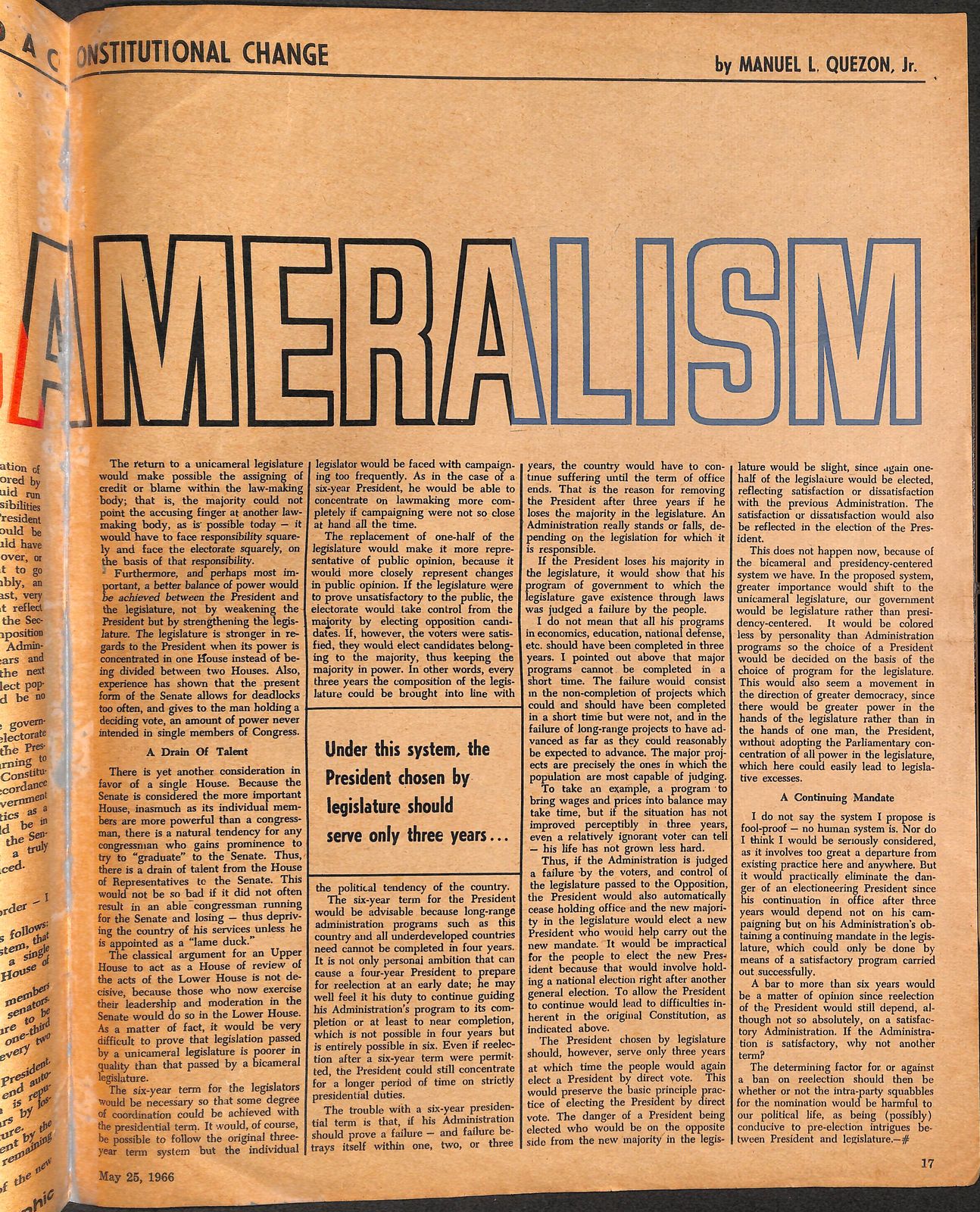
The original clipping