DEMOCRACY has become so thoroughly imbedded in our consciousness that we naturally tend to identify the democratic form of government with just government, to the exclusion of any other form. However, democracy is not synonymous with just government but rather the safest means for insuring just government.
What is just government? It is a government that is just in its possession and exercise of power, as well as in the philosophy behind that power and its exercise. In judging the merits of a particular government, we must ask a fundamental question: Does it, or does it not, recognize any limits to the power of the State? Does it, or does it not, recognize that there are areas of human life outside the scope of its power? In this lies a far more basic difference between governments than that between power in the hands of one, a few or many. It is the touchstone that first fell us whether a particular government can possibly be good.
When a government is founded on the premise that it has a monopoly of all power and all right over every aspect of human life, it is basically unjust. It destroys the very concept of human nature, of human life, which a government ought to protect. It reduces men to the status of so many cogs with a meaning only in relation to the machinery of the State, nothing else. The very notion of human dignity and human personality is erased. It was such an absolute concept of the state that gave rise to the attempted extermination of a whole people in the case of Nazi Germany.
On the other hand, a government founded on the conviction that its powers have definite limits, beyond which all attempted exercise of power is an abuse—such a government has passed the first test for a just government. A government must recognize that its field of activity is limited—and limited not because the government chooses to inhibit itself, but because the nature of government is itself limited. A just government must recognize that its people are not solely parts of the whole, without any meaning aside from the whole. There are aspects of a human being that are entirely outside the scope of the State, whether or not the State chooses to recognize the fact. A man’s right to develop his personality, to seek his own perfection and his happiness within the limits of morality, to acquire the truth, to perform his duties to God—these, and others, are rights, which the State cannot invade without the greatest injustice.
In itself, it is different whether government be in the hands of one, a few or many—it may be just or unjust. Even a democracy may be basically unjust if the idea of inviolable rights independent of the State is not accepted. It does not help to say that the people agree to grant certain rights or to suppress them, all in a democratic fashion. Where fundamental rights are concerned, it does no good for the people to attempt to create them. A group of people without such fundamental rights cannot give themselves those rights by mere agreement. No one gives that which he does not have in any way. It is a matter of recognizing rights already in existence. And then, any attempt to abolish such rights does not affect their existence one whit. It merely makes the government unjust.
On the other hand, a government of one man may recognize the basic human rights and not invade them. As the one man governing could be governing alone by the legitimate mandate of a democratic majority, in view of the needs of the country, how could we doubt the justice of the process?
Nevertheless, in practice, a democratic government gives a greater degree of safety in the matter of just government. It is very unlikely that people at large will admit that they have no inviolable rights.
But we must be continually on our guard against the tendency to violate rights simply on the basis of majority rule. That is mob rule, a pure matter of greater physical power, which does not of itself grant moral power.
We must see to it that our leaders, in the exercise of their powers, do not pass measures destructive of the human person. When our government begins to act as though a thing were just, simply because they, the people’s representatives, so desire, we must beware. We may retain the outward form of democracy but actually be under the tyranny of the mob.
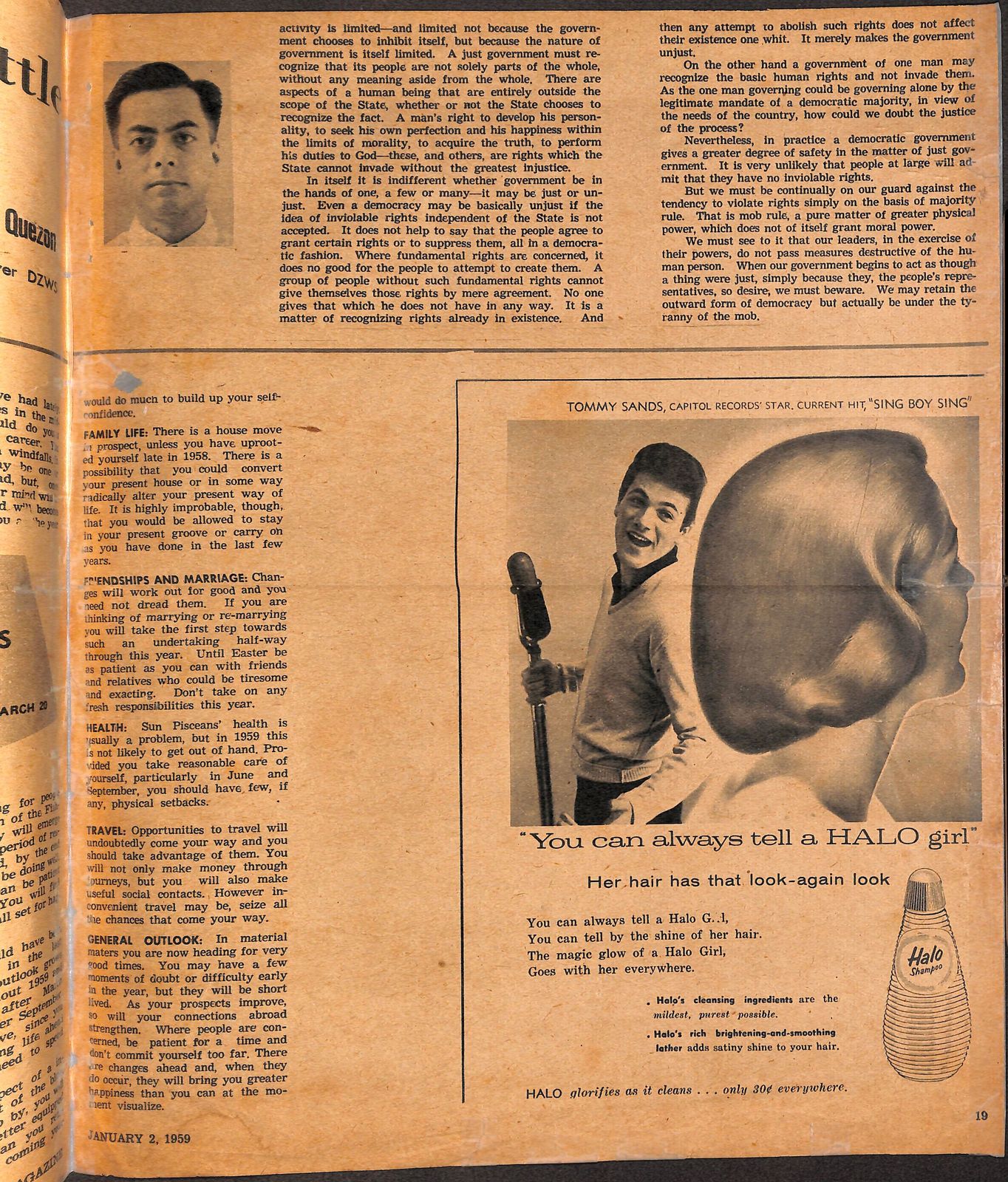
Broadcast over DZWS and printed in the Weekly Women’s Magazine, January 2, 1959, pp. 18–19.
Text checked against the scanned clipping.
The original clipping