MUCH of civilized living consists of doing things according to a set of rules called good manners. Fundamental right and wrong ordinarily are not involved in themselves. It makes absolutely no difference whether you use a spoon, a fork, or a knife to put a piece of meat into your mouth. But it is human psychology to do frequently repeated actions in more or less the same way. This is so true that those who decide not to follow convention in reality adopt the rule not to follow rules. Going back to the piece of meat, today we are surprised if we see someone spear a piece of meat with a knife to eat it. Still, in itself it really makes no difference at all, except perhaps for the danger of cutting one’s mouth. The case is entirely different if one uses that same knife to spear an innocent human being deliberately. The act would be wrong even if a big group of people got together and said it was all right.
Because of the conventional value of manners, some disregard them or even treat the subject with contempt. We are familiar with the phrases “a diamond in the rough” and “he really has a heart of gold.” It sometimes takes sustained effort to dig deep enough to find that heart of gold buried under thick layers of crude manners.
People who have a low regard for good manners are frequently sincere about it. Some people identify politeness with effeminateness or inferiority complex. They miss the point entirely.
Good manners are anything but effeminate. Here the old Spanish proverb applies—“Jo cortes no quita lo valiente” (one’s bravery is not lessened a bit by politeness).
Least of all are good manners a sign of inferiority complex. On the contrary, they impart dignity to a person. One of the most obvious signs of a man who has money and little else is his faulty manners. Today, we frequently see a group of noisy individuals lumber into a restaurant, sprawl all over the chairs at a table, summon a waiter roughly, gorge themselves, and pull out a big fat roll of paper bills to pay. They think they are showing everyone in the restaurant how much they are worth. But the poor waiter who politely serves them shows that he is worth much more than all of them put together. It is these people who have inferiority complex—an inferiority complex is an inferiority complex, even when turned inside out.
It is unfortunate that there seems to be a widespread tendency to give up the Filipino tradition of good manners and mutual respect. Many consider it all right to be rude, to be offensive in their humor. They think that politeness and respect are against the democratic spirit.
When a man has to depend on rudeness to make an impression, or to show that he is as good as anyone else, he deserves our pity. He impresses no one. And as to showing that he is as good as the next, he is fooling himself. He certainly is fooling no one else. Our tradition of good manners and mutual respect is worth more than all the shiny cars and baubles, which often are considered a fitting substitute.
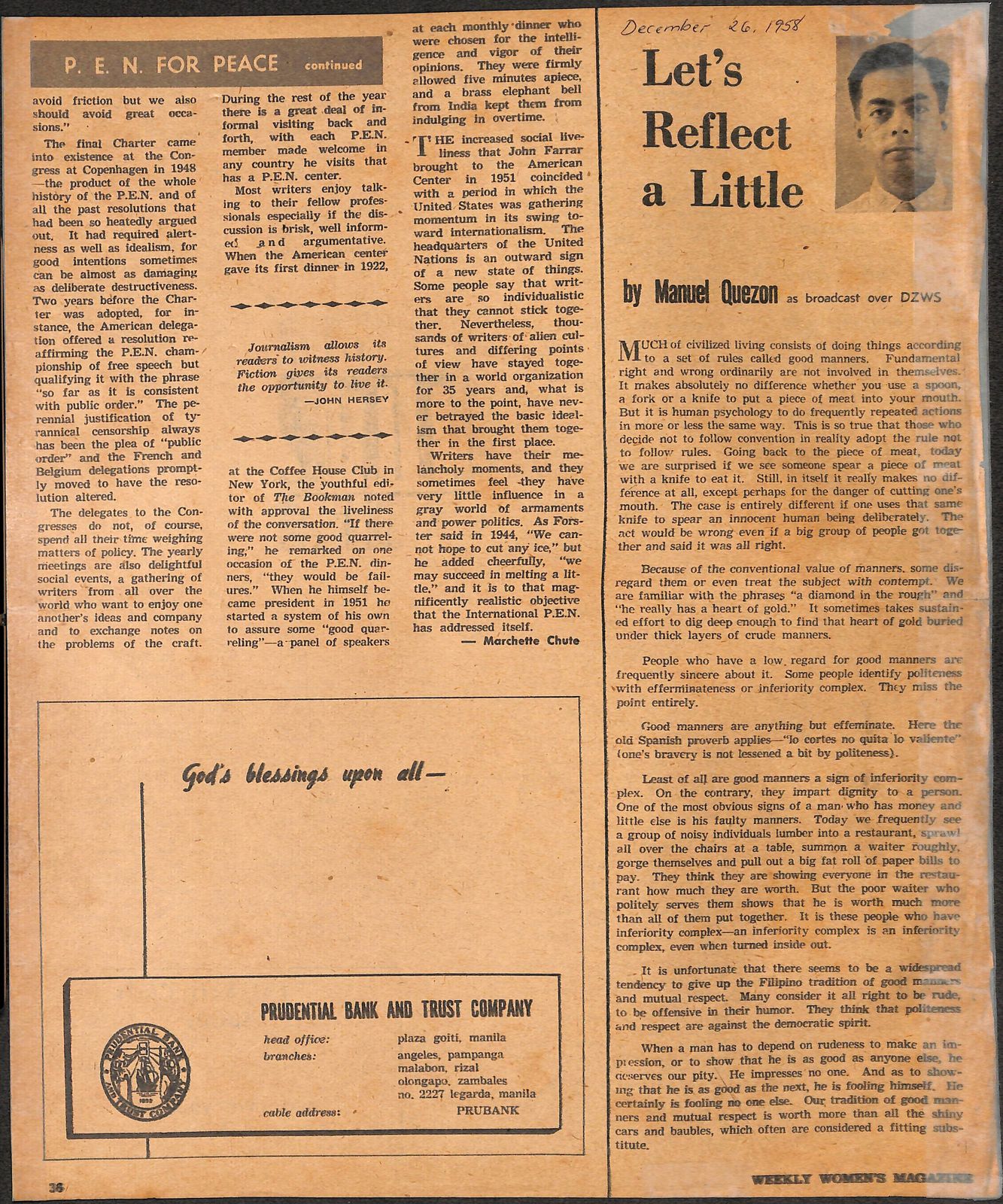
Broadcast over DZWS and printed in the Weekly Women’s Magazine, December 26, 1958, p. 36.
Text checked against the scanned clipping.
The original clipping