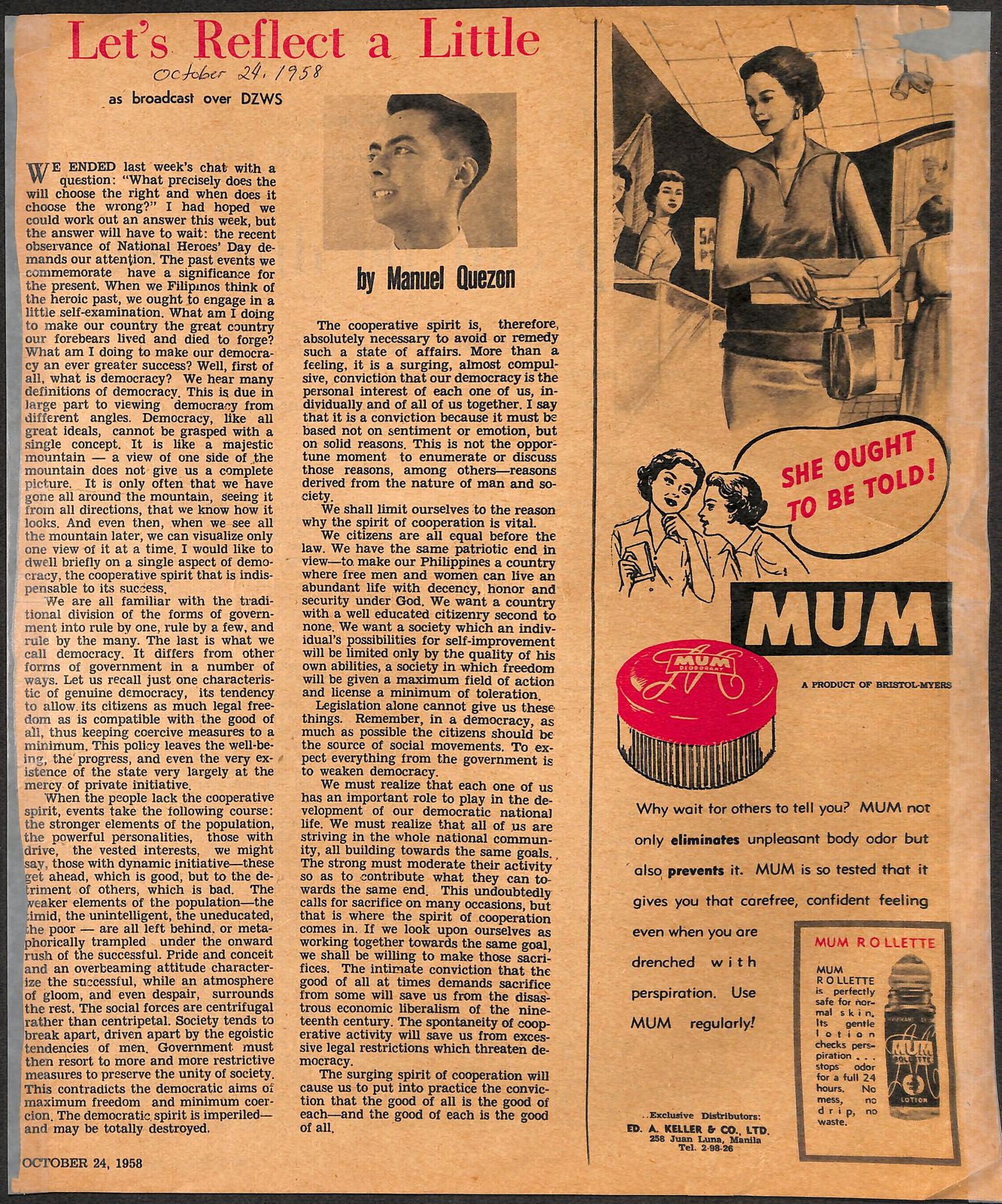
WE ENDED last week’s chat with a question: “What precisely does the will choose the right and when does it choose the wrong?” I had hoped we could work out an answer this week, but the answer will have to wait: the recent observance of National Heroes’ Day demands our attention. The past events we commemorate have a significance for the present. When we Filipinos think of the heroic past, we ought to engage in a little self- examination. What am I doing to our country the great country our forebears lived and died to forge? What am I doing to make our democracy an ever greater success? Well, first of all, what is democracy? We hear many definitions of democracy. This is due in large part to viewing democracy from different angles. Democracy, like all great ideals, cannot be grasped with a single concept. It is like a majestic mountain—a view of one side of the mountain does not give us a complete picture. It is only often that we have gone all around the mountain, seeing it from all directions, that we know how it looks. And even then, when we see all the mountain later, we can visualize only one view of it at a time. I would like to dwell briefly on a single aspect of democracy, the cooperative spirit that is indispensable to its success.
We are all familiar with the traditional division of the forms of government into rule by one, rule by a few, and rule by the many. The last is what we call democracy. It differs from other forms of government in a number of ways. Let us recall just one characteristic of genuine democracy, its tendency to allow its citizens as much legal freedom as is compatible with the good of all, thus keeping coercive measures to a minimum. This policy leaves the well-being the progress, and even the very existence of the state very largely at the mercy of private initiative.
When the people lack the cooperative spirit, events take the following course: the stronger elements of the population, the powerful personalities, those with drive, the vested interests, we might say, those with dynamic initiative—these get ahead, which is good, but to the detriment of others, which is bad. The weaker elements of the population—the timid, the unintelligent, the uneducated, the poor—are all left behind, or metaphorically trampled under the onward rush of the successful. Pride and conceit and an overbeaming attitude characterize the successful, while an atmosphere of gloom, and even despair, surrounds the rest. The social forces are centrifugal rather than centripetal. Society tends to break apart, driven apart by the egoistic tendencies of men. Government must then resort to more and more restrictive measures to preserve the unity of society. This contradicts the democratic aims of maximum freedom and minimum coercion. The democratic spirit is imperiled—and may be totally destroyed.
The cooperative spirit is, therefore, absolutely necessary to avoid or remedy such a state of affairs. More than a feeling, it is a surging, almost compulsive, conviction that our democracy is the personal interest of each one of us, individually and of all of us together. I say that it is a conviction because it must be based not on sentiment or emotion, but on solid reasons. This is not the opportune moment to enumerate or discuss those reasons, among others—reasons derived from the nature of man and society.
We shall limit ourselves to the reason why the spirit of cooperation is vital.
We citizens are all equal before the law. We have the same patriotic end in view—to make our Philippines a country where free men and women can live an abundant life with decency, honor and security under God. We want a country with a well educated citizenry second to none. We want a society which an individual’s possibilities for self-improvement will be limited only by the quality of his own abilities, a society in which freedom will be given a maximum field of action and license a minimum of toleration.
Legislation alone cannot give us these things. Remember, in a democracy, as much as possible the citizens should be the source of social movements. To expect everything from the government is to weaken democracy.
We must realize that each one of us has an important role to play in the development of our democratic national life. We must realize that all of us are striving in the whole national community, all building towards the same goals. The strong must moderate their activity so as to contribute what they can towards the same end. This undoubtedly calls for sacrifice on many occasions, but that is where the spirit of cooperation comes in. If we look upon ourselves as working together towards the same goal, we shall be willing to make those sacrifices. The intimate conviction that the good of all at times demands sacrifice from some will save us from the disastrous economic liberalism of the nineteenth century. The spontaneity of cooperative activity will save us from excessive legal restrictions which threaten democracy.
The surging spirit of cooperation will cause us to put into practice the conviction that the good of all is the good of each—and the good of each is the good of all.
Broadcast over DZWS and printed in the Weekly Women’s Magazine, October 24, 1958.
Text checked against the scanned clipping.
The original clipping