
(above: contemporary print of the impeachment of Andrew Johnson)
Thoughts on the first week of the impeachment.
In a nutshell, I believe the Senate (independent of the good will of many if not most senators) has become full of itself, in that it has become bedazzled by its velvety robes and deluded into thinking, acting, and wanting to be judges and by so doing, departing more and more from what an impeachment should be. Part of the problem is everyone is compensating for the shortcomings of the Senate President because the quick fix to his weakness has been to tie the institution into knots and by so doing, turning it even more into what it shouldn’t be –a court of law.
In any institution, two things matter: the rules, and tradition. Tradition provides precedent, and precedent is a guide, not because we should slavishly ape the past, but a guide nonetheless to problem solving that’s already been done for us; to follow those guides is an assurance we are treading solid ground and builds an institutional, and not personalistic, approach to institutions –we are temporarily here, the institution is for ever. A lot of talk about humility on the part of the Senate President, which may be true, but I remember something attributed to Saint Theresa, which is that in a bishop wisdom is preferable to sanctity.
It’s half-humility, to me anyway, to retain the Senate Presidency but surrender the gavel to a wily colleague. Half-humility because if you really feel inadequate, don’t take the job and saddle your colleagues with ad hoc solutions to compensate. Second, and upon reflection this is why I keep returning to the subject, this weakness strengthens the very type of behavior that has helped get our country into the mess it’s in: it strengthens the hand of those who play a corrupt or corrupting game. The only reason you want a wily presiding officer (and not, say, a sensible one, or a fair one, or a wise or courageous, or at least self-confident one) is that you don’t just expect, but instead welcome, a wily game. If criticism of the Senate President’s abdication of his duty is countered by saying the Senate can provide for its own rules in an impeachment (which is true and yes, it ends the legal debate but not the political repercussions), then it is logical to ask: Why should the Senate welcome, much less create, rules that encourage a rigid dependence on the rules of court? That does not serve the interest of justice. It serves the interest of a specific type of legal practitioner.
There’s the view that challenges the assertion impeachment is a political process by insisting it is also a legal one because, after all, it is a creation of our supreme law, the Constitution: but again it’s not either or, but rather, which is to be preferred, and which is to be kept in its subordinate place? It is a procedure to settle a fundamental political –not legal– question: continued fitness for office as determined by a panel of co-equals, so to speak; but it is not meant to be a lynching, or a kangaroo court, either.
So basic rules of fair play, and rules that make for orderly and fair proceedings, are called for, and here, much can be borrowed from court procedures. But again the rules are changeable if impractical or counter-productive. This past week, senators and the public saw the rules of court invoked to the extent it not only dulled the proceedings, but I’d argue, derailed them.
Legislatures (and civic organizations, even corporations) use parliamentary procedures (or used to; I still remember when familiarity with Robert’s Rules of Order was considered basic equipment for the educated person) so that they can have orderly proceedings, to prevent mob rule, the tyranny of the majority, protect the minority, and generally keep things moving. But the rules can and do change depending on what works and doesn’t. Bam Aquino made an appeal to this effect, and properly so. The fury of the Cayetanos, to Hontiveros repeatedly returning to the core questions an impeachment is meant to address, betrayed the dangers of over-lawyering the proceedings. In a nutshell, the Cayetanos shrieked because Hontiveros kept getting to the core of the problem when in a court of law there would extensive opportunities to score procedural and other points which can overcome other defects (such as say, the guiltiness of a party!). But the whole purpose of an impeachment is to get to the core problem and decide on it either way.
We learn through trial and error and as humans we have culture as a kind of operating manual for getting along and thinking about and doing things. Richard Dawkins famously coined the term meme to suggest the cultural equivalent of a gene: a morsel of information that can be transmitted and which is replicated over time.
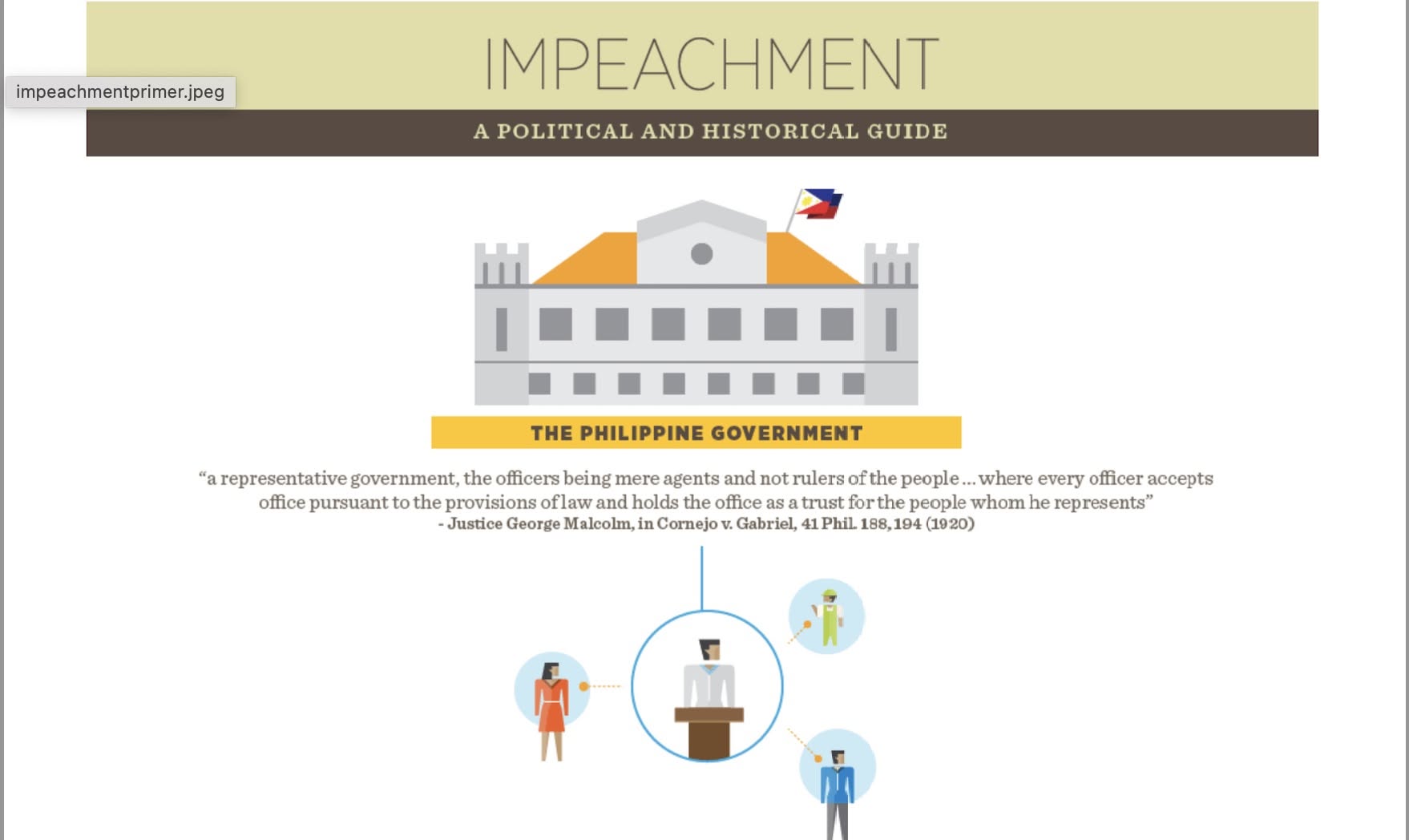
When we borrow institutions, we inherit a couple of things: first, the organic evolution of that institution and with it, core ideas: What was impeachment at its core? Trial by a jury of your peers, that is, your equals. Why was this preferred to say, trial before a judge? Because it addresses questions of political fitness and not legal guilt or innocence. Why was this more suitable? Because until then, as Benjamin Franklin pointed out, if you had a leader or ruler who exceeded their powers and became a menace to society, the solution was murder, all the way from Julius Caesar to King Charles I. But an impeachment was also supposed to be better from the institutions used for political vendetta in the past: so-called Star Chambers, ad hoc tribunals, the Inquisition, etc. For this reason, basic rules of fair play were expected, but not a standard so difficult or so precise it would become a judicial exercise.
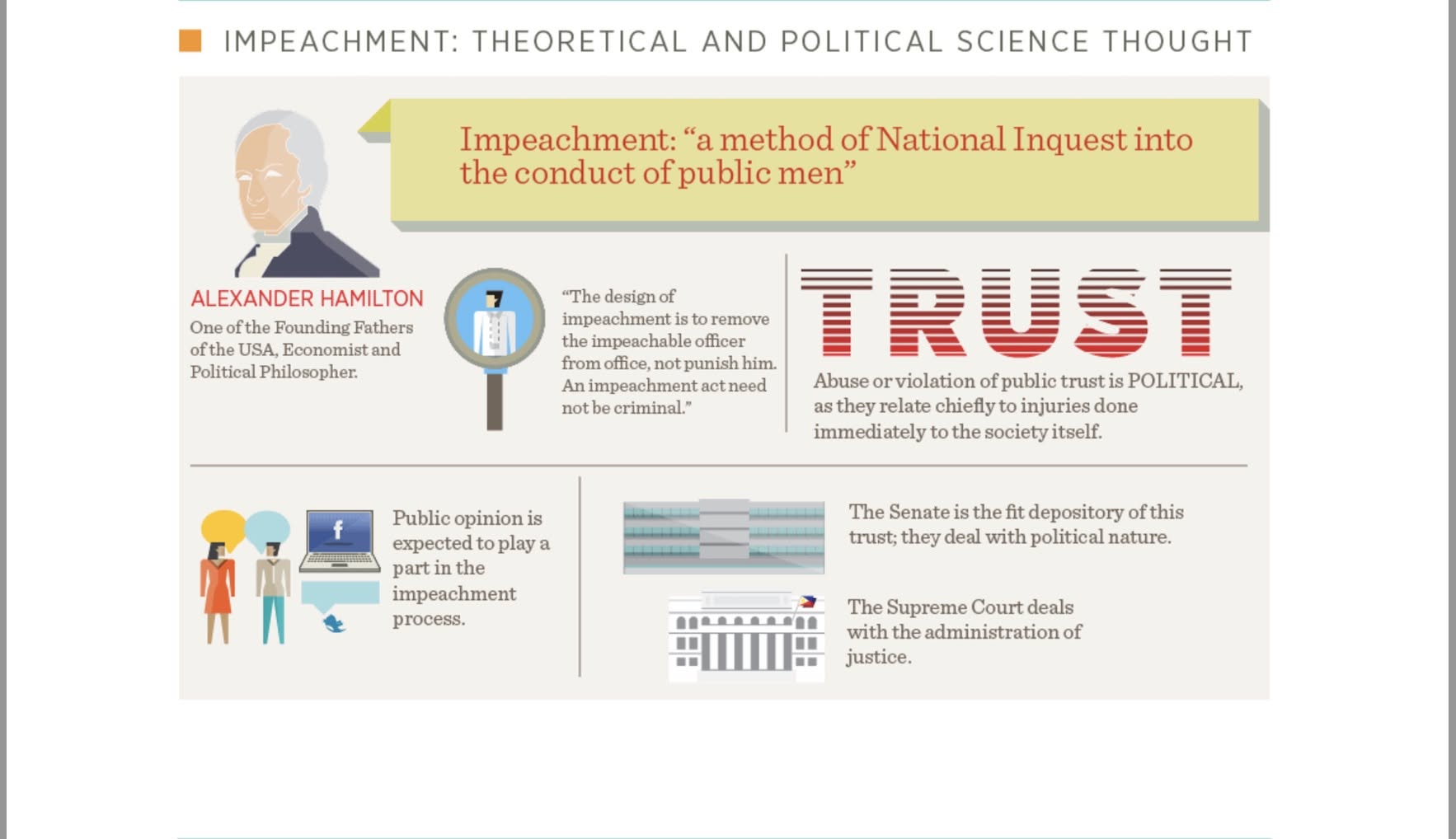
Second our inheritance includes assumptions, that don’t need to be written precisely because they’re part of the organic evolution of those institutions.
There are also assumptions that are specified but precisely assumed because a consensus already exists due to common sense or past experience. In the United States, only three individuals can preside over an impeachment: the Chief Justice, when a President is impeached; or the President of the Senate (ex-officio, the Vice-President of the United States), or the Senate President Pro Tempore, the highest-ranking because elected by the senators themselves, member of the Senate. No ifs and buts about it. It would be inconceivable to suggest otherwise not because the US Constitution specifies it (it only specifies the Chief Justice for presidential impeachments) but because it’s common plain logic. There is a designated presiding officer for the Senate, full stop.
More on assumptions. Case in point: both the American and our charters specify specific offenses (treason, bribery, which have concrete, precise definitions)but also use the term “other high crimes” without specifying them, yet knowing no such thing as a “high crime” exists in the legal codes of either country. What is the purpose of a catch-all phrase which would leave a lawyer frankly at a loss? Precisely that: a catch-all to provide room to include behavior that manifestly makes someone unfit for continuing in office, according to the consensus of the people’s representatives.
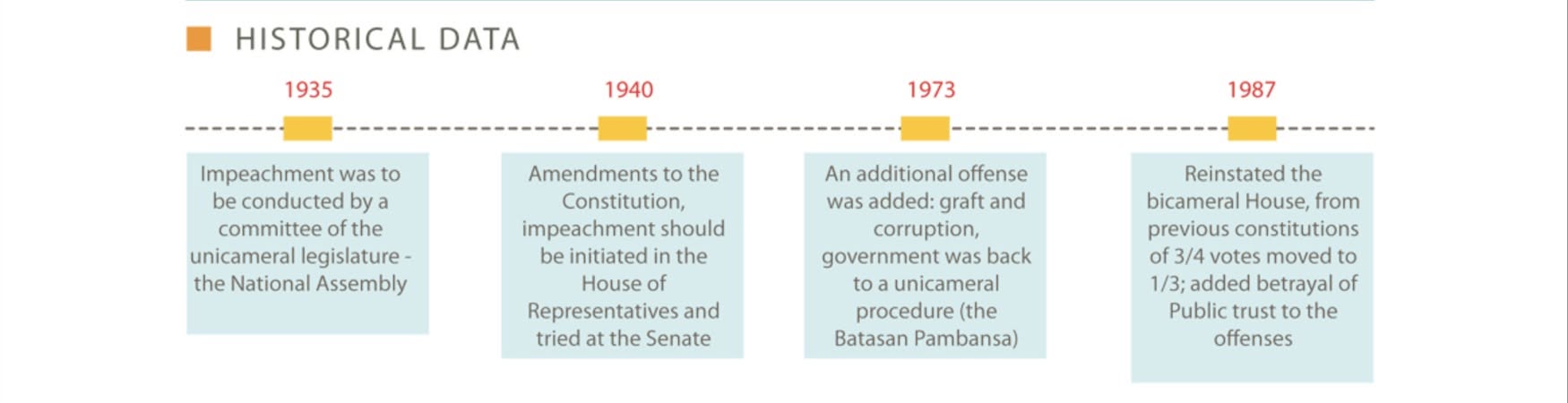
The moment we borrow institutions, however, they start evolving, too, which is how we make those institutions our own. Example: we expanded, in the 1973 and 1987 Constitutions, the offenses which could justify removal from office: “graft and corruption” in 1973 (after every election since 1946 had been fought on that issue) and “betrayal of public trust” in 1987 (which was ultimately what Marcos’ dictatorship was ousted over). The first half of the history of impeachment in our country from 1935 to 1985, was that it was very much an instrument of last resort and practically impossible to invoke. From that, the framers of our present charter decided it would be better to make it a little (but not a lot) easier.

To give a more bird’s eye view, example, consider the three branches of our government. The whole idea of three branches is borrowed from the West, specifically, the American evolution of political institutions. Yet we have made their our own: the presidency we have is a Filipino executive, stronger from the start, than the American, with far greater powers until the present Constitution tried to clip them somewhat, but the tension arising from both presidents and the public being conditioned to expect the office to be more powerful than it now is, leads to perpetual alarm combined with expectation when it tries to, or fails to, match the expectation.
We have a vice-president elected separately from the president, again a decision dating back to 1935 when the office was established, out of the feeling, back then, that the public would only consider a vice-president a proper successor to a nationally-elected president, if that vice-president had an iron-clad mandate of their own. And we’ve simply carried over this thinking in our subsequent constitutions.
We have a bicameral legislature, again patterned after the United States, but a compromise in 1940 to restore the senate after it was abolished in 1935, means we have a hybrid Commission on Appointments to approve or reject executive appointments, when that power, in the American model, should lie in the senate alone; it was necessary to share the power as a sweetener in 1940 yet we have carried over that 1940 compromise three constitutions later. We have a judiciary, but after 1987 invested it with so much power to review everything and anything, that it has become far more powerful than any Supreme Court in such a system has ever been.
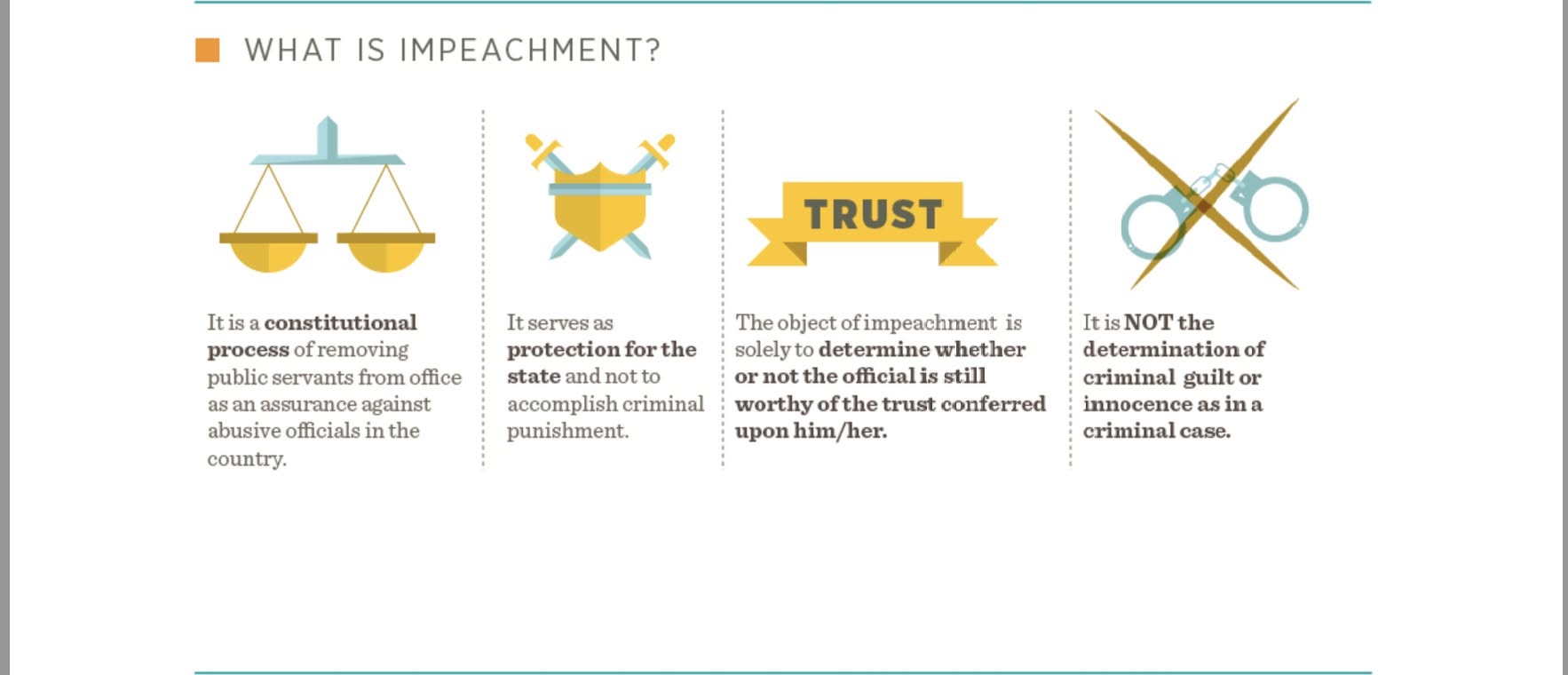
Similarly, we borrowed impeachment, we borrowed the reasoning –thinking– that serves as the justification for this specific institution. I keep returning to these foundations because we have to be conscious of what an impeachment is, and what it isn’t, if we are to evaluate if it is accomplishing its purpose when we resort to its use.
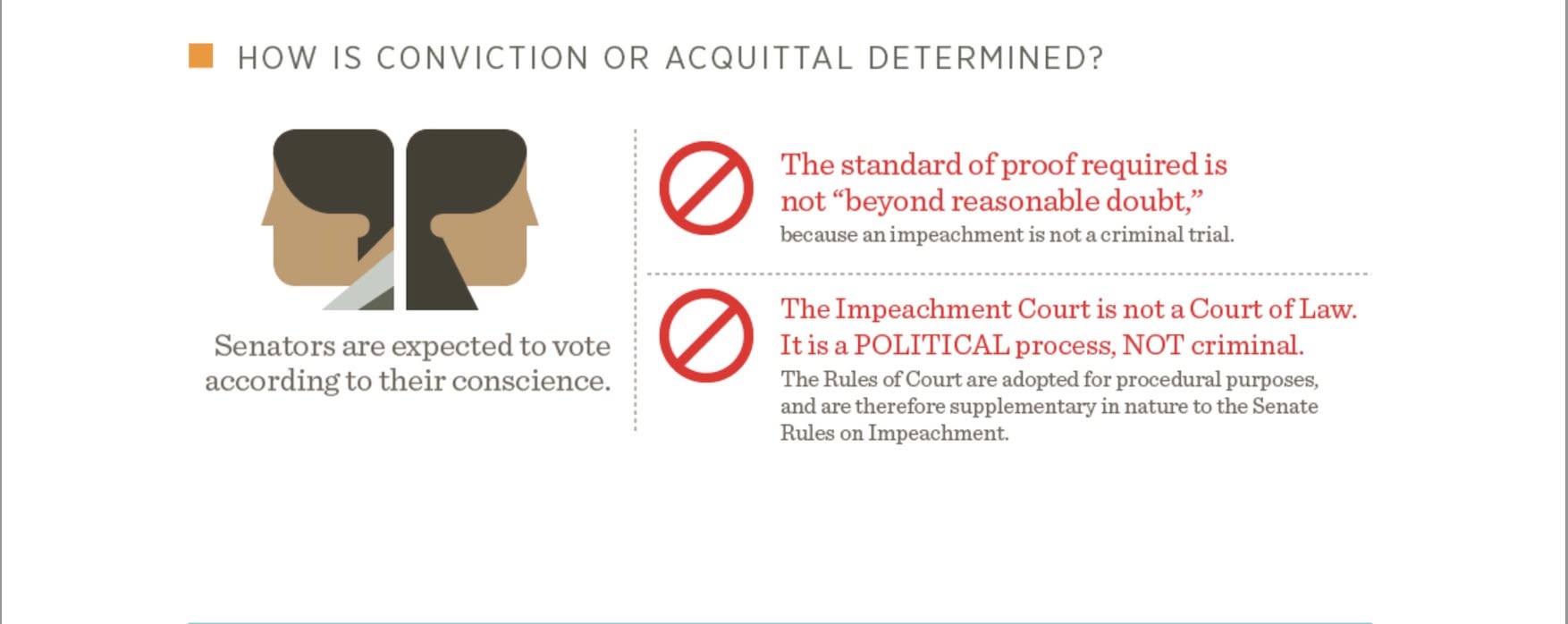
These are the three foundations, to my mind.
The first is that it is supposed to be an instrument of last resort, an emergency fix for a problem that is serious and otherwise won’t go away.
The second is that is a collective process –a group of persons initiates it, a group of persons resolves it– and none of those persons are required to be lawyers. What they are required to be, are persons with the appropriate personality: so the House of Representatives as the body closest to the people, speaks for them in making a case and prosecuting it –an impeachment. The Senate, as the body that is the only counterpart, in terms of a mandate from the people, to the highest possible impeachable officials (the President and Vice-President) and of sufficient stature to render a verdict on behalf of the nation in terms of other high, impeachable officials, is a jury of peers.
The third is that it is a process to resolve continued fitness for office, and not to establish, much less punish, criminal guilt. That is why you can leave it up to non-lawyers, since only public office –holding it, and being qualified to hold it in the future– is at stake. Life, liberty, and property, the most sacred rights of any individual, are not at stake –and properly, when any of the three are at stake, it is only in a trial in a court of law that you should be charged and judged because of what’s at stake. Which is why if you are found to have committed actual crimes, to receive the legally-imposed penalties for those crimes, you must still undergo a judicial trial after impeachment. You do not go to jail when found guilty in an impeachment; you go home with your personal effects in a box because you’re out of a job.
We have, over time, decided which foundations to retain and which to modify and by so doing, have made the institution our own.
One of our decisions was to increasingly discard the concept of a jury of peers and increasingly adopt the Gallo-Roman idea of a tribunal of judges. From this one development, other things have proceeded, leading to what we have now, an impeachment increasingly conducted like a full-fledged judicial trial, which most certainly was never the American idea of an impeachment or, for that matter, of the framers not just of this constitution but our past ones, ever since we adopted impeachment in 1935.
I realized today I’ve been witnessing impeachments for literally half my lifetime, and so I belong to a cohort who’s done it’s citizens’ duty by observing such proceedings, but at least one, if not two, or more, generations have grown up for whom pasty impeachments are ancient history. Which makes it even more necessary for those who’ve observed past impeachments to add context to what’s taking place today.
I think this is the most lawyerly-infested, in the sense of it seeping into every pore of the proceedings, impeachment we’ve ever had and I think that is a terrible, undemocratic, unproductive and demeaning thing for our institutions –and the legal profession, too. Because surely the lawyers know they are only giving the impression of participating in a judicial trial but not really performing in one. So there is a perhaps inescapable element of humbug if not hoodwinking going on. Because they must ultimately play to the gallery –something I do not object to, because the public is itself rendering judgment on the impeachment –and properly so.
I laughed when lawyers fumed over the defense invoking the Vice-President’s electoral mandate in their opening statement. It was necessary, even correct, to do so: it is part of her core defense because bluntly speaking, woe unto anyone who thinks disregarding a majority mandate in an election is “immaterial or irrelevant, if your honors please.” It points to the sobriety an impeachment demands: to cut short a term conferred by the people is very serious business indeed and cannot be on a whim, or merely out of vendetta. It can only be justified by continuing harm to the republic, or disqualifying unfitness for office being demonstrated, by the accused.
On the other hand–
A defendant is entitled to the best defense but if that defense is anchored on a dangerous assumption –that an impeachment is won or lost according to lawyerly standards– the defendant is not getting the best defense possible. A defendant in an impeachment is not fighting for their life, but they are fighting to retain office; they need a powerful, meaning able, advocate and not a wily magician of the rules. This is why I felt Estelito Mendoza, a wizard at the rules and the pinnacle of the institutional insider’s profession, was so bad in the Estrada impeachment. He could not comprehend that what would have dazzled a judge didn’t impress the bigger jury out there, the public; and in the end, what was probably considered a very clever legal maneuver, to suppress opening the second envelope, had explosive consequences.
Joker Arroyo famously declaimed, “we cannot have a nation run by a thief,” the simplest, most powerful, articulation of what that impeachment was about. All the legal acumen of Mendoza and former Chief Justice Narvasa could not rebut that simple declaration: the witnesses were too plentiful and their testimony too powerful to a public hanging on to every exchange in the Senate.
The defense is making a similar mistake now –and worse, because its defense panel lacks even the gravitas, the awe-inspiring presence, of respected (like Narvasa) –or a least feared (like Mendoza)– legal figures among its ranks. Gravitas could be made up for with eloquence, but it doesn’t seem that any of the defense panel, so far, can be considered gifted communicators.
Here, the House Managers, to their undeniable advantage, combine two necessary skills –legal competence and the ability to talk to the people– because they are actual lawmakers and politicians, too. (We forget that one reason Chief Justice Davide mastered the proceedings, and on the whole, inspired public confidence, was because he was a seasoned politician before he was Chief Justice; he possessed political instincts; similarly, presiding over the Senate in the Corona impeachment, Juan Ponce Enrile for all his supposed legal brilliance, was also a very experienced politician with a strong confidence in his own capacity to lead). The House Managers are also assisted by private counsel who understand they are being watched by the public.
I never understood what practicing law “in the grand manner” –there’s a quote to this effect by Justice George Malcolm in the Hall named after him in U.P.– meant until I saw Amando Virgil Ligutan at work in this week’s impeachment hearings. Here is a seasoned lawyer and, according to Antonio Montalvan, a principled one, viewing legal procedure not as a points-scoring system but rather as what it is, a system to facilitate arriving at the truth. Along the way, he also clearly showed he understood the distinction between a court of law and an impeachment.
It is a trap even the public can very easily fall into, the trap of over-legalizing both the proceedings and its aims. I fell into it myself, at first, when I was unconvinced that the House Managers had a case with the article on impeachment on the threats made by the Veep. I was looking for a smoking gun: proof the Veep had gone beyond channeling the bruising style of her father, to contracting an assassin, with proof of the transaction.
Let’s return to what will prove, over time, to be an early and important (because revealing) confrontation in the impeachment. Risa Hontiveros pointed out that so far, she remained unconvinced by the case being built by the House Managers on the Veep’s threats being an impeachable offense; she asked Ligutan what their argument was, as a whole. He obliged. He did so in what I consider the “grand manner,” he went to the heart of the case they want to make, reminded everyone what it is and how the things the Veep’s done (and said) may not quite constitute a crime in terms of what the law requires to say, prove criminal conspiracy or attempted murder or whatever; but more than enough to demonstrate thinking and behavior that is not in keeping with what any government official, much less the second highest in the land, is expected to be and uphold.
The question then before senators is, when the defense is done, does that argument hold or not? And rinse, lather, and repeat as often as necessary until every senator can arrive at a decision.
I objected back then, and I still do, to co-presiding officers as silly egotism, bad management and worse symbolism, just as I objected back then, and still do, to the entire term “senator-judges.” It exalts those with legal background and diminishes those who don’t, a psychological and moral pressure demonstrated by Panfilo Lacson’s complaint yesterday about something-or-other but the gist of which was, don’t demean senators who aren’t lawyers. I heartily agree not least because none are required to be lawyers –and we should welcome the fact that never has there been a legislature in our country composed exclusively of lawyers.
I do think that many senators are getting tired of pretending to be part of a formal trial because as political animals, they do know what’s at stake, and I think this goes for both sides of the political fence. The warning of the Estrada impeachment remains: you can win a procedural, a legal, technical skirmish but lose the battle. Because there are two arenas, not one. The larger arena resulted not just in the ousting of a President, it killed the political careers of quite a few senators and handicapped that of some others for a decade or more.
Which leads me to close on something Risa Hontiveros said, as a gentle rebuke to the presiding officer, Francis Escudero. She says in previous impeachments senators seemed at greater liberty to ask questions. I had to jog my memory, but upon reflection, I agree. Both lawyers and non-lawyers in the Estrada impeachment were given ample opportunity to ask questions, challenge assertions, even seek clarification and guidance and by so doing, invited in the public, so to speak, to their thought processes and the process itself: making it more of an inclusive exercise –and under the watchful gaze of an actual Justice who, however, had political sense (and I say this as someone who is not particularly a fan of Davide, particularly because of how Edsa Dos was handled).
I hope the coming weeks leads to a recalibration by the House Managers and the defense panel and greater reflection –or greater flexing of each senator’s independence to ask questions and not be browbeaten by the rules of court– on the part of senators.
