Notes on Day Three of the Impeachment

The day began with the Cayetano’s rehashing the previous day’s argument over the private counsel for the House Managers summarizing what they were trying to prove. The Cayetano lawyers insist on following court procedure when it’s really unessential –it only matters because they realize the summary refocused everyone’s attention on the charge after everyone was near-catatonic from the Great Nitpicking.
Today, the defense was given its turn to examine the witness put forward by the House Managers.
The defense focused on challenging the conclusions of the House Managers by showing that there was an earlier document in the NBI saying there was no basis to prosecute the Vice-President for her statement not least because of apparent deficiencies in the paperwork and marking of exhibits. I don’t know if this would impress a lawyer but now the painstaking testimony yesterday makes sense as it cures any nit-picking quoted by the defense. The basic point the defense wanted to make was the original investigation by the NBI was superior to the later one presented by the House Managers the day before.
I think. I also think the defense tried to insinuate that the NBI mounted an investigation upon instructions from the President. At another point the defense had a video played of a weeping Zuleika Lopez –Antonio Contreras believes this was a blunder as “it only shows that Sara was triggered to issue a threat.” He adds it “gives the prosecution more reason to subpoena Lopez.” Lopez had been detained by the House for trying to prevent the Commission on Audit from providing audit reports on the Veep’s confidential expenses. Duterte’s meltdown took place during a presser held by Lopez at midnight over Zoom.
Raffy Tulfo asked some questions about social media. “There were concerns whether the videos presented yesterday were AI-generated or authentic.” Witness explained why they weren’t (length, mainly). Plus personal observation. Then Tulfo started to systematically inquire into the presser, who called it, etc. Were members of mainstream media invited? What was the reach of the video? Etc. How did the video spread on social media. “It became trending, Sir.” Interesting that Tulfo seemed interested in the seditious aspects of the presser.
Bam, Aquino asked about seven points the witnesses was asked to address between his first and second versions of his affidavit. He asked the witness to read them, and also asked if the witness did his best to remedy them, yes, except the last point, which was, why didn’t the offended party participate? To which the NBI replied, for a preliminary observation the offended party doesn’t have to participate. Bam said the presence of a “hitman” is serious, did the witness investigate that? No, he didn’t but the House Managers confirmed they will present evidence on that (aha!). Bam said he will pursue this line of inquiry in the future.
Kiko Pangilian then asked about the educational bonafides of the witness.
Risa Hontiveros asked about the relevance of the Lopez video? “There was a systematic oppression by the House of Representatives even before their mini-trial conducted by the committee of Rep. Chua… even if she was answering questions faithfully, she was cited in contempt, detained, her lawyer was not allowed to be with her when she was detained in the women’s correctional facility…” Risa: so the defense is saying you can let slide the grave threats because of this? At which point Escudero tried to deflect the question saying it would lead to counsel providing a point of fact or law. Risa accepted the deflection with good grace. But she pointed out in past impeachments the proceedings had been liberal when it came to senators’ questions.
Joel Villanueva asked how threats are evaluated. Witnesss: demeanor is a consideration. Win Gatchalian asked about media personalities: why invite only 6 for questioning when 40 attended? Answer: we considered only those who asked questions of the Veep. Gatchalian: did you have a criteria? Witness: if you don’t ask your name doesn’t appear. Gatchalian asks whop paid for witnesses’ training; answer: part of the package when procuring tools.
Erwin Tulfo asked there is a law that authorizes your agency to investigate threats to high officials particularly if it involves national security? Answer: Yes. Question: Is it automatic to file cases, or do those threatened have to ask you to do it? Answer: if output of investigation warrants, we file a case. Question: even if the person threatened doesn’t complain to you, you don’t have to ask them? Answer: No need for the purpose of a preliminary investigation.
Imee Marcos: we get confused because of so many papers (so asks for some documents), including the letters saying no private complainant was needed. Escudero clarifies that all they have are documents that have been premarked, but not everything has been premarked because some will still have to be formally offered.
Alan Cayetano: hints digital copies would be nice.Some confusion about premarking ensued but was clarified. Migz Zubiri notes how American authorities gives the Secret Service the power to investigate and prosecute threats to the President, etc. He establishes the NBI has a similar authority. He points out what is needed to secure a conviction: (knowing, wanting, intending, etc.).
The House Managers declare they will not redirect questions. (This was in response to Escudero wanting to know if they should allow the questioning before a Collective Answer to the Call of Nature).
Another lawyer for the defense then rose to make their case to answer the House Managers the day before. But Vicente Sotto III wanted to ask the witness about AI generated videos having an AI-generated caption: Yes, now that’s the case, says witness.
Panfilo Lacson: in this day and age of AI would you agree with me it’s almost impossible to tell an AI video from the real thing? Witness: it’s difficult. Lacson asks what tools are used, the witness gives an answer based on his experience. (questions on software, witness says file too big and too long).
Eventually, the witness (a very good one!) was mercifully dismissed. What followed was another defense counsel, to rebut the House Manager’s private counsel: Hontiveros was right when she observed no case had been made to prove an assassin was contracted. The prosecution has no proof the Veep contracted an assassin. “Using a hodgepodge of materials” to stretch out a story is a waste of time, the Veep herself said she didn’t talk to an assassin; she was justified in her “unorthodox” statement. The NBI was gaslighting. Etc. The Veep was the target of an “Operation Romanov” that subjected her to surveillance, compromised her security, and caused her anguish. The Veep in her statement was only channeling public opinion.
Bam Aquino manifests it took 9 hours for the first witness. Can we have the testimony heard and go straight to the point? An appeal against the Great Nitpicking. The Call of Nature was going to be declared answerable by the chair for fifteen minutes. But then the House Managers said their witnesses will be presented on when things resume on Monday. Subpoenas accordingly issued (for Lopez!). Administrative matters were dispensed with: BIR box returned, and subpoenas issued. Both parties ordered to submit memos on the BIR records and the bank records of the Veep and husband, for the coming week.
So that’s it for Day Three and this week’s proceedings.
Yesterday, when one of the private counsel of the House Managers summarized the meaning of their witnesses’ testimony, the defense was left speechless and Pia Cayetano had a public meltdown over the clarity of the counsel’s summary (in reaction, mind you, to a skeptical question from Risa Hontiveros).
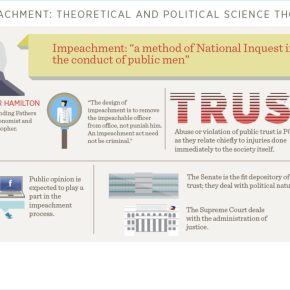
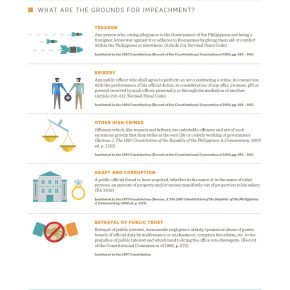
I fully expected the defense to try to score points in a lawyerly way, by burying the witness in a blizzard of technical fault-finding. I doubt if that’s convincing to the public or even senators (including those who might be lawyers but also have keen political antenna). One observer pointed something out that made me pause: the reason Pia Cayetano had a meltdown was that the private counsel for the House Managers connected all the dots: you may not have evidence for a criminal conviction in terms of proving an assassin was hired; but you have evidence, through the videos presented and other public comments of the Vice-President, to establish a pattern of behavior including statements, that constitute a betrayal of public trust because of their irresponsibility, provocative content, and disregard for appropriate norms for official conduct. This was the summation of a lawyer who understood the broader context of the trial –that it is an impeachment, “an inquest into the conduct of public men.”
Ligutan’s a lawyer worth his salt because he understands the difference between a court of law and an impeachment. Narvasa’s Death by a Thousand Nitpicks isn’t how you win an impeachment.
A word on lawyers and rules of court. Since it’s fashionable to insist on nothing beyond what the Constitution says, then it’s well worth pointing out that nowhere does it require lawmakers to be lawyers, and nowhere does it say the Rules of Court in all their dizzying complexity are necessary in an impeachment –and that means the legal jargon and tactics of lawyering are unescessary, too. (It also explicitly provides for the Senate having a President without bothering to define what that means because, well, some things used to be obvious but nothing is, anymore because of… the lawyers).
Proof, again, if you want it, of how lawyering can be counterproductive in an impeachment was Estelito Mendoza’s performance in the Estrada impeachment. The man who mastered –then twisted– the rules of the game to leave our legal profession far removed from what it was before he came onto the scene, was frankly out of his element in the impeachment because his mastery was of an insider’s game. Put on display before the public, it not only failed to convince, but boomeranged. Neither was Andres Narvasa’s sad end to his legal career worth his participation in the trial.
Tony Laviña summarizes it well and emphasizes something I’m glad I arrived at on my own too, as a non-lawyer: the Senate could define the rules of the game and if things are getting bogged down in a lawyers’ match that was a conscious choice of the Senate but not, by any means, preordained.
Procedures are simply that: the rules of the game which can be as simple or as elaborate as you want them to be. What the Senate chooses to adopt as its rulebook is not only paramount but explicitly, by its own insistence, accepts the rules of court as as a supplement to fill in whatever blanks it feels needs to be filled.
The danger of over-lawyering the proceedings was on full display yesterday when Risa Hontiveros asked the private counsel of the House Managers, and the private counsel, an astute man, laid it out clearly. The defense was speechless because the the House Manager’s private counsel –I told you, he was astute– took the opportunity to clearly and simply state their case. “But these things aren’t done by lawyers in court!” the off-camera tantrum of the defense went, and Pia Cayetano practically shrieked and howled in indignation too–
But why? Escudero was lawyer enough to make soothing noises for Cayetano and the defense but enough of a political animal enough not to take a deep dive into the drama beyond an admonition to let things go according to their programmed flow; but how can any reasonable person object to Hontiveros’ question –and observation– and who really minds if the House Managers repeatedly sum up the case they want to make per article considering the tediousness of the proceedings?
Instead bogging things down in lawyerly fashion does not promote justice in this case and only promotes some of the worst habits of legal practitioners and gives the presiding officer an opportunity to preen but this is not an exercise for preening, as the continuing demeanor of our defeated Senate President keeps reminding us. Engaging in pataasan ng ihi is a choice, not a duty.