Ashes to ashes: The five phases of Johnny Enrile
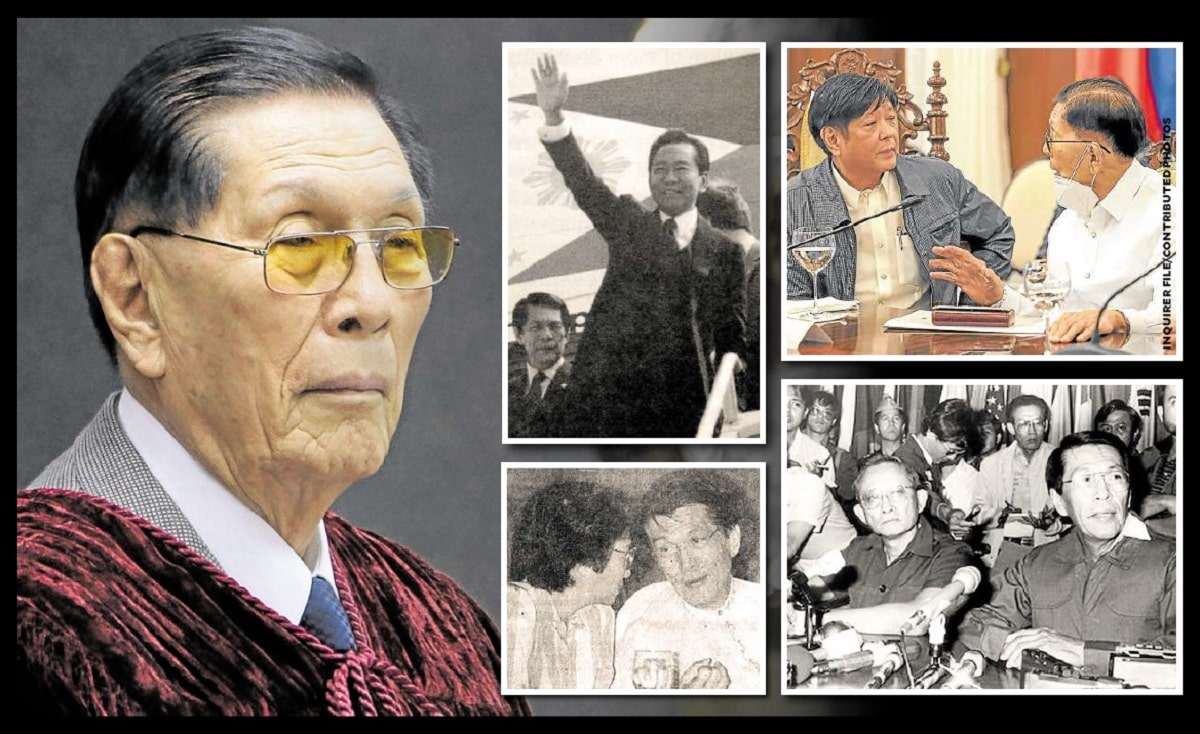
MANILA, Philippines — Juan Ponce Enrile, once Ferdinand Marcos Sr.’s principal lieutenant in planning the dictatorship only to oust him, ended up half a century later as consiglieri to the son.In 2010, writing for Rogue Magazine, I made Enrile the face of the Emperor card in the Tarot deck and wrote: “Nothing grows under the shade of the Banyan Tree, or so goes the fortune cookie saying familiar in our part of the world. The Patriarch is a political colossus, a living monument, and a wizened, formidable operator to whom all scurry for favor and preferment. For those purely interested in power, or for whom ability fortunately marries with fortune, resulting in both prestige and political clout, to be considered a patriarch is the summit of a career, and the foundation for an enduring line of leaders. Too much success can, of course, as the saying implies, stunt the growth of a successor generation, or even of one’s successors. But this is something best left to journalists, historians, and posterity to puzzle over. It would be impolitic to mention this dire possibility in polite company — or the patriarch’s.”As it turned out, this was far from Enrile’s political sunset. He would be disgraced again and rehabilitated again, remaining a durable player in politics for another decade and a half.With his passing comes the opportunity to take stock of his life, one that spanned five distinct phases in which he was never far from center stage, from the mid-20th century to the first quarter of the 21st century.
Enrile I: The Prodigal Son
Like Ferdinand Marcos (Sr.), Juan Ponce Enrile was both an outsider and an insider who came of age at the moment when World War II smashed the certainties of Philippine Society. Marcos, despite his accomplishments, had been given short shrift by his more pedigreed peers. However, he considered himself provincial gentry: His father had achieved modest political standing, but Ferdinand himself would rise to prominence in part due to the manner in which he defended himself on a charge of political murder, and through shrewd networking forged during the murky years of the Japanese occupation.Juan Ponce Enrile, for his part, belonged to that subset of the upper class for whom being born illegitimate would prove a temporary but still psychologically searing obstacle. His authorized version of his own story has him growing up as an impoverished son of a laundrywoman; he benefited from the patronage of minor civil servants and officials whose patronage may have been fostered by the knowledge that his father was a former legislator turned partner in one of the most prestigious Filipino-American law firms of the prewar and immediate postwar period.After the obligatory (because biodata-burnishing) stint as a young guerrilla, he says he embarked on being reunited with his father, who not only welcomed him but took the life-changing decision to legitimize him. With his academic performance, he was, in time, an up-and-coming lawyer on his own terms, the icing on the cake being that his father made him a junior partner in his firm. There, he gained experience as a corporate, and not criminal, lawyer.Marcos himself, already a coming man before the war, assiduously dedicated himself to arriving in postwar society. He said all the right things but believed none of it.
Enrile II: The Useful Man
By the time the paths of Juan Ponce Enrile and Ferdinand Marcos (Sr.) crossed in 1964, both were men who’d outgrown the period of deference and dependence on the old upper class. In Marcos’ case, aside from cool calculation, luck served him well: two of his fiercest opponents, Eulogio Rodriguez, a durable prewar and postwar machine politician, and Arsenio Lacson, postwar originator of the iconoclastic urban tough guy in urban politics, had died by then.After 15 years in the Liberal Party, during which he’d wrested the Senate presidency, Marcos found his path to the presidency blocked by his erstwhile party chief and then incumbent President, Diosdado Macapagal, who decided to renege on a previous promise to serve only one term.Worse, Macapagal had bungled one of the biggest postwar corruption scandals surrounding influence peddling by an American tycoon, Harry Stonehill, deporting him in a panic, which left implicated officials like Marcos looking quite guilty, indeed.The opposition Nacionalista Party obligingly welcomed Marcos into its ranks, and in the last hurrah of old-time party politics, Marcos engineered a victory in the party convention. He then won the presidency based on being a guerrilla hero confronting an incumbent who’d collaborated with the Japanese.
Political momentum
In 1967, Filipino voters for the first time rejected a proposed amendment to the Constitution. This created the political momentum for the holding of a Constitutional Convention and the possibility of removing, either by amendment or through an entirely new constitution, term limits on the presidency. This, in turn, opened up one of the tracks Marcos would pursue to perpetuate himself in power.The moves would require, first of all, his reelection: a feat at which all his predecessors, bar one, had failed.Up to 1967, Enrile had served in the fiscal side of things, in sensitive posts, first as head of the Bureau of Customs, then as head of the Insurance Commission, and then undersecretary and finally secretary of finance. The series of appointments leading up to 1967 is revealing of Enrile’s usefulness, since that year (1967) also happened to be a crucial midterm election year. (In the Philippines, presidential midterms, in which control of the Senate is decided for the rest of the President’s term, have always served as a referendum on the incumbent president, determining if they will enter the preparatory period for seeking reelection as fatally damaged lame ducks or viable candidates).From his first job in the politically sensitive, extremely lucrative Bureau of Customs to heading the entire Finance Department, Enrile was obviously the man with the smarts and finesse to build up the Marcos war chest.But in 1968, Enrile was given a new job: secretary of justice, one he held throughout the period in which Marcos sought and achieved the only successful presidential reelection bid since Manuel Quezon’s in 1941. Enrile managed to retain—and increase—Marcos’ confidence in him despite having been widely considered an ally of Rafael Salas, who’d been Marcos’ dynamic executive secretary but who was purged in July 1969. Enrile was proving adept at the Byzantine intrigue of court life.
Sub rosa assignment
Marcos himself, in his diary, wrote that he assigned the task of looking into how different regimes declared and ruled under a state of emergency in that watershed year, 1969. Again, in a period of increasing radical protest and intensifying political polarization, the selection of Enrile as secretary of justice points to how useful he was, including his sub rosa assignment of researching how to establish a dictatorship.By February 1970, shortly after Marcos had been assaulted after his State of the Nation Address before Congress and an urban insurrection by students led to a direct attack on the presidential palace in January of that year, Enrile was given the Defense portfolio.The Marcos-approved story (in a Marcos propaganda channel) goes that it was an ad hoc assignment due to the incumbent Secretary of National Defense showing up drunk in the midst of the student assault on the Palace. Another ad hoc move may have been the ill-fated decision to field Enrile as a senatorial candidate in the unprecedented second midterm election of Marcos, in which his candidates fared badly in marked contrast to his first successful midterm election.Having fallen on his sword for his chief, electorally speaking, Enrile returned to the Defense Department for the main event: martial law.
(To be continued)
(Second of three parts)
MANILA, Philippines — To this day few Filipinos appreciate the kind of legal legerdemain engaged in by Ferdinand Marcos Sr. and his lieutenants. In a country still close enough to the American colonial era to be thoroughly grounded in American precedents, the understanding of martial law was imbued with the precedents of the American Civil War: It did not, for example, include the suspension of terms of office. If Marcos was going to use martial law to establish a dictatorship, not just legal, but political, creativity would be required.
It’s a testament to Juan Ponce Enrile’s usefulness and, it has to be assumed, reputation for efficiency, thoroughness, and discretion, that he was assigned the task not only of planning, but implementing, martial law.
Three fronts
The plan unfolded on three fronts: the first was the martial law proclamation itself, building on the suspension of the writ of habeas corpus a year earlier— communist rebellion was afoot and the republic had to be saved.
The second was the actual self-coup, in which Marcos, in the absence of the legislature which had gone on recess until January 1973, assumed lawmaking powers and excluded his actions from the purview of the courts, invoking, all the while, powers as commander in chief that were never contemplated, much less granted, by existing laws.
And the third was the replacement, entirely, of the 1935 Constitution with one that would provide the means not only for his continuation in office, but the abolition of other, possibly contrarian, institutions, such as Congress itself.
Marcos had planned to impose martial law on Sept. 21, after Congress went on recess. When it looked like Congress might take longer than expected due to committee meetings, Marcos, it seems, had to improvise and Enrile famously provided the pretext: a supposed assassination attempt that he famously said, in 1986, had been faked, but which more recently, in his memoirs, he denied was staged.
Marcos duly appeared on television the next morning to inform the Filipino people of a fait accompli: the media was shut down, utilities placed under government control, and a quick succession of proclamations, executive orders, and the first of his presidential decrees sandbagged the new regime against all comers.
Within five months, he had achieved all his aims. But as early as a few days after imposing martial law, he’d already been able to crow in his diary that“nothing succeeds like success!”
Number Two
As secretary, later minister, of national defense, Enrile was widely perceived at first to be the No. 2 man in this new dispensation.
In the division of spoils, so to speak, under the dictatorship, Enrile’s origins in the forestry-rich Cagayan Valley made him the ideal administrator of the lucrative logging industry, responsible for assigning timber concessions. A manifestation of this is his continuing domination of matchstick production in the Philippines. Murder incidents in the logging concessions he controlled were never his responsibility: investigations he ordered pinned the blame on rebels.
He became embroiled as well in the efforts to create state monopolies on the country’s two traditional agriculture exports, sugar and coconut. In Enrile’s case, he became one of the top two cronies involved in the coconut industry. (In an interesting aside, after decades of litigation over what is called the coconut levy, the funds sourced from coconut farmers and held by the Philippine government since the Marcos administration, one of the last acts of President Rodrigo Duterte was to authorize presidential use of the fund—a new perk that Ferdinand Marcos Jr., by deciding early in his term to personally hold the agriculture portfolio, found under his purview).
Joined at the hip
Whatever the division of spoils, and the impunity he enjoyed, there always remained the paramount interests of Ferdinand Marcos and his family. The interlocking nature of these arrangements is best exemplified by the saga of the shares held by various associates of the Marcoses in a telecommunications firm that were consolidated in 1988 into Civil Case No. 0009, pursued by the Presidential Commission on Good Government established by Corazon Aquino in 1986 to go after the hidden wealth of the Marcoses.
Along with various associates of the Marcoses, defendants in the suit included the Marcoses themselves, Ferdinand Jr., and Enrile. The case continues in court, but in 2019, the Marcoses, Marcos Jr., and Enrile were acquitted, although the case continues on the assumption that the remaining defendants were dummies of Marcos.
As we shall see, Enrile remaining, for all intents and purposes, joined at the hip with the Marcoses in these cases may have fostered their eventual reconciliation and renewed alliance.
The apogee of Marcos’ rule is widely considered to have been reached in 1981, when he responded to papal pressure by formally lifting martial law while proclaiming a New Republic. By 1983, Enrile’s interests and clout had led him to establishing his own law firm, Pecabar (which exists to this day as Ponce Enrile Reyes & Manalastas). Here, he was almost a decade late in the game of legal rent-seeking (Accra was established in 1972).
But that was also the year in which rumors of Marcos’ illness had stimulated not only jockeying among his subordinates over the succession, but arenewed activity by opposition figures, such as Benigno S. Aquino Jr., who came home to reason with Marcos but was assassinated instead.
Enrile III: From hero to heel
By 1983, Ferdinand Marcos had conferred the status of crown prince on Ferdinand Jr. and made him governor of their home province. But if the dictator were to suddenly die, a shadowy committee would be given governing power. By all accounts, Imelda Marcos was the only acceptable successor to Marcos and constituted a faction of one, with the military chief, Fabian Ver, aligned with her.
For his part, Enrile had been increasingly marginalized as Marcos got sicker and Imelda operated as acting president during his confinements. Enrile by this time had gathered around him a coterie of ambitious young officers. The assassination of Aquino at a time when Marcos was quite sick began a process of disintegration that ended with the Marcoses going into exile.
The accepted chronology is that the fall of Marcos itself was kicked off by a foiled attempt—by Enrile—to topple him.
If, once upon a time, Enrile had dreamed of setting himself up as the successor-by-putsch of Ferdinand Marcos, when he realized that such ambition couldn’t be fulfilled, he reconciled with the dictator.
The date? Feb. 25, 1986. The time? Sometime past 7 in the evening. The location? The park of Malacañan Palace itself, as Marcos prepared to board the helicopter on the first leg of his journey into exile.
According to Sterling Seagrave, from the shadows emerged Enrile, who, after a brief private conversation, embraced Marcos. Having helped pull Marcos down, Enrile almost immediately started helping him up again.
(Marcos’ own aide-de-camp never mentioned such a meeting; according to him, Marcos’ last contact with Enrile was over the phone).
Fractious relationship
If true, the meeting marked the moment Enrile returned to the fold. It’s more plausible than one might think.
Earlier that day, having rejected an offer by Marcos to pardon him in exchange for Marcos staying on as ceremonial president, Enrile attended Cory Aquino’s inauguration and told a gathering of his frustrated fellow putschists that nothing could stop Aquino from assuming power.
Enrile, as it turned out, would have a fractious relationship with Aquino. By November of 1986 he was fired, accused of trying to mount a coup and become a candidate for the opposition, composed of the remnants of Marcos’ formerly monolithic machine.
Marcos’ aide-de-camp in his memoirs did point out that Enrile publicly apologized for the “mistake” of the Edsa Revolution in 1990, five months after Marcos’ death in September 1989.
Enrile IV: Thwarted statesman
For almost 20 years, the incomplete stump of a skyscraper –Jaka Tower, it was called, after the Enrile holding company which itself was an acronym of his children’s names, Jack and Katrina—suitably represented the thwarted commercial ambitions of Enrile, the corporate lawyer who never quite became a tycoon.
During the same period, he came close more than once, but never quite succeeded, in becoming a statesman, either. As he approached his centenary, he remained both an insider and an outsider.
His skyscraper was built on what had been the headquarters of the preeminent Spanish business family of the prewar and immediate postwar years, the Elizaldes. Just as they had faded, new men like Enrile had taken their place. But he would somehow never quite achieve the status he craved, of either mogul or statesman.
Started in 1996, the Jaka Tower was halted in 1998; it was finally sold to another Spanish merchant house, the Ayalas, in 2014.
Revising history
Riding high but facing retirement, Enrile in 2012 published an autobiography that he hoped would help launch the political career of his son. He revised history and, it seems to me, began toying with a new twist to what should have been familiar tales.
In his autobiography, Enrile said that as President Cory Aquino prepared to dismiss him, he warned her that what she needed to worry about wasn’t him, but young officers.
In 2018, Enrile would tell a similar tale to Ferdinand Marcos Jr., who asked him about the Edsa Revolution. It wasn’t an effort on his part to replace his father, he told the younger Marcos. Instead, what he attempted to do was head off a military coup being mounted against President Marcos.
He obliged by retelling the past; he was also useful as a living embodiment of what the past meant.
Aside from his startling lucidity, Enrile even at 98 brought with him an air of political menace few could muster in the already gangsterish atmosphere of Philippine politics.
Enter Maria Imelda Josefa Marcos, more popularly known as Imee, who in many ways can claim to be the real heir of Ferdinand Marcos in terms of smarts—but because she is merely a daughter, was denied being his true political heir. She is, at present, a senator reduced to trying to grab the limelight from a first lady (her sister-in-law) she loathes, and to communicate by means of press conferences with a brother who seems content to ignore her.
(To be continued)
(Last of three parts)
‘Grand duchy’
But our story takes us back to 2017, when Imee Marcos was still governor of what she breezily calls the “grand duchy” of Ilocos Norte, the Marcos’ home province. She had gotten into hot water with an on-again, off-again rival and ally in provincial politics, Rep. Rodolfo Fariñas, who’d launched a congressional investigation into her spending tobacco excise funds.
He seemed on the verge of pinning her down. In typical take-no-prisoners Ilocos style, he’d placed low-ranking provincial employees in detention to pressure them to testify against the governor. As for Marcos herself, she risked being cited for contempt if she refused to attend congressional hearings meant to produce the evidence to indict her.
What the ex-dictator’s daughter did was this. She showed up at the congressional hearing presided over by Fariñas with her lawyer in tow: Juan Ponce Enrile. Together with Imelda Marcos, the venerable Enrile simply sat beside his client as Fariñas did the political grandstander’s equivalent of averting his eyes.
During the impeachment of Chief Justice Renato Corona back in 2011, Fariñas had practically genuflected each day before Enrile, who’d presided over the trial as Senate President. Now, once again faced with Enrile, Fariñas blinked. As I put it back then: “In the end, without a case, only face-saving rhetoric was left for Fariñas. The main point had been made: Marcoses do not lose. They do not undergo detention. They take on all comers. Their arsenal may be antique, but it works.”
Imee Marcos’ antique arsenal was composed of two ancients, both of them lawyers. One was Estelito Mendoza, who’d been her father’s Solicitor General (or government counsel), and the other was Enrile, who’d been her father’s personal lawyer, secretary (later minister) of defense, and martial law administrator.
Creative approach
What both had in common was a creative approach to the law and legal procedures, which served to astound more conservative (or scrupulous) practitioners. What separated the two was that Mendoza was most effective behind the scenes and operating in the judicial arena. His forays into politics, first as governor of Pampanga and much later as defense counsel for President Joseph Estrada when he was impeached, ended in humiliation and disaster.
On the other hand, Enrile was living proof of the dictum that when the guns speak, the law falls silent. Imee apparently believed a political lynching required the kind of lawyer who made offers that couldn’t be refused.
But it is equally important to consider where Enrile was at the time this primal and primeval exhibition of alpha male behavior took place in Congress. Aside from having served in the Marcos and Aquino Cabinets, he’d been elected four times to the Senate, once to the House, and had been Senate President. But in 2017, he’d been out of office for a year, and out of jail for only two years.
He was, by any normal political reckoning, a figure in the midst of his third, and perhaps terminal, fall from power.
He’d ended up in jail in the first place after being toppled from the Senate presidency because, humiliatingly, he’d been pinned down on corruption allegations that actually prospered and ended up with his arrest, that of his chief of staff, and two other senators besides: one of them the son of former President Estrada, the other, an action star from a show biz dynasty.
Brief stay
For the third time in his political career, Enrile was not only in jail, but this time it wasn’t for political crimes but old-fashioned allegations of pocketing pork barrel funds. The humiliation lay in being laid low by the kind of official mulcting far younger, more obscure, and hungry politicians might do, but which no one of Enrile’s smarts or stature should be caught doing.
But as was the case with his earlier detention on political charges—in 1987, over suspicions he plotted a coup, and in 2001 over egging on a mob to attack the presidential palace—his stay behind bars was brief. Not only was he still somebody; longer incarceration would have provided a highly inconvenient precedent for too many of his peers.
This time, what led to his being released was his great age. (It is noteworthy to bear in mind that cases against Enrile continue to be litigated in court; he is actually out of jail on bail. Then again his client, the president-elect, remains a defendant in multiple cases).
In 2022, much as he ran for office, the professional putschist Gregorio Honasan II dismally failed in a Senate bid. The Marcoses, it seemed, wouldn’t let him grab on to their coattails; neither was the support of outgoing President Rodrigo Duterte, in whose Cabinet he’d served, particularly effective.
But what Ferdinand Marcos Jr. did do was announce that Enrile, in political mothballs and disgraced, would join his Cabinet as chief presidential legal counsel, or the President’s own lawyer—making Enrile, at 98, the oldest Cabinet member in Philippine history.
It wouldn’t be surprising if Enrile was as impervious to irony and as immune to demonstrating a long view of history as the Philippines and its people.
Enrile had very much wanted to be present at the ceremony held on June 30, 2022, when the Marcos Restoration achieved fulfillment with the inaugural of Marcos Jr. The irony was that the ceremony was held on the steps of the very building in which the 1935 Constitution of the Philippines had been drafted, and where the legislature it created had held its sessions, until both were abolished by Ferdinand Marcos in a five-month self-coup in 1972 to 1973.
Where Marcos Jr. took his oath, Enrile had been busy putting the finishing touches on Marcos Senior’s grand plan for an autogolpe.
Enrile V: The Prodigal Minister
What, if anything, was Enrile thinking when he stepped into the presidential study in Malacañan Palace on July 26, 2022, to take his oath of office as chief presidential legal counsel? As he entered that familiar room, did Enrile even think of the many times he’d dreamed of taking possession of the presidency (and that office) and failed in the doing, whether by means of the bullet or the ballot?
Did he reflect, however momentarily, on how he’d first entered that room as a young man eagerly drafted to serve Ferdinand E. Marcos Sr., only to end his political career as a nonagenarian, a useful courtier—but a courtier nonetheless, back where he’d started: this time serving Ferdinand R. Marcos Jr.?
By then he was so old that, in a country where fully 33 percent of the population is below 18, with 60 percent aged 15 to 64 years old and only 4 percent over the age of 65, Enrile become an internet meme, shorthand for being as old as time itself.
By the time he passed away, he had not only outlived his contemporaries, but remained physically and mentally capable of taking advantage of it, to the extent that he repeatedly revised even his own history, and by so doing served as an accomplice to the remarkable process of both erasing and amending the national memory of Filipinos.
In this manner he preserved not only personal power, wealth, and privilege. He also helped restore the Marcoses to the preeminent position from which he’d once been instrumental in ousting them.
Human talisman
Restored to office, he served as a kind of human talisman for the Marcos Jr. A propaganda “coming home” video in which the President, waxing nostalgic for his days as the longest resident princeling in the Palace, played tour guide, came complete with an Enrile cameo: the nonagenarian’s office, it turns out, is in the environs of what was once the late dictator’s sanctum sanctorum—his old private library.
The second Marcos administration marked the fourth political incarnation and third political resurrection of Enrile. He never quite achieved his ambition, and quite often, he destroyed himself. But what made him and kept him relevant was that he was the very model of A Useful Man in politics.
The end, such as it was, began with a vindication indistinguishable from a final humiliation, and finished as an online carnival. From the Sandiganbayan came formal notice that the last obstacle to Enrile ending his life a free man had been eliminated: he was cleared of 15 charges related to the Napoles scam.
But in this, as it turned out, his last appearance, the future was there for all to see, and it spelled out sic transit gloria mundi—thus passes the glory of the world. It was on Zoom, and he was confined to a hospital bed, with a tube up his nose, weak and frail. His appearance was brief and reporters were instructed not to take pictures.
Mere days later, Sen. Jinggoy Estrada informed his colleagues that Enrile was at death’s door, beginning a ghoulish countdown involving a flood of what he’d become to most of the young—a meme.
Few Filipinos can match Enrile’s official résumé over eight administrations: insurance commissioner, commissioner of customs, secretary of finance, twice secretary of justice, thrice secretary of national defense, chief presidential legal counsel, elected senator four times and Senate President twice, member of parliament twice, congressman once.
He died an exceedingly wealthy man, an educated man, and, at 101, he died an old, old man.
2nd most powerful Filipino
He died unencumbered by accountability, particularly for the portion of his life in which he could justifiably claim he was the second-most powerful Filipino in government; the years in which he presided, as a civilian, over the militarization of the country and the subjugation of the nation—and where every crime demanding accountability was foiled by the official narrative of the dictatorship that it was rebels who did all wrong.
He was, ultimately, a destroyer: of constitutions, of reputations, of lives, of the economy, of good governance and civic responsibility. He was no builder and, indeed, so bad at it that even in the instances when he redeemed himself, he set about destroying his reputation all over again.
Still: he died in harness, possessing office, retaining status, imbued with power, endowed with wealth.
But he had failed in the real markers of success for his generation and class: he had a law firm, but it was never the most powerful. He had riches, but never attained the status of a bona fide mogul. He had position, but had been disgraced in his executive and legislative positions and ultimately denied the presidency. He was a lawmaker with no real legal accomplishment to his name, except getting acquitted. And he didn’t succeed in establishing a political dynasty. INQ
