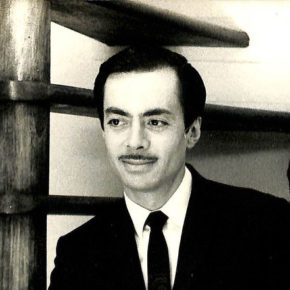
The Religion of Manuel L. Quezon
by Manuel L. Quezon Jr.
Message given on August 19, 1971 at the Parish of San Juan Nepumoceno, Malibay, Pasay City.
Monsignor Francisco Avendaño: Ang ika-93 kaarawan ng kapanakan ng Pangulong Manuel L. Quezon. At nais ko sa ngalan ng parokya ni San Juan Nepumuceno ng Malibay, Pasay, ay batiin ang ating mga panauhin dito, ng isang maligayang pagdating.
Nais kong ipagpauna na kung baka may nakita kayong palatuntunan, ay maaring magkaroon ngayon ng kaunting pagbabago, at sa halip na ang kaisa-isang anak na lalaki ng Pangulong Manuel Luis Quezon, si Ginoong Manuel Luis Quezon Jr. ay magsasalita sa huli, ang ating ipagpapauna, ang nasabing pagsasalita.
Kaya ngayon, heto ang kaisa-isang anak na lalaki ng ating minamahal na Pangulong Manuel L. Quezon:
“Quam bonum et iocundum est habitare fratres in unum.” “Oh, how full of goodness and cheer it is for brothers to live with hearts united.” Psalm 133:1.
Bishop Fideris, Bishop Ramento, Bishop Gano, Father Coronado, Reverend Estajo, Mr. Sayo, it warms our hearts to have you here with us this evening. I repeat the greeting Monsignor Avendaño gave you upon your arrival. Surely when we are able to come together like this, with peace in our hearts and joy in our faces, we have a firm assurance from the Holy Spirit of better days ahead for all of us. I hope you will always feel that your presence is not only welcome. Much more than that, it is a source of great joy.
We know the precise day and hour when my father was born. The 19th of August, when the church bells were ringing for Mass. For it was the Feast of the patron saint of Baler, St. Louis,not the king of France,but the Franciscan Bishop of Toulouse, in France. Hence, his second name, Luis. Why Manuel, I do not know. Hence alsothe idea of his mother, my Lola Titay, that he should be a priest.
He was baptised almost immediatelyand so began his spiritual life. Spiritual life, when first introduced into the soul,is like the lighting of the bonfire.The fire is there, but it needs to be fanned into a roaring flame. Notwithstanding an early brush with death, the Franciscan Friar drowned, saving my father’s life, that fire does not seem to have burned with a brightnessabove the average youngster.Did it ever go out?Well,the depths of another’s conscience are beyond our clear scrutiny.
Judge notthat you may not be judged, but certainly,my father thought it did. In his youthhe struck a Spanish Sergeant on the headso forciblythat he left him for deadand took flight.Now he thoughta murdererin mortal sin.When his father, my Lolo Lucio, told him that the sergeant was alive and well,unable out of shame to admit that he, a Spaniard,had been knocked unconscious by a mere Indio stripling, my father, was relievedboth as regards his own personal safety,and as regards the security of his conscience. He was not in mortal sin after all,he was not damnedto hell.
We may well smile at this naiveconfusedconsciencewhich thought itself in mortal sin one moment,and not in mortal sin the next.As thoughsin were wholly and entirely,a matter of objective,external fact,rather than a combination of objective fact and our subjective appreciationof that fact. Whoever looks at a woman to lust after her, has already committed adultery in his heart.Butthat is how my father recalled the event.And that is how he recorded it in his autobiography.But then his autobiography was not a theological treatise.
Later onas an officer in the Philippine Army, defending the Philippine Republic, he again thought he was not in God’s grace. He does not say why,but he records it as a fact.During his firstbattle experience,the enemy bullets nearly made him bolt.He was afraid of deathand subsequent damnationbecause of the state of his soul.The voice of his commanding officer steadied him: “Cuidado joven, que los soldados te están mirando.” Careful young man,the soldiers are watching you.He stayed at his position.How exactly he squared matters with his conscience and his God,we do not know.We do knowthat his view of the state of his conscience was by nowmore reliable,for he had been under the Dominican fathers for years.
It was while studying under the Dominican fathers, that he had a sudden flare-upof religious sentiments.He turned upin a theology classroom.When the professor, a priest who knew him well, asked why he was there,he answered, “To study for the priesthood.”
“And who told you that you have a vocation?”
“Father so-and-so.”
The crushing retort came with typical Dominican bluntness. “Father so-and-so is as crazy as you;run along.”Crestfallen, father gave up his short-livedecclesiastical career.Perhapshe consoled himself with the thoughtthat the priesthood is for the few,not the many.He could not have known that he was not of the many, but of the fewer stillwho are called to national leadership.Many years later, when he was president,he used to tell his beloved Dominicans, humorously,and to their great amusement, “If I had not stopped,I would have kept going until I becameArchbishop!”
But to go back. During an interlude of convalescence from an illness, his spiritual life took the very different turn.He read a book which brought doubts of faith.Ultimately,he gave up his religion and left the Church.When precisely that happenedand under what circumstances,he has not recorded for us in detail.The period of unbelieflasted roughly25 years.
I suppose he did not at once lose all his beliefs,but he seems to have believed in less and less. For, in the document which he composed and signed,asking for reconciliation with the church,he wrote, “With sorrow, and why not say it,with shame even,I must confessthat in the course of such a long period of my life, in practice, I have forgotten my God,if indeed I have not ceasedto believe in Himwhile He,of His infinite goodness and mercywent on loading me with his benefits.”
“If indeed, I have not ceased to believe in Him.” “Si es, que no he dejado de creer en El.” I lay stress on this sentence and repeat the Spanish original, because the Spanish was elsewhere translated into English as “but I did not cease to believe in him.” The translation makes him affirm that he never stopped believing in Godandthe translation is wrong! in the Spanish original,he very clearly doubts,whether he still believed in God.
The document goes on, “The day came in which I began to feel a complete desolation in spite of the material goods which I enjoyed,and I sought the cause and found it in my want of faith in the supernatural life,that is,in my lack of religion. After much vacillation, I decided to take the stepstending to the profession of a religionifit should be possible for me to believe in one.”
He felt dissatisfied with his position,he felt empty and wanted to change.But he would embrace a religion,only if he found it possible,honestly, to believe in oneand he was fully prepared to profess some other religion, If he could not find his way to believing againin the religion of his youth. In his own words, “It took a great deal of work and time,butby the Divine Grace…” And so on,to the end of the documentin his own handwriting,with lines crossed outand corrections of his ownwithout making a clean copy,simply signing the untidy documentwitnessed by my mother and Carmen Peña,a cousin of my motherand submitting it to the then-Manila Archbishop aMichael J. O’Dougherty, an intimate friend of the family. The date:August the 18th,1930.After 25 years,he was reconciled to the faith of his youthalmost on the anniversary of his birthand subsequent baptism.
I want to make it clear that he returnedout of personal conviction and with absolute freedom.Anyone who has any doubts on that score, should read the entire document.Whether one agrees with himor not,the documents leaves, absolutely,no doubtabout his convictions.The document makes it clearthat he did not return for family reasons.
I might add that my mother had married him while he was outside the Churchand been his loyal wife for 12 years, a devout Catholic. She could not be a compelling reason, now,for him to return.Nor was the returnfor political reasons.He did not need reconciliation with the Church in order to gain the support of clergy and laity. By and large, he had enjoyed that support during the long years of alienation.My father was reconciled on board shipon his way to the United States. When he returned,Mass was celebrateC in our home,in the presence of friendsand he received communion,visible proof of his complete reconciliation.He never againwavered in his beliefs.
I will not claim that he became and remained a perfect Christian.No.But he was regular in his devotions which he took very seriously.He was a regular churchgoerand received the sacramentsmore oftenthan the minimum requirement of Church law.Speaking of communion,my mother told me a storywhich you may find amusing.When my sisters made their First Holy Communion, they asked why he had not received communion with them. He was then outside the Church, but presumablycould not explain the situation.He answered, “You see,you are girls.So your mother received communion with you,but when your brother makes his First Holy Communion,thenI shall receive communion with him.”It was one of those typical embarrassing parental evasions.Little did he know that he really would receive communion with me. By the time I made my First Holy Communion,he had been receiving the sacraments againfor five yearsat least.
How did my father’s returnaffect his public life?While outside the church, he had very willingly. availed himself of the talents of members of the Churchfor the common good.His return to the Churchdid not prevent him from using the talents of those outside the Churchor even opposed to itfor the good of the country.I believe he had and managed to retainthe friendship and goodwillof those of all faithsand of none.This doubtless explains, at least in part,the extremely cordial treatment. I have always receivedfrom the members of all creedsfrom agnosticsand evenoutright atheists.Father would have moved naturally and spontaneously in the atmosphere of Vatican II ecumenism,although he would not have fallen into religious indifferentism.He had his convictions, butcould, and did, respect the convictions of those who differed from him.I have very early memories of the late Gregorio.Aglipay, first Obispo Maximo of the Philippine Independent Churchas a frequent visitorin our home.The late Jorge Bocobo and former Senator Camilo Osias, member of the Constitutional Convention, both well-known Protestants, were close collaborators and trusted friends.He also had intimate friends and collaborators belonging to the Muslim faith.And the constant companion and associateJake Rosenthal,was a Jew.
So the years passedfrom 1930to the outbreakof World War Two.Politically,they were among the most important of his life. Those were the years of the famous Hare-Hawes-Cutting fight.My earliestpolitical memories.We often hear that father engineered the rejection of the Hare-Hawes-Cutting Act and got the Tydings-McDuffie Act passed,substantially the same law, with onlyminor differences.What is referred to as a “minor” difference, was the provisionregarding military bases.Under Hare-Hawes-Cutting,the United States would have retained military bases automatically,with the Philippines having nothing to say.Under Tydings-McDuffiethe military bases were to be the subject of negotiations between the United Statesand an already sovereign Republic of the Philippines.
Is that a “minor” difference?After all our unfortunateexperience with military bases, and at a time of growing demand for the withdrawal of bases, not only from the radical Leftbut also from other sectors of public opinion,I think people had better stop calling the bases provision of Tydings-McDuffie minor and unimportant.I am not here to condemn the Pros and praise the Antis.The Pros were sincerely convincedthat nothing better than Hare-Hawes-Cutting could be obtained,and certainlyevery indication at that time, tended to confirm their view.The Antis knew they were taking what we today call a calculated risk.
In gambling. It was what we would calla long shot.The Antis, thought the stakes worth a try.It so happens that the gamble won.Things could very well have gone the other way.I bring up this matter which is outside our topic,because that long-ended struggle is so often cited as devoid of real issues, merely a political tactic my father usedto gain the upper hand.It is truethat it took all his political skill.But he was using that skill primarilyfor the triumph of his views,not of himself. Just as his opponents,his former colleagues,use their skill primarilyfor the triumph of their views, notof themselves.To affirm otherwise is to misread history and misjudge the characters involved in it.
Happily, after the struggleboth sides joined hands for the final stage of nation-building before independence.Father ran for president. His former opponent, Don Sergio Osmeña, gallantly ran as his vice president.Both were elected.
From the religious viewpoint,our viewpoint, nothing especially important seems to have happened in father’s lifeduring the years 1930 to 1941.We might mention two things in passing.As president of the Commonwealth,he established the chaplain service organized by Father Edwin Ronan,which provided for all the faith’s represented in the armed forces. Monsignor Avendaño, our parish priest,was among the first trainees.So, I believewas Bishop Macario Ga of the Philippine Independent Church.The other event was a less happy one.A bill for compulsory religious instruction, was passed by the National Assembly.And father vetoed iton purelyconstitutional grounds. He was a firm believer in religious instruction,buthe was convinced that the bill violated the provision on optional religious instructionin the Constitution, which he had sworn to uphold.Of course, there was room for disagreementand the National Assembly could have overridden the vetobut it did not. Father then became the villain of the piece and was attacked by some of his fellow Catholics.Rather unfairly, I think.Piqued,he responded more strongly than he should have.It was the over-energetic and notvery thoughtful responseof a fiery temperamentand should be regarded in that light.
The years of the Commonwealth passed,and the country progressed,,while abroad,the clouds of world war gathered ever more thickly. During aflare up of his old illness,tuberculosis,father rested in our country hometoday in Quezon City,and during thatthat enforced rest, Father Cosgrave of the Redemptorists gave us a family retreat.Perhaps God in his ever-constant generosity,was giving my fathera chance to prepare spiritually for what lay ahead.The tragic war years,his final sicknessand death.
As the world sees things,the outbreak of war,dad’s foreign exile,his last illness and death,form a kind of anticlimaxto his life.But I think we ought to view those years from a different perspective.I thinkwe should consider father’s life,up to World War Two,as a providential preparation for,and an actual period of serviceto the nation.During that time, father, while serving his country had unfortunately, by his own admission, turned his back on God. But God had very patiently, waited and then retrieved him, without interrupting that public service.
Apparently, with the coming of World War Two, the task God had set my father in the service of his people was almost at an end. nNow,with that mysterious generosity, which only the eyes of faith can recognize,father was to be given a span of timeto prepare himself for death, far from the distractions of official Duty in the Philippines. It was the final stage of purification.And I have no doubt he passed from it a truly, holy man.
At the outbreak of War, father, had high hopes of a quick national deliverance.Buthis inability to protect and save his peoplewas brought home to him forcibly. Chaplain Avendaño overheard him praying alonein the improvised Chapel in our Corregidor tunnel, the only illumination,the vigil lights before the Blessed Sacrament.His prayer: “Lordsave my people.”Father could no longer care for them as he had in the past.Nothing remained, but to commend them to God.
On Corregidor,in Australia,and in the United States, father’s spiritual lifebecameever more intense.As his worldly careersank lower and lower, the flame of his spiritual lifemounted higher and higher.
How did the final process of purification and sanctification take place?St. Francis de Sales in his introduction to a devout lifepoints out that sanctity, holiness,does not consist in any particulardevotional practice.It consists in doing God’s Willand devotional practices have value only to the extentthat they are a carrying out of God’s Will.In the last analysis, the model of Christian sanctitycan only be Jesus Christwho came to to do not his own will ,but the will of the Father who sent Him.And so his prayer in the Garden of Olives. Father,if it may be,let this chalice pass from me.Nevertheless,not my will,but Thinebe done.
In this, my father was no different from any other man.External eventsand interior gracemust bring him with absolute sincerityto that prayerand that habitual state of mind, and heart, and soul, “and Thy will be done, not mine.”
The process was gradual.At firstfather, thought our country, goodand would be quickly retaken.Even while he could still move around, before complete bed rest was imposed on him, he realized he was wrong.After Winston Churchill’s visit to the United States, father knew that Europe had been givenabsolute priorityin the war effort.The Philippines,and his return to it,would wait for years.What a frustration.
Even in his family life,he suffered a frustration.I never knew,he never told me,that he had hopedafter leaving politics to go into law practice with my oldest sister and myself.That was his ultimate life plan.Well,he noticed that I was now hearing Mass daily at 6 a.m.even in Winterand deep snow.He came into my room one day and without further introduction, asked me, “Are you thinking of becoming a priest?”I was just starting to toy with the idea so I answered, “Why, do you object?” Since my childhood,whenever I asked him, “Dad, what do you want me to be when I grow up?” he had always given the same answer. He gave that answer now. “Whatever you wish, my son.”He had taken my evasive answer for an affirmative replyand he treated the matter as a closed issue. He even jokedabout the advantages of being a secular priest rather than a religious: “Your neck is less likely to be cut.”He never gave the slightest indication that he was displeased or disappointed.I never dreamed that, with that evasive answer, I had shot down one of his fondest dreams.I found out from mother accidentallyyears after his death. Frustration? Yes.But: Thy will be done.
When his health deteriorated further and he was ordered to take complete bed rest, more frustration.He had to keep us at a distance to avoid contagion.in bed,he seemed to stage an amazing recovery,notwithstanding occasional setbacks.But ,continued frustration.During the school term,father lacked the consolation of my mother’s presence.I had extracted a promise,as young people will, thoughtlessly, that I would not be a boarder during my last year in high school.So my mother stayed with me in Washington, while my father was in Florida. We joined him and my sistersfor my parent’ssilver wedding anniversaryand for the Christmas holidays. I think it was thenwe made our last family retreat.
All this time,father had becomeeven more assiduous in his prayers.He communicated as frequently as Church law than permitted, the Bible was constantly read to him,and he meditated on every inspired word.He was making an ever-greater effort to curb that volcanic temper of hisand apologized humblywhen he lost control.His faithful valet, Adong, wept.The war news from the Pacific was getting better and better,but while hopes of retaking the Philippines constantly improved, his hopes of returning,waned.Upon our return to Miami, from a trip to Cuba, my sisters and I learned that he had taken a turn for the worse.I found out only afterwards that it was then he said his definitive “Thy will be done.”He called my mother and told herhe had no hopes of returning to the Philippines. He commended my sisters and myself to herand told her he accepted God’s willnever to return home.He was accepting this and all his sufferings in atonement for his own sinsand for the redemption of his native land.
What were those sufferings?A Physically active,tense man,who almost always had his way, now quite helpless,almost unable to move.A man who for so many yearshad basked in the glory which is countrymen gave him,now relegated to a corner of a sick room, tucked away from sight. A man who, so perceptive of his countrymen’s needs and quick to respond to them, now unable to lift a fingerto help them.A man of unusually powerful will, now unable to exercise that willexceptinone way: To bring it deliberately into linewith the Divine Will,absolutely. totally,unconditionally,without reservations of any kind.But perhaps in a life of 65 years during which that will had enjoyed such free play,this was its most, powerfuland therefore most free and glorious exercise: Tthe acceptance of defeatas the world sees it.Yes, is there not in all this, an underlying resemblance, to a mannailed to a crossdying, who’s willdeliberately accepted solitude and defeat as the world sees defeat, to fulfill the will of his father?
I hope I am not shocking anyoneby suggesting this comparison. But after all,can we Christians ever be real Christians unlesswe resemble Christ?
So summer came,and with the summer,the move to Saranac.I said that father would only see us briefly for reasons of health. Now he was deprived of one final satisfaction.I graduated valedictorian,got the gold medal as he had oncemany many years before.His father had the satisfaction of being present,although he was assassinated almost immediately afterwards.My father could not knowthat he would die so soon after my graduation but he did know that he could not attend.He sent that great gentleman, patriot, and lifelong personal friend of his Don Sergio Osmeña as his official representative .Then I joined the family in Saranac.His last birthday present to me on my hand: A ring,and an ID bracelet.I had just turned 18.
In Saranac, the usual routine :prayers, frequent communion,daily reading of the Bible. The news from the Pacific got even better,and amazingly,so did he.We actually thoughthe was on the way to recovery.But perhaps deep down insidehe realized,it was the final flickerof a dying flame.
August 1st,the usual prayers. the Bible reading. Today, The Beatitudes: Blessed are the poor in spirit.For theirs is the Kingdom of Heaven.The poor in spirit. Thathe had truly become.The reading went on: Blessed, are the meek for they shall inherit the Earth.
But the Beatitudes were never finished. He had a coughing spill, and it was the end.Father Ortiz gave him absolution,but he was chokingand unable to receive communion.As we knelt praying the rosary, we could see from his eyesthat he was praying,though he could not speak,then his eyes closedpeacefully.Shortly afterwards. a Franciscan Friar of the Atonement who had become our friend,gave him extreme unction,conditionally.A Franciscan had presided over the beginning of his spiritual life, now,another Franciscansealed it.
So today,as the nation celebrates my father’s birth,because of the things he did for his country, we his children have another reason to rejoice.The greatest consolation that a son, a daughter can have is to have had a fatherwho diedas God wanted himto die.
Thank you.