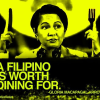
The Long View: On the cusp of redemption

August 31, 2009 by mlq3  
Filed under Article Archives

The Long View
On the cusp of redemption
By Manuel L. Quezon III
Philippine Daily Inquirer
First Posted 00:42:00 08/31/2009

It’s interesting that the President and her people have reserved their most venomous attacks for two senators: Manuel Roxas II and Benigno Aquino III. She seems less concerned about her other critics or potential successors while being particularly offended, even threatened, by these two. This is the best possible endorsement either man could possibly politically desire.

Both men, on the other hand, have pledged not to further divide their party, which already has a faction that decided to tie itself to the President’s apron strings but which realizes it has found neither a fixed place in the existing administration coalition nor much of a political future if it doesn’t somehow eke out a return to its original Liberal affiliation before 2010.

Both men have stated they will discern the country’s call, in partnership with their partymates, who have, in a sense, the rare luxury of choice which other parties don’t enjoy.

Both Roxas and Aquino have shown the necessary openness to answer the country’s call, within the context of being their party’s standard-bearer. Both will eventually make the right choice so long as they discern the national need for redemption.

Call it apathy, call it cynicism, call it disappointment, or even pragmatism: Redemption is what the country has required since 2005, and what has evaded it, as it seemed unreachable until quite recently. The citizenry, as being at the mercy of the professional politicians playing a power game that has come to be perfected in the hands of its current, unrepentant, practitioners, fostered the sense that the only means to preserve sanity seemed to be resignation—not in terms of a President prepared to shed blood to retain office, but resignation by a public that sensed it would be fatal to truly resist—and which, even when it sputtered in indignation, had to wonder if the current crop of leaders were motivated by anything other than ambition.

There is one great benefit to the Great Remembering that has taken place this month, and it involves George Santayana’s oft-misquoted observation that “Those who cannot remember the past are condemned to repeat it.” Now that remembering has taken place, what is the real lesson, the real comparison, between 1986 and 2010?

The lesson is, the political game will degenerate into merely a contest involving guns, goons and gold, unless the public can see itself capable of summoning not just leaders, but itself, to greatness. The similarity is, there is an administration that thrives on dividing, bribing and intimidating the people.

And yet this leads me in turn to wonder if there isn’t a danger if we’re perceiving things purely in terms of reenacting 1986. Karl Marx famously pointed out that “History repeats itself, first as tragedy, second as farce.” The repetition of Edsa in 2001 ended up a tragedy. Summoning the Spirit of ’86—only to reenact it like a bad high school performance of Joan of Arc—could end up a farce.

Bruce Reed, writing of Ted Kennedy, observed, “Every cause is better served when principle takes a seat at the table, and no cause moves forward when its champions walk away.” The focus on Noynoy and Mar will end up a farce if not accompanied by a self-examination, on their part and those calling on one or the other to be drafted for the presidency and vice-presidency, as to why the call is being made and the manner that call can inspire the electorate.

The real issue for 2010, based on a real appreciation of our past, is: will the next president continue the Arroyo legacy of impunity by means of the combined clout of the presidential checkbook and saber? The sense of impunity applies to all things, from broad concepts of human rights, to flouting the specific provisions of law, to ignoring even generally accepted (until recently, anyway) interpretations of the separation of powers, to the self-serving and downright deceitful presentation of official statistics.

This has been made possible by a President prepared to turn what should be normal operations of the law and institutions into an auction in which the support of a parade of civilian, military and religious leaders willing to be bought by a chief executive in turn prepared to be the highest bidder. Conditioned by this, the parade of leaders at the President’s side today will simply march to the tune of any drummer prepared to bang on the cashbox the loudest.

And don’t forget that where there are carrots there’s always a big stick: the President has always pointedly reminded who might be offended by her cash-based governance that she has the armed might to selectively persecute those who disagree with her. This threat will endure going into the May polls.

For 2010, too, will involve a referendum on collaboration. To elect an administration candidate or one who pursues the same tactics as the present dispensation, will be to endorse and continue the Arroyo legacy of impunity which was made possible by so many officials either cooperating with her, or surrendering integrity and independence to her.

There are only two track records that will matter: that of the supporters of the present dispensation who backed it through thick and thin, particularly after 2005, and those who decided to do the right thing by parting ways with the President, even in the face of the ferocious attacks and harassment by her minions.

Next May, even as the entire leadership of the country from council to president will be up for election, and even as the President attempts to keep herself relevant—whether to perpetuate herself or simply ensure she and her sons don’t end up in exile or in jail—the choice is already obvious: whether it will be Mar or Noynoy, or both, the country already knows they’re the only two whom the present dispensation can’t tolerate. In that sense, they have already been redeemed.

Platforms

August 28, 2009 by mlq3  
Filed under Daily Dose

Coalition Platform 1935

I’ve been meaning to write about this since July. Aside from the interesting experiments people are undertaking to analyze and understand the public opinion data coming in on the various candidates (see Journal of the Jester-in-Exile and Far From Neutral Notions), there’s an ongoing effort to get people to think deeper about the process of voting. And that includes going beyond liking or disliking individual candidates and asking what, if anything, they adhere to in terms of a cohesive vision for governance and what they actually hope to accomplish during their time in office.

Since 1935, when we had our first national presidential campaign, platforms have been part of the political landscape, an essential foundation document not just for campaigning for votes, but for cobbling together coalitions. Emilio Aguinaldo, in announcing his candidacy, apparently unveiled a 44-point platform.The document above, for example, was the 14-point Coalition Platform for the Nacionalista Democratico and Nacionalista Democrata Pro-Independencia parties approved on June 16, 1935, the realigned factions of the Nacionalista Party that split over the Hare-Hawes-Cutting Act and the Democrata Party that dissolved over the same question. You can survey the State of the Nation Addresses for 1936, 1937, and 1938 to see how the platform was carried out, or not, particularly in terms of the question of agrarian reform. (a glimpse into how the reunified Nacionalistas put together their campaign platform for the next presidential campaign, in 1941, can be be seen in a Free Press article from July, 1939).

A description of the NP Convention in 1953 in which former Liberal Ramon Magsaysay became the Nacionalista standard bearer, shows how a platform is the formal basis for affiliation in any electoral contest where a tug of war takes place not just for the votes of the electorate but the affiliation of candidates and other leaders. In 1985, the Convenor Group and National Unification Council had to hammer out a platform as a basis for unity and participation in case Ferdinand Marcos called for a snap election. Most recently, the President herself put forward a 10-point Agenda for her administration.

There have been two entries of note that go to the heart of making a vote not just for the President and Vice-President or the Senate, but for an entire ticket, an informed one. Ideally, one shouldn’t just vote for particular positions in isolation, but as much as possible give leaders a chance to have a basis for governing, which requires electing as many like-minded people as possible so they can support each other once a new administration’s inaugurated.

See Platform Plez and Kepner-Tregoe and the 2010 Presidential Elections to see how citizens can go about evaluating candidates, not just on the individual merits of particular candidates, but according to the affiliations they’ve chosen. In an ideal democracy, the basis of that affiliation should be a party platform. Everyone in the party is obliged to uphold a particular set of party principles, and beyond that, to adhere to a set of objectives the party hopes to accomplish within the forthcoming term.

However, in our imperfect world, the standing of political parties is low and only a minority, a little over a quarter of the population, takes parties or party affiliation seriously. The survey, which dates back to 2007, revealed that three parties stood out in terms of platform, etc.: Lakas-CMD, the Liberal Party, and Bayan Muna. Of these three, the survey findings can be explained on the basis, first, of ubiquity in terms of Lakas-CMD as the dominant administration party; in the second instance, because the LP had, until it was divided over the question of continued collaboration with the President, gone through the process of requiring seminars for aspiring members and trying to modernize the party’s processes; and in terms of Bayan Muna, because of the identity of the party as a front organization for a movement with a specific ideology.

In all three cases, and in the case of all parties, there will be those who are leaders and members of the party who are unconcerned with what the party platform says; but even if this is the case, the existence of the party platform represents a set of principles and programs to which it is reasonable to expect the leader or party member to adhere. It is a starting point, at the very least, for evaluating any candidacy: a candidate proven to be ignorant of, or dismissive, of the party platform ought to be taken less seriously than one who has bothered to at least parrot the party line. If the candidate can be shown to have worked towards accomplishing the party’s objectives, then the candidate can be said to have passed a major hurdle in terms of having a respectable candidacy.

At the very least: if certain candidates have an existing political affiliation, then they can be assumed -and expected- to adhere to the platform of the party they belong to; if they move to a party, they can be assumed to have signed on to the platform of the party they’ve joined. More importantly, the first basis for evaluating these candidates is to ask what their party affiliation, formally at least, stands for, and then, asking whether the candidate’s affiliation is nominal or more deeply-rooted, and that can be by means of inquiries in forums, etc. There will be instances where candidates, besides their party affiliations, also have their own, personal platforms (the Magsaysay Credo for example, or that of Noynoy Aquino).

An individual candidate who belongs to party is bound by the party platform; he can add to it, but not subtract from it, or deviate it from it to an extent tha would make his affiliation meaningless. One thing is sure: a candidate should be held accountable to a party platform; from the start, identification with a party means that candidate automatically adheres to the party platform.

For this reason, it’s useful to see what platforms are available on line, for comparison, and in terms of seeing what the presently-affiliated candidates already officially subscribe to. With the caveat that party platforms are changeable documents, ideally revised during the party convention preparatory to waging a new campaign; and that party platforms are, ideally, consensus documents, reflective of the various factions and interests within a party seeking wider public support at the polls.

Lakas Kampi CMD, which has as its potential standard bearers Vice President de Castro, Defense Secretary Teodoro, MMDA Chairman Fernando, and Senator Gordon, among others, has a Lakas Kampi CMD Party Constitution online, with a Declaration of Principles and Polices (Article II), and a General Platform of Government (Article III).

The Nationlist People’s Coalition, which as as its potential standard bearers Senators Escudero and Legarda, has a Nationalist People’s Coalition Party Manifesto online, in Mission-Vision form, with further breakdowns for Human Capital Development; Good Governance; Enterprise Development; Energy and Infrastructure Development; Fiscal Discipline and Security.

The Liberal Party (one assumes all factions subscribe to the same platform) which has as its possible standard bearers Manuel Roxas II or Benigno Aquino III, puts forward what it calls The Liberal Vision, which includes The New Agenda which proposes Policies for the New Century subdivided into three categories: an Economic Program, a Political Program, and a Social Program.

The most meager information is provided by the Nacionalista Party, which is heavy on reciting its past history but terse when it comes to specifying what, exactly, the party stands for. See Nacionalista Part FAQ. In his own wesite, Manuel Villar, Jr. is also rather unforthcoming about the specifics of his candidacy and relating the specifics with the party he heads.

As for the other major parties, I haven’t found their official websites with their party platforms.

The Long View: Like Chino, like Doy

August 27, 2009 by mlq3  
Filed under Article Archives

The Long View
Like Chino, like Doy
By Manuel L. Quezon III
Philippine Daily Inquirer
First Posted 00:18:00 08/27/2009

Back in 2006, Cory Aquino told a few people that someone would have to die, for the country to realize how far it had strayed from its ideals. Cory couldn’t have known then that the death she felt was required would turn out to be her own. Her wake and funeral—a period in which the country remembered what it was like not to be cynical—has taken on the characteristics of a continuing remembrance of things past for our elders and an unfolding discovery of a previously undiscovered country for the young, as young and old first came to terms with Cory’s dedication to duty and then Ninoy’s martyrdom.

This, in turn, has led to the stirrings of a kind of national consecration to a rekindled hope that unity is possible and that sacrifice can be demanded; and it has the professional political class spooked. The politicians are sniffing around to see if this is a rising tide or a mere ripple. Mention Benigno “Noynoy” Aquino III nowadays and you will immediately hear the phrase, “game-changer” to describe his potential impact on the political scene.

There is a need for more than a new Cory; there is a need for a Chino, and there is a need for a Doy. Chino Roces took it upon himself to trundle around town with a little cart, gathering real signatures on real paper, calling on Cory to run. And if Cory, in turn answered the people’s summons, it took a Doy Laurel to show the country that it was possible for a leader to sacrifice ambition, with only one condition: that his and his partymates’ efforts be recognized by her agreeing to run as the UNIDO candidate.

On Feb. 25, 2003, Laurel delivered a speech at Club Filipino to commemorate the 17th anniversary of the Edsa Revolution. He observed: “A developing country like the Philippines needs a leader who is more than just a symbol. He must be decisive. He must have a clear-cut vision of the nation’s destiny—or he cannot lead. He must give clear and consistent messages—at all times—or the people will not follow. He must be selfless and sincere—or he will not be believed. He must not tolerate graft and corruption—or he will not be believed.”

Furthermore, Laurel suggested, “He must be in three places at the same time: In front of the people, so he can guide them and lead them onward to a greater destiny. Beside the people, so he can feel what they feel, suffer what they suffer and even laugh and cry with them. And … behind the people, to make sure that the weak and helpless, even critics and dissenters, are not left behind!”

These, then, are things that Noynoy needs. He must be called to the front: there must be a draft that comes not just from Metro Manila but from the Visayas and Mindanao. The call must come from those prepared to stand beside their candidate, which provides an incentive for other leaders to renounce their own ambition. And leader and followers must stand for something in common, which puts forward the need for a political party.

They are all part of a piece: the signatures, if they come from all parts of the country, makes the call national and irresistible; and if people commit to a Noynoy candidacy then they should be prepared for the long haul, and that includes seriously considering adopting his party affiliation which proposes a blueprint for the governing of the country.

If there’s one thing noticeably absent in our political parties, it’s actual membership. We have the most top-heavy parties in the world, and being top-heavy presents the dangerous possibility the leaders can imprison any potential candidate, unless that candidate can point to a constituency of ordinary people prepared to challenge the party leaders on their candidates’ behalf if need be.

So ask yourself: If your candidate belongs to a party, then that candidate is committed to an existing party platform. People who want to follow a leader need to examine what that party platform is, to decide if they are prepared to be card-carrying members of that party so that they can participate in that party’s deliberations on its standard bearer for 2010.

Politically, this is the first step any presidential candidate has to hurdle. Only after securing a party’s nomination can a candidate present himself to the electorate at large. Unless the public clamor is for the candidate to leave the party, and join a movement—which would still need a concrete platform arrived at, not by decree, but by consultation.

Gary Wills wrote of leadership in his book, “Certain Trumpets: The Call of Leaders” that “the leader is one who mobilizes others toward a goal shared by leader and followers. In that brief definition, all these elements are present, and indispensable… [They] make up the three equally necessary supports for leadership… The goal must be shared, no matter how many other motives are present that are not shared.”

President Gloria Macapagal-Arroyo’s loyalists justify much of her misrule on the basis of her having to “get things done,” by fair means or foul; she has to work with whoever’s left that still wants to work with her, and if it comes at a cost, so be it. Of course, that cost will be high, because the President had no real public support; her support, such as it was, was by proxy—lesser leaders with their own followers (more reliable, at that, than say, civil society which has fatally divided since 2005 and perhaps even as far back as May 2001).

Along the way, the President has resorted to dividing her critics, and it worked until the country became reacquainted with how it feels to be united—at first, in grief, and then, in a renewed appreciation of idealism and ideals.

Nick Joaquin once wrote that August is, historically, a dangerous month. Realizing there is more that unites us than divides us and that there are values Luzon, the Visayas and Mindanao hold in common is dangerous indeed.

The Long View Prerogatives versus consensus

August 24, 2009 by mlq3  
Filed under Article Archives

The Long View
Prerogatives versus consensus
By Manuel L. Quezon III
Philippine Daily Inquirer
First Posted 01:06:00 08/24/2009

How often have you heard people say the following: That rather than risk a downward spiral into political instability by means of People Power putting a fragmented and uninspiring opposition in power, or worse, inaugurating a series of equally fragmented unelected ruling juntas, they’d rather grin and bear it until the President bows out of office in 2010? A strange consensus that indicts the entire political class, but which rewards failure with continued power.

Actually, not a consensus but a surrender, because the public has abandoned any pretense of exacting accountability. Boil down the issues, and they will be reduced to the problem of officials asserting their prerogatives because of the inability of the public to arrive at a consensus because of all the assertions of prerogatives, not just by officials, but anyone claiming a semblance of authority.

The ongoing controversy surrounding the proclamation of new National Artists has degenerated into a legalistic division between proponents of either presidential or artistic prerogative, with both sides essentially insisting on an all-or-nothing approach. And yet both the President and artists opposed to her forget that the title of National Artist is most meaningful when reflecting a consensus arrived at both by artists and by the broader public, who could be represented by a president if sensitive to both public opinion and recognizing individual excellence.

Consider the ridiculous obsession with “premature” campaigning when the real question should be whether our existing official campaign period is even sufficient for the public to clarify, in its collective mind, what the real issues are, or adequate enough to introduce candidates and their platforms to a public that needs time to scrutinize the candidates based on those issues.

As it is, the campaign officially begins in November, and only because automation requires it; otherwise it would’ve begun next February. A full year too late.

We have candidates criticized for presenting themselves to the public, but who cannot claim any real constituency behind them—because of a lack of material time. Take just three examples.

All the current contenders for the presidency should’ve begun campaigning a year ago, going through the elimination rounds of their own card-carrying constituents before even presenting themselves to the broader public.

But by law, they have to short-circuit the process, since conventions can’t even take place until November.

And people wonder why the race will inevitably become an intensive ad campaign, substituting emotion and posturing for a meaningful dialogue on the issues?

What choice do any of the candidates have? Without an organized following—a constituency mobilized to campaign for and fund a candidacy—political independence can come only from mobilizing personal or familial wealth, which enables them to escape the chicken-or-egg situation in which not having money leaves even charismatic candidacies stillborn.

This situation means that candidates who think that if they’d only be given a chance they could muster a national constituency are hampered by the short campaign period requiring a pell-mell realignment of the political pros. The pros simply don’t have time to waste on elimination rounds where candidates vie for party votes, and where the country, in turn, is watching and learning and then judging the merits or demerits of candidates who survive the party conventions.

That’s because the political pros only have half the official campaign period to make their national choices, since the other half of the campaign’s devoted to the nitty-gritty of their local political fight for survival.

This magnifies the clout of organized groups that rely, not on the critical thinking of their followers, but rather, their blind obedience. The captive, collective votes of churches and preachers, of the Communist Party and its fronts, or of the warlords aren’t capable of electing candidates on their own. But they can make the difference in a close election with many candidates and an electorate deprived of enough time and opportunity to coalesce around a majority-winning candidate.

Where then, can a citizen really say he is free to vote as he truly pleases?

Rushed to a choice by an artificially limited campaign period in which ads are less about the issues and more a blitzkrieg of emotionalism on the airwaves; placed in a situation where, even if the voter would rather see candidates up close, campaigns are hampered by rebels in the hills extorting from the candidates; and where voters are intimidated or spied upon by bodyguards or commanded by preachers, elders and prelates; where can democracy actually thrive?

The illusion of one man, one vote, is merely that. Where the campaign period is artificially limited; where candidates sell the illusion they represent a constituency instead of arising, organically, from organized constituencies; and where, because of the mad rush to cobble together, not a true majority, but a minority slightly larger than any other rival minority, no one has an incentive to truly capture the popular imagination, and thus, enjoy truly popular support.

Why do you think the President said “Let us also make the alliance between the local government units and the Armed Forces of the Philippines a major campaign plank, especially in the local elections”? Naked force is the key to survival of a coalition that, like Marcos, does not intend to die. Which is why in nine years, it has only proposed ways to entrench itself but not really change the system.

In one respect all the non-administration candidates have an advantage the Frankenstein coalition of the President lacks. All can foster the illusion that they are viable national candidates—an illusion because all are incapable of mustering what the country requires: a true majority to finally forge a national consensus.

Philippines Free Press commentary: A totalitarian agenda

August 22, 2009 by mlq3  
Filed under Article Archives

Philippines Free Press, August 22, 2009 issue

A totalitarian agenda

By Manuel L. Quezon III

WAR, the German military strategist Carl von Clausewitz famously proposed, is the exercise of force for the attainment of a political object, unrestrained by any law save that of expediency. For most people, however, war is supposed to have a kind of sacred purpose. Democracies, in particular, are supposed to resort to war, not out of bloodlust or the desire to conquer and subdue, but rather, in fulfillment of a basic human right that applies to nations as it does to individuals: self-preservation can require self-defense.

The problem of course is that once the sword of war is unsheathed, force of arms may require an exertion in lives and money as to make even victory a losing proposition. Therefore, even when self-defense takes on the characteristics of a sacred duty –there are, after all, in both Christianity and Islam, justifiable wars according to the tenets of those great religions- what is demonstrably a right is not necessarily the wisest course of action.

Put another way, even when justified, war isn’t necessarily the best solution to a conflict; arbitration and negotiation should be pursued and exhausted first. Winston Churchill famously expressed this as follows: “To jaw-jaw is always better than to war-war.”

For a generation now, since Ferdinand Marcos fell, our governments have tried to jaw-jaw but always end up resorting to war-war in dealing with two rebellions that began in the late 60s and early 70s: the pursuit of revolutionary struggle by the Communist Party of the Philippines and the Moro quest for independent nationhood.

While military offensives often prove more popular than not, the cost in lives and the damage to the economy usually end up bogging governments down in a quagmire of human rights and other scandals, such as the lack of equipment of the armed forces and damage to infrastructure. So administrations end up back at the negotiating table and resume peace talks.

No one, it seems, is capable of securing a lasting peace. Never mind the various rebel groups, who may or may not be sincere in their protestations that if only reforms were really put in place, they’d come down from the hills and become peaceful, productive citizens. Consider the dilemma of our civilian and military leadership.

You will often hear the military complain that if they only got enough material and political support, they could “finish the job” and truly whip the various rebel movements. But then you also hear civilian politicians, for their part, complaining that the military isn’t really interested in final victory because it would then make the armed forces obsolete –or at the very least, require a substantial reduction in the number of troops- which would, endanger, along the way, lucrative armaments and other contracts.

Another aspect to the civilian-military divide is the frustration the military feels over what it perceives to be the ability of its enemies to hide behind laws passed by naïve civilian politicians, which essentially ties one hand behind the military’s back, leaving them handicapped when it comes to military operations; while civilian politicians, on the other hand, believe the instincts of the armed forces are too brutal to be given free rein in pursuing combat operations.

Another way of looking at this civilian-military divide is that it is a form of checks-and-balances; it prevents military operations from getting out of hand, but also limits the ability of governments to simply give away everything in order to secure a peace that may actually represent a defeat for the state.

But what happens when civilians and the military alike, come to a meeting of the minds, and decide that the security of the state cannot be separated from the partisan political interests of the ruling party, composed not just of civilian politicians but the military’s top brass as well? You have a situation fraught with danger, because the state becomes something greater than the people, for by unifying the military and civilians in the national leadership, you have a state that commands, and which can disobey, the people.

For the default position of the public is for the maintenance of peace, and the pursuit of war only in terms of necessary self-defense but not for outright conquest. The default position of those with a militarist mentality is to worship war, and to pursue it regardless of the consequences. Notice I do not say this is the default position of the military; a military properly schooled in the proper relationship between civilians and the military recognizes war as the last option and one that furthermore requires limited, realizable goals, always guided by civilian parameters of legality and ethics.

The present administration has proposed, time and again, the subordination of the rule of law and ethical parameters like human rights, to the military objective of defeating various rebel groups. This galvanized domestic and international opinion against the administration, which has beaten a strategic retreat every time the criticism got too widespread and sustained. It has not prevented the administration from trying to resume its policy of all-out war, the moment it thinks the coast is clear.

The result has been to further radicalize both rebels and the uncommitted public that simply wants peace and an end to the fighting. The administration has pretended to pursue peace talks while embarking on a path that guarantees the failure of any such talks. This is not just because the various rebel groups are not interested, themselves, in anything more than a tactical breather to recover their strength, but also, because the administration finds it useful to provoke its enemies and so recklessly seeks out opportunities for confrontation.

The pursuit of Abu Sayyaf bandits, practically on the eve of the resumption of peace talks with the MILF, the start of a major PNP operation to confiscate illegal weapons, and the President’s stated policy of blurring the lines between civilian and military authorities by making “the alliance between the local government units and the Armed Forces of the Philippines a major campaign plank, especially in the local elections” in 2010, are all part of a whole: and it is called totalitarianism, in fact if not actual name.

The Long View: Official persecution of readers

August 20, 2009 by mlq3  
Filed under Article Archives

The Long View
Official persecution of readers
By Manuel L. Quezon III
Philippine Daily Inquirer
First Posted 01:03:00 08/20/2009

Book lovers expressed satisfaction when President Gloria Macapagal-Arroyo, during her ninth State of the Nation Address, stated her administration’s policy as follows: “Taxes should come from alcohol and tobacco, and not from books. Tax hazards to lungs and livers, do not tax minds.”

Two months before her speech, Makati Rep. Teodoro L. Locsin Jr. had hailed the President for instructing the Department of Finance to rescind Department Order No. 17-09 dated March 24, 2009. DO 17-09 provided the legal basis for the Great Book Blockade of 2009, and officialdom was surprised when the imposition of taxes on imported books provoked opposition from book lovers from all walks of life. Citizens joined hands with booksellers, the National Book Development Board and Unesco Philippines in expressing indignation over an arbitrary and patently illegal tax.

In response to the public furor, the Department of Finance issued Department Order No. 27-09, dated May 25, 2009, saying it had received letters from the NBDB and the Philippine Book Publishing and Development Federation while ignoring Unesco and the citizenry. The officialese used in the new order was pouty: DO 17-09, it said, was “hereby suspended pending resolution of the issues raised.” The phrasing was good-naturedly ignored by many book lovers celebrating what they thought had been a kind of successful People Power; the general, and magnanimous, opinion at the time was that the bureaucrats in the Department of Finance and Bureau of Customs had to save face.

However, between the time the book tax was “scrapped” (according to the Palace) or “suspended” (according to Finance officials), troubling news began to trickle in that the bureaucracy apparently had a mind of its own and fully intended to defy the President and keep on putting the squeeze on the public. And in a manner, mind you, calculated to soothe the bruised amor propio of officials stung by the President weighing in upon the urging of Locsin. If the bookstores, fully supported by Locsin, had scored a victory, the public, meaning individual citizens, would still be at the mercy of the bureaucrats—and they’d get their pound of flesh.

On May 29 one reader of my blog, Dondi Imperial, was assessed customs fees for three books he ordered from abroad. In early June he was told to apply for a customs exemption if he didn’t want to pay the assessed taxes. Things dragged on in the following manner:

“My dad volunteered to go to the DOF to apply for the exemption. The first time he went, they said to come back another day because the person who signs these documents was not there. When he told me of this, I told him that maybe it was better for me to just pay whatever the customs official was charging me but he refused and went back another time. They made him wait for over half a day and on top of that charged him P200 for what the receipt says is ‘FF’ (who knows what that is?). He had to photocopy a few documents and asked where the machine was. The person he asked had someone take him to the photocopier and said, ‘Ikaw na bahala sa kanya.’ The photocopier was about 20 feet away.

“In the end with the certificates from the DOF in hand the post office still charged a total of P515: BIR taxes-P15; Proceeds-Auction Sale (the letters IPF are written beside this line)-P250; Miscellaneous (the letters CDS are written beside this line)- P250

“So P500 + P200 + over a day and a half of my dad’s time + the cost of gasoline for two drives both ways from Parañaque to the DOF.”

Various accounts in various blogs testify that officials are imposing arbitrary rates of illegal taxation, ranging from 30 percent of the retail price of the books to almost 100 percent of the retail price.

Writer Conchitina Cruz contacted the NBDB about the problem and was told by Andrea Pasion-Flores, “According to the NBDB, the individual book buyer must apply for duty exemption at the DOF. You get the exemption the same day you apply for it. You have to apply for an exemption every time you have books coming in.”

But as Dondi Imperial and his father found out, officials will drag their feet and try to strangle you with red tape should you dare to apply for an exemption.

The point, of course, is that no such exemption is even called for. No taxes on imported books are supposed to be assessed. The government supposedly scrapped a policy that was illegal in the first place, and then tried to appear responsive to public opinion. Its too-late-the-hero posturing already gypped many citizens during the time finance and customs levied the illegal book tax; and citizens continue to be gypped by customs assessors in various post offices.

This time around, since the commercial bookstores are still in the clear, it doesn’t look like any official will take up the cudgels for the consumer, whose existence was studiously ignored by the DOF in the first place. So if the book tax is to be truly eliminated, citizens will have to get together with fellow citizens and organize themselves.

How can this be done?

1. Tell RockEd Philippines you want to help by e-mailing info@rockedphilippines.org, or contact them via these numbers: (632) 709-0792; (63916) 409-2378; Telefax: (632) 376-2184.

2. Try to take photographs of the customs assessors, post office employees, etc. and document your case and inform chingbee.cruz@gmail.com who has been in touch with UP College of Law dean Marvic Leonen since last May. Leonen has been compiling evidence for the filing of appropriate legal cases.

3. Be prepared to call the attention of Jaime Regala of the BOC IIPD-CIIS (Internal Inquiry and Prosecution Division-Customs Intelligence and Investigation Service) or complain to him personally at tel. 527-4522 once RockEd and Leonen have a clearer idea of the scale of the illegal duties being assessed.

Le Circus Freak (massively updated)

August 12, 2009 by mlq3  
Filed under Daily Dose

Introduction

(last updated 8/23 12:45 PM)

This entry was first published on August 12, but has been constantly updated. As much as possible, updates are to the timeline itself, updated every day; updates to previous dates are, as much as possible, cited in the latest date addition for easy reference. As a general note, concerning the two documented dinners of the President ($15,000 in Washington, DC and $20,000 in New York City,) the Philippine Peso equivalents for each are 720,152.14 and 960,202.85 respectively; at 50 persons in Washington and 15-50 persons, depending on the testimony, in New York, that comes out to $300 per head in Washington and to $400 to $1,333 per head in New York City. A range of $300 (14,412.27 Pesos) to $1,333 (64,037.14 Pesos) per head for the two meals.

The question then, is, are these reasonable costs per head? See Forbes Magazine’s 2008 article, The Most Expensive U.S. Restaurants, to see that neither are the DC resto, Bobby Van’s, nor Le Cirque in New York City, in the league of most expensive restaurants; yet the per-head costs of the President’s meals were on par with the reported costs of the truly expensive places: and this is because, as all the reports suggest, the costs of food were increased by the wine bills for each meal. And the dinners have triggered fierce criticism from the public because of the contrast the costs represent with assistance the President herself extends to poor citizens.

“Moderating the Feed”

The Filipino is Dining For

On August 12, in a Publisher’s note, the Philippine Daily Inquirer pointed out the following:

TWO RECENT news stories and an editorial mistook an intellectual exercise for hard fact.

Yesterday’s editorial mistakenly attributed the alleged itemization of the Le Cirque bill incurred by President Macapagal-Arroyo and her party to the “New York Post.” In fact, the hypothetical itemization was done by columnist Manuel Quezon III in his blog on Aug. 8, and introduced as “a theoretical breakdown of how the presidential party could have racked up the bill.”

Our story on Aug. 9 reported that “The purported menu included caviar; such appetizers as lobster salad, wild burgundy escargot and soft shell crab tempura; main courses of black cod, halibut, Dover sole, saddle of lamb and prime dry-aged strip steak; and Krug champagne at $510 a bottle.” There was, in fact, no such menu, only a hypothetical list of ordered items.

Our story on Aug. 10 reported that “The restaurant tab, purported copies of which have since circulated on blogs, showed that the Arroyo delegation had five servings of wild golden osetra caviar ($1,400), 11 bottles of Krug champagne ($5,610), and 25 orders each of the Chef’s Seasonal Menu and Tasting Menu (totaling $1,450 and $4,500 respectively), along with 17 other items.” There were no such copies circulating, only links and images from Quezon’s blog.

Based on these two stories, yesterday’s editorial criticized the presidential party’s insensitive self-indulgence. We stand by that assessment, however, since the original New York Post report is a fact. It read, in part: “Macapagal-Arroyo ordered several bottles of very expensive wine, pushing the dinner tab up to $20,000.”

The reality everyone’s confronted with here, is that nature abhors a vacuum. It’s no surprise then, that in the face of Press Secretary Cerge Remonde’s vacuous handing of the Le Cirque brouhaha, the public and press have had to seize on anything to compensate for official vacuity. isn’t something anyone should tolerate in government. Or perhaps it’s more appropriate to compare Le Cerge’s vacuousness to a black hole.

Surely, he has gotten all the facts; but once he has them, nothing apparently escapes –certainly, not the facts. A kind of destabilizing energy, of course, radiates from him, but it’s along the lines of that tried and tested political dictum of the administration –if you can’t beat ‘em, confuse ‘em!

The story begins on July 31, a few hours after the President was informed Cory Aquino had died, and she’d taped her bungled message to the nation (private media had to clean up the RTVM tape sent them, as the video showed the President, to put it diplomatically, displaying signs of relief and even levity during the taping). The press contingent was left in Washington while the President sped off to New York City.

Late that evening, the President had what would turn out to be that infamous Le Cirque dinner. It wasn’t officially announced; in fact it wouldn’t become public knowledge until the New York Post’s notorious Page Six gossip page reported it on August 7, although the first person to break the news was fashionista Bryanboy, via Twitter.

In contrast, every conceivable opportunity to portray the President as moderating her grief by engaging in the hard world of serving the nation, was lovingly covered, documented, and reported by RTVM –including working meals. This is important to bear in mind because at one point, Le Cerge insisted what they had at Le Cirque was “just like any other working dinner.” And emphatically denied the dinner had anything to do with the President’s wedding anniversary.

Later on, Le Cerge began to modify his story. In showbiz terms, “in fairness,” it has to do as much with the bumbling of the President’s other allies, as Le Cerge’s seemingly infinite capacity to do so on his own. He said 15-20 people dined with the President; Rep. Suarez later said no, it was more along the lines of 50 people (to bring the per unit cost down?): including American Secret Service agents as among the beneficiaries of the meal, which could lead to those agents being charged criminally or administratively for accepting perks from foreigners while on duty; so since then, it seems everyone’s tried to keep mum on who, exactly, was at the dinner.

Then Le Cerge insisted that Rep. Martin Romualdez paid for the dinner until Romualdez’s staff denied it, saying it was the congressman’s brother, Daniel, who paid for dinner –but not before the President’s own son, Rep. Mikey Arroyo, enthusiastically thanked Romualdez for paying. It’s a pretty boorish crew that accepts a dinner without bothering to find out who, exactly, was hosting it.

Le Cerge then said no one had fun, that everyone wolfed down their food in an hour; but Senator Lapid complained the dinner took ages and he was exasperated by all the cutlery and changes in courses.

So Palace has remarkably not taken the pains to correct two details widely reported in the press.

First, the total spent, reported by the NY Post at $20,000. No one has categorically denied that was the actual amount. At best we have Le Cerge remarking, early on, he though it wasn’t that much –but then he didn’t even know who really footed the bill, so obviously he’s not an informed source.

Second, there’s the impression the Le Cirque dinner took place on August 2, which would make it a kind of reward for the President’s hectic August 1 schedule. But it took place on July 31, but for the Palace to emphasize this would then focus attention on the distinct possibility she rushed to New York to make it to the dinner.

To keep up the confusion, the President’s dining pals inadvertently leaked all the other places the presidential party dined at: Wolfgang’s Steakhouse on Park Avenue (per Rep. Amelita Villarosa) after the St. Patrick’s Mass; and dinner that evening at Bouley’s Restaurant (per Rep. Hermilando Mandanas); the President’s husband, before she could snatch him away from the clutches of reporters, enthusiastically burbled he intended to take her to an “expensive restaurant” that night –it turns out, with the usual hangers-on.

The result is the President’s own people were the ones to point out the President made time for communal dining on three occasions and not just at Le Cirque, originally portrayed as a working dinner until everyone ended up admitting it was a wedding anniversary dinner –followed by a wedding anniversary lunch and yet another wedding anniversary dinner. None of these meals, until after the fact, were publicized.

Le Cergue then started making arguments like a circus freak: if it was really ostentatious, we should apologize, but it wasn’t, so we won’t -$20,000 being carinderia-style small change? Then he argued that if one invites the President of the Philippines to dinner, you wouldn’t have it at hotdog stand. King George VI who was invited to have hotdogs in Hyde Park by FDR, must be rolling in his grave. But then again GMA’s beloved Obama, too, has a déclassé liking for… chili dogs and burgers (see The Presidential Wiener) and indeed, his “beer summit” at the White House swept aside all American notice of his tete-a-tete with our president -who probably needed to console herself with wine at Le Cirque.

The President’s boosters have gleefully latched on to the media’s mistake of taking their cue from Jejomar Binay’s inadvertently confusing a theoretical computation posted on my blog for the actual bill, as a vindication of their hard-working president.

It’s the opposite -a deeper indictment of the President and her people: an honest mistake by media cannot be put on the same level as the disingenuous handling of the issue by the Palace, which has left press and public starved for facts.

The Timeline

So, in light of the above, the following timeline. Because events prove that those capable of providing the facts, of being proactive in the face of the public reaction to the New York Post’s revelation, themselves confused matters.

I am greatly indebted to these entries: GMA’s $20,000 Dinner at Le Cirque in New York?!? August 8, 2009 and Do the Math… August 10, 2009 in Market Manila; Pièce de Résistance August 10, 2009 and Cerge Remonde’s Circus Tale August 11, 2009 in {caffeine_sparks} among others.

July 29

The day after the State of the Nation Address, President Arroyo and party (the party included the President’s husband; Executive Secretary Ermita, Defense Secretary Teodoro, Agriculture Secretary Yap, Foreign Affairs Secretary Romulo and Press Secretary Remonde; Speaker Nograles; and some 20 legislators) departed for their 72nd trip overseas, on 1 PM flight, PR 116, for Vancouver, switching to a chartered PAL flight to Washington, DC, according to the newspapers.

(It will later be announced that on July 29, the President signed Executive Order No. 825, creating a local anti-hunger task force. News of this will only be released on August 11.)

6:20 PM Scheduled arrival in Washington D.C. Venue: Andrews Airforce Base. The President, during the FILUSA dinner, will explain why they missed their scheduled arrival:

You know when we arrived in Canada a half an hour ahead of schedule, so I was so happy… Oh, we’ll arrive in Washington half an hour ahead of schedule instead combination of paper work and inclement weather along the way made us not leave half an hour ahead of schedule…

8:30 PM The President’s actual arrival at Andrews Airforce Base with what a Palace press release calls “a lean delegation of legislators and a number of Cabinet members.”


The President was billeted at the Willard Hotel. She occupied the Capitol Suite. Reported total cost: US$70,879.78

The President’s delegation includes-

Family: Atty. Arroyo, the President’s husband; the President’s sons, Pampanga Representative Juan Miguel Arroyo and Camarines Sur Rep. Diosdado Arroyo

Cabinet: Executive Secretary Eduardo Ermita, Press Secretary Cerge Remonde, Defense Secretary Gilbert Teodoro, Finance Secretary Margarito Teves, Trade and Industry Secretary Peter Favila, Labor and employment Secretary Marianito Roque, Global Warming Adviser Heherson Alvarez, Solicitor General and Acting Justice secretary Agnes Devanadera, Ombudsman Merceditas Gutierrez, MMDA chairman Bayani Fernando, deputy presidential spokeswoman Lorelei Fajardo, Lupita Aquino Kashiwahara of Radio-TV Malacañang, Juris Soliman, chief of staff of Atty.Arroyo, and Remedios Poblador.

(The Ombudsman, according to former Justice Sec. Raul Gonzales, accompanied the President so that a reconciliation could be brokered with Solicitor-General Devanadera; see also Palace looking for new Ombudsman?).

The President’s media team included Usec. Romeo L. Junia, press undersecretary, OPS; Asec. Maribel C. Dario, Asst. Press Secretary, OPS; Rosalinda Jacoba Coni, Advance MARO Project Officer, OPS-MARO; Rodrigo Del Agua, Presidential Close In Writer, OPS-PND; Jose L. Ogrimen, Jr., Special Assistant to the Press Secretary, OPSEDP; Exequiel Supera, Presidential Close in Photographer, OPS-Photo; Ruby Jane Villaverde, MAROCo- Project Officer, OPS-MARO; Janet V. Mariano, Advance MARO Project Officer, OPS-MARO; Luis Morente, Presidential Close in Writer, OPS-PND and Enrico Borja, Presidential Close in Photographer, OPS-Photo.

Senate: Senators Miriam Defensor Santiago, Manuel Lapid.

House of Representatives: Speaker Prospero Nograles, Jr., Marikina Rep. Del de Guzman, Pampanga Reps. Aurelio Gonzales Jr. and Anna York Bondoc, Manila Reps. Benny Abante and Zenaida Angping, Cebu Reps. Ramoncito Durano VI and Nerissa Soon-Ruiz, Camarines Sur Rep. Felix Alfelor, Quezon City Reps. Annie Susano and Vincent Crisologo, Bacolod Rep. Monico Puentevella, Batangas Rep. Hermilando Mandanas Deputy Speaker Amelita Villarosa, Leyte Rep. Martin Romualdez, Palawan Rep. Antonio Alvarez, Abra Rep. Cecilia Searez-Luna, Quezon Rep. Danilo Suarez, Malabon Rep. Alvin Sandoval, Pangasinan Rep. Rachel Arenas and Bohol Rep. Edgar Chatto, Surigao del Sur Rep. Francis Matugas, Iloilo Rep. Ferjenel Biron, La Union Rep. Thomas Dumpit, party-list Reps. Rodante Marcoleta, Catalina Leonen Pizarro, Godofredo Arquiza (with wife Remedios), Agapito Guanlao (with wife Socorro), Carissa Cosculluela (Buhay), Daryl Grace Abayon (Aangat Tayo). (Originally, 100 congressmen had wanted in on the trip. See also 23 lawmakers join Arroyo in US trip)

Local government: Gov. Tet Garcia (Bataan); Mayors Marides Fernando (Marikina) Nitoy Durano (Danao City).

Concerning the inclusion of members of the House, former Foreign Affairs Secretary Roberto Romulo had this to say:

The meeting with the President of the United States in the Oval Office includes the cabinet, such as the Secretary of Foreign Affairs, the Secretary of Trade and Industry, the Secretary of Defense, and the respective heads of the Senate and House of Representatives or their representatives. Recently, the Executive Secretary is also included. It is really the President’s personal selection which cabinet members are included. As a rule of thumb, that means a total of six including the President (1+5).

There has been much controversy about the limited number allowed in the Oval Office. Congressmen accompanying our President fervently believe that they have a “God-given” right to also meet the American President and, of course, to avail of a photo opportunity. . Even members of the press accompanying our President have had a similar presumption. Because of the strictures of protocol and US practice and failure to accommodate these demands, I have incurred in the past the ire of our venerable legislators and pundits.

Turning now to the US visit this week of President Arroyo, I am informed that some 30 members of Congress are going to Washington “at their own expense” to accompany her. The problem with this is that it gives rise to a perception of extravagance and ostentatiousness from a developing country. This additional entourage really has no added value to the President’s delegation for a meeting in the White House. To be precise, they have no role to play. All they do is encumber our embassy staff in Washington with the burden of finding “things” for them to do so that they can justify their own travels to the press and their constituents. Dyahe!!!

The Speaker himself claimed,

Asked what the House of Representatives delegation would do in the US, he said the congressmen would attend meetings in New York City. He did not specify the meetings, however.

”In New York, there will be a lot of meetings about the economy anddiscussions on possible legislations that will produce win-winsolution to both America and the Philippines,” Nograles said in a text message.

”It’s work and meeting here for all of us, the schedules are hectic,” he said.

The Philippine Star observed,

Be that as it may, the Philippine delegation this time was billeted at the much larger Willard Hotel instead of at the 220-room Four Seasons Hotel where it stayed in May 2008 when Mrs. Arroyo was invited to the White House by President George W. Bush.

8 PM Scheduled Dinner Meeting with FILUSA (Venue: Willard Ballroom, Willard Hotel). Reported cost of “Filipino community” expenses: $ 79,720.22

10 PM Actual start with the dinner was held with around 400 members of FILUSA:


Officials said it was an event organized and attended by FILUSA members at their own expense and initiative. The President, however, seems to have indicated the dinner was a government initiative:

Thank you very much for coming despite the very short notice and thank you for waiting.

Here is the President’s speech.

A backgrounder (July 22) on FILUSA, from Greg Macabenta:

There was also a “newly-organized” group called Fil-USA, purportedly established to spread the word about the accomplishments of the Arroyo administration. Needless to say, we’ve never heard of Fil-USA.

July 30

The President’s planned activities for the day had tentatively included meetings with national intelligence director Adm. Dennis Blair and Rep. Sheila Jackson Lee; lunch with leaders of the RP-US Friendship Caucus; coffee with Sen. Harry Reid; and a forum on the Coral Triangle by the National Geographic Society. Other reports prior to the President’s departure mentioned the President was slated hold talks with officials of the Millennium Challenge Corporation and representatives from the US Veterans’ Affairs Office before dining with members of the Filipino community.

The Voice of America reported the President was expected to meet with House Speaker Nancy Pelosi, Senate Majority Leader Harry Reid, and Senate Minority Leader Mitch McConnell.

The following meetings were documented by government media, as having taken place in the President’s hotel room, it seems in rapid succession.

10 AM Meeting with Admiral Dennis Blair, Director of National Intelligence (Venue: Capitol Suite, Willard Hotel)


10:30 AM Meeting with Sheila Jackson Lee (Venue: Capitol Suite, Willard Hotel)


A call by Jeffrey Schafer, Citi Group Executive Director for Asia Pacific & Former Assistant Secretary of Treasury:


A courtesy call by Former Senator Ted Stevens:


The President, accompanied by Speaker Nograles, then called on Speaker Nancy Pelosi at the US Capitol:


12:30 PM During a luncheon reception the President conferring the Order of Lakandula on various members of the RP-US Friendship Caucus in the Veterans Committee Room, Cannon House Office Building:


The President apparently had time to return to the Willard Hotel to change costume from blue to red.

3-4 PM President Arroyo meets with President Obama for half an hour to 45 minutes in the Oval Office, followed by a brief press availability (according to Ellen Tordesillas, the Secretary of Finance was bumped off the meeting to accommodate presidential factotum Remedios Poblador; while the Secretary of National Defense got bumped off so that Global Warming Adviser Heherson Alvarez could make it).


Philippine President Gloria Macapagal Arroyo meets US President Barack Obama from RTVM Malacanang on Vimeo.

Obama mentioned the Philippines was ASEAN Coordinator with the United States. Palace announced it as token of esteem by the American president. Diplomatic sources later clarified to Ellen Tordesillas (veteran of the Department of Foreign Affairs beat) that when President Arroyo was designated coordinator for Asean, it was in keeping with established practice. According to Tordesillas (in an e-mail to me),

The chore of coordinator with Asean dialogue partners is by rotation in Asean. Last year, for example, the Philippines was coordinator for Asean-Russia. It was Thailand that was coordinator US-Asean last year. Philippines was vice-coordinator to Thailand. New designations were decided last July, during the ministerial meeting in Phuket, as part of Asean’s housekeeping.

6 PM Stakeholders’ forum on the Coral Triangle (Venue: Grosvenor Auditorium, National Geographic). The President went to the National Geographic Society to give a briefing on the Coral Triangle.

7:30 PM Philippine Media Interview – Joe Taruc (Manila), Rey Langit, Jennlyn Kabiling (Washington): President Arroyo and party then return to the Willard Hotel where she records some press interviews.

9-10 PM (?) Only on August 12 would the public find out that the President had dinner at Bobby Van’s Steakhouse in 15th St., NW. As The Washington Post’s Reliable Sources blog would post at 1:o2 AM EST on August 12,

The group took over one of the restaurant’s private rooms and dined on lobster, steak and fine wines; at the conclusion of the meal, an unidentified woman opened a handbag stuffed with cash, counted out bills and paid the $15,000 tab — which included a generous tip.

The dinner would be confirmed, on the record, by a congressman, Danilo Suarez, and by one anonymous source on August 12-13 when the story broke. It would take Rep. Suarez some time to realize he actually invited the President to have dinner and paid for it.

July 31

What were documented were the following, all at the Willard Hotel.

10:30 AM A courtesy call by Attorney-General Eric Holder:


11 AM A courtesy call by Transportation Secretary Ray La Hood:


This was immediately followed by the signing of a Memorandum of Understanding, again, with La Hood:


A courtesy call by the US Trade Representative, Ron Kirk:


1:30 PM A courtesy call by Senators Daniel Inouye and Daniel Akaka to receive Presidential Citations:


2 PM A courtesy call by Veterans Affairs Secretary Shinseki:


Afinal courtesy call by Nicola Goren:


4 PM President Arroyo is advised that President Aquino has died. She asks for confirmation.

4:30 PM President Arroyo meets with Secretary of State Hillary Clinton at the Willard Hotel in Washington for 30 minutes. Confusion surrounded the meeting, with some officials insisting it had been canceled hours after the meeting took place. Clinton was informed of Aquino’s death not by the President, but by a Filipina reporter.

5:30 PM An hour after her Clinton meeting, the President then tapes an official message on the death of Mrs. Aquino:


(The original version sent media outfits includes the President breaking out into a big smile after concluding her message, but media outfits suppress this out of deference to the President.)

For her message, the President put on a grey suit.

7:30 PM (?) The President then left the media contingent behind in Washington and went ahead of schedule to Andrews Airforce Base, for a flight to New York City, her haste in doing so subsequently making sense to some observers only in terms of her having to keep an appointment to dine at Le Cirque.

8:20 PM According to RTVM, the President landed at the Newark Signature Terminal:


She was met by Ambassador Hilario Davide, Jr.

She was reportedly brought directly to her New York billet, the Waldorf-Astoria Hotel. The President occupied the presidential suite, though reports of the suite rate at $3,500 a night remain unconfirmed (a 2002 article cites the presidential suite at $7,500 a night). Also unconfirmed is that 60 other rooms were booked for Filipino officials/staff at $990 a night. Reported total cost: S$94,576.93

A news item, Arroyo orders 10 days of mourning details the President’s options at the time (as relayed to reporters left behind in Washington DC):

Upon arrival at the Waldorf Astoria hotel in New York, the President was met by top Cabinet officials led by Ermita, who advised her to cut her trip short.

Ermita said Arroyo could afford to skip the rest of her trip—stops in Chicago and Guam until Aug. 5—because her scheduled meetings with Filipino-American organizations could be moved to another time.

A press conference is scheduled at 11 a.m. Saturday (11 p.m. Sunday in Manila), where Ermita will report on the President’s return date…

While she was pondering on cutting her trip short, Arroyo signed Proclamation 1850 setting a period of national mourning from Aug. 1 to 10, with all flags to be flown at half-staff at all government buildings and installations in the Philippines and abroad.

Ermita said Arroyo could afford to leave for home on Saturday night (when a dinner party with FilUSA at the Newark Sheraton was scheduled) or Sunday morning (when she was to attend Mass at St. Patrick’s Cathedral).

She was scheduled to leave New York for Chicago on Aug. 3.

It was on the evening of her first night in New York City, that the President and party had dinner at Le Cirque. (One member of the President’s party later said the dinner was originally planned somewhere else; see this interesting comment by Market Manila on the logistics of the variously-mentioned dining venues that have emerged in the news.)

August 1

The President’s Executive Secretary announces the San Francisco and Guam legs of the trip will be canceled:

Ermita said Mrs. Arroyo would be canceling her trip to Chicago, San Francisco and Guam and would fly directly to Manila from here on Monday.

Ermita said the party was scheduled to arrive in Manila before dawn Wednesday in time for the funeral rites for Mrs. Aquino.

Meanwhile, a full day of courtesy calls.

Coca-Cola executives pay a courtesy call on the President in her hotel room:


Chardan Capital Bank executives call on the President in her hotel room:


Market America executives call on the President in her hotel room:


Dr. Vassilis Morfopoulos, Managing Director of Basic International Development Corporation, called on the President in her hotel room:


The President then had a working lunch -in a private room, of the Peacock Alley, of the Waldorf-Astoria- with Hedge Fund executives, but documented by RTVM:


Apparently having decided not to leave for Manila just yet, the President made a FILUSA appearance at the Newark Sheraton in New Jersey (uncontroversial, because publicly announced ahead of time):


It’s entirely possible FILUSA event in New Jersey was along the same lines as the FILUSA event in Washington -organized by the Philippine government.Official cost of Filipino community-related expenses: $ 33,714.33

The only thing that marred the President’s dinner was that the Philippine press contigent boycotted the dinner due to the hostility of one of the FILUSA top honchos, as reported in the Philippine Star:

FILUSA was organized early this year by pro-Arroyo sympathizers and claim to have chapters in Maryland, Virginia, New York, New Jersey and California.

When Mrs. Arroyo and Obama had talks at the Oval Office on July 30, the day after her arrival in Washington, FILUSA members rallied in front of the White House shouting slogans in support of her, while a much larger anti-Arroyo leftist group taunted her for being a US lapdog.

FILUSA organized a dinner for Mrs. Arroyo in Washington in recognition of her being the first Southeast Asian leader invited by Obama to the White House and the President was effusive in singling out organizer Jacqueline Lingad Ricci for praise.

While the President was in New York, she motored to New Jersey for another FILUSA dinner in her honor.

At the New Jersey dinner Ricci confronted one of the Filipino reporters covering the event and lambasted him for “lying” in his reporting and yet “wanting to eat our food.”

The reporter walked out and, in solidarity, all the other reporters followed him and boycotted the event.

The President also recorded an interview with CNBC:


CNBC Closing Bell from RTVM Malacanang on Vimeo

August 2

10 AM President Arroyo attends Mass at St. Patrick’s Cathedral for President Aquino, but Archbishop Timothy Dolan, according to the Inquirer also mentions from the pulpit that the High Mass was also to celebrate President Arroyo’s 41st anniversary.

The President is frosty to the media when asked for further comment on Mrs. Aquino’s death.

At this point, having been advised of potential travel plans on July 31, the Manila Bulletin reports the President announced yet another change in her travel plans, this time, for a side trip to Silicon Valley:

Mrs. Arroyo, who arrived here from Washington, DC last Saturday, is scheduled to take a chartered flight out of New York City on Monday afternoon and proceed to San Francisco, CA and then to Manila. The revision in the President’s flight does not change the arrival date in Manila on Wednesday.

“Are you going with us to Silicon Valley? Are you going with us to San Francisco? We still have a last event in Silicon Valley signing,” she asked reporters after a church service at the St. Patrick’s Cathedral here.

Reporters, who have complained about the lack of transparency in the President’s itinerary in the US, told the President that they would not be able to join the hastily arranged San Francisco leg.

Executive Secretary Eduardo Ermita earlier said the President’s plane will just land in San Francisco for refueling.

Incidentally, the use of a chartered jet contradicted the reasons given by Cerge Remonde, in the wake of criticism that the President was obviously not doing any rushing to get home as soon as possible. See this Philippine Star report:

Mrs. Arroyo’s only public engagement on Sunday was to attend mass at St. Patrick’s which had been scheduled before news of Aquino’s death broke.

Filipino community leaders said Mrs. Arroyo would have made more impact had she headed to the airport after mass and .boarded a flight for Manila.

But Sunday was the 41st anniversary of her wedding to First Gentleman Mike Arroyo so the guess was that she wanted to celebrate the event on the ground rather than aloft.

Press Secretary Cerge Remonde said President Arroyo could have flown anytime she wished had she been on a chartered flight, but she was on a commercial flight to save on costs and had no control over flight schedules. But she has decided to curtail her trip and cut the Chicago, San Francisco and Guam portions out.

But she took a chartered flight to make a side trip to Silicon Valley after all.

The same Bulletin report had the President’s husband (before his wife corraled him to stop him from talking further to the media) saying,

He said he gave President Arroyo a bouquet of roses and was expected to host a dinner at a fancy restaurant last night.

(“Last night” referring of course, to the nightof the day the interview was given).

12 Noon (or thereabouts) Wedding anniversary lunch at Wolfgang’s Steakhouse on Park Avenue near the Waldorf-Astoria where the President was staying.

8-11 PM President and party have dinner at Bouley’s Restaurant, and judging from what the President’s husband told the Bulletin, at the First Family’s expense. This would be mentioned, first, by Rep. Hermilando Mandanas on August 11 and confirmed by Rep. Bienvenido Abante on August 13.

August 3

President Arroyo reportedly departs New York for San Francisco in the late afternoon.

August 4

August 5

The President arrives and visits Cory Aquino’s wake.

August 6

August 7

8:04 AM Fashionista-blogger bryanboy is the first to Tweets:

from my friend in NYC: “President Macapagal-Arroyo’s dinner at Le Cirque here in NY cost the taxpayers of the Philippines $15,000!!!”

The New York Post’s infamous Page Six publishes its article on the President le Cirque shindig but reports the bill at $20,000:

The economic downturn hasn’t persuaded everyone to pinch pennies. Philippines President Maria Gloria Macapagal-Arroyo was at Le Cirque the other night with a large entourage enjoying the good life, even though the former comptroller of her country’s armed services, Carlos Garcia, was found guilty earlier this year of perjury and two of his sons were arrested in the US on bulk cash-smuggling charges. Macapagal-Arroyo ordered several bottles of very expensive wine, pushing the dinner tab up to $20,000.

The article establishes the following:

1. The dinner took place “the other night,” relative to the publication date of the story, August 7.

2. The President was accompanied by “a large entourage” to “enjoy the good life”.

3. The President ordered several bottles of very expensive wine.

4. The dinner tab was $20,000.

Incidentally, there’s a curious item in Get It From Boy, on Gen. Garcia’s son turning his bail tracking device into a fashion statement! The Post story was picked up by New York Magazine, in cityfile and Grub Street.

Ellen Tordesillas blogs and Tweets about it close to midnight. She says Press Secretary Cerge Remonde confirmed the dinner took place.

August 8

I posted my entry Saint and Tippler with an image that attempted a theoretical breakdown of how the presidential party could’ve racked up the bill:

Dinner expenses simulation

The theoretical computation, prepared by an accountant friend, was based on ongoing online discussions on how the President and her party could have run up a $20,000 tab. The choices were made based on the published menu and wine list of the restaurant. Unfortunately, within hours and over subsequent days, the image was circulated as a facsimile of the tab, which it was nor ever pretended to be.

1:05 AM A former senator gets an email (date/time: Saturday, August 8, 2009, 12:37 AM), with the following in it:

I’m overly sensitive today especially when I have learned from one of my patients who works as a waiter at a Filipino-French restaurant in New York, that GMA and twenty three of her entourage had a dinner that cost the Filipino taxpayers $40,000 during her recent state visit to the US. He claimed that their wine alone cost $16,000 and they paid in HARD COLD CASH. That is the cost of one dinner alone and how many dinners and lunches did  they have during their stay in the US?

However, in no media reports would a “Filipino-French restaurant” or any bill amounting to $40,000 be mentioned, nor payment in cash while in New York.

11:44 AM Manuel Buencamino raises the relevant questions concerning the $20,000 tab:

Did she pay cash or charge? Who actually settled the bill? I doubt the restaurant would gave the tab to Gloria and she whipped out a bag of cash or her Amex black card.

At any rate….

If the taxpayer picked up the bill then I object.

If she paid for it out of her own pocket then she must have an incredible annual income.

If the bill was paid by a friend then that falls under the ban of government officials receiving large gifts.

If the party went dutch treat, then I want to know who “advanced” payment.

That’s all.

9:29 PM ABS-CBN reports, Palace: Congressman paid for $20,000 dinner in NY: Remonde was asked to respond to the theoretical bill, which was presented by Makati Mayor Jejomar Binay.

August 9

12:01 AM Shoot First, Eat Later reproduces but accurately labels the theoretical order list.

12:56 AM PDI reports Arroyo dined for P1M in New York—report Critics: ‘Lavish’ meal in bad taste and Cerge Remonde’s statement (by SMS) on who was at the dinner, upon who’s invitation, what was consumed, and the date of the dinner, which he said was on August 2:

1. Yes, there was a dinner at Le Cirque. Reps. Danilo Suarez and Deputy Speaker Amelita Villarosa said “she remembered dining at Le Cirque but not the details because she had several lunches and dinners during the trip.”

2. The dinner took place on August 2.

3. It was hosted by Rep. Martin Romualdez.

4. The Palace did not know how much was spent for the dinner.

1:14 PM ABS-CBN reports, Report on Arroyo’s NY dinner exaggerated – Palace:

1. No taxpayer money was spent.

2. Dinner was soup, salad, one main course, and dessert. Remonde says some diners had red wine.

3. Remonde says that in keeping with the death of Cory Aquino, the President and husband chose not to celebrate their wedding anniversary.

4. Remonde says 15-20 people were at the dinner;:

According to the press secretary, Romualdez invited the President and her husband, First Gentleman Jose Miguel Arroyo, for dinner with some chosen members of the Philippine delegation and diplomats based in New York.

5. The presidential party included “some chosen members of the Philippine delegation and diplomats based in New York” who traveled by bus to the restaurant.

L Cirque

This number is significant because it suggests familiarity with the restaurant, which has tables that seat 8 persons each; two tables, which is the number of tables Remonde said were occupied, would seat 16 individuals maximum. But with a $20,000 bill, the per person cost of a 15-20 person meal would be much more difficult to justify than a larger party, which is eventually the assertion that would dominate the alibis.

6. On ANC’s “Dateline Philippines,” Remonde attributed the Le Cirque story to Bagong Alyansang Makabayan, ignoring the story having broken in the New York Post, and even earlier Tweet by bryanboy, and sustained interest by bloggers.

5:32 PM Publication of a story in which Remonde tells the Manila Bulletin,

“The truth of the matter is when we went there, there were many Filipinos already dining in the restaurant,” he said, adding some of the Filipinos managed to get their pictures taken with the visiting President.

Which may account for the Palace’s disinclination to contest the cost of the dinner.

9:13 PM In Solon says P1M just right for dinner, Rep. Danilo Suarez gets chattier about the July 31 Le Cirque dinner:

1. The President was originally invited by Rep. Romualdez’s brother, architect Daniel, who lives in the Hamptons, to have dinner at the yacht club, but that it was full. So they ate at Le Cirque itself (which brings up a logistical question concerning travel times from the airport, to the Hamptons, to Le Cirque, to the Waldorf-Astoria or some permutation thereof).

2. Suarez reiterates Rep. Martin Romualdez paid for dinner.

August 10

The legal implications of dinners for public officials is raised by Market Manila.

11:25 AM PDI publishes What’s wrong with eating in a hotdog stand? in which the date of the Le Cirque dinner is still identified as having taken place on August 2.Concerning the August 2 dinner, Cerge Remonde said,

During the dinner on August 2, Remonde said the Malacanang group occupied two tables and ordered a set menu consisting of soup, salad, main dish, drinks, and coffee and tea.

But was he referring to an actual August 2 dinner, with the menu he described, or was he referring to Le Cirque?

4:09 PM Torn & Frayed in Manila zeroes in on the reality-trumps-fiction aspect of the whole story:

Philippine public life often has a novelistic, chiaroscuro quality to it; only it is the sort of novel where you think “how unrealistic, that would never happen in real life.”

Gloria’s now infamous $20,000 meal at the Le Cirque in New York is a good example of the Philippines failing the real life test.

Eight thousand miles away from GMA and her sycophants tucking in at the Le Cirque trough, a woman lay dying in Makati Medical Center. Cory Aquino devoted her life to ending the gross excesses of her predecessor, the conjugal dictatorship, the worst of which were committed in, guess where, New York. As a symbol of how we are back where we started that $20,000 bill could hardly be bettered.

Except that it could bettered. The knee jerk response to Malacañang’s excesses (as with the envelope handed out to Ed Panlilio and the other 190 elected officials who visited Malacañang duing the impeachment hearings) is always “oh the president wasn’t paying, it was one of her supporters.” And who was the generous host on this occasion? Leyte Congressman Martin Romualdez, Imelda’s nephew. You couldn’t make these things up.

6:26 PM PDI publishes Mikey thanks Leyte solon for NY dinner:

1. Rep. Juan Miguel Arroyo thanks Rep. Martin Romualdez for footing the bill for the Le Cirque shindig.

2. But an aide of Rep. Romualdez, lawyer Nick Esmale says that it wasn’t his principal that paid; Architect Daniel Romualdez, the congressman’s brother, is the one who paid the bill.

3. This contradicts what Sec. Remonde and Rep. Suarez have been saying about which Romualdez paid for the bill.

9:20 PM in Bishop slams GMA’s P1M dinner in New York, Rep. Danilo Suarez states that:

1. There were more than 50 in the group that dined at Le Cirque, including the President’s security people and Secret Service agents. This figure contradicts the 15 or so persons mentioned by Sec. Remonde a day or two before.

2. He repeats his comments to media, of the Le Cirque dinner being Plan B after dinner at the yacht club in the Hamptons didn’t push through, are republished here.

Also in the same story, is an assurance by Sec. Remonde that,

To quell speculations of Ms Arroyo’s supposedly wasteful spending in her US trip, he said he would ask the deputy executive secretary for finance and administration to release this week a financial statement on all expenses for the visit.

No such report has been released as of August 15 .

3. Another story quotes Suarez as saying,

“The food is good but the place is not fashionable. With our numbers, the $20,000 is cheaper,” Suarez said.

Since Filipinos are hospitable people, Suarez said the delegation allowed those who accompanied them to partake of dinner, “including the American security personnel assigned to the President by the State Department.”

August 11

Leyte Samar Daily Express publishes a rather confusing story, in which lawyer Nick Esmale, a staffer for Rep. Martin Romualdez, says:

“The report was not only factual but unfair. It was not FM but his elder brother Daniel who foot the bill,” Esmale said over the phone, addressing the solon through his nickname.

He described Daniel to be one of the most successful Filipinos in the United States and is considered to be among the leading personalities in his profession.

Daniel, who chose to stay and live in the US since the 1986, is an architect by profession.According to Esmale, Daniel learned that his younger brother was in New York together with the President who was then on a state visit.

“So he asked his brother if he could host the President to a dinner. But he was not around during the dinner,” Esmale said.

(Who was absent, Daniel or Martin Romualdez?)

New York Post’s Page Six publishes a follow-up story, confusing the theoretical computation for the real thing:

OUR little scoop about the $20,000 dinner Philippines President Gloria Macapagal-Arroyo enjoyed last month at Le Cirque has blown up into a political firestorm in her homeland, where memories of Imelda Marcos’ shoe collection are still fresh. Makati City Mayor Jejomar Binay pointed out that the cost of the dinner for 25 could have fed “almost 3,000 hungry families with three square meals.” A copy of Arroyo’s tab, posted on several blogs, showed 11 bottles of Krug champagne were ordered at $510 a pop. The entourage — who were charged $238 a head for the feast — also devoured Osetra caviar at $1,400 for five ounces. An Arroyo spokesman said Leyte Province Rep. Martin Romualdez, part of the delegation, footed the bill. But Philstar.com quoted Binay, “What they did was deplorable, especially if taxpayers’ money was spent. If they spent private money, what they did was in bad taste and again showed insensitivity to the millions of Filipinos who face hunger daily.”

New York Magazine makes the same mistakes, citing the theoretical bill as fact.

The Straits Times of Singapore publishes a story on the Le Cirque brouhaha. So does Gulfnews.

The Office of the Press Secretary announces the President created (Executive Order No. 825) a local anti-hunger task force on July 29.

1:23 AM PDI Publishes Palace won’t say sorry ‘We won’t glamorize this issue any more’ in which:

Remonde said he finally located the “source” of the information detailing what Ms Arroyo and her party supposedly had at Le Cirque—a blog.

He said the blog made assumptions about how the bill could have reached close to $20,000, based on the menu.

One computation making the rounds of blogs pegged the total bill at $19,866 with such items as Wild Golden Osetra Caviar ($1,400) and 11 bottles of Krug champagne ($5,610).

The widely circulated New York Post, which reported on the dinner, said Ms Arroyo “ordered several bottles of very expensive wine, pushing the dinner tab up to $20,000.”

Remonde insisted the meal that Ms Arroyo and her group had at Le Cirque was “simple” and without caviar and champagne.

6:27 PM PDI publishes Nograles on NY dinner: ‘Stop making a mountain out of a molehill’ in which:

Close to 20 congressmen went with the President in the US trip last week of July, including Nograles. But the House leader left ahead to speak at the Asean parliament assembly in Thailand.

At least four House members who joined the trip claimed no knowledge about the Le Cirque dinner even amid Malacanang’s admission.

Pangasinan Representative Rachel Arenas told reporters to instead talk to Romualdez.

Marikina Representative Del de Guzman said they had dinner but not in Le Cirque. He said he ordered spaghetti.

Mindoro Occidental Representative Amelita Villarosa confirmed that they had dinner on August 2, but that she could not recall the name of the restaurant. She said the restaurant sounded like “Wolfgang,” and that the steak costs about $20 per serving.

Batangas Representative Hermilando Mandanas said the dinner he attended on August 2 was at the Bouley restaurant, which lasted 8 p.m. to 11:30 p.m.

Newsbreak reported the congressmen’s recollections as follows:

Curiously, other solons who joined President Arroyo in her working visit to the U.S. denied the dinner was at Le Cirque.

Occidental Mindoro Rep. Amelita Villarosa said they didn’t eat at Le Cirque, and that the food was not that expensive.

“Hindi Le Cirque yun. Parang ano nga, Wolfgang. It was the last dinner before we left New York. The president was there. It was not expensive. The steak was only around US$20,” she said.

Batangas Rep. Hermilando Mandanas denied it, too.

“I was in the dinner on August 2, 2009 with President Arroyo from 8 p.m. to 11:30 p.m. It was not at Le Cirque. There was no champagne, no caviar, etc. I don’t know who paid and how much,” he said.

“I have never been at Le Cirque. The first time I learned about it was from the Philippine Daily Inquirer. Baka kuryente yan, but then again I am surprised Secretary Remonde let it pass,” Mandanas added.

Remonde has admitted the presidential entourage had dinner at Le Cirque, but denied it was lavish.

Marikina Rep. Del De Guzman also said he never ate at Le Cirque. “I ate spaghetti in a different restaurant. It’s not in Le Cirque,” he said.

Both accounts have the congressmen thereby revealing the other places the President dined: Wolfgang’s Steakhouse, Park Avenue (near the Waldorf-Astoria where the President stayed in New York) and Bouley Restaurant.

Both accounts helped confirm the Le Cirque dinner as having taken place on July 31; and that other meals were had at other places on August 2. (An Inquirer report on August 13 will mention that Rep. Hermilando Mandanas said the Bouley’s dinner took place from 8-11 PM.)

And also, that the initial published report of the le Cirque tab totalling $20,000 still stands uncontested by Palace or either of the Romualdez brothers.

House on a Hill attempts to do some sleuthing, too, primarily in terms of Le Cirque’s menus (though oddly enough she couldn’t find caviar on the menu):

Despite the paper’s shady ethics and less-than-credible stories, it doesn’t necessarily follow that the New York Post’s Page Six article “Eat and Drink” about Mrs. Arroyo’s Le Cirque dinner is false nor inaccurate. Even the most lurid publications do manage to come out with bits of truth on occasion.

That the dinner actually took place is not denied. Mrs. Arroyo and her husband did dine at the Le Cirque with a number of people. That Le Cirque is an expensive restaurant is not being contested either. Most Americans cringe at $20 dinners and Le Cirque’s is pegged at $58. I’ve seen its website and the photos of the restaurant are straight out of Lifestyles of the Rich and Famous. The burning issues are, first, the total cost of the dinner and, second, who paid for it and with whose money.

August 12

The story attracts international attention: The Age (Australia); The Peninsula in Qatar (republishing a Philippine Star report); Reuters news service; the Saudi Gazette; The China Post; The Brunei Times; Episcopal Life Online; and then, The Washington Post’s Reliable Source blog which serves up a scoop of its own:

The Reliable Source has learned that three days earlier, Arroyo and an entourage of about 65 people (including security and food tasters) had dinner at Bobby Van’s Steakhouse on 15th Street NW hours after she met with President Obama. The group took over one of the restaurant’s private rooms and dined on lobster, steak and fine wines; at the conclusion of the meal, an unidentified woman opened a handbag stuffed with cash, counted out bills and paid the $15,000 tab — which included a generous tip.

The Philippine Embassy did not return calls for comment Tuesday.

(Anyone want to link this story to Medy Poblador replacing the Secretary of Finance at the Oval Office meeting? Update: on August 14, columnist Lito Banayo does just that.)

Not to be outdone, the New York Post weighs in again:

BEFORE their $20,000 meal at Le Cirque, Philippine President Gloria Macapagal-Arroyo and an entourage of about 65 — complete with food tasters, Secret Service and a kitchen monitor to watch food preparation — dined at Bobby Van’s Steakhouse in DC on July 30. “The party spared no expense, and had lobster, steak and expensive wines,” said a source. “They paid their $15,000 bill, including a generous tip, with cash — which was counted out, unseen, underneath a table by a staff member.” Meanwhile, we’ve learned that Philippine Congressman Martin Romualdez, who allegedly paid for the Le Cirque feast, is a nephew of Imelda Marcos — who was exiled and acquitted in the US of racketeering charges before returning to her country.

As an interesting aside, in a subsequent comment in a thread in Market Manila (August 13), one commenter says the detail about lobster establishes verisimilitude:

Joey in Dubai says:

I have a friend who works in the catering services in Dubai airport which provide the food for all airlines going out of Dubai. My friend shared a tidbit when GMA twice visited Dubai and in both times, GMA’s party specified that lobsters be included in the food to be provided to her charter flight when they depart Dubai. That’s why when the Washington Post’s article mentioned ‘lobsters’, it kind of confirmed my friend’s tidbit of GMA’s penchant for the expensive lobsters for her in-flight food. Next, I’ll ask my friend how much did the GMA party rack up for their in-flight catering.

Anyway, the above makes sense when linked to:

12:54 PM Party-list Rep. Walden Bello submits a letter of complaint to the Ombudsman concerning the President’s dining habits:

In his two-page letter of complaint, Akbayan Rep. Walden Bello said Ombudsman Ma. Merceditas Gutierrez must look into the issue as public officials embroiled in the controversy may be held liable for violating several laws, including Republic Act 6713 or the Code of Conduct and Ethical Standards for Public Officials and Employees, the Revised Penal Code, and Presidential Decree 46 which makes it punishable for public officials and employees to receive gifts on any occasion.

(One problem, however, is that the Ombudsman was traveling with the President.)

5:13 PM PDI reports Arroyo lawyer lashes back at media:

In a Palace briefing, lawyer Romulo Macalintal blew his top and said the media had no right to raise morality as an issue when they were accepting advertisements

from politicians obviously violating the law against premature campaigning.

Which is as much an indictment of members of the President’s own cabinet and the ruling coalition as it is possibly of the media.

But it seems from Washington to New York to Manila, the alarm bells are ringing.

6:18 PM Palace: probe of P1M dinner waste of time.

7:52 PM Before NY, there was a $15k Washington dinner. A member of the President’s party, the garrulous Rep. Danilo Suarez (of whom Jarius Bondoc asks, why the gallantry in footing the President’s bill?), confirms the dinner took place but won’t confirm specifics:

In Manila, Quezon Representative Danilo Suarez, who was with Mrs. Arroyo in Washington, confirmed that they dined with the President at Bobby Van’s Steakhouse. He however did not confirm the reported $15,000 bill and was coy on who paid for it.

“I doubt if you will spend that much there. Parang Italianni’s yan e (It’s just like Italianni’s),” Suarez told GMANews.TV in a telephone interview.

He also said he could not remember how many they were, and whether they went to the restaurant hours after Mrs. Arroyo met with President Obama.

Suarez refused to divulge more details, saying he and his colleagues in the House have decided not to issue any more statements about the President’s dinners in the US since an “impeachment” case has been filed against her.

8:09 PM Report: Arroyo entourage also had $15,000 meal in D.C.

9:09 PM Heartburn over two big meals. Also, in Newsbreak.

August 13


Papers pick up that Palace announces the creation of a regional anti-hunger task force:

Executive Order (EO) 825, signed on July 29, set up the local group as counterpart to the national anti-hunger task force, to implement programs at the regional and provincial levels.

9:37 AM See GMANews.TV story on the above.

10 AM (approx) Elbert Cuenca reproduces an SMS message,via Twitter (see here, here, and here) supposedly from an employee in the Philippine Consulate in New York City (hat tip to The View from Saturday). I also got it as a forwarded message, and here it is in full:

Im ok, sir. Same here, im also ashamed about d extravagant stay. Her Waldorf suite, $3,500/day, $950/day for each of d congressmen and others. 60 rms wr ocupied in waldorf. 2 days they feasted in Le cirque charge to our office. At least 50 dined for 2 nites. They all came in stretch limos, rented for 3 days.

Reporters begin sleuthing around to see if there is any basis to this SMS. The alleged details above deviate in many respects from the official stories thus far: in terms of there being multiple Le Cirque dinners, in the number of persons (only Rep. Suarez said 50 people dined at the restaurant), even vehicles used (Sec. Remonde said most went by bus).
(Update: the SMS would finally be categorically denied by the Consul-General on August 16.)

11:04 AM Follow-up stories to the Washington, D.C. steak dinner story. ABS-CBN citing an anonymous source, says Arroyo feasted on steak, lobster: source:

The source, who was among the reported 65 people in Mrs. Arroyo’s entourage, confirmed they had dined at the Bobby Van’s Steakhouse on 15th Street in Washington D.C. last July 30.

ABS-CBN’s Balitang America learned that the group agreed to dine out after President Arroyo was interviewed by Manila-based radio stations.

The source denied the dinner was lavish or extravagant…

The source told Balitang America that only Mrs. Arroyo and ranking Philippine officials, which included Defense Secretary Gilberto Teodoro, Agriculture Arthur Yap and Foreign Affairs Secretary Alberto Romulo, and a group of congressmen, sat down on the long table for dinner.

The source said Mrs. Arroyo and the top Philippine officials ordered fresh oysters for appetizers and feasted on steaks and lobsters for the main course.

The rest of the party, the source added, were spread out in various tables or just standing around eating hamburgers and drinking soda.

The source also revealed that Mrs. Arroyo and her group were so full, they decided to walk back to the Willar Hotel, about two blocks away from the popular steakhouse.

11:33 AM Ombudsman exec: No standard on ‘lavish lifestyle.’ in response to letter submitted by Rep. Walden Bello.

3:15 PM In Not just free meals, solon says of US trip, Rep. Bienvenido Abante confirms that:

1. Besides free meals, congressmen enjoyed free hotel accomodations, although he would not say who actually paid for the hotel rooms.

2. While Abante denied being at the Bobby Van’s dinner in Washington or in the Le Cirque dinner in New York, he did attend dinner at Bouley’s Restaurant that took place on August 2. This meal had originally been mentioned by Rep.Hermilando Mandanas; the report says he mentioned at the time (August 11) that the dinner took place from 8-11 PM.

4:36 PM Acting Justice Secretary Agnes Devanadera ventures the opinion that the President’s dinner was not an impeachable offense.

6:04 PM Deputy presidential spokesman Anthony Golez says,

“The issue at hand cannot be the sincerity of this President’s commitment to uplifting our poor,” Anthony Golez, deputy presidential spokesman, said in a statement.

“Whatever monies may have been spent for the appropriately ceremonious conduct of her official trip abroad are but a tiny fraction of the billions of pesos she has committed, and will continue to commit, to the alleviation of hunger and the amelioration of poverty in our country.”

8:44 PM Palace: President entitled to best amenities:

“In their frenzy to score media points at the President’s expense, these critics will go so far as to demean and debase the office of the Presidency itself, not just its current occupant,” said deputy presidential spokesperson Anthony Golez in a press briefing.

“They would now have us believe that the leader of our nation is somehow not good enough to be hosted in the best hotels, or chauffeured around town, whenever he or she travels abroad as the representative of one of the fifteen largest countries in the world,” he added.

Blogger At Midfield points to an August 11 Leyte Samar Daily Express story from August 11, in which a staffer of Rep. Martin Romualdez says it was the congressman’s brother, Daniel Romualdez, who paid for the Le Cirque dinner (see August 11 portion of this timeline). A curious side note is the story that the Palace wants to buy a new presidential jet, when the existing presidential Fokker F-28 has just recently been refurbished by the Philippine Air Force.

August 14

Returning to the confusion over which of the Romualdez brothers actually picked up the President’s tab, Stella Arnaldo in her blog comments as follows:

I have it on good authority though that Daniel didn’t pay for the dinner either. Apparently it’s a well-known fact among those close to the Romualdezes that while Daniel may be generous in charitable events, he is “too kuripot” to shell out that much for a lavish dinner where he doesn’t even personally know half of the guests. “It’s actually Martin who is galante,” as per a source. Martin is so galante, he is said to have gifted the presidentita a Rolex w/c costs anywhere bet. $3,600 to $11,000. Hmmm….

12 AM Now Rep. Danilo Suarez says he paid for the President’s dinner in Washington:

“I was the one who paid for the dinner. I invited the (Arroyo) family and our group, we were more than 60, including Secret Service agents and drivers,” Quezon Rep. Danilo Suarez told The STAR.

He said the Washington Post and the New York Post erred in reporting that a female staff member opened a bag full of cash and took out $15,000 to pay for the dinner.

“Actually, my first choice was Morton’s steak house, but since there was no space for us there, we settled for Bobby Van’s. The cost would have easily been at least 20 percent more had there been space at Morton’s,” he said.

He said he saw nothing wrong with the Washington and New York City dinners since “it was their (Arroyos’) wedding anniversary.”

Suarez revealed that there was another dinner in New York City for which the presidential entourage also spent a big sum.

“Perhaps, even that, the papers might discover,” he said.

This latest alibi brings up some interesting points:

1. On August 12, Rep. Suarez, while confirming the dinner had taken place, had declined to state who paid for it.

2. But the next day (August 13, or in time to meet presstime August 14) he finally recalled who paid (he did!).

3. It raises the question of how the balding, grey-haired Suarez could be mistaken for a woman with a handbag, unless he attended the dinner in drag and carries around a purse.

4. He has begun to lay the basis for the handling of another New York dinner revelation (based on details originally leaked by his colleagues and mentioned in the timeline above, covering August 2).

5. In the story above, Rep. Bienvenido Abante, in addition to his August 13 statements that congressmen’s hotel rooms had been paid for by others (though he declined to say who, exactly), added:

a. Congressmen were billeted both at the Willard and the Waldorf-Astoria, same as the President, upon the invitation of the Palace;

b. And that he assumes the Palace paid for their trip and their accomodations.

6. Assistant Ombudsman Mark Jalandoni saysm in the same report, a “fact-checking investigation” will be undertaken.

7. The report also mentions the details being bruited about since the day before: 60 rooms booked at the Waldorf at $990 a night. Perhaps reporters are zeroing in on this tip.

Certainly, these tips are leading reporters and columnist like Jarius Bondoc to focus on previous presidential trips, and scuttlebutt from OFWS, in this case from a hotel worker, circa April 15, 2009:

“Si Pangulo pala nag-check in dito two nights and one day lang sila ang dami nila kasama, si Angelo Reyes at madami pang iba, mga 50 sila. Grabe ang gastos nila 150,000 dirham lang naman ang mga kuwarto kada gabi, times P12 per dirham equals P1,800,000!!!

“Mga fine wine ang in-order at mga Wagyu beef, ito ‘yung steak na pinaka-mahal, at champagne Dom Perignon.

“Tapos ’yung taga-Mindanao na governor ata ’yun, ang in-order na cognac ay ’yung 800 dirham (x P12) per shot, e naka 14 shots lang naman siya…

(see an OFW in Dubai’s scuttlebutt on inflight dining).

4:07 AM Rep. Danilo Suarez fleshes out his alibi:

Asked about the reported woman with the handbag, Suarez said: “No, I paid.”

He also said it was usual for Ms Arroyo’s friends and allies to treat her: “It’s normal, it’s normal. Even here, we invite the President for dinner.”

He added that people were making too much of the dinners when there were important deals that Philippine officials had been able to negotiate with the US government.

Suarez said the food bill amounted to about $11,000; adding the service charge and taxes, it came up to $15,000.

He pointed out that it was a big group that included the security staff and Secret Service agents.

Suarez said Bobby Van’s Steakhouse was the second choice after Morton’s Steakhouse.

In the same article, acting Justice Secretary (and concurrent Solicitor-General) Agnes Devanadera, who’d previously opined that the President can’t be impeached for the dinner, says she was part of the group that dined at Le Cirque: but she only had salad as she was “missing rice.”

8 AM In a Malaya report, the deputy presidential spokesman clarifies that the President’s lawyer does not necessarily speak for the either the President or the Palace:

[Golez] also said the questions of Romulo Macalintal on the Philippine media’s morality Wednesday for harping on the expensive dinner in New York and Arroyo’s ballooning wealth is not necessarily shared by Malacañang, even if Macalintal is the President’s lawyer.

Macalintal, in a radio interview, said it is typical to spend $15,000 on fine dining in the US. “Palagay ko, kung sa Amerika gagastusin iyan palagay ko ganyan ang magagastos. Siguro tingnan natin kung iyan ba ay illegal o immoral,” he said.

He said with 65 members in Arroyo’s entourage, each would have consumed $230.77 or P11,036 – which he said would not have been immoral.

Macalintal on Wednesday turned the tables on the media for making a moral issue of the President’s spending too much in the New York dinner. He said media companies earn millions from the “illegal” political advertisements of presidential aspirants, who use public money for their propaganda, and challenged them to turn down these ads.

Not only presidential aspirants have the so-called infomercials. A number of Cabinet men eyeing elective posts have similar ads.

10:42 AM Rep. Suarez elaborates his alibi further (and hints there will be others to back him up):

Suarez said several people heard and witnessed him invite Mrs. Arroyo to dinner at the Morton’s Steakhouse, also in Washington, but the “more fashionable” restaurant was already packed, so they ended up in the middle-class Bobby Van’s, which is equally famous in D.C.

“After the meeting of the President with President [Barack] Obama, I told the president that her 41st wedding anniversary is nearing and I would like to host a dinner,” Suarez said…

The congressman said he was seated at the back of the long table, which was inside a special room at the Bobby Van’s, and had to ask someone to get the receipt.

“We were seated behind. Pinakuha ko ang receipt, then I gave the money,” he said, indicating that he paid cash.

11:01 AM Arroyo spent P2.7B for foreign trips–solon 11:49 AM The Speaker of the House makes an appeal:

“I think we should stop making the President a punching bag, and let us concentrate more on the donut, not the hole. And let’s look at the better things in life,” he told reporters in Malacañang after the ceremonial signing into law of the Magna Carta for Women.

4-5 PM On ANC Presidential Spokesman for Economic Affairs Gary Olivar says of the sustained criticism of the President, her travels, and the meals:

“These are people overly concerned with delicadeza. Other things are more important to her.”

(Two interesting entries on the concept of delicadeza can be found in Vaes9 and opinyong pinoy; see also Randy David’s column,The death of ‘delicadeza’ )

Gary Olivar also responded to question concerning the President’s travel expenses by saying that while the Commission on Audit had released figures, they had their own Department of Budget and Management Figures that not only are much less, but reflect a savings from the budgeted amount. Therefore, there should be a process to resolve the conflicting figures:

But Gary Olivar, Arroyo’s presidential spokesman on economic affairs, disputed Guingona’s claims.

He explained that based on an advisory of the Department of Budget and Management (DBM) in 2008, the president only spent P233 million for foreign trips, around P11 million less than the actual travel budget of P244.6 million.

“What we have is a difference of numbers between what is advised by the DBM and what the COA [Commission on Audit] report is alleged to have stated,” he said.
He also said that the Palace did not use contingent funds to augment Arroyo’s travel expenses, claiming that no releases were made by the DBM in 2008 from the contingent fund for these expenditures.

Olivar said the law allows the Office of the President to exceed its budget for foreign travel. He cited Section 62 of the 2008 GAA, which allows agencies to utilize their savings under the Maintenance and Operating Expenses even without prior approval by the DBM.

He said the budget allows for flexibility.

But on June 24, the same Presidential Spokesman had said,

Deputy presidential spokesman for economic affairs Gary Olivar said the Palace respects the plan of some senators but said it is puzzling because details of her trips are open to the public.

He said the Commission on Audit (COA) has offices in various government agencies and its records are available for scrutiny.

“So people who want information on auditable activities and transactions can just go to the COA and go through the process of asking for information and people can also be assured that if anything wrong happens, COA would do its job that’s why COA is there in the first place,” Olivar told a news briefing.

August 15


12 AM ‘GMA used P800-million emergency fund for foreign trips’ has Rep. Danilo Suarez paving the way for handling news of another New York City dinner:

Meanwhile, Quezon Rep. Danilo Suarez confirmed yesterday that President Arroyo and her large entourage had another expensive dinner in New York City other than the controversial $20,000 meal at the posh Le Cirque French restaurant.

“Yes, there was a second dinner in New York. But I was not there. I had other engagements,” he said.

He could not say where it was exactly or how much the presidential entourage paid.

6:15 AM In Suarez: DC dinner a wedding gift to Arroyos the Washington steak house alibi is amended as follows:

1. Having apparently told ABS-CBN that he’d invited the President to dinner, but that his invitation had been declined, he now said what happened was, he’d invited the President to Morton’s but the place was full, and so the presidential party ended up at Bobby Van’s:

“I think some of the congressmen and some senators were there when I said, ‘Ma’am, if you have some free time, I would like to invite you and the group to Morton’s,’” he said.

But Morton’s Steakhouse was closed, so the group settled for Bobby Van’s.

2. Instead of personally paying the bill as he’d claimed in his 2nd version of the steakhouse alibi (after initially simply confirming the dinner had taken place, but saying he didn’t know who’d paid), he now presented a 3rd version more in keeping with the Washington Post report:

The woman reported by the Washington Post as having paid the $15,000 bill in cash was a member of the Presidential Management Staff (PMS), Suarez said.

“I don’t want the Americans to think that I paid for the dinner. Besides, why should they care as to who paid [for the dinner]?”

He added: “It was the PMS who made the arrangement.

“What I told them was, ‘Show me the receipt and I’ll give you the money.’ We did it discreetly.

Why he wouldn’t want the Americans to think he paid for dinner, he didn’t explain.

3. He said he originally wanted to pay by credit card, feared he’d exceed his limit, so opted for cash -which he’d been authorized to bring out of the country by the Central Bank.

So at this point, the Washington alibi has returned to trying to adhere to the Washington Post’s details. While the New york alibi is expanding to begin paving the way to include any further revelations that might emerge from leaks like the supposed SMS from a consulate staffer.

9:16 PM In NY consul says banquet story inaccurate, Philippine Consul-General Cecille Rebong, who used to be the President’s Palace protocol person, is said to have sent an August 14 report to the Press Secretary quoting a Filipino-American paper’s debunking the New York Post story:

Rebong told Remonde that Manny Caballero, writer of the Filipino Reporter, had interviewed Le Cirque’s contact manager Mario Wainer and wrote a story about the dinner that came out in the paper’s August 14-21 issue.

In the story, “Mr. Wainer was quoted as saying `It’s a lie’ and `It’s far from the truth,” Rebong said, adding that Wainer said Arroyo and her entourage “had dinner here like everyone else.”

Remonde refused to answer follow-up questions.

Rebong furnished him a copy of Caballero’s story, and vouched for the credibility of the weekly, Remonde said.

“Let the document speak for itself,” Remonde said, when asked if Malacañang was standing by the document.

A more intriguing quote comes out in The Manila Bulletin:

Philippine Consul General in New York Cecilia Rebong disclosed that the August 14 to 21, 2009 issue of the Filipino Reporter in New York reported that the $20,000 dinner tab controversy is a “lie,” based on an interview with Le Cirque contact manager Mario Wainer.

Wainer was quoted as saying, “it’s a lie” and “it’s far from the truth.” He said: “President Arroyo and her group had dinner here (Le Cirque) just like everyone else.”

“The $20,000 dinner tab was not true,” Rebong also said.

She added: “The article said the Filipino Reporter suggested to Mr. Wainer ‘that in the light of conflicting claims in Manila and by critics of Mrs. Arroyo and by the New York Post, on one hand, and the President’s men, on the other, perhaps, Le Cirque should issue a statement to clarify the issue.’ However, Mr. Wainer replied that we (Le Cirque) do not involve ourselves in politics.”

The online edition of The Filipino Reporter was last updated June 19-25, 2009. Manny Caballero, columnist, doesn’t have a new column on the topic. However, the blog Memypoliticsandmyworld publishes what may be the article in question.

An article in The Negros Chronicle categorically denies that any member of the media covering the President’s visit ate either in Bobby Van’s or Le Cirque.

August 16


2 AM A facsimile of the article is uploaded online:

Filipino Reporter

The article quotes Mario Wainer, “contact manager” of Le Cirque, as saying, “It’s a lie, it’s far from the truth,” adding, “President Arroyo and her group had dinner here just like everyone else.”

When asked “whether the mention of $20,000 dinner tab was accurate,” Wainer “became furious and said it was not true.” His response to Manny Caballero’s question suggests that the response was a denial of the theoretical breakdown being a facsimile of the bill; because Wainer on the other hand, refused to categorically confirm or deny the actual amount spent:
“He said he was not supposed to reveal any figure for the customer’s privacy but the New York Post story was false.” But then, false how?

1. The President was there with a small instead of a large entourage? (See August 9; this would be in keeping with Remonde’s original assertion that only 15-20 people were at the dinner; but it makes the per-person bill close to $1,000 a head)

2. The President did not order several bottles of very expensive wine, pushing the dinner tab to $20,000? But if the tab was not $20,000 was it lower? Or higher? Remonde, Suarez, etc. have never categorically disputed the supposed amount: if that wasn’t the amount why were they unwilling to categorically deny it?

So the denial raises even more questions. If you check the Filipino Reporter story, it was published on August 14, therefore, written on or before then; and it was only on August 14 that the Philippine media sorted out it had been incorrectly reporting my theoretical computation as the actual bill.

In other words, Wainer was responding exactly as Remonde did –by saying the supposed bill couldn’t be real, because, indeed, the bill being alleged as real was not real at all.

8 PM A categorical statement: No consulate funds used in Le Cirque dinner–DFA:

“News reports have reached the Philippine Consulate General in New York insinuating that our funds were used to pay for expenses related to the recent official visit of President Gloria Macapagal-Arroyo to New York and that this arrangement would cause possible delay in the payment of salaries of consulate personnel. News also said that somebody from the consulate general relayed this information to some media agencies in Manila,” she said.

“I categorically state that these reports are not true. The funds allocated by the Department of Foreign Affairs to the consulate general in New York are never used to pay for expenses related to official/working visits of the President. The consulate funds were not used to pay for hotel accommodation, transportation, meals, or any expenses related to the recent New York visit of the President. More importantly, nobody from the consulate in New York contacted any media agency in Manila about this matter and therefore, all these allegations supposedly coming from a consulate staff are false.”

Gulfnews, Xinhua, among others, report the President’s decision to forego the purchase of a new presidential jet in the wake of sustained criticism of the proposal. See Philippine Information Agency.

August 17


12:07 PM In Lawmakers on US trip told to help shoulder expenses, the Speaker of the House announced that upon receipt of a statement of account from the Executive Department, lawmakers would reimburse their share of expenses incurred during the President’s travels:

In a text message to GMANews.TV, Nograles said the amount to be shouldered by the more than 20 lawmakers who joined the President in her trips to Washington DC and New York will depend on the statement of account that will arrive later on.

“There is no statement of account yet that has been sent to the House for that trip. Let’s wait for further developments. But before the trip, I already said that expenses won’t be for House account,” said Nograles…

1:24 PM Rep. Bienvenido Abante, who’d revealed on August 13, that the plane fare, accomodations and meals of congressmen had been paid for -without disclosing by whom- finally admits it was the Executive Department that did: see Abante: Taxpayers paid for US trip:

Manila Rep. Bienvenido Abante admitted Monday that he will be reimbursing more than P300,000 to Malacañang after he was included in Mrs. Arroyo’s official entourage to the US. He said he did not pay for his plane fare, hotel accommodations and other expenses since he was only informed that he would be part of the entourage a week before the trip.

5:07 PM the GMANews.TV is updated to reflect members of the House modifying their promise to pay: Lawmakers on US junket with Arroyo will pay if billed.

5:30 PM In More Arroyo dinner exposed; Palace mum , a Palace spokesman responds,

Deputy Palace Spokeswoman Lorelei Fajardo did not confirm reports that President Arroyo and her entourage also visited Bouley restaurant and Wolfgang’s Steakhouse in New York. She said, however, that the dinners may have been one of several that Mrs. Arroyo went to while in the US from July 30 to August 4.

Fajardo said she did not know who paid for the dinners but said that if it was an official occasion, then the Office of the President paid the bill. “If the lunch or dinner was private, then private funds should have been used,” she said.

Manila Rep. Bienvenido Abante and Batangas Rep. Hermilando Mandanas earlier confirmed that the group had dined in Bouley restaurant on August 2. Mindoro Occidental Rep. Amelita Villarosa, meanwhile, said the entourage also dined at Wolfgang’s Steakhouse on Park Avenue, Manhattan.

August 18

Economist Winnie Monsod undertakes an Analysis: Arroyo’s foreign trips:


See also GMA’s foreign travels and Proof of GMA’s costly travels presented:

According to data from the DBM, there was an overspending in travel expenses, for both local and international destinations, since 2002. There was no data given on the regular budget for travel expenses under the Office of the President in 2001.

Source: Dep’t. of Budget and Management – Budget of Expenditures and Sources of Financing (DBM-BESF)
(Data presented by Bukidnon 2nd District Representative Teofisto “TG” Guingona)

1:02 AM In Speaker urges solons to pay up, the Speaker of the House says he only authorized the 28-member House contingent to travel, but did not authorize expenses or per diems. He said,

1. The House contingent numbered 28, finally settling conflicting figures on how many congressmen actually accompanied the President:

Nograles also said the 28 (including himself) who joined President Arroyo’s working visit is 4 times the original number of legislators that he previously said he would allow to join the trip…

Asked who among the 28 were official members of the delegation, Nograles said, “You cannot distinguish anymore.”

To be able to join, all 27 congressmen had to first seek Nograles’ approval.

“They asked me for travel authority. They didn’t ask me for a per diem,” Nograles said. “It’s one of the hazards of the job. To sign travel authority.”

2. He said the contingent’s size was acceptable since chartered flights had been used (but contrast this statement with Secretary Remonde’s statements during the trip itself, that commercial flights had been used, to save money):

However, Nograles said the large House contingent wasn’t an added burden since a chartered plane was used for the trip.

“We used a chartered plane. Whether it’s 4 or 20 people who go, the Philippine government or the US government will pay the same amount,” he added.

3. The offer to pay is contingent on a bill being presented by the Palace, although the Palace hasn’t billed congressmen in the past:

Nograles also disclosed that the House of Representatives has never been billed for expenses of congressmen joining President Arroyo’s trips.

“Not under my watch. In the few times that I traveled with the president, I was not billed,” he said.

If the House of Representatives will be billed for the 28 congressmen in the entourage, Nograles said it will be the first time this would happen.

“It’s very clear, when a lot of people (congressmen) want to go, I say, we are on our own. When there is a billing that will come na hindi sinagot, that is the time that we will know that we will bill each person who was there equally.”

“I don’t know ano yung excess. Pag dating dito, saka natin pag-usapan. We will probably charge it sa kanilang travel allowance,” he said.

4. He theorized the United States paid part of the expenses (but if you consult Roberto Romulo’s Primer on presidential visits, for a working visit this means American sponsorship of at most, 6 officials including the President herself):

“I cannot tell whether there will be a bill or there will not be a bill, because it’s the US government that invited the Philippine delegation. We had a series of meetings with them. Pag inimbita ka, sagot ng host country,” he said. “Kung walang bill, that means sinagot either partly by Philippine government and partly by the American government.”

10:46 AM It was first mentioned on August 11 by Rep. Hermilando Mandanas, but wasn’t actually confirmed until August 17-18. But the Bouley Restaurant dinner is now official. Both Deputy Presidential Spokesman Lorelie Fajardo and Rep. Danilo Suarez officially confirm dinner at Bouley’s Restaurant. See Arroyo’s 3rd US dinner wasn’t lavish, lawmaker claims:

In an interview with broadcast journalist Arnold Clavio on GMA’s Unang Hirit, Quezon Rep. Danilo Suarez said he does not know who paid for the dinner at the upscale French restaurant Bouley, and only said: “Hindi naman maluho yung lugar (The place was not expensive at all)…”

Amid the heat of public backlash over the two dinners – which Malacañang had strongly denied were lavish – it was learned on Monday that Mrs. Arroyo and her party also dined at Bouley while they were in New York.

Presidential deputy spokesperson Lorelei Fajardo confirmed that “this is just one of the dinners or lunches the President and her delegates had during the trip.”

Fajardo, however, said she could not answer how much was spent for the meals because she was not part of the delegation. “If it’s an expensive restaurant, I cannot verify that.”

GMA News checked Bouley’s menu, which revealed that a set menu costs $150 (roughly P7,200) per head while a set menu with wine costs $245 (roughly P11,800) per head.

In Tuesday’s interview, Suarez said only “a small group” attended the dinner, as he fended off rumors that the entourage occupied five tables with eight seats each.

Asked whether the entourage dined at restaurants other than Le Cirque, Bobby Van’s, and Bouley, Suarez replied: “Let me think, wala na akong matandaan (I can’t remember anything).”

There still remains the absence of official confirmation of the other meal mentioned by Rep. Amelita Villarosa, at Wolfgang’s Steakhouse, Park Avenue.

1:50 PM In DoJ chief admits using govt funds in US trip, the acting Justice secretary says,

Acting Justice Secretary Agnes Devanadera admitted that the airfare she used for the trip to the United States with President Gloria Macapagal-Arroyo came from the Department of Justice’s fund.

However, she pointed that the fund she used is allotted for trips of justice officials which is allowed under the law.

She added that the rest of her expenses in the US came from her own pocket.

Note that the acting Justice chief and the Ombudsman, according to former Justice Secretary Raul Gonzales, accompanied the President, on the President’s request, for the purpose of patching up their quarrel (Devanadera’s chances of being a Supreme Court justice were scuttled by a pending case in the Ombudsman’s office).

Note: for those seeking confirmation the Ombudsman accompanied the President on her trip, see the August 7 Newsbreak article, Palace looking for new Ombudsman? See also the Sun-Star for July 31. Both the President’s husband and the Ombudsman seem to have stayed behind in the USA rather than return on August 5 with the President.

4:11 PM In Palace spent for 3 solons in US trip the Executive Department contradicts Rep. Amante, and leaves the majority of the 28-strong House delegation in the lurch:

Malacañang on Tuesday said it shouldered the expenses of Senators Miriam Santiago and Lito Lapid, and House Speaker Prospero Nograles when they joined President Gloria Macapagal-Arroyo’s recent working visit to the United States.

But Ching Vargas, deputy executive secretary for finance, said the Office of the President did not spend a single centavo for the reportedly lavish dinners in Washington DC and New York.

5:34 PM In Palace, House, US govt all disown lawmakers’ US bill, it’s obvious that the Palace has left the Speaker of the House in the lurch. The US Embassy didn’t oblige the Speaker or the Palace, either:

[A]t a press conference Tuesday, Susana Vargas, Malacañang’s deputy executive secretary for finance and administration, denied that the Palace paid for the expenses of the 28 lawmakers, except for Nograles and Senators Miriam Defensor-Santiago and Manuel “Lito” Lapid, who were part of the presidential party.

The Office of the President spent a total of P19 million during the trip on the president herself, her security and staff, in addition to the three legislators, Vargas said.

While the dinners in the US — called “lavish” by critics — have known benefactors, the three denials indicate that funds for traveling expenses of the remaining 25 congressmen accompanying the president has become a mystery.

Nograles had earlier speculated that the US government and Malacañang split the bill for the lawmakers who were part of the Arroyo entourage, which has since become embroiled in controversy over charges of extravagant wining and dining while the nation was mourning the death of former president Cory Aquino.

Nograles’ speculation was debunked on Tuesday by both the US Embassy and the Palace.

“The US government only provided security protection for the visit, as is normally provided for foreign leaders meeting with President Obama,” Rebecca Thompson, the US embassy’s deputy press officer , told GMANews.TV in a text message when asked if the US government paid for any part of the Philippine lawmakers’ trip.

And so, A mystery in the House: Who paid for members’ US trip?
7 PM In the evening news, Rep. Mikey Arroyo in an interview aired on TV Patrol World said,

“Do you want your president to eat in a Mcdonald’s or in a turo-turo? I think there is more dignity in having your president and her cabinet members and members of the lower house eat at a decent restaurant.”

While in a comment on this blog, Market Manila says a report on ANC’s Top Story news program stated the lunch in Wolfgang’s on Park Avenue has been confirmed. Rep. Mandanas said he arrived late.

9 PM Rep. Danilo Suarez finally shows what he says is the Bobby Van’s bill. $13,500 bill, $1,500 tip; he says what happened was he asked Protocol to pay the bill and then at the hotel, he refunded Protocol for the bill. The bill as flashed on TV, confirms the details of the Washington Post story, and his latest iteration, with the Protocol lady (and not PMS lady as he previously said), confirms the Washington Post story in its essentials. Why it took four days to produce the receipt is yet another mystery.

11:39 PM Lawmaker left P70-K tip for Arroyo dinner at US restaurant

August 19

3:30 PM In ‘Arroyo foreign trips exempted from austerity measures’ the Palace asserts,

The austerity project is very much observed but I am sure that, in the context of foreign travels…it’s an exception because they are ministerial (and) important meetings (that the President has to attend),” Press Secretary Cerge Remonde said.

10:16 PM In Arroyo entourage spent over P37M in US, document shows, the following was gleaned concerning the President, her husband Jose Miguel Arroyo, Senators Miriam Defensor Santiago and Lito Lapid, House Speaker Prospero Nograles, two Palace officials and 50 other support staff from Malacañang (although PDI reports, Arroyo’s US trip cost P19M–Palace):


August 20

1:20 AM In Arroyo party gave away P6M in tips during six-day US stay, gratuities given by the presidential party, as reported in official documents, ends up a story in itself:

Based on an official breakdown of expenses provided to GMA News by Susanna Vargas, Malacañang’s deputy executive secretary for administration and finance, Mrs. Arroyo’s party spent $66,000 in Washington D.C. and $59,000 in New York for various service tips.

GMA News said the Arroyo party gave money to bellboys, porters, drivers, convoy escorts, and housekeeping personnel in the US for the services they rendered to the President and her party.

UP Councilor Bong Ong in a Plurk, noted,

DBM PresCon: Lei Alviz caught Andaya offguard w/ 6-M “gratuity” expenses on GMA US trip. Andaya: such “small” expenses dont require receipts

10:36 PM $15-K dinner treat for Arroyo linked to Suarez’s business interest:

The Sentro Gabay Legal sa Quezon led by its convenor, Frumencio Pulgar, claimed that a corporation owned by the congressman’s family is awaiting the go-signal for the release of a P1-billion government loan for the construction of a 10-megawatt power plant in Quezon that will cost $27.7 million.

Suarez dismissed the allegation. He said the US blowout for Mrs. Arroyo and her party was not meant to influence the President’s decision on the proposed project.

August 21

12 AM GMA’s US dinner host admits applying for P1-billion loan
12:01 AM Imelda: Fight over Le Cirque bill shameful

1:17 AM Arroyo US dinner opens rift between Nograles, Suarez

Back on August 20, in Palace outlines benefits of Arroyo’s trips, the claim that the President brought back 6 billion worth of bacon began to be disputed:

Malacañang Wednesday released a “spreadsheet” showing the “gains” from Ms Arroyo’s trips to the US, United Arab Emirates, China, South Korea, Japan, Australia, New Zealand, Thailand, Russia and parts of Europe and the Middle East.

In the US trip alone, it said the government got $6.2 billion in investments and other forms of financial assistance. Curiously, the list included $429 million worth of military assistance starting from the Estrada administration in 1999 until this year, and aid to Mindanao amounting to $312 million from 2001 to 2008.

In visits to parts of Asia and the Middle East in 2007, the Palace said the country got $873.4 million worth of “sales, investments, and grants.” A similar trip in 2008 generated $399.9 million.

Today, in the Philippine Star, its Washington Bureau further dissects the Palace’s claims in GMA windfall from US visit may not be what it seems :

A Philippine embassy press statement on Wednesday quoted Press Secretary Cerge Remonde as saying the windfall from her visits to Washington and New York in July was higher than the total benefits generated in her combined foreign trips for 2007 and 2008.

Remonde said benefits received by the Philippines included $136 million in security and development aid, $350 million Millennium Challenge Corp. grant, $1.6 billion involving the Generalized System of Preferences, $198 million for the Filipino veterans’ equity fund, $1 billion in estimated garment exports, and $1.2 billion in estimated investments.

He also cited a $1-billion investment commitment by US-based Coca-Cola Co., $300 million of which has already entered the country, the embassy statement said.

Remonde’s tally as reported by the embassy does not conform to Generally Accepted Accounting Principles, a set of standardized accounting rules, so it is not surprising that the sum conjured seems totally out of whack with reality.

The STAR Washington bureau, parsing his tally, notes that:

• The $350-million millennium grant has not yet been approved as the Philippines still has to pass a ‘control of corruption’ criterion.

• The $1-billion in garment exports refers to a bill filed by Rep. Jim McDermott in June to allow certain types of clothing made in the Philippines to enter the US duty free or at substantially reduced tariff. If, and that’s a big IF, Congress takes up the bill next year and approves it, Philippine garments exports to the US are projected to increase by $1 billion after the first full year of implementation.

• The $198-million for veterans was signed into law by President Barack Obama in February after decades of tortuous negotiations between both sides.

• On the $1.6 billion involving the GSP, the Philippines has consistently not fully utilized its benefits under this program aimed at promoting economic growth in the developing world by providing preferential dutyfree entry to the US for nearly 5,000 products.

• The rest of Coca Cola’s proposed $1- billion investment in the Philippines will be spent over five years for the construction of a new soft drink plant as well as the improvement of distribution networks.

In light of the above, the President’s failure to have a meeting with the Millennium Challenge Corporation is significant.

Back on August 20, Raissa Robles published the breakdown, based on official figures, of the President’s travel expenses. Here they are, copied verbatim from her blog:

July 29-August 5
Expenses of Pres. Gloria Macapagal-Arroyo’s stay in Washington and New York

Washington (3 days) ; New York (two days)
hotel US$70,879.78 ; US$94,576.93
air fare 2,508.70 ; 4,675.60
transportation 82,824.00 ; 182,957.50
Filipino community 79,720.22 ; 33,714.33
equipment rental 8,775.00 ; 5,909.00
Embassy expenses: 1,092.07
RP-US Friendship caucus 5,178.42 ; NONE IN NEW YORK
Stakeholders Tour 7,164.66 ; NONE IN NEW YORK
Secretariat supplies 6,305.00 ; 14,173.57
representation 42,500.00 ; NONE IN NEW YORK
gratuities 66,000.00 ; 59,000.00
______________ ______________

Total Washington – three days – US$ 371,855.98 (P48.47 per US$1)= P18,023,859.35
Total New York – two days – US396,099.00 (P48.47 per US$1) = P19,198.918.53

(NOTE: The “gratuities” are the tips for services rendered by bellboys, hotel chamber maids, security convoy escorts and a butler that your taxes so generously paid for.)

I’ve also added the figures to the timeline, as appropriate.

In his column, Michael Tan tries to place the issue in a Social Justice context:

For a country like the Philippines, with so much hunger, the ethical issues keep converging around the question of social justice. Even the leftovers from a relatively cheap buffet, or a fast-food meal, can be questioned. Yet, we tend to order more than we can consume in a restaurant or at a party, and whatever isn’t consumed is thrown out. A group of young Filipino filmmakers has even made a six-minute video about this waste of food (www.cultureunplugged.com/play/1081/ Chicken-a-la-Carte).

So yes, I did wince while reading about a $175 (P8,400) burger, appropriately called the Richard Nouveau, available at the Wall Street Burger Shoppe in New York and made out of Kobe beef, gold leaf, black truffles, foie gras and aged Gruyere cheese. If you had the money, would you buy that burger?

As for Le Cirque, New York Times restaurant critic Frank Bruni describes it as a place where “you will indeed eat too much food, of a kind that neither your physician nor your local Greenpeace representative would endorse, in a setting of deliberate pompousness, at a sometimes ludicrous expense.”

Spending taxpayers’ money is a straightforward issue. It’s not a matter of entitling the President to spend because she represents the Philippines. In fact, it’s precisely because she represents the Philippines that she should be more circumspect about where she eats and how much is spent. Last May, US President Barack Obama got mixed reviews after eating burgers at an Arizona diner. He was praised for eating as ordinary Americans did, but was also criticized for promoting burgers, which are seen as unhealthy food.

During Cory Aquino’s wake, one Catholic sister gave an amusing account about an Aquino grandchild running to Lola before accepting some food that had been offered by the nuns. The grandchild asked Cory, “Is this the Filipino people’s?” apparently taking to heart advice that Cory had hammered into her family members: “Never take what is the Filipino people’s.”


August 22

5:56 PM Palace boosters insist Palace able to defend foreign trips.

In his blog, Sonny Pulgar argues the media (the Philippine Daily Inquirer in particular) dropped the ball because it didn’t really want to focus on the President’s dinner stories:

Nothing was mentioned by the Philippine media about the dinners in Le Cirque in Lexington Ave. New York and Bobby Van’s in Washington DC near McPherson and Lafayette Squares. They were 21 all including Malacanang staff whom Philippine media have grown too fond of. From where does one think get the information on deviations from the itineraries? From the Malacanang staff and protocol. The encased Philippine media are familiar fixtures in Malacanang that in any press con, the president’s spokesperson does not need the moderator’s prologue of the identity or provenance of the reporter fielding the question. The spokesperson calls them by their first name, proof of familiarity, breeding contempt.

Macalintal wants to say that the encased Philippine media pigged out with the delegation whether in Washington and New York . The dinners were what we call “blow outs”, part of our eating habits no matter where we are. They were celebrating for proving the First Couple’s critics wrong. Right after the bacchanals, GMA’s company was in festive mood to challenge Ping Lacson or Erap to travel to America and see who gets arrested.

If Philippine media failed to leak the events to the Philippine press it was because of hiya.

They took part in and of course enjoyed the parties and should we expect them to rat on the likes of Danny Suarez and Martin Romualdez? Being in a cold and far away place, we are not saying that envelops changed hands. Suarez is noted for his generosity to the press specially. In Quezon, the PDI correspondent is a known ally, and under the pocket, of Suarez. Notwithstanding the magnitude of the 10MW biomass power plant to be owned and operated by the Suarez family and the latter’s pending P1B loan with the Development Bank of the Philippines, nothing was heard from the local reporter.

Some people were indeed red in the face when the Washington Post and the New York Post went to town front paging the lavish dinners. It took two American newspapers to spot the depravity of the feasts.

Here’s a poor country upfront in the White House begging for aid where its elected officials in the company of journalists of what was touted to be the freest press in Asia bingeing in two of the most expensive restaurants in the US .

So, who will guard the guards? The ensuing uproar and the vilification of Suarez and Romualdez were just a Freudian slip of saving faces.

That was what Mac wanted to say.

  Although if you look at August 15, there’s a categorical denial members of the press were invited to the dinners in question.

August 23


12:12 AM In, ‘Speaker should account for lawmakers’ US trip’, it seems the Palace has decided to slap the Speaker on the wrist to signify its continuing support (and gratitude?) for Rep. Danilo Suarez:

(The Speaker’s office must account for this because the travels of the members of the House of Representatives will not push through without approval from the Speaker’s office.)

Remonde issued the statement after Nograles and Quezon Rep. Danilo Suarez argued over leadership issues that were linked to the alleged lavish dinners of Mrs. Arroyo and her entourage in the US.

The press secretary called on Nograles and Suarez to kiss and make up.

Epilogue

President with Rep. Romualdez

As for high society, which took much of my time in the past, I must say that its days are over. Finished. Society, as we knew it in the 1950’s till the 1980’s is dead. It has been killed by new contending forces and has sunk without a trace. The rise of new classes, a drastic change in public ideology and the social contract, the expanding economy have done it in. It’s almost as if there had been a revolution. The detritus is the new cafe and club society we see parlayed and hyped up in the lifestyle sections of the press today.

Chito Madrigal Collantes, In her autobiography, Picture Me

Machiavelli advised that the appearance of piety is politically more important than piety itself. In a society that puts a premium on social conventions, conforming to those conventions is more important than whether anyone involved actually feels anything about the event concerned. But the broader debate concerns changing definitions of acceptable official behavior.

This is the continuing political dilemma the President faces as a result of the Le Cirque dinner story. And that’s only one story that actually became story primarily because of the bill involved. The President has been fortunate in that details haven’t been leaked concerning other dinners or lunches she had while in New York, because as it is, she’s been given some slack in some quarters on the belief she only had one fancy dinner to mark her wedding anniversary. This is because others considered the dinner inappropriate considering the President herself had enjoined her countrymen to mourn Cory’s passing. The President’s husband did tell the press, after their wedding anniversary Mass, that they had a lunch lined up.

What then, is the moral, such as it is, of the tale? In terms of political communication, only that days of furious crisis management by the Palace have failed to debunk the original assertions of the New York Post:

1. A wedding anniversary dinner took place on July 31 (not on August 2, the actual anniversary) at Le Cirque (there were other anniversary-related meals on August 2 itself);

2. The President was accompanied by “a large entourage” to “enjoy the good life”;

3. The President ordered several bottles of very expensive wine;

4. The dinner tab was $20,000.

So that, just when the Palace thought it had turned the tables on the Philippine media, the Washington Post reports a $15,000 steakhouse dinner in Washington DC.

Which has opened up another can of worms -and there’s nine years’ worth of those cans ready to burst open, it seems. Though Carmen Pedrosa thinks Gloria is no Imelda.

The austerity project is very much observed but I am sure that, in the context of foreign travels…it’s an exception because they are ministerial (and) important meetings (that the President has to attend),” Press Secretary Cerge Remonde said.

The Long View: Detached from reality

August 10, 2009 by mlq3  
Filed under Article Archives

The Long View
Detached from reality
By Manuel L. Quezon III
Philippine Daily Inquirer
First Posted 00:41:00 08/10/2009

A joke going around goes like this. Why did the President’s husband stay behind in the USA even as the President “rushed” home to make it to Cory’s wake? Answer: he has to wash the dishes at Le Cirque after he tried to pay for the dinner with Martin Romualdez’s credit card.

What should be the appropriate context for evaluating whether the public response to that revelation of a $20,000 dinner for the President and her hangers-on reflects a genuine issue, or simply the deep dislike most people seem to have for our chief executive and most of officialdom?

The first is the public expectation that our presidents must “show the flag,” and that means even if we’re a poor country, our chief executives as head of state are accorded the widest latitude in asserting their status because it’s also an assertion of our existence as a sovereign nation. For that reason, the President’s staying at the Waldorf-Astoria raised few eyebrows, not least because as a hotel used to handling heads of state, billeting the President there makes some sense.

But if this is so, why then should a meal at New York’s Le Cirque kick up such a fuss? The primary reason seems to be the contrast between the President and her party enjoying themselves while her countrymen lined up hours in the heat and the rain to pay tribute and express grief and appreciation for one of her predecessors, during a period of national mourning proclaimed by the President herself.

I think we are a reasonable people and I’ve seen many reasonable reactions among those expressing criticism of the President’s anniversary dinner. Quite a few pointed out that had the President been able to point to some reason of state—a dinner for the purpose of courting foreign investments, for example, or to secure diplomatic support for a Philippine initiative—the country might’ve written the dinner off as a justifiable case of official lobbying.

But it was a purely personal occasion celebrated among fair-weather friends; and again, quite a few pointed out that had the President eaten at the same place with her husband and children the country might have been inclined to respect their desire for a treat to mark a personal milestone in the First Family’s lives. Instead the whole kit and caboodle dined out, when there has been sustained public criticism on the composition of the President’s official party to begin with as excessively large.

It was also the manner in which the President’s anniversary bash came to public attention that immediately imbued it with rather unsavory connotations of subterfuge the Palace can’t shake off, even if Representative Romualdez has taken the bullet for the President (and the Cebu businessman whom some quarters believe actually footed the bill). It only served to underscore the contrast between the public expressions of sympathy by the President and the hesitant, even bumbling, manner officialdom—beginning with the President herself—actually responded to Cory’s death.

There was the ineptly edited tape sent by the Palace to TV stations showing the President breaking out into a big smile after concluding her public statement on Cory’s passing.

There was Cerge Remonde saying the President would cut short her trip, but not short enough that what she’d scheduled as a wedding anniversary Mass at St. Patrick’s Cathedral was passed off as a memorial Mass for Cory; the gesture being proven hollow again, by the subsequent revelation of the anniversary dinner.

And, even before the dinner was trumpeted in the New York Post’s infamous Page Six, Remonde, taking pains to say the President was skipping an original side trip to Guam, and head straight for Manila to make it to the wake, couldn’t shrug off strong suggestions from Filipino-Americans themselves for the President to get on the first available plane right after the St. Patrick’s Mass.

Remonde said President Arroyo could have flown anytime she wished had she been on a chartered flight, but she was going on a commercial flight to save money. So, instead of New York-Manila, she went New York-Los Angeles where she skulked around, without the Filipino community in the area, according to Greg Macabenta, even knowing about it.

A case of presidential paralysis due to overanalysis over the consequences of Cory’s death? Or sheer ambivalence? You do the math: blogger Market Manila pointed out the President must have known Cory died by 4 p.m., yet after her subsequent meeting with Hillary Clinton, it took a Filipino reporter to inform Clinton that Cory had died—the President had apparently considered it too unimportant to mention. And the “rushing home” trumpeted by Remonde was truly at a snail’s pace: Aug. 2-3 in New York; Aug. 3-4 in Los Angeles; a photo finish arrival for the last hours of the wake, when the President could’ve been home at least a full day earlier.

It’s important to point these things out because the public noticed the President’s insecurity and how her officials shared that insecurity, setting them apart from the rest of a country united in commemoration and sadness. Just as it noticed Ambassador Lagdameo studiously downplaying the importance of Cory during a stint as a guest on the BBC.

And just as it noticed the government stations trying to pretend there wasn’t a massive public tribute to Cory going on, and choosing to broadcast the President’s speeches instead. And how, when the President finally appeared at the Cathedral, an NBN announcer breathlessly cooed, “It was amazing, the grace under pressure of our president, to go to the funeral despite jet lag and a busy schedule.”

There’s the problem right there. Could it have been different if the public had been informed of an anniversary dinner in the first place? Probably not; the disconnect was obvious from the start.

Saint and Tippler

August 8, 2009 by mlq3  
Filed under Daily Dose

This week there were columns by David Pilling in the Financial Times, an obituary in the BBC,  in  even as Time Magazine devoted its Asian edition cover to Cory Aquino, Ellen Tordesilla came upon a shining example of the President getting some foreign media exposure too -in the (in)famous page six section of The New York Post. The Post reported that the President spent a cool $20,000 on a dinner at Le Cirque. The bill bloat seems to have come from several bottles of wine. The restaurant says its wine ranges from $28 to $12,000. The news item got top billing on Grub Street (in contrast to the American First Lady taking her kids out for burgers).

A Palace reporter tells me the guest list comprised almost 30 individuals: a party composed of lawmakers (plus staff and spouses), a number of cabinet officials, the President’s own people plus US-based allies (FILUSA and its leader) to commemorate the 41st wedding anniversary of the President and her husband.

New York Post page six

We know from the press reports the following were part of the President’s delegation and featured in events during her visit:

Eduardo Ermita, Heherson Alvarez and Alberto Romulo Arthur Yap, Gilberto Teodoro, Cerge Remonde, Bayani & Marides Fernando; Senators Lito Lapid, Miriam Defensor-Santiago; Speaker Prospero Nograles; Reps. Rodante Marcoleta, Daryl Grace Abayon, Catalina Leonen Pizarro, Godofredo & Remedios Arquiza, Agapito & Socorro Guanlao; , Gov. Tet Garcia of Bataan and City Mayors Nitoy Durano of Danao in Cebu and Fernando of Mariki; FILUSA’s Jacqueline Lingad Ricci, etc.

Per Ellen Tordesillas, the dinner was upon the invitation of Rep. Martin Romualdez of Leyte. And Sec. Cerge Remonde confirmed it took place.

A senator shared, online, an email from a Filipino in New York which differs from the information above (perhaps because second-hand knowledge) as follows:

I’m overly sensitive today especially when I have learned from one of my patients who works as a waiter at  a Filipino-French restaurant in New York, that GMA and twenty three of her entourage had a dinner that cost the Filipino taxpayers $40,000 during her recent state visit to the US.  He claimed that their wine alone cost  $16,000 and they paid in HARD COLD CASH. That is the cost of one dinner alone and how many dinners and lunches did they have during their stay in the US?

Here’s the dinner menu of Le Cirque, and here’s Le Cirque’s wine list. Here’s a theoretical breakdown of how the presidential party could’ve racked up the bill:

Dinner expenses simulation

The contrast with the Cory a new generation has come to know and appreciate, couldn’t be more vast. I wonder how someone like Bookmarked! who was touched by the events of the past days, or someone like Quiet Time Ramblings, who went to the wake and described her experiences there, will feel about articles like the New York Post’s.

Anyway, see also Greg Macabenta on the President skulking around Los Angeles.

Show Obama the Money

Well worth bearing in mind an official response to questions why the President wasn’t rushing home as quickly as possible after Cory died:

Remonde said President Arroyo could have flown anytime she wished had she been on a chartered flight, but she was on a commercial flight to save on costs.

Summing up Cory’s life continues among bloggers. Some more noteworthy entries follow.

From Belmont Club, And last, on the funeral:

That procession in the rain was Cory’s last duty of state; the final act in the public drama. It was also, to those who understood it, the concluding chapter in a love story. At the end of the cortege was a relatively modest grave, no grander than that which a successful small businessman might have, dug beside the spot where Ninoy lay. It was where she wanted to go. When she first learned she had colon cancer more than a year ago, Aquino told her family she would refuse aggressive treatment. Her time, she said, had come. Her daughter Kris related how, when the end was near, she was called back into the room by a nurse from the corridor, where she had stepped out to drink some coffee. Cory bade her daughter bend and said, “I can see him now. Your father is holding out his hand to me.” Dylan Thomas wrote of grave men “near death, who see with blinding sight”; of those on their deathbeds who, perhaps from the effects of medication, delirium or that blinding sight see before them those to whom they would come. Underneath the story of the People Power revolution was also a story of a woman who avenged her husband and reached out to him across the gulf of death with the frail hand of love.

And also, from the same blog (Belmont Club) in Maria Corazon “Cory” Cojuangco Aquino (January 25, 1933 – August 1, 2009)

There is at the location where the multitudes gathered in Manila to chase out Marcos an artistically inept statue of something called Our Lady of EDSA. It is a hideous representation of the Virgin Mary as she is believed to have come to a poor and desperate nation. It’s a terrible statue — all gray concrete and rain stains. But nobody minds its aesthetic defects because everyone who was there in 1986 saw the real Lady of EDSA in the flesh: a little woman, once beautiful in youth, in a dowdy yellow dress giving multitudes for a moment a glimpse into all that they could be. She could be their mirror because she was empty of normal ambition; and that is the way of miracles, when we see the extraordinariness of it all for the first time because we have learned to see. Goodbye Cory. And thank Ninoy for us.

And from Ricky Carandang:

It has become fashionable these days to say you failed. That the freedom that you helped us win in 1986 has not gotten us any closer to building a just and prosperous society. That while you yourself were not corrupt, your relatives and your advisers were. That we’ve simply replaced one set of thieves and murderers with another.

It has become fashionable these days to blame you for all of that. Because you didn’t do enough to prevent your revolution from being dismantled from within.

But the people who say that fail to see what 1986 was really about. It wasn’t about you saving us from the Regime and everyone living happily ever after. You did your part everytime you were called upon to do so. The problem was we expected you to do it all by yourself while we stood on the sidelines. We didn’t realize that we had a role to play too and that one person would not be able to do it alone. You didn’t fail. We did.

From Hansley Juliano in Spaces of Resistance:

Corazon Cojuangco-Aquino embodies, in ways that people would be hard-pressed to actually articulate, the revolutionary trajectory of the Filipino in their quest for self-realization and the establishment of a true government of the people, for the people and by the people. We see in her the personification of what can be done to make the best out of a bad situation. It has not been new to us. Emilio Aguinaldo was thrust in the global political sphere in the aftermath of the Spanish-American War, and exhausted every effort he can in order to maintain the independence his people were able to grasp from Spanish hegemony, if not for the tragic mistake of trusting the “cold, calculating Sons of the North.” Manuel Quezon, for all his flair, pushed on the platform of immediate independence despite its unfeasibility not just solely because he wished to strengthen his political acumen but because he is also among those who wanted a Philippines that truly speaks for itself.

Cacique democracy, it must be admitted, can never be separated from Tita Cory’s political identification. And yet despite this, it appears that, similar to that a creole like Quezon gained Malacanang at the downfall of the Federalistas, she was able to achieve what before seemed already a hopeless effort: an inauguration of a new revolutionary tradition. Though many would say that, in her later years, she is a fading voice of conscience in a society that has already lost its own and is apathetically (and pathetically) bumbling towards a hand-to-mouth existence, no one can claim that all that effort for re-imagining and reinstating what the people seeks for themselves did not make any relevant impact on the people’s fight. Her humble demeanour, never the first to impose but willing to strike back (as witness her denouncement of her own Vice-President, Salvador Laurel, after his turnaround during the Christmas Coup of 1989), appeals to our masses in the same way that we have a fanatical devotion to the Blessed Virgin Mary (she herself being one), the essential mother figure. That Gloria Macapagal-Arroyo attempted to ape it (and ultimately failed to do so) shows us how permanent an image she has imprinted in our cultural consciousness.

From Rosselle Tugade also in Spaces of Resistance:

The death of President Aquino cornered the Filipino people in such a situation: we are reminded of how we whitewashed our hopes, how fragile we have become in the face of change, how impatient we are at engaging in long struggles, and more importantly, how infantile our democracy is. After her tenure, President Aquino was the subject of criticism because of acts of injustices which transpired during her time: the refusal to repudiate national debt, the Mendiola Massacre, and the exclusion of Hacienda Luisita from the agrarian reform project. These, of course, were all very real but Cory was neither the best executive this country ever had. Amidst the criticism to her government, the spirit of forgetting intervenes to make the most of us surrender to the conditions of what we were born into, hence making us prisoners into another vicious cycle of stagnation. Cory Aquino’s life was a life of suffering, but it was a suffering with acceptance and suffering for a purpose. Her greatness certainly does not lie in her acuity at managing the bureaucracy; it rests within her courage and faith as an ordinary person to heed the call of democracy and freedom which are far larger than her own life.

Forgiveness is the key to action and freedom, Hannah Arendt says. But in order to do so we must know first of which crimes against the country should be placed under the platform of justice. It is only then that we may proceed to making the guilty accountable and to growing more maturely from what has happened. Whatever fate the Philippines has experienced for the past two decades is surely not the result of a case of a quick forgive; it is rather the consequence of forgetfulness and an allergy to learning from the past.

As the rest of the Filipino nation poured out their sympathy for Cory, I cannot help but fear that what we have been grieving over is not the loss of a great woman and her extraordinary life. I fear that what we have seen is regression into the nostalgia of a golden age we enjoyed but did not care to fight for and preserve. The task then is for us to move out of the preference for forgetting and do so as how Cory did: inspire one another with the spirit of revolution and hope.

From A Leftist’s Reflection on the Death of Former President Corazon C. Aquino:

I contented myself with the proposition that my current disposition is valid, politically correct and consistent with the masses’ interest and pulse. Cory will not have my sympathy.

But then again, as I was watching Mrs. Aquino’s funeral service, I cannot help but notice the continuing pouring of support and sympathy from many people. I am not talking about here of middle class people who we often associate with Cory but rather, of ordinary, everyday people; the labanderas, the obreros, the manangs, the urban poor, the probinsyanos; the very same masses we from the broad left movement have sworn to serve with utmost passion and dedication.

They have no anger in their eyes, no impassioned tirades on the Aquino government’s horrible mistakes, no finger pointing, no rage, no resentment. All I saw on television was a long yellow line of sad heart-broken faces waiting for their turn to view their president one last time; mourning as if they too have lost a loved one, grieving as if they too lost something important in their life.

My first reaction was sheer amusement and bewilderment which immediately turned into anger. How could the people have possibly forgotten? How could have they possibly forgiven Cory and her regime when they were never given any exoneration from their misery and poverty in the first place? How could they idolize her and identify with her?

I concluded this could be the result of the Filipino people’s overt romanticism, its legendary propensity to easily forgive and forget which inevitably fused with corporate media’s proclivity for creative spins and spectacles. I said to myself, this would quickly fade as it was quickly created with the people going back to reality; back to their wowowee dreams, back to our same old rubbish shitty lives.

However, each passing day was a revelation. Particularly, what struck me most was when people were asked why they were there. Almost all answered that they wanted to pay tribute to the woman who helped them restored democracy, who helped them reclaimed what was rightfully theirs. From the mother who brought her daughter all the way from Isabela to teach her about democracy, the students who were too young to even remember Edsa 1 up to the laborers and the poor who proudly claimed to have been participants to people power 1, 2 and even 3, all said it was because of democracy.

Then it finally dawned on me why this woman despite her regime’s numerous social and economic transgressions is so loved and cherished by a people representing three generation of Edsas. It’s not so much because she is religious, a mother-like figure to many, a glorified widow or simply a martyr; beyond the labels, our ideological flexing and the comfortable branding of pundits, Cory has been duly recognized by the people as an icon in their transition from despotism to rule of law, their struggle from tyranny towards a sense of freedom and democracy. Cory is first and foremost the representation of that ideal, of that difficult journey towards democratization, of that collective national experience.

And it did not stop there. She will also be remembered as a defender of that particular form of democracy flawed and wanting it may be in so many ways, not measuring up to our Marxist concept of a democratic archetype. From people power 2 which removed an incompetent and corrupt regime up to her participation in the fight to throw out the illegitimate Arroyo regime and its sinister plan to amend the constitution, Cory will be remembered and respected as a person who despite her privileged status joined the people in their most trying and important political junctures.

She will also be remembered for her seemingly incorruptible disposition and her lack of desire to cling to power more than what was bestowed to her. This is in sharp contradiction with the succeeding governments that followed her especially the current Arroyo regime which has shown its penchant to further its illegitimate rule through a combination of brute force and fake consent.

By Jessica Zafra:

To us she was the symbol of the world we wanted: a world where people could speak their minds without disappearing, where public servants actually served, where leaders were honest, just, selfless, intelligent and dignified.

You don’t have to be 35 and up to know that that was not the world we got. These days when we speak of politics at all it is with indifference, anger, or “Please, could we talk about something that doesn’t make us nauseous?” But there was a time when we could discuss government with hope, pride and trust in our leaders, and that was when Corazon Aquino was president.

It did not last. We were cruelly disillusioned: “Pare-pareho lang naman pala kayong lahat.” The revolution had failed us, if it was a revolution at all. Later, whenever Tita Cory urged us to join mass protests against official corruption we still went, but many of us wondered what for. Massing on the streets would cause traffic jams, disrupt business, generate bad press for the country. We should be mature, let the democratic process take its course.

In other words we had resolved to suck it up. Grownups do it all the time.

So we did what was deemed pragmatic. We made compromises and dug in.

We didn’t want any trouble. We got by; some would argue that we did pretty well under the circumstances. But something rankled. If we were doing the right thing, why were we beginning to loathe ourselves?

We heard ourselves speaking with fond nostalgia about how orderly the city was during the Marcos years, how at least there was support for the arts. More and more we found ourselves throwing our hands up and saying, “Whatever.” Is that what being an adult is like, saying “There’s nothing I can do”? No more applying your imagination, just sheep-like acceptance? Because if that’s maturity, it is not a good thing.

When I heard the news of President Cory Aquino’s death I was surprised at how upset I was. I found myself getting teary-eyed when talking about her. Most times I will gouge your eyes out before I let you see me cry, but in this instance it’s all right — my friends are getting soppy, too. On TV, hardcore former coup plotters are weeping because Tita Cory is dead.

Thousands of people with nothing to gain lined up for hours at La Salle and at Manila Cathedral to pay their last respects to our president. They had nothing to gain but their self-respect and the feeling that they had a country. Politicians promise us everything, but sometimes all we really want is to feel that we are part of something bigger than ourselves.

On Monday morning on EDSA I thought it was 1986 all over again. Why this massive outpouring of grief and affection for a symbol we thought we had outgrown?

I think Tita Cory reminds us of our other, better selves — the ones who were prepared to make sacrifices for a noble cause. Politicians and governments have sorely disappointed us, but we never lost faith in Tita Cory the human being. She never mocked our aspirations or knowingly insulted our intelligence. She defended the Constitution from those who would bend it to their own ends; she rejected the idea of perpetuating herself in power. Say what you will about the missed opportunities and lost chances, Cory Aquino was decent to us.

She was a good person.

And after all our “growing up,” “learning to face harsh reality” and losing our illusions, it turns out that character does matter. Being good does make a difference. You will not receive praise or payment for it, and other people will mistake your goodness for weakness, but it resonates among people you won’t even meet.

The Long View: Awakening

August 6, 2009 by mlq3  
Filed under Article Archives

The Long View
Awakening
By Manuel L. Quezon III
Philippine Daily Inquirer
First Posted 00:41:00 08/06/2009

For five days, the country remembered what it was like not to be cynical. It was like the real-life story of “Awakenings,” written by Oliver Sachs. In his book, Sachs recounted how patients unconscious for decades ever since they contracted a mysterious sleeping sickness in the 1920s awakened for a brief period of time in 1969, due to a drug therapy he administered. They were themselves again, shocked over how they had gone to sleep as young people and awakened as elderly people. And then, suddenly, they went back to sleep.

We were ourselves again, for five brilliant, beautiful, gut-wrenching because soul-searching, days. One young alumna of St. Scholastica’s, Cory’s alma mater, recounted in her blog “Bookmarked!” something Cory had told her and other student leaders back in 2005, “Never stop dreaming for the country, and never stop working towards those dreams.” But those dreams had faded—or worse, dreaming had become equated with being delusional—by the time Cory died.

A friend quipped that cynics are just disillusioned idealists, and to a great extent this is true and explains the awakening that has taken place. To be sure, that disillusionment remains in some quarters but it was, at least temporarily, displaced by a strange, because so long absent, feeling of unity by means of little acts of solidarity.

To be sure, it wasn’t perfect all around. A foreign observer, blogger Torn & Frayed in Manila, trenchantly observed, “Sadly, the wake was much like Cory’s presidency; despite all the talk about ‘the Filipino people’ the people had to stand still while a parade of the entitled ones waltzed past with their newly coiffed hair.” The blogger, “after moving about 50 yards in an hour,” gave up—which was a pity. But then perhaps understandable, because the compulsion to remain in line to see Cory for the last time could only be a Filipino’s to feel.

When I lined up on the first day, ahead of me was a small group who had come straight from work at the Department of Education, and they shared stories of how they lined up for a similarly lengthy period to pay their respects to Ninoy in 1983. They did so with the knowledge that they were putting their jobs on the line. They were standing in line again, not because they had anything to lose, but because of what they had gained.

I am sure all who lined up have similar stories, and even among those who didn’t have to line up, there are other stories. One struck me in particular: As a large throng of VIPs complained that they had to wait on the second night in La Salle Green Hills because access had to be limited due to concerns over the structural load the gym could carry, Susan Roces was whisked to the elevator, only to encounter a disabled mother being brought by her daughter. None of the VIPs seemed inclined to give way, so she exited the elevator and quietly climbed the stairs.

A young married couple, having difficulties making ends meet because the husband had lost his job, went in the early dawn hours. The wife did so with the intention of making “pabilin,” she said.

And what did she ask Cory by way of intercession? “For the country, of course,” she said, “but also, for my husband—that he will find work.” And she proceeded to unburden herself of her resentments over a society in which her husband, only in his mid-thirties, could no longer find work because of employers’ bias for the young. “It’s as if he’s now worthless, because he’s no longer in his twenties,” the wife indignantly said of her husband, who hung back, abashed at how vocal his wife was. “And you know what’s worse, so many are experiencing this same problem and it is forcing them to forge papers and bribe agencies simply to get a job by pretending to be younger than they actually are.”

So she had come to entrust her petition to Cory, to whisper an entreaty, since those left behind seemed indifferent to the couple’s plight.

In Intramuros, there was an even greater commingling outside the Manila Cathedral of Filipinos from all walks of life, standing in line together. As in La Salle, upper and middle class Filipinos tended to depart as soon as they paid their respects; the poor tended to linger to keep vigil. Everywhere you could see those of a certain age were heavy with memories, and the young were avidly accumulating new ones. What brought both old and young together was the unfamiliar sense of unity, the idea that in public and political life goodness can and did exist.

There are those who insist that the past few days were strictly a revisiting of 1986 and nothing more—certainly not that despicable thing known as politics. As if 1986 weren’t about politics, in its purer, proper sense. Along the same lines are the exhortations for unity, by which its proponents mean a papering-over of the political divide since 2005.

Surely there were many who have pursued different political paths since 1986, or even none, putting them on opposite sides to Cory, particularly as she, in many ways, in her last years returned to where she had been during martial law—denigrated, dismissed, even despised. But I think the public saw with fresh eyes once more that while Cory studiously avoided personal acrimony, she was prepared to be shunned by friends and family on fixed points of principle.

Fr. Manoling Francisco, SJ taking a cue from Ninoy’s poem, said the country fell in love with Cory thrice: in 1983, 1986, and 2009. If so, then surely it must have fallen, this last time around, in love with the complete Cory of 1933-2009 who proved unity comes from a country ultimately respecting those who maintain fidelity to principle while others surrender to cynicism, hopelessly seeking nuances, or cold-hearted pragmatism.

Next Page »