The future of Asia: Whither nation and state?
November 30, 2008 by mlq3
Filed under Article Archives
Remarks delivered at the Asian Thoughts Leaders Forum held under the auspices of the Arts House of Singapore. The forum, the first of its kind held by the Arts House as part of its Asia-on-the-edge Festival, had the theme, “The Asian Past, Present & Future.” November 30, 2008.
THE FUTURE OF ASIA: WHITHER NATION AND STATE?
Manuel L. Quezon III
Abstract:
This is the first time in the history of our nations that leadership has passed to a generation with no memory of what it was like not to be free citizens of independent nations. The challenges and call of achieving independence has been a reality for a full generation for some; for others, close to three.
Whichever way you measure it, the struggle for independence is passing from living memory and so are the emotions and motivations of our independence struggles. Instead the call of our times is to be worthy stewards of that independence and to build societies in which each and every citizen is truly free: in terms of their health and wealth and, increasingly, in terms of individual liberties and participation in the political process.
Independence as our birthright means that for the generation of the children of the “independence generation”, they in turn, hear the siren call of global opportunity and challenge their elders and the socities that they built, which put a premium on stability, consensus, and domestic economic growth. The challenge they put forward is for heir elders to validate validity the notion of nation and nationalism.
Even as we build bridges between our nations, engaging in cooperation and mutual assistance that’s also unprecedented, our young people ask whether nation, nationhood, nationalism and even citizenship are even relevant labels in their lives. Considering the limits imposed on their peers who remain at home, in nations concerned not with individual freedom, but national stability.
IAN McKellen, the actor known to teenagers and those who adore Shakespearean drama alike, once said, “Actors don’t describe – they inhabit.” This gathering of thinkers has proposed something similar: that while those of us who think and write for a living, obsess over who or what we are, the majority of our countrymen and our fellow Asians just are and that it takes a summoning of the imagination for us to grasp what is immediate, what is real, for the rest.
This would have suited the great players of the game of realkpolitik in the past -in the European past that subdivided us. The word “Italy is a geographical expression,” Metternich wrote, in a letter to the Austrian ambassador in April 1847, “a description which is useful shorthand, but has none of the political significance the efforts of the revolutionary ideologues try to put on it, and which is full of dangers for the very existence of the states which make up the peninsula.” And so the Roman Pontiff drew a line, cleaving the world in twain, so to speak, and the Spanish derived legitimacy to declare dominion over the Philippines on one hand, and Portugal claimed the Moluccas, on the other. The British, from their East India Company headquarters in India then seized Manila briefly, and their compatriots then painted the region pink, adding Burma and what they then called Malaya, and Singapore, to their dominions while France’s ouvre civilsatrice carved out its mission in Indochina and the Dutch displaced the Portuguese and declared dominion over their Dutch East Indies.
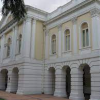
You and I all know this, it was in the textbooks we read in school; and from those colonies arose the nations whose passports we individually carry, whose flags we salute and wave with pride, and whose anthems we sing in languages our colonizers considered unfit for political consumption. Around us continue to stand monuments to imperial self-satisfaction and permanence, now reduced to whitewashed artifacts of antiquarian, mainly tourist, interest. And inexorably in our nations the buildings of truly Roman braggadocio ‘because such clearly structural representations of pretentions to Roman-inspired imperial cultural pride- have been reduced, as this building has, to enclaves where the past is preserved but no longer exclusive enclaves where all the truly momentous decisions are made. Those decisions are now made in postcolonial-era towers of glass and steel, by young men and women under the watchful eyes of middle aged men and women who have never known what it was like to be a colonial subject.
And yet, the era of direct foreign rule was not so long ago, that it has passed beyond living memory. There are still quite a few among us who were born and raised the subjects of a foreign power. To be sure, to still be with us, means that they were only in their teens or at most, in their twenties or thirties at that time; but they can all remember that defining moment when the flag of the foreign power was finally lowered and the new flag of a new nation hoisted, waving alone over territories over which the imperial or colonial sun was never supposed to set.
In 1939, my grandfather, then President of an autonomous republic four years into what was expected to be a decade-long transition to full independence, remarked in a speech that he wondered what would happen once the unifying influence of the independence cause was lost. With independence, he asked, would the various ethnicities then resume squabbling among themselves, according to loyalties that had predated the colonial powers and whose rivalries and jealousies the colonialists had so superbly harnessed to -as the Romans put it- “divide and rule”? His answer was to centralize authority, to build an army, to create a one-party state and to focus public attention on spectacles of state: parades, speeches, flags, anthems, banners, slogans. To begin refocusing the energies of the rulers and the ruled, onthemselves, since the others, the foreigners, were scheduled to depart the scene.
Yet two years prior to his inauguration the first popularly-elected President of his country, the British and the Americans had concluded a treaty further refining the territory between the Southernmost territories of the Philippines and the British territories in Malaya and Borneo. Thus it was, for the Filipinos that their national territory was defined by the colonial powers: as it would be for the Indonesians, as it would be for the Malaysians, the Singaporeans, the peoples of Laos, Cambodia, and Vietnam, and to a certain extent, the Thais with relations to the Burmese.
Much has been made of Benedict Anderson’s thesis that nations are fundamentally “imagined communities,” but for us Southeast Asians, at least, and to a certain extent for all Asians, particularly East Asians, we are all geographic expressions, trying to translate our vernacular cultures and identities into the high language of state and statecraft, imposing reason into often unreasonable -because arbitrary- negotiated borders arrived at without either consultation or reference to our precolonial histories. As it was in the Empire of India, about to be cleft, in twain, between India and Pakistan, and where the borders between the two was being penciled in on a map by Sir Cyril Radcliffe, literally lives and treasure on the line -a British-drawn line to the end!
Still: if, for prestige and profit, the region had been subdivided and parceled out among the great and mediocre powers of the West, it was in each parcel that there germinated and thus, sprouted, the concept of a national identity.
My grandfather’s anxiety over whether the often fractuous independence movement of his country could survive the sobering reality of independence was not unique; what he could not foresee was that after the formalities and full panoply of independence was achieved, our respective Asian countries all then began to wrestle with another struggle altogether, the fight against Communism. And after that, or to be precise, inspired by that ideological fight, another preoccupation became central in the minds of what I call our independence generations: the question of social order and material progress.
When Suharto of Indonesia died, Lee Kwan Yew of Singapore went to pay his respects; Mahathir of Malaysia paid tribute, too. The elaborate courtesies they exchanged were courtly; and criticized in the West as a kind of last hurrah of Asian Values, the exact sort of values the West of course viewed as essential during the heyday of these statesmen: but the era of statesmen seems to have passed, and in its place we have the much more modest or perhaps it is more accurate to say, definitely merely as large-as-life, politicos-cum-technocrats of today. In all our countries, the passing of a Suharto, and the shuffling out of official retirement of a Lee or Mahathir, is worthy of a kind of momentary pause; I daresay we all gawked at the goings on during those Indonesian state obsequies, because we fully well know no such political giants shall ever walk our respective lands again -whether we loved them, feared them, hated them, admired them.
These men -and they could only have been men, in their times and respective places- were statesmen in the broadest sense of the word; with the exception of Lee, they were more properly the heirs of the generation that had actually secured independence, but they were the generation that had turned the formality of sovereignty into a living and functional reality. They also had the advantage, in the main, of political longevity, and thus an unrivaled -and possibly, unsurpassable- record of institutional incumbency. Marcos was as to Quezon as Suharto was to Sukarno, and as Mahathir was to Tunku Abdul Rahman, or even as Indira Gandhi was to Pandit Nehru. The transformation of colonial government and territory to national state and national territory may have been for the first of the independence generations to achieve; the transformation of that state into a nation: it may be that for better or worse, it was the second of the independence generations that achieved that, with leaders creating what Pierre Bourdreau described as a “State Nobilityâ” for each country: those we like to call, in more pedestrian fashion, technorats.
With independence achieved, the Cold War at an end, in many cases the economy either transformed or permanently stunted, whether rich or poor, groaning under poverty or enjoying unprecedented prosperity, Asians, in particular Southeast Asians, have run out of causes to which entire peoples can find a collective reason for being in unity with their leaders. Is it no wonder then, that in countries where prosperity has eluded governments, or where political legitimacy is fragile, two, sometimes three, generations after independence, literally prehistoric from the perspective of our present nation-states- campaigns are launched, whether on the ground or simply in the feverish imaginations of rabble-rousers?
Claiming temples, disputing the old colonial boundaries, encroaching on modernity by disputing bedrock principles of the modern nation-state, like secularism, and challenging notions of national identity by repeatedly invoking the communitarian, sectarian, and ethnic divisions of old: all are, in a sense, the rituals and aesthetics of what the present-day State Nobilities in the clubs, churches, and schools of that nobility, consider the primitive, the dangerous, the subversive. And, alas, the thrilling and inspiring for everyone else. A specter is haunting Asia, to freely borrow the tired old rhetoric of Karl Marx: it is the specter of militant theocracy. But this is, in many ways, truly Asia, with all due respect to the Malaysian tourism authority. For it is the Asia of emperor-kings, riding on war elephants, where those God-like kings trampled the alien neighbor, and where the rulers and ruled were united in fealty and tradition; and where the world, in a word, operated to the true rhythms of nature and not the enforced, artificial, distinctions of Western time and the calendar of the secular state.
So long as you could remember what it was like to see your part of the world considered yet another province, colony, protectorate or even department of a foreign metropolitan power, the incentive for you to set aside difference with your neighbor in recognition that ultimately, to the foreign ruler, they saw no differences among you except that you were all inferior, was irresistible. You would speak more eloquent, elegant English or French; you would learn Latin and the law, you would master metallurgy and engineering, you would learn military tactics and political economy, you would draft a constitution, design a flag, make speeches, write books, sing songs, declare loyalty that set yours apart from what was expected of you by the Governor-General, the Regent, or the puppet emperor.
You would fiercely defend that against the Japanese, against returning colonialists, against Marxists; you would come up with plans superior to any Socialist Five Year Plan, you would have children who knew not hunger, nor thirst, nor malaria nor beri-beri. We have, to a certain extent, even in the poorest of our respective countries, accomplished all that; and yet, for the generations who never knew that, there is, -what?
When Megawati Sukarnoputri became the first President of Indonesia not to have been born a colonial subject, I found it a truly remarkable thing. And even more remarkable, to me, was that Gloria Macapagal-Arroyo is only the first president my country has ever had, who hadn’t been born under a foreign flag. Chances are, for my country, the next head of state would also have been born a free Filipino, just as Megawati’s successor, Yudhoyono, was also born a free Indonesian -indeed, born in the year the former colonial power reluctantly recognized his country’s independence. Whether one speaks of Najib or Anwar in Malaysia or Lee Hsien Long in Singapore, the inevitable transition to a purely post-independence-born leadership is at hand; and everywhere else, the generation of the War, the veterans of long marches and Dien Bien Phus and even of Khmer Rouge, are passing from the scene.
Just as many of the bright, well-fed, well-educated, well-accomplished of the generation of their sons and daughters and grandchildren are passing from the scene -passing from the national to the international, from the domestic to the global; inspired not with nationalist yearnings but globalized appetites for the glitter of career and its material manifestations. There is no thrill in anthem, no particular stirring invoked by flag, certainly nothing but a skepticism in the concept of army or national service, no attitude towards the state and the law but hurdles to overcome, in this and these generations. The blessings of indepence seem so mixed, so hollow, in this sense: of a failed promise for countries like Indonesia and the Philippines, where nationhood is an obstacle and it seems, often an imposition; of fulfilled promises but one which has been superseded by personal ambition, in the case of Singapore or even Japan, where the countries have material prosperity but are grappling with the frightening possibility of being unable to, literally, procreate to continue the family of the nation.
Ask any Asian and I think you will hear them say, our respective nations all face problems. The problems may differ, as I pointed out, but they all point to a similar phenomenon of a political and administrative, educational and entrepreneurial, class of leaders all wondering why their sons and daughters would rather live elsewhere than at home.
There is no consensus on what to do, not least, because increasingly, consensus seems more and more difficult to reach in these countries.
The problem of arriving at a consensus is more serious in some places than others: it may be, the longer the history, the more difficult consensus is to reach.
There is no consensus, in the Philippines, for example, on our national beginning. There is little consensus, on where the Philippines is, though a broad but shallow consensus that the Philippines has not met its national potential. There is even less consensus on where the Philippines ought to go, much less where it’s headed. Though being the perennial optimists that we are, thee seems no consensus that we are or will be, a failed state.
But then, consensus seems more and more impossible in Thailand, which has never formally been under foreign rule. And the old certainties of one party rule seem more and more endangered ‘and the consensus-building within the political class, more and more tenuous and thus, fragile- are vanishing in Malaysia.
But what we have are young people armed with truly astounding practical gifts, incredible mastery of tools and machines, and who now instill a kind of terror in the West that the West used to instill in our forefathers; where the West once sneered at us as old, tired, degenerate cultures, now our young people can sneer at the West for the same things -yet irony of ironies, the baubles of Orientalism now have their equivalents in our young and their Occidentalism.
And everywhere, it seems, whatever the economic accomplishments or lack of them in nations considered Asian, a problem confronts nations that are embarking on anywhere from their second to third generation of existence as independent nations. We all have a nationality; a defined sovereignty; an entrenched political class. All under leaders who are, themselves, products not of the colonial era, but of the nationalist regimes born out of that era. For the first time in our own individual national existences, a majority of both the leaders and the led have no living memory of what it was like to be colonial subjects or be pondering either the desirability, or inevitability, of a sovereign national existence.
Was it all a Pyrrhic Victory, then? We have independence, but the free peoples of the East now want to make a living as freely as possible -or sometimes, unfreely but profitably- in the West? And even as our our best and brightest desire to go elsewhere, who is left? Those that never bought into the concept of Western time with its linearity, its evolutionary aspirations, its developmental and institutional delusions? They seem to be ever-growing, ever-demanding, ever-headed for a direct confrontation with the state and its institutions.
The techocentric concern of governments: as was demonstrated in Meiji Japan and Kuomintang Taiwan, industrialization superseding the development of a civil society can result in either a nation of drones marching to destruction or to a despotism accomplishing material comfort for all, to allow the former despots to become mere politicians. We overlook the essential flaw in the design -because the design of our respective states conform to the clockwork mechanism views of polities, politics, and peoples in the era of the Enlightenment, with its underlying assumption that nations fully adept at engineering then become capable of transformations that improve, and do not wreck, the body politic.
On one hand in nations where the blueprints are beautiful but the executions is slovenly or where the design and execution really have zero tolerances for human error, the end result is the same. Millions taking to planes and making plans in a manner their ancestors long ago would have found similar, as they embarked on finding new homes in new lands, and by so doing became the mythical founders of our respective imagined or shall we say, arbitrary and accidental nation-states.
Singapore has wrestled with this problem, of technological proficiency versus the imagination -and yet the imagination, political and social creativity, with their necessary ferment, create not a new problem, but a new concern: that imagination and initative are antithetical to the orderly industrialization so craved and sought as a measure of national success and stability. The Philippines on the other hand, sees its evolution in devolution, in ignoring the grandeur of even imagining a nation-state, but instead, adoring the domestic, the local, even the feudal: autonomy under caudillo democracy.
However in the end it is the legalism and legalities of nationhood, the bureaucratic trappings of nationality, that are inescapable: passport, identity card, they are what we are born to, and what, if necessary, we must exchange, but which we cannot escape producing, whether in East or West. The documents of colonial control, refashioned, redesigned, but ubiquitous: they continue to circumscribe what for all of us, are our national identities and the tangible signs of that identity
The worm within
November 26, 2008 by mlq3
Filed under Daily Dose, Events Mode, Quezoniana
This will be my only entry for the rest of this week, as I have to clear the decks and prepare for Asia on the Edge in Singapore this weekend. If you’re there, you may want to attend some of the Thought Leaders activities.
The news has now shifted from the killing of impeachment to the Palace game plan on amending the Constitution. After all, it seems RP Elections 2010: The Election Watchblog, might either be an exercise in futility, or a premature one until pending matters are resolved.
On November 11, I wrote of the Poisoned fruit of the Constitution. Instead of incrimental, confidence-building reforms, one problem is that officialdom is immediately going whole hog without the public being in the know as to what, exactly, is being proposed -or if there are any limits.
But I’d like to put forward a survey of past Charter Change efforts as a guide to ongoing debate on Charter Change and ask, along the way:
1. What makes for a succesful Charter Change effort? More Charter Change efforts have succeeded than have failed: 1939, 1940, 1947 all succeeded, and 1967-1971 (to get a convention going) worked; ; 1976-1986 amendents all succeeded; 1987 succeeded.
2. What dooms Charter Change to fail or at least, imperils it? 1973 worked due to force majeure and legal legerdemain; 1997-98, 1999-2000, and 2005-2006 all failed due to public protests, defeat in the courts, or both.
In general, what is remarkable is that Constitutional Change is viewed as some sort of magic pill to cure the illnesses of the country.
When Adrian Cristobal died, it seemed to me that he and his fellow intellectuals who served Ferdinand Marcos brought forth the only real game in town, other than Marxism-Leninism-Mao Zedong Thought. And that is, the idea of a New Society, a Bagong Lipunan. Though both are essentially two sides of the same Year Zero coin.
May bagong silang,
May bago nang buhay,
Bagong bansa,
Bagong galaw,
Sa Bagong Lipunan.Magbabago ang lahat,
Tungo sa pag-unlad,
at ating itanghal,
Bagong lipunan!
From the Right to the Middle,the -or a- New Society is the dominant perspective to this day: the idea that there is an Old Society and that it is possible -and desirable- to institute a New Society. This goes against traditional notions of nation-building as an evolutionary process.

The President is a product of history, in her case, a thoroughbred history, and the various members of the ruling coalition partake, too, of that thoroughbred history, with its own dynamics.
let’s look back at why the populace is often so hostile to any proposals to amend the Constitution. You can see contemporary attitudes reflected in Daily Musings and A Simple Life.
From the very start, our efforts to establish and live under constitutional government have been constrained by events. Let me suggest is that the reason is the public generally takes a reverential attitude towards the law, while the political class, because of its colonial experience, takes a more fluid, tactical approach while maintaining an outward reverence that’s necessary both to keep in step with public expectations, and because that reverence is required to maintain public order and security.
Yet there are times when the public is confronted by what it perceives to be a divergence in its attitudes between the public itself and its leaders.
When the Revolution began, it was under the auspices of a secret society, the Katipunan; dissatisfaction on the part of established provincial leaders, used to a more orderly and legalistic manner of doing things, led to the elimination of that secret society and its replacement with a series of nominal republics until the Revolution could be resumed against Spain; but attempts at establishing a fully-functioning state with a true national reach was aborted, in turn, by conflict with the United States.
Under American rule, Filipino leaders, more often than not, also called to the bar, had to walk a kind of tightrope: by training and instinct they were oriented towards the law; by avocation and even ambition, they were tasked with undermining that law, or diverting it to ends not intended by the colonial ruling power. Yet the ultimate means to replace one regime with another -armed force- was not an option for a generation and a people who’d lived through the defeat and trauma of the Filipino-American War. So they did it by fundamentally playing within the rules but pushing the envelope as much as they could.
In 1923, Manuel Roxas was quoted by Time Magazine as saying,
We have encroached upon the rights of the Governor General because in that guise liberties are won.
This admission that they were out to subvert the powers of the American governor-general was nothing unique or surprising for it was the bedrock of other independence efforts, such as the Congress Party’s independence agitation in India. Your allegiance to the law and logic of an alien power extends only to such allegiance being convenient to your ultimate cause, independence from that alien power.
Of course, the perspective of a lawyer, however incendiary his rhetoric may be, is different from that of the ideologue, the bobm-throwing revolutionary; in that sense the Nacionalista Party’s leaders in the Philippines were closer in attitude to temperament, tactics and objectives to Mohammed Ali Jinnah than they were, say, to Gandhi (Gandhi would only become relevant to a later generation, as Ninoy Aquino’s embracing of Gandhian tactics during martial law demonstrated). See Stanley Wolpert’s summary of Jinnah’s life and ideas.
Yet as American historian Joseph Ellis recently pointed out in his book Founding Brothers, the problem of any generation self-consciously embarked on establishing a new nation, is how to dismantle the old system on one hand, while establishing firm foundations for a new state. The danger of any revolution, whether violent or peaceful, is that it plants the seeds for an endless cycle of revolution and rebuilding.
In the 1935 Constitutional Convention, as Teodoro M. Locsin recounted (quoting another writer),
Among the delegates there were, as one writer pointed out, “blue-blooded nobles from the Moroland, trained intellectuals from world-famous colleges and universities, religious leaders and moral crusaders, political moguls and parliamentary luminaries, eminent educators and outstanding jurists, revolutionary generals and World War veterans, business entrepreneurs and banking magnates, opulent hacenderos and small planters, noted writers and famous orators, wealthy landowners and indigent professionals, and former school teachers and actual university professors.”
Yet nearly all had memories of the Revolution of 1896 and the Republic of 1898, of the Filipino-American War that followed. How, then, to establish a government that would endure? See Constitution Day, February 7, 1953.

The debate over amending the 1935 Constitution took place over five years, practically from the ratification of the charter until amendments were finally accomplished and ratified in 1940. During that period, three main points emerged and it’s interesting that the three main points -the issues- have remained consistent over time. It’s important to note, and this is often overlooked, that before World War II, two main branches, or approaches, to constitutional amendments emerged. The first was economic, the second, political and structural.
With regards to the economic provisions of the Charter: For a kind of prologue, refer to Some free trade nonsense, April 3, 1909. See Committee Thrashing Out Details of Independence, December 24, 1932 and ; how the Philippine economic lobby operated under Joaquin Elizalde in the late 30s; how this framework evolved: and my own article, Institutionalizing state interventionism.
See Primer on the plebiscite, October 21, 1939. which provides a rundown on the economic questions put before the people.
With regards to the politico-structural debate, they centered, in turn, on two debates:
1. The term of the chief executive:
2. Unicameralism vs. Bicameralism:
Economic provisions proved less contentious, before the War, than political provisions. The first glimmerings of public opinion by means of polling began could be seen in the national debate over term limits and the restoration of the senate.
So then the issues having been joined, the question was how would the administration accomplish its objective of amending the Constitution?
One of the most interesting political autobiographies I’ve read is Jose E. Romero’s Not So Long Ago, now sadly out of print. In Chapter 11 of his book, he recounts the circumstances surrounding the amendments of 1940. His recollections provide an insight into how such proposals arise, and the rollercoaster ride such proposals go through before they reach fruition.
He begins by pointing to the problem faced by the Nacionalistas, who had established, for the first time, in 1938, a complete and total dominance of the legislature. And their natural worries that by 1941, that party dominance and unity might be fractured by fighting over the successor of the incumbent:
Midway in his term of office [1937-38], the inevitable speculation as to President Quezon’s successor and the beginning of the stirrings of the potential candidates began. Of course everybody realized that President Quezon would determine the choice of his successor. Vice-President Osmeña was a logical choice. President Quezon had given him some encouragement, but he also encouraged Mr. Roxas and, it seems, Speaker Yulo. At one time he even considered the possibility of a compromise candidate, and I remember his mentioning Teofilo Sison, who was then Secretary of the Interior and who had done a good job in that important position and also as Governor of the big province of Pangasinan. Mr. Osmeña who as I said was the most logical successor, had often been unfortunate politically. On the one hand, his ambition was opposed by the leaders of the National Assembly, Speaker Jose Yulo and Floor Leader Quintin Paredes. The peculiar situation had arisen that while all the different factions were reunited under the leadership of President Quezon, the cleavage between the former Quezon followers and the followers of Osmeña and Roxas had persisted. There still was rivalry and mutual suspicion between the ANTIs, who had followed President Quezon in the fight on the Hare-Hawes-Cutting Independence Act, and the PROs, who had followed the leadership of Osmeña and Roxas. Now on top of the opposition of the ANTIs, Mr. Osmeña had to reckon with the opposition of his erstwhile ally, Mr. Roxas. When Mr. Osmeña would press his claim on President Quezon, the latter would tell him that he would have to have an agreement with Mr. Roxas. Mr. Osmeña would tell President Quezon that Mr. Roxas had assured him that he had no ambition for the position himself, but Mr. Quezon would smilingly tell him that he should get an iron-clad assurance from Roxas because the latter had given him to understand otherwise. It was quite obvious to me that President Quezon was playing one against the other as the threat of disruption of the United Nacionalista Party would inevitably give rise to a movement to draft President Quezon to prevent such disunity. Either their ambitions had blinded Messrs. Osmeña and Roxas to this strategy or Mr. Roxas actually preferred the reelection of President Quezon to Osmeña’s succession to the office.
The solution, as Romero pointed out above, was to maintain the status quo; but that political objective had to be couched in terms more appealing to the public than merely preserving party dominance:
So it was that the movement was started to draft President Quezon. One day, he appeared before the National Assembly together with the members of his Cabinet. He told the members of the Assembly that he could no longer ignore the movement to amend the Constitution to permit his reelection; that what he was particularly interested in among the proposed amendments was the one reestablishing the bicameral system of legislature; that as to the proposed amendment to permit his reelection, he would only consent to this provided that at the same time a provision was adopted limiting the term of office of the President to not more than eight years, following the example of George Washington.
Yet there remained the problem of how to maintain that status quo, without provoking a new split in the ruling party:
As soon as President Quezon left the session hall of the National Assembly, the Assemblymen held a caucus to discuss the proposed amendments, and if a vote had been taken that same evening the proposal would have been rejected.
I called the attention of my colleagues to the fact that the President had just told us that he would be receptive to the amendment permitting his reelection with the proviso he stipulated and for us, immediately after his speech, to reject the proposed amendments might be taken as a slap in the face. I suggested that we take a little time to consider this very serious matter and go about it in the most tactful manner. I was promptly seconded by Assemblyman Pedro Sabido, and the meeting was adjourned.
This gave the proponents of the amendment time to do some arm-twisting, and by the time the matter was taken up again, the majority had shifted in favor of the proposed amendments. Regarding this arm-twisting, Assemblyman Tomas Oppus, the Chairman of the Committee on Appropriations and one of the wittiest Assemblymen, described the situation in his inimitable way in a story he told his colleagues. He and his colleagues had asked the directorate of the Party if they could vote freely on the amendments since this was a matter of conscience, involving as it did the fundamental law of the country. The party leaders replied that the party had taken a stand on this question and that while they were free to vote in accordance with their own conscience, the party would take a dim view of their reliability as party men.
The situation, said Oppus, was like that of a little boy who asked his uncle if he could go to the show. The uncle said he could do so but that when he came back, he would get a whipping. “That,” said the little boy, “means I cannot go to the show.”
Romero then describes how the leader concerned, Quezon, set about finding out how public opinion -and his allies- would react to his extension in office; arm-twisting in such a case, wasn’t enough; conviction, not compulsion, was essential if public opinion was to be won:
Still, the President was bothered by what history might say of his part in the approval of the amendment to permit his own reelection. He organized a group of nine men that he considered his close friends who could wisely advise him as to whether the amendment to permit his reelection should be presented. I can easily remember those who composed this group because there were four Joses in it -Jose Yulo, Jose Abad Santos, Jose Laurel, and Jose Romero. There were two Manuels -Manuel Roxas and Manuel Briones (three, if President Quezon, who was always present in spirit, was to be counted as member of this group) and there were Claro Recto, Quintin Paredes, and Pedro Sabido. We were made to promise not even to mention the existence of this group. We even agreed not to arrive together at the place selected for our meetings, which was the office of the Chairman of the Board of the PNB, the Chairman then being Secretary Abad Santos. At one of these meetings, Dr. Laurel said that if he had his way, he would not touch a comma of the Constitution. Eventually, however, Dr. Laurel and the rest of us would line up behind the proposed amendments. After thorough deliberation, we took a vote. The vote was four in favor and five against. Those who voted in favor were Abad Santos, Yulo, Paredes, and Roxas. Those who voted against were Recto, Laurel, Briones, Sabido, and I.
I really thought that with President Quezon already bothered by compunctions as to the move he was about to take, this majority opinion against the proposal expressed by men whose loyalty and wisdom he reposed confidence and whom he had called on to give their honest opinion, would deter him from proceeding with the proposal. In any event it did not turn out that way. In later deliberations of the party caucus, the proposed amendments were approved.
Romero then recounts how lobbying was done, one-on-one:
I hied myself off to Malacañan and was immediately taken to his office. “Romero,” he said as soon as I was seated, “I wish I had died before this question of my reelection arose.”
I was shocked. I told him I saw no reason why he should be so concerned with the problem, that the great majority of the people were behind him, and that they would accept whatever decision he made. As I have said, I knew that he had been bothered about the moral issue involved and about his image in the future being tarnished with the same brush of ambition that characterized most of the presidents and dictators of the banana republics. But I did not imagine that this would worry him so much that he preferred to have died before he could face such a problem…
He said that now he was doubtful whether he should encourage the movement for his reelection… I asked him if he would take it as a lack of of affection and loyalty towards him if we started an opposition to the proposal. He said that we could go ahead and spearhead such an opposition. He suggested, however, that the term of office of the next President should be reduced to four years without reelection…
Everyone having been consulted and heard, the time then came for the enforcement of party discipline:
As I was entering the session hall of the National Assembly a few hours later, I was met at the aisle by Speaker Yulo, who asked me what it was that I had told President Quezon which made him change his mind. I narrated the whole story, but the Speaker was adamant, and he said he would proceed with the campaign for the approval of the amendments irrespective of President Quezon’s desires. I told him that the process of amending was not easy as we needed only a few votes to defeat the proposed amendments. At that time we were adhering strictly to the interpretation that questions had to be approved by three-fourths of all the members of the National Assembly, and not only of those present. There were many vacancies at that time in the National Assembly, mostly due to the appointments in the Executive Department, and a mere twenty votes either voting against or abstaining from voting or absenting themselves would defeat the proposed amendments. I told the Speaker that I had the President’s permission to oppose the amendments and I thought I had the votes to succeed in our opposition.
I began getting the signature of those opposing the amendments. Many assemblymen were wary about signing although, at heart, they were opposed because of their regard for, or more candidly, fear of President Quezon. I assured them I had the President’s permission and they signed on condition that they were assured that the President really had no objection to our move. Predictably, the Assemblymen from Cebu and from Capiz were among the first to sign. Thereafter, others followed and I thought I had the required number of votes to defeat the amendments. The leadership of the house, seeing we were making headway, appealed to President Quezon to ask us to withdraw our opposition. This came about one night, at a gathering at Manila Hotel when everybody who was anybody in politics was in attendance. I was surprised and flattered when, leaving all the other political moguls, the President took me by the arm to a corner. He began by asking me if my political antagonists in my province were still bothering me. I told him they were still preparing the ground against me in the next election. He told me I had nothing to worry about for, if need be, he would go and campaign for me. Then finally, as if incidentally, he said that as regards the matter of the amendments, the leadership of the Assembly had committed themselves too deeply, that their prestige was involved, that that he was therefore requesting me to withdraw my opposition to them.
As I have already said, the opponents signed the agreement on condition that really President Quezon was not interested one way or another in the approval of the amendments and so, naturally, when I told them about the final word of the President, the whole movement collapsed…
These extracts indicate the dynamics at work both among legislators and between legislators and the chief executive; in three generations, the dynamics have hardly changed.
The issue of party solidarity having been resolved, what was taking place in private could now unfold in public. See United behind Quezon, July 15, 1939 which identified the way the various proposals evolved into a menu of proposed changes:
“AYE!” With a tired roar that echoed hollowly in the dark bowl of the Rizal basketball stadium in Manila, one night last week, the Nationalist party convention approved the proposal to amend the Constitution, so as to allow the reelection of the President.
“Nay!” A half-hearted and scattered cry in opposition went up, after hours of resounding but futile debate.
An undisputed majority sent up an “Aye!” again, the following morning, approving another amendment, to revive the old senate.
The “Nay!” was even weaker.
For three days and nights last week, the party which rules the country met in the stifling shadow of a gathering typhoon to deliver itself of a series of historical mandates to its members in Malacañan, in the Assembly, in the cabinet, in every important office of the government. The mandates, expressed in resolutions, were to:
1. Change the Presidential term from one six-year period, to two four-year periods;
2. Revive the old bicameral legislature;
3. Create an administrative body to take charge of all elections;
4. Revise local governments to make them more, responsible and efficient (presumably, along the lines of the Quezon plan for appointive mayors and governors);
5. Readjust the three-year terms of assemblymen, provincial and municipal officials, so as to make them fit the new four-year presidential term;
6. Reaffirm loyalty to the coalition platform, including independence in 1946;
7. Request President Quezon to call a special session of the Assembly;
8. Ratify Presidential and Assembly action on the JPCPA report;
9. Congratulate President Quezon for his social justice program, and to request him to remain in office (that is, take advantage of the reelection amendment);
10. Congratulate Party President Yulo for his handling of the convention;
11. Increase the representation of governors in the Nationalist executive commission, from five to 12, thus putting them on a par with the Assemblymen.
The whole menu being called, by Speaker Yulo, a series of “Conservative Reforms,” which were opposed by one Assemblyman as going against public opinion(see Free Press straw vote will feature reelection, May 6, 1939. according to the October, 1939 article above, public opinion, as expressed in the poll, opposed re-election).
A year later, in 1940, the amendments had been boiled down to four:
1. Changing the President’s term from six years, no re-election, to four years, with one relection, with a special election in 1941 qualifying the incumbent to a two-year extension to make for eight years; furthermore, the change in the President’s term was reflected in the proposed lower house, making the terms of representatives and local officials 4 years instead of three years, while senators would be elected for 6 year terms.
The argument of the “indispensible” man was put forward by Quezon himself, as a signal to his partymates that their forty year old one-party dominance (in the 1938 mid term election, for the first time, not a single opposition Assemblyman had been elected) might be imperiled on the eve of independence:
“The only thing that I am afraid of,” he confessed, “is that after I leave the presidency the country may be divided, not along political lines, but on the choice of my successor. The country is not prepared for a great division among our people.”
2. Restoring the Senate but on a purely national basis; unicameralism had only won out in the 1935 Constitutional Convention because the bicameralists were divided on whether the Senate should be elected according to districts, as was the case under the Jones Law, or nationally. (One compromise no one has noticed is that the restoration of the Senate came at a price: the Congress of the Commonwealth and the Republic would both have a Commission on Appointments composed of congressmen and senators, in equal measure, a deviation from the Jones Law and American practice that puts the vetting of executive appointments strictly in the hands of the Senate. Further research, I think, might reveal that this was a very clever move to make assemblymen agree to diluting the powers of their chamber, while ensuring that no Senate President would be able to wield the powers Quezon had so effectively wielded in fighting the American governors-general by threatening to reject the confirmation of appointments. The always-pliable House would at least be able to obstruct any senatorial inclinations to put a squeeze on appointments: thus, while future Senate Presidents would always look back to the 1916-1935 Senate as a blueprint for their presidential ambitions, in truth, the 1940 setup makes using the Senate Presidency as more than a rhetorical podium a structural impossibility)
3. Establishing a Commission on Elections: combined with bloc voting, this made for the kind of equity of the incumbent that remains a reality in other Southeast Asian countries; removing bloc voting in the early 1950s, however, began a quarter century of erosion that led to the parties being unable to stand up to Marcos in 1972; and the multiparty system, in turn, has entrenched executive influence on national elections but in terms of a single person and not a ruling party, which reconfigures with every new presidency.
4. (Actually accomplished, separately, in 1939) approving the amendment of the Tydings-McDuffie Act to establish preferential trade relations with the United States up to the 1960s.

The amendments were approved in a national plebiscite. See Prelude to Dictatorship? Monday, Sep. 02, 1940 for Time’s account of the campaign for amendments in the context of the Far Eastern situation, and Bedroom Campaign: Monday, Nov. 24, 1941 (where block-voting was first practiced) for an account of the amendments finally operating for the first time: and the establishment of what, if the war hadn’t intervened, would have been a political system very familiar to the Malaysians and Singaporeans today (hency my belief that the Philippine experience since World War II has been a tug-of-war between our political class, whose instincts and preferences aren’t far removed from their peers in Malaysia and Singapore or even Japan, and the public, increasingly Western or at least broadly populist in its political actions and orientations; hence the constant frustration of the political class, which has failed to return to the comfortably setup envisioned before the War but came quite close to it in under martial law).
What the ideological and political development of the Commonwealth would have been if uninterrupted by the War, is perhaps best explored by the French historian William Gueraiche, reflecting the most recent scholarship on the subject.
Get your own at Scribd or explore others: Politics US Federal language philippines
But the War took place, proving that the best laid plans of mice and men can be derailed.The country had been poised, more or less, to make a smooth transition to independence prior to the War; but in a matter of a few months, the country was devastated and its infrastructure wrecked. The generation that reached adulthood during the Spanish era passed from the scene. The first generation that reached maturity under the Americans were now at the helm.

With independence finally taking place under Roxas, and with the issues of the president’s term and the legislature’s composition having been settled in 1940, the question of economic provisions once more emerged, this time on the basis of the destruction of the economy and infrastructure.
See Economic Relations with the United States:
The most controversial provision of the Bell Act was the “parity” clause that granted United States citizens equal economic rights with Filipinos, for example, in the exploitation of natural resources. If parity privileges of individuals or corporations were infringed upon, the president of the United States had the authority to revoke any aspect of the trade agreement. Payment of war damages amounting to US$620 million, as stipulated in the Philippine Rehabilitation Act of 1946, was made contingent on Philippine acceptance of the parity clause.
The Bell Act was approved by the Philippine legislature on July 2, two days before independence. The parity clause, however, required an amendment relating to the 1935 constitution’s thirteenth article, which reserved the exploitation of natural resources for Filipinos. This amendment could be obtained only with the approval of three-quarters of the members of the House and Senate and a plebiscite. The denial of seats in the House to six members of the leftist Democratic Alliance and three Nacionalistas on grounds of fraud and violent campaign tactics during the April 1946 election enabled Roxas to gain legislative approval on September 18. The definition of three-quarters became an issue because three-quarters of the sitting members, not the full House and Senate, had approved the amendment, but the Supreme Court ruled in favor of the administration’s interpretation.
In March 1947, a plebiscite on the amendment was held; only 40 percent of the electorate participated, but the majority of those approved the amendment.
What is significant in the 1947 Parity Amendment campaign were two things:
1. The first time an assassination attempt was made on a President (a crazed barber, as it turned out, not a full-scale plot; but a close call nonetheless for Roxas at Plaza Miranda).
2. The removal of enough opposition congressmen and senators (on charges of fraud and terrorism) in order to obtain the votes required to propose the amendment to the people.
See Time’s Two Freedoms, Monday, Mar. 24, 1947 for a contemporary overall report and Report on the Plebiscite, April 5, 1947 for a report from the critics of the plebiscite.
Death had prevented Roxas from seeking a second term and possibly, uniting the Liberals and Nacionalistas and restoring the one party system carefully built up prior to the War. Roxas’s death put the presidency in the hands of Elpidio Quirino who became the first president to face an impeachment effort and who was unable to unify his own party, much less consolidate power to the extent he could envision a restoration of the prewar, one party system.
But his defeat at the hands of a charismatic protege -Ramon Magsaysay- meant that the old instincts to unify under one party government could reassert themselves. Magsaysay himself had reached maturity in the prewar years, was an admirer of, and consciously modeled himself in terms of how he wielded executive powers, on Quezon (this is often overlooked by those attempting to describe his government). See The “dictatorship” of Ramon Magsaysay, October 15, 1955.
Ramon Magsaysay was poised to run for re-election in 1957 as the combined candidate of the LP and NP; his reelection, had it taken place, would then have confronted the country with a question set aside only by Quezon’s death in 1944 and Roxas’s in 1948: what then, after the President’s succesful re-election? An amendment to allow a third term?
Of course Magsaysay died in 1957 and with his passing, instead of what seemed an inevitable return to the prewar single-party system, the country lurched, instead, and it seems to me, quite accidentally, in the direction of a multiparty system; Carlos P. Garcia was elected as the first plurality, and not majority, president in the country’s history. Garcia remains under-appreciated, or more accurately, under-studied, in terms of his institutional and political influence on the development of the presidency. He wrestled with questions that have become par for the course for post-Edsa presidents: how do you govern without a majority mandate? How do you wage a campaign if you lack charisma and popularity?
This man beside Magsaysay, Ferdinand E. Marcos, would set out to accomplish what was probable under his predecessors but which fate had intervened to foil. Marcos was ten years younger than Magsaysay, so less thoroughly steeped in the unselfconscious pro-Americanism of Magsaysay’s generation; was more ambivalent about democracy perhaps and definitely, Marcos was fundamentally different from Magsaysay in that FM was steeped in the fraternity power-culture of the prewar University of the Philippines, and had an entirely different and again, ambivalent experience during the War years.
Of Marcos what has insufficiently been written about, is how he grew up in the closing years of the American colonial period, but at a time when leaders were attempting to lay out the premise for a political development that consciously deviated from the American experience. Quezon had begun the building of an Army as the “backbone of the nation,” had proposed “partyless democracy,” had put forward the need for a national ideology, which Jose P. Laurel, one of those who’d been drafted to come up with those ideas, during the Japanese Occupation actually tried to undertake. Thus were the intellectual foundations laid for what Marcos would later describe “Constitutional Authoritarianism”. In Laurel’s 1943 Inaugural Address, there are three passages of particular relevance.
First,
In the ultimate analysis, all government is physical power and that government is doomed which is impotent to suppress anarchy and terrorism. The Constitution vests in the President’s full authority to exercise the coercive powers of the State for its preservation. In order to make those powers effective, my administration shall be committed to the training, equipment and support of an enlarged Constabulary force strong enough to cope with any untoward situation which might arise. Certainly, everything must be done to forestall the indignity and humiliation of being obliged to invoke outside intervention to quell purely internal disturbances.
Next,
Without political consolidation, we cannot hope to accomplish the desired integration of our political, economic, and social life. The abolition of political parties is a desirable feature of the military regime which we must conserve especially during the formative period of our Republic. Political parties have divided us in the past and we should avoid the recurrence of our sad experience. We must eradicate the baneful influence of factional strife and strike at the very roots of partisan spirit. I shall stand for no political party while I hold the rudder of the ship of State. We must serve, only one master-our country; we must follow one voice-the voice of the people. We must have only one party, the people’s party, a party that would stand for peace, for reconstruction, for sound national economy, for social reform, for the elevation of the masses, for the creation of a new world order.
And finally,
I consider as rallying centers of our national unity: the Flag, the Constitution, the National Anthem, and the President of the Republic. The Flag, because it symbolizes the sacrifices of our heroes and synthesizes our common imperishable tradition. The Constitution, because it expresses our collective and sovereign will and embodies the sum of our political philosophy and experience. The National Anthem, because it epitomizes the trials and tribulations, and crystallizes the longings and aspirations of our race, The President, because he is the chosen leader of our people, the directing and coordinating center of our government, and the visible personification of the State. Four-square on these rallying points, the dynamic instinct of racial solidarity latent in the heart of each and every Filipino must be aroused from its lethargy and inflamed with the passions of faith in our common destiny as a people.
Notice the legislature doesn’t even enter into the picture. A formal legislature in this context is less important than instituting mechanisms for consultation with the national-provincial leadership.
Still, it’s important to note that both main influences on Marcos’ political development: the intellectual underpinnings provided by Laurel, the up-close understanding he gained of executive-legislative and executive-public dynamics he obtained by being the son of an assemblyman, and an up-and-coming leader himself, the institutional weaknesses of institutions such as the courts, all molded Marcos in a direction the Germans might call Führerprinzip but with Filipino characteristics. In that periodic consultations, if only to give the appearance of importance for subalterns and to save face all around, take place, preferably discreetly behind closed doors, so that a united front of authority can be maintained in public.
There had been questions concerning the political structure established under the 1935 Constitution, and through a combination of populist-democratic rhetoric and weak executive leadership, the concentration of powers in the hand of the presidency was reduced. Briefly, the main reductions were as follows:
1. Making mayors elected and no longer appointed by presidents (hence, the first elected mayor of Manila, Arsenio Lacson, would prove a thorn in the side of Elpidio Quirino and all his successors).
2. The elimination of bloc voting, reducing party influence in the election of senators, and ushering in the era of media popularity as an antidote to political machinery; ironically, even as the elimination of bloc voting weakened party influence, it made presidents even more important to candidates on all levels, for Palace, instead of Party, support.
3. The gradual limitation of the President’s powers to juggle funds.
This wasn’t helped by fate intervening to knock out presidents poised to achieve second terms (Roxas, Magsaysay) which would then have led to the still-unresolved issue of presidential term limits having to be faced.
In 1969, Marcos finally achieved what had last been achieved in 1941, and that was, reelection to the presidency. Marcos, however, was saddled by sagging unpopularity and the rise of something last seen when Marcos himself was a young man -a nascent youth movement. Except this time, the youth were far less polite and infinitely more radical, than Marcos et al. had been when they were young.
After fits and starts (and one wonders, since the Constitutional Convention law was passed in 1967, whether with the encouragement based on foresight, of Marcos, preparing for his second term), a Constitutional Convention was called, with several main proposals to consider:
1. Unitary versus Federal
2. Presidential versus Parliamentary
3. Unicameral versus Bicameral
Though it seems economic issues were not at the forefront of people’s minds.
The results of the Convention would, of course, have an impact on Marcos’ political future. Leadership in the Convention would become the means by which the agenda of the Convention might be determined.
Blogger-lawyer Kataspulong, in recounting the fight between Carlos P. Garcia and Diosdado Macapagal for the presidency of the 1971 Constitutional Convention, points out the powers of an incumbent president in pursuing his own desired political outcome by aiding and abetting the ambitions of others:
It was a fight between him [Macapagal] and his 1961 routed political rival, Carlos P. Garcia. But Garcia was a dyed-in-the-wool Nacionalista, the party that adopted FM in 1965. Garcia looked at it as his last hurrah against his conquistador, the Liberal DM. Perhaps Marcos could not get over the promise made by his party mate DM in 1961 that he would not seek reelection and that Marcos was it.
In not so many words, the Boholano made it all known to the Ilocano that he wanted a last bout with the Pampango. How Garcia remonstrated with Marcos was in a manner only understood by weathered politicians. Maybe it was in Garcia’s voice or body gestures that sent Marcos in stitches. The showdown went on, and Garcia proved to be the better man. Marcos, like a statesman, disowned any hand in the selection. In just a few days, Garcia died in what was alleged to be a heart attack. His relatives swore that in his death bed, they saw the faint smile of the man Serging Osmeña christened, El Negro.
Again, the convention sought about looking for a new leader. But after Garcia there was Raul Manglapus, Teofisto Guingona and other dark horses that proved intractable. Macapagal, it was bruited about, again repaired to the Palace and sought the benediction from the tenant. The meeting was swift and soon after, the charter caucus sworn in DM as its new president.
So the 1973 Constitution, passed by the Convention convened in 1971, ended up passed in a manner similar to the way Congress passed the Parity Amendment (Parity, too, scheduled to expire in 1974, provided an impetus for foreign investors to welcome martial law, which might maintain parity by other means, though many had already sold out, hence the transfer of control of such hithertofore American companies like PLDT and Meralco to Filipino hands in the late 1960s as the Parity clock counted down to the zero hour): by means of removing the critics from the scene.
And by other means, as well: when Marcos managed to maneuver the defeat of the “ban Marcos resolution,” he then maneuvered a sweetener to ensure a healthy majority for approval: dangling seats in the proposed National Assembly for Convention Delegates who approved the draft Charter. With this incentive, the niceties of parliamentary procedure could be dispensed with, further fortifying the administration’s advantage since the opposition within the Convention had been reduced by means of arrests and some of its leading members being in exile, as Delegate Augusto Caesar Espiritu recounted in his diary on the day the Convention approved what had become a document essentially written by Marcos himself:
Teroy Laurel made a brilliant defense of his proposed amendments to the draft. We should not limit membership to the National Assembly to the delegates who would opt to serve, as was provided for in the draft, because this was really making the thing a mockery; it was humiliating.
It would seem from the amount of applause he received and the raising of hands that followed, that the amendment was carried. Indeed, it was announced by Abe Sarmiento, who was then presiding, that the motion was carried.
But then Fidel Purisima demanded voting by tellers. This changed the situation. Many delegates would not express their true wishes because the walls of the session have many eyes: the dissenters would be watched by Big Brother!
In the voting by tellers, the result was 128 to 123 -or something like that- in favor of retaining the original draft provision which states that members of the 1971 Constitutional Convention who opt to serve in the Interim Assembly by voting affirmatively would be the only ones who would be members of the National Assembly. This is c;early immoral, unfair and unjust -but the proponents have made up their minds
Yesterday, I casually told Ramon Encarnacion that perhaps the President would be a little more reasonable than his own lieutenants in the session hall. I overheard Bebet Duavit was willing to give 72 hours to those who were not present during the voting to signify their intention of voting affirmitavely. I, therefore, went to Duavit in order to persuade him to lengthen this to, say, two weeks, to enable those who are abroad to come back and give their decision. But Duavit said this was impossible. As it was, he was only trying to get them to agree on this 72 hours’ grace, but not as an amendment to the provision. It is going to be some kind of suspension of rules before actual voting on the amendment.
Later, I rose, anyway, to introduce an amendment to extend the time for those who are absent to be able to vote. Before I could complete my first few sentences, however, the floor leader, Munding Cea, cut me off, and on the same theme, said it would be completely unfair and unjust to preclude our colleagues who are not present from voting…
To our great chagrin, Toto de la Cruz, chairman of the Committee on Rules, stood to oppose this.
How could anyone in conscience oppose something like this? Where is our sense of fairness? But then, a people secure in their numbers and certain of their purpose can too easily forget that democracy requires tolerance!
Arturo Pacificador would not brook any moderation. Evidently following a “script”, he announced that those absent would be given 72 hours, provided they personally cast their votes in an open session. When some amendments were proposed, such as to allow voting by cablegrams and tegerams or letters, Pacificador, his porcupine hair blasphemously pointing heavenwards, arrogantly gesticulated. “If this is under question, I better withdraw my motion,” he haughtily trumpeted.
So we had to vote.
The tension in the air was very heavy during the voting. The roll call took place. There were 14 “No” votes.
Afterwards, the dominant group made a motion to have our vote considered, for all purposes, as the same vote for the second and third readings.
It seems no quarter are to be given. Like a no-prisoners taken stance in war. In other words, the majority would take what it can -everything- now; why wait?
It was indecent, of course. But decency could not wait any longer. Immediate voting was done -and it passed almost unanimously.
In one stroke, so to speak, we actually voted on second and third readings on the provision in question -and that means then that the provision is finished -passed!
What is done is done. We have failed our people. We were elected to be members of the Convention, not to be assemblymen. The grant of extraordinary powers and the ratification of all actions of the President does not seem to bother the delegates too much. The fact that ours is now a rubber stamp Convention and that the Assembly would be a rubber stamp Aseembly does not really matter. What is ultimately important to them, it would seem, is that we are going to be members of the Assembly -so the next area of concern is what salaries we are going to have.
Marcos therefore accomplished reestablishing what had been in place in 1941, what might have been restored sooner in 1949 or 1957, yet did so by means that hadn’t been contemplated in the more obedient days of the 40s or 50s. You actually never fully restore what once was; people and institutions are never static, even if harking back to old forms, they are somehow altered by what took place in the past. Instead of cajoling the public and Congress he did it by means of a “Revolution from the Center” -a coup d’etat- and establishing his “Constitutional Authoritarianism.”
In 1978, after having amended the 1973 constitution in 1976 to guarantee himself legislative powers even if a parliament convened, Ferdinand Marcos finally restored the legislature. It’s interesting to consider what the process of constitutional amendments was like, when the Batasan Pambansa was eventually established.
In 1980, one of his lieutenants, Assemblyman Rodolfo Albano Jr. of Isabela province proposed a constitutional amendment. The amendment would turn the immunity from suit enjoyed by a president during his term of office, into a permanent protection. That is, immunity from suit for life. Assemblyman Arturo Tolentino rose in parliament to oppose the amendment (Tolentino also wrote one of the most interesting autobiographies ever penned by a Filipino politician, titling his book Voice of Dissent).
In a move reminiscent of Quezon’s informal committee to study his re-election, Parliament set up a committee composed of Justice Minister Ricardo Puno, Solicitor-General Estelito Mendoza, Defense Minister Juan Ponce Enrile and Minister Leonardo Perez (Marcos’s adviser on political affairs) and Assemblymen Emmanuel Pelaez, Juan Liwag, and Tolentino. Tolentino convinced the committee to refuse to tackle the proposal. It was sent to President Marcos and discussed in a meeting.
Tolentino recounts that in the meeting, Marcos was furious. He asked, “Where is it? Where is that provision? What will the military think of me if I will have only my own immunity as president and during my tenure?” He looked at the report and angrily repeated, “What will the military think of me when I will continue to be immune from suit as president but those who are under me and who followed my orders in times of crisis and in an hour of need will not have any immunity?”
Marcos’ table-thumping met with silence. So he went further: “This is the time for us to determine who are with me and who are not with me; and for those who are not with me, the door is open. You can join people who are like you. You have no place here.”An Assemblyman immediately chimed in suggesting not only that the proposal for lifetime immunity for the President be presented to Parliament, but immunity should be lifetime as well for other officials. Tolentino recounts, “in the face of presidential ire, nobody objected; I did not object.”
The proposed amendment was debated in parliament and Tolentino devoted six pages of his memoirs to a transcript of the debate. He claimed he was able to”water down” the amendment through a typically lawyerly definition of terms:
The extended immunity after tenure would not prevent a court from acquiring jurisdiction over the person of the ex-president who had become a private citizen, and as such subject to the judicial process. But the court would have no jurisdiction over the subject matter of the suit if it is a lawful official act… and so the case would be dismissed. The ex-president would not really be immune from suit but cannot be held liable because what is charged is an “official act”.
In other words, no president would be exempt from being charged in court; but because every official act’s presumed legal, and thus every official act is lawful, the courts would have had to automatically dismiss any charges against any former president.
There 1973 Charter was the most heavily amended charter, the Wikipedia entry on this will have to suffice:
The 1973 Constitution, promulgated after Marcos’ declaration of martial law, introduced a parliamentary-style government. Legislative power was vested in a National Assembly whose members were elected for six-year terms. The President was elected as the symbolic head of state from the Members of the National Assembly for a six-year term and could be re-elected to an unlimited number of terms. Upon election, the President ceased to be a member of the National Assembly. During his term, the President was not allowed to be a member of a political party or hold any other office. Executive power was exercised by the Prime Minister who was also elected from the Members of the National Assembly. The Prime Minister was the head of government and Commander-in-Chief of the armed forces…
The 1973 Constitution was amended in 1976 to allow the incumbent president to hold the position of prime minister and president simultaneously and to exercise legislative powers as well…
A minor amendment in 1980 changed the retiring age of judges from 65 to 70 years of age.
Amendments were done again in 1981 which established a semi-parliamentary or (semi-presidential) form of government with a president elected by direct vote of the people. Additionally, executive power was transferred back to the President (who was now the Chief Executive) and the position of Prime Minister was reduced to a minor position. Additionally, the 1981 amendments created an Executive Committee…
The last amendments in 1984 abolished the Executive Committee and restored the position of Vice-President (which did not exist in the original, unamended 1973 Constitution).
What is noteworthy that in the time of Marcos, the ghosts of history haunted all those involved, since many of them had received their political baptism of fire in the heated debates over the 1940 amendments (Marcos, Tolentino, Speaker Yñiguez, had all been prominent members of Young Philippines, opposing the 1940 amendments).
Since 1987, the historical memory of the public and the politicians has become far more limited. The ghosts of past amendments, however, live on, institutionally:
1. From the 1940 amendments, the bicameral composition of the Committee on Appointments, a nationally-elected Senate (but weakened by the elimination of bloc voting, briefly restored under Marcos then abandoned again), a Commission on Elections.
2. From the 1980s amendments, the position of Vice-President and the retirement age of 70 for justices.
At best, that memory goes back only to Marcos, whereas the memory of his generation went back all the way to the Revolution. There was 1896-1946, the period of national identification and creation; and 1946-1986, the period of the great divide between liberal democracy and constitutional authoritarianism; and 1986-2006, the rise and fall of people power as a Third Way.
As the PCIJ reported in 2006, In 1971 and 2006, New Charters Designed to Keep Embattled Presidents in Power, which makes for a struggle and debate untouched and uninformed by the great debates that took place prior to Marcos: which accounts for the essential sterility of the debate today.
Paul Hutchcroft is an advocate of incrimental reform, and lists several he thinks might be less contentious than going into the presidential-parliamentary or unitary-federal debate. Among them: senators elected by districts; reforms to the Comelec; abolishing Party-List representatives but coming up with better ways to elect members of the lower house.
I myself think either a return to the two-party system, or run-off elections for the presidency if the multiparty system is to be retained, are essential. I’m in favor of bloc voting, too.
After 1987, every proposal for Constitutional amendments has foundered on the question of:
1. Fear of presidents perpetuating themselves in power and mistrust of the ruling coalitions of the day as being interested only in their own self-perpetuation, too.
2. Presidents, all of them armed with mere pluralities, lacking the mandate necessary to demonstrate political will; instead, they are hostage to whichever of their coalition supporters are best-funded and best-organized; yet none of these coalition members can sufficiently mobilize to convince the public that they represent anything more than sectoral interests.
3. The lack of any durable party identity to stiffen the resolve of the political class or sufficiently weaken opposition from the public or sectors opposed to any changes (including those who will oppose any and all change).
4. No organized constituency capable of blunting the ferocity of the Left in portraying any change to economic provisions as a sell-out and treason. The latent inclination of the public -specifically, the middle class- to go along with liberalizing economic provisions therefore, hasn’t been tapped.
Fidel V. Ramos came closest, but in the end held off from a full-blown confrontation with his erstwhile allies. Jose Almonte later said he felt FVR had backed off prematurely; but perhaps Ramos himself, a master of minority, factional politics, knew that he lacked time to properly consolidate the coalition he’d built up.
Joseph Estrada proposed economic revisions but the divided Edsa forces who’d failed to unite to block his election to the presidency recombined in enough numbers to topple him from the presidency, because of scandals that helped erode Estrada’s formidable popularity.
The most recent effort to achieve Constitutional change foundered in 2006 but the lesson from that effort is that the old Edsa coalitions are divided themselves, sapped by old age and diminished standing before the people. And the public itself, its civic sense sapped over the two decades since 1986, has proven difficult to arouse and organize.
To answer the questions I proposed in the beginning:
1. Success is achieved by marshaling the support of:
a. the political class to undertake changes even if, in the short term, they may seem not entirely beneficial to that class itself. The most effective appeal, to the political class, is a conservative one, that dangles political advantage and stability in the system in equal measure.
b. public opinion, if not to the extent of enthusiastic, widespread public support, then at least, without provoking widespread, sustained public opposition.
c. Invoking political will, on the part of a presidency armed with popularity or aty
2. The proposals made should be:
a. concrete, that is, specific enough to be adequately discussed: or at least give the impression of a sufficient national debate;
b. they must offer, in terms of institutions, at least some sort of incremental benefit over what currently exists; in terms of the financial bottom line, of economic gain for Filipinos and not just foreigners, which is why the President’s son really ought to keep in the background:
“…I have to admit I really want some provisions revisited like the economic provisions, especially foreign ownership. If we liberate this barrier of foreign ownership, more investors will come into our country and have more control of our money. That’s what they have been saying. I’m only interested in that specific provision,†Arroyo said.
c. they must not require changes so extreme as to raise the frightening possibility for most ordinary people already comfortable with the present system, that their knowledge and their current place in the current scheme of things might end up rendered obsolete overnight;
d. reflect some sort of national consensus.
3. The process should be accompanied by:
a. Ample and vigorous debate, as much as possible with the leadership being forthright in taking responsibility for the changes proposed;
b. Engage the support of crucial institutions with no particular bloc publicly exercising its veto power (since 1986, the Catholic Church exercises a strong veto power; the Iglesia ni Cristo, a weaker one; informally, the military wields a kind of veto power, too, as does big business)
c. Pass legal scrutiny and challenges and avoid confrontation being taken to the streets, or be close enough to an election so that, in case of failure, its proponents then risk some sort of reckoning in the polls.
The Inquirer editorial for today, Constitutional menace, suggests the cart has been put before the horse, politically speaking. The story Plan to zap 2010 elections exposed: Resolution for term extension of all elected execs, because indicating subterfuge, only heightens public alarm.
You also want to read Congress on the dock in the PCIJ and in New cha-cha move tied to ‘Arroyo Supreme Court’ in Newsbreak (and Three Likely GMA Appointees To SC Listed; Tinga To Be Ombudsman? in At Midfield).
Also, Manila Gets Set for the Downturn in Asia Sentinel.
Mike and Joe: The Second Battle of the Books
November 25, 2008 by mlq3
Filed under Daily Dose
We shall see, today, whether Jose de Venecia Jr. has been able to rattle enough congressmen to give impeachment a second wind, or whether the Palace’s intention to kill it comes to pass (the funeral rites will have to wait for a plenary vote). Make no mistake: the killing of the impeachment was supposed to be preordained from the start. It was supposed to have been completed last week. It has to be killed by midweek, this week. Today, the House truly has a three-ring circus going (and why no complaints from the usual Senate-as-circus bashers, eh?): the Justice Committee hearing on impeachment; a hearing on Constitutional Change (you know my views on this being helpful as a smokescreen, besides it’s being a Palace priority, anyway); and a Bolante hearing.
The only reason impeachment is still part of the circus is that there have been some wrinkles in the scheduling (and I think we intervenors can take at least a day or two’s credit for helping achieve this), because of the reorganization of the Senate, the publication of former Speaker de Venecia’s book, he and his son’s decision to come out swinging more than they did previously, and so on.
The Palace and its ruling coalition never leave anything to chance; and they know, too, that every government since 1986 that has fallen has done so, less because of its long-standing opponents, but more from the destabilization caused by its own allies bolting the administration of the day. Among the former close friends turned outright enemies if not uneasy and rather disgruntled allies, are a bunch of people with quite a resume when it comes to bringing down governments: never mind Cory Aquino, who on her own, without Cardinal Sin, has been, at worst, a living reproach to the President.
Think Fidel V. Ramos, and Juan Ponce Enrile. Why, consider, even, Eduardo Cojuangco, Jr., who, together with Enrile and Ramos were part of the “Rolex 12″ who helped plan martial law in 1971-72.
The buzz of the town has been, as I mentioned in my column last September, that de Venecia had proposed a scheme by which he and FVR would scuttle the Lakas-Kampi Merger, and bring at least a rump of their old party to coalesce with the Nacionalista Party of Villar, with Cojuangco’s NPC rejoining the NP, from which it had split over a quarrel over the party leadership and franchise with the late Doy Laurel. Together, they could put together a formidable machine, keeping government safely and comfortably in the hands of the Old Guard: all the old pragmatists could do business the old-fashioned way. de Venecia and FVR could demonstrate, along the way, that they could exact their revenge for being double-crossed by the President, Cojuangco could bring to the table a new generation of leaders like Escudero, Villar could be a reasonably accomodating President, or the three could back one of Cojuangco’s proteges or even commit to bankrolling the Vice-President, and Villar could consider becoming Speaker again or something (de Venecia’s ambitions? Who knows. Senate President? Secretary of Foreign Affairs?)
Which is not to say the oldies but baddies trust each other, but they are old pros and can reasonably cooperate with each other; but FVR is said to have told JDV, to show tangible signs of not only meaning business, but having a tangible effect on the dynamics of the House. If JDV could rock the boat enough, then the other elders could move and provoke a party split, as a prelude to swinging the votes necessary for an impeachment -or even a cabinet coup, declaring the President incapacitated, which she would challenge and which would then have to be put to a vote in Congress.
Among the ex-Speaker’s supposed big bombs: testifying that he had personal knowledge of the Batasan being broken into, and election documents stolen, thus nullifying both Congress’ proclamation of the President and Vice-President in 2004, as well as the Supreme Court’s declaration of the authenticity of that proclamation, based on the official documents kept in the burgled ballot boxes in the Batasan (see SAF commandos confirm 2004 poll fraud coverup and Complicity in poll fraud coverup taints SAF record ). This is a bomb that might have delivered the presidency to Villar, making him Acting President and a powerful incumbent. Enrile’s election as Senate President means Villar is down, but not out, he can still be supported by the elders in 2010, but another elder with wide experience in bringing down governments, can be enticed with the glittering prospect of crowning his career, not just as Senate President, but as President of the Philippines. And the other presidential wannabees might just risk it, too.
A scenario that requires nerves, to be sure, and which furthermore brings to the same table four figures with their own bases of military support: Ramos, Enrile, Lacson (as part of the new Senate majority) and Cojuangco, whose nephew,after all, is Secretary of National Defense and has, together with his uncle, carefully cultivated generals all the way back to the Marcos years. And lots of money, and a little luck. But one that offers the comforting prospect of a predictable, fairly safe, elimination of the President and a chance for the ruling coalition to remain pretty much intact, meaning those enjoying the perks can continue enjoying those perks in a new government, and one which can claim it saved the Republic from both the President and the parts of the opposition they don’t like or can’t deal with.
Now there’s supposed to be a reason behind the President’s husband suddenly coming home, which is that the Palace has gotten a little nervous over all these plots and sub-plots (and it is always sniffing out plots, real or imagined), that it was beginning to wonder if the loyalty of the ruling coalition was fraying a the edges, and that it had better have someone minding the family store if JDV starts going berserk.
One source of nervousness is the possibility that the financial resources of the powers-that-be aren’t what they used to, between the losses of $100 million by the DBP or $800 million by the GSIS, and who knows, what if personal portfolios ended up evaporating in the financial meltdown, too? Besides which, even if the piggy bank’s still stuffed to the gills, someone has to make sure the “bon bons,” as the euphemism du jour puts it, these days, reaches the intended recipients. And if there’s one tradition as deeply entrenched as the Opposition revival of impeachment year after year, it’s the ruling coalitions expectation of bon bons for quashing impeachment and for Charter Change, besides.
So it was interesting to see the President’s husband shuffle out of St. Luke’s, flanked by his sons, when he could very well have been whisked away. This was obviously a calculated move to reassure friends and foes alike, that the President’s main operator is present and accounted for, aided by his two sons, who have grown into the job of being junior operators, too.
And it was equally interesting to see that even as JDV rambled on in the Committee on Justice, his colleagues slipped away -to consult? Be reassured? Extort? All of the above?
We shall see, today. Last night, Matias Defensor on Ricky Carandang’s show tried to sound balanced but gave the impression he was inclined to discount the former Speaker’s testimony. The ruling coalition, then, seems to be holding together.
And why not? While FVR, JDV, Cojuangco, and Enrile might be an Old Boys Club inclined to get along, the idea of a President Juan Ponce Enrile -even in a temporary, acting, capacity- should be enough to give even the most jaded of legislators the creeps.
Still, there you have it, what has been talked about, for some time now. I understand that even people in the government’s own network have taken to freely exchanging scuttlebutt on a potential Enrile assumption of the presidency. Which only goes to show their lack of affection for their boss.
Still, if the President and her husband show any signs of running out of bon bons to hand out to their coalition supporters, then anything is possible.
But first things first. Just dispense with impeachment as a matter of necessary housekeeping that’s already gotten untidier than it was ever supposed to. Then refocus on what had to be brought forward a bit to act as smokescreen to try to deflect de Venecia’s own sense of timing: Charter Change.
Whatever’s afoot, it’s still important to keep an eye on the President’s husband, and whether he will once more recede from the scene or become more visible as part of the Palace being on a war footing.
While there have been many reports on the behind-the-scenes role Atty. Arroyo plays in the administration (see Did Mike Arroyo fund postelection ’special operations’ in Lanao? in the PCIJ blog), his own statements for posterity leave little room for speculating as to what he does and is capable of doing.
In the 1960’s, Nick Joaquin, writing as Quijano de Manila in the old Philippines Free Press, wrote a piece titled “The Battle of the Books”, about the propaganda battle between Diosdado Macapagal and Ferdinand E. Marcos, waged in part by means of their authorized biographies.
It’s one of those ironies of history that Jose de Venecia, Jr. has weighed in with his authorized biography while another, penned by Joaquin, already sits on the shelves. That authorized biography is Madame Excelsis: Historying Gloria Macapagal-Arroyo by Nick Joaquin, published in 2002 by Philippines, Inc. and Strategic Advantage, Inc. (the “Project Principals” co-chaired by Donald Dee, Luis P. Lorenzo, Jr. and Sergio R. Ortiz-Luis, Jr.).
I’d like to reproduce some extracts from the book, which has the President’s husband explaining his own role, as he and his wife saw it, in her assuming the presidency in 2001.
The first extract has something to do with a problem I discussed previously in my entry Numerology and politics: it is wrong to think that everyone -or actually, anyone- acts truly rationally, not only because of emotions, but because the Supernatural is something these players factor into their actions. Take for example one of the odder reasons given for that curious midnight Mass the President held in the Palace: that it had something to do with feng shui. Aside from listening to visionary nuns,and periodically having priests exorcise the presidential palace, the President or at least her people, do believe in feng shui and it seems to me likely, based on the published recollections of the President’s own husband, that the couple don’t think feng shui hurts, either.
Take pp. 212-213, from Joaquin’s book, where the President’s husband talks about the fallout from his wife’s decision to resign from Estrada’s Cabinet:
“We had been too busy in the rest of the country to worry about Metro Manila -until this black propaganda surfaced. Then Gloria came hurrying back to Metro Manila and began stumping all over like during an election campaign. She was going from barangay to barangay, and we were distributing her presidential programs -and the tactic worked. Gloria did a great job convincing the populace that she had done the right thing in walking out on Erap. And she won back Metro Manila. She had throttled the black propaganda and brought back the media to free ground. Then the impeachment trial started -and we knew it was tuloy-tuloy na. We were on our way. I remember telling Gloria at this time that I reckoned the regime would fall before Chinese New Year, which fell on January 24 in the year 2001. There was this friend of mine, a Buddhist, who visited her grandmother’s grave on All Saints Day and posed her grandmother a question: Is Erap going to fall? And the answer was: Yes, before the New Year. But when January 1 came along and nothing had happened, we thought the answer false -until we realized that, for the grandmother, New Year was Chinese New Year.”
Anway…
The second extract, I think also adequately answers the question of whether now Senate President Juan Ponce Enrile is a cause for celebration or sleepless nights in the Palace. On pp 220-221 this aged figure now in everyone’s mind springs forth, this time in the context Estrada calling for a massive rally, as a show of strength:
The very next Sunday, November 11, the Iglesia ni Cristo and Mike Velarde’s El Shaddai assembled a million people on the Luneta in a prayer rally that was really a manifestation of Erap as Lord of the Masses.
Lord Erap had espied the error of the opposition: It wanted him out but were in violent disagreement on: what next? There was no consensus yet on just letting the Constitution prevail, with Veep Gloria taking over should President Erap be ousted.
Unhappily there was a contrary tenet that Gloria should be bypassed because she had collaborated with the corrupt Erap government.
“That,” says Secretary Rene Corona, “was the propaganda ploy of a certain group: the group of Johnny Ponce Enrile.”
Rene Corona, in those days a Gloria monitor (and afterwards her Malacañang spokesman), insists that prevalent then was the preference for the succession prescribed by the Charter.
“So, judging from the public mood, I could conjecture that it was Gloria the people wanted to be seated. Certainly they didn’t want the military to take over, nor any civilian not authorized either. But there was this group saying: No, not Gloria, she is an Erap discard. And this group wanted a civilian-military junta to take over. The result would have been Johnny Ponce Enrile sitting in that junta as the civilian leader, with the uniformed pals he had picked as the military component. My perception was that the junta would simply have been a power grab by Enrile and Honasan.”
Rene Corona says they learned of this junta plot in November, when in the public mind Gloria was not yet separate from nor independent of the Erap government. And yet, says Corona, there was an instinctive recognition of her as the legitimate successor…”
Corona then describes how Arroyo, returning from Europe in October, had been met by what he describes as a “spontaneous” crowd at the airport; and that relief greeted her speech explaining her decision to leave Estrada’s Cabinet. Corona continues,
“I think the foreign community there present heaved a sigh of relief: our probable next President was no bloody Amazon. Better yet: she simplt wanted the law followed.”
This may have cost her the hearts of those who believed that Erap could not be dislodged without violence, chief of whom was the Enrile group proposing to field a combined civilian-military force. Rene Corona opined that where this group erred was in so airily assuming that Gloria and the Constitution could be so lightly bypassed.
On p. 224 is this:
Gloria herself is definite about her takeover being for sure from the start: from the moment she resigned from the Cabinet… The subsequent meetings with the military began, I think, with Victor Corpus, towards the end of October. And it was never a question of me supporting them, no. They were going to support me, period -for a constitutional succession.”
Enter, once more, her husband. What you last saw in Ellen Tordesillas’ column, taken in turn from The Philippine Graphic, appears once more in the book, pp. 235-239, here’s how that particular interview was woven into the book,:
However, this second People Power epiphany was not unformly the tea party that Mao said no uprising could be. For a while, again and again, it looked as if bloof would have to be shed. And Mike Arroyo says they were ready to shed it.
“Our group there was a back-up strike force. In fact, it was our group that won over to our side the PNP first. If Panfilo Lacson had resisted, he and his men would have been repelled: there would have been bloodshed, but not on EDSA. In every place where Erap loyalists had a force, we had a counter-force to face it, with orders to shoot. And not only in Metro Manila. Carillo had already been sent to the provinces; and in Nueva Ecija, for instance, we had Rabosa. This was a fight to the finish. That’s why those five days that Erap was demanding were so important. He was counting on counter-coups and baliktaran.”
And on real war. A hot war to empty EDSA, divide the nation, ands keep him in Malacañang. All he needed was time: time to get the hot war started and startling. And so Erap’s endgame was delay, delay -delay discussions, delay agreements, delay decisions. But Mike Arroyo says they were prepared for that, too.
“Why, I was negotiating with Pardo up to three o’clock in the morning: niloloko lang pala kami. But I told him point-blank: “If by six o’clock this morning [Saturday] you haven’t given us the resignation letter, we will storm the gates of Malacañang!’ But they insisted on more talk: with de Villa up front, and my back channel debate with Pardo, which even became a three-way contest, with Buboy Virata pitching in. But the threat to march to Malacañang was for real. And so was the danger of bloodshed.”
And those who taunted the peaceful “mob” at EDSA to go ahead and make revolution -with scissors and bolos and kitchen knives- didn’t know how close they came to being killed in a not so gentle show of People Power. If Erap was banking on a hot war, so were certain troops of Gloria’s, including Mike Arroyo’s forces.
Superstition maybe, but all the signs, as Mike Arroyo read them, pointed to the room at the top for Gloria.
“When she became vice-president, a believer in feng shui told her she was lucky: Erap would not last his full term. ‘Why, will he die?’ we asked, knowing that Erap had a bad liver. And this guy said no, but Erap wouldn’t last three years as President.”
Mike Arroyo would marvel how people who sneered that Gloria was too greedy and impatient for the presidency would later, when Gloria the President consulted with this or that people’s group, would very snidely sneer that the consultations proved that Gloria had not been preparing for the presidency.
“But Gloria knew that her job as vice-president was to be prepared to take over. She was the spare tire: what happens to the jeep of State if it suffers a flat tire and the spare tire is also flat? Gloria has always shown herself ready to take over -and for that she has been taunted as being in a hurry to be President.”
Mike Arroyo admits he had his moments of doubt.
“There was a time honestly, when I felt I erred in advising her to resign from the Cabinet. The Masa in Manila apparently wanted her to stick it out with Erap. And when she started attacking him, everything fell on us – grabe!- everything! But I told myself: it’s now or never; if we lose here we’re totally destroyed and it’s goodbye to her political career – but if we win here, she becomes President! So we really fought. We bought one million and a half million copies of Pinoy Times to give away so the public could read about the Erap mansions and bank accounts. And when EDSA happened, we texted everybody to go running there. EDSA, EDSA: everybody converge on EDSA! Panalo kung panalo. Patay kung patay! Jinggoy had already announced what they would do to us if they won.”
Arroyo says he and Chavit Singson had what they called Plan B, involving elements of the military eager to strike the first blow against the Erap regime.
“They would kindle the spark by withdrawing from the government, and one by one others would follow: Class ‘71 would also withdraw, then Class ‘72, and so forth. But General de Villa warned that the timing had to be precise because one untimely move against the government and the military would automatically defend it. The move must be made at what De Villa called a ‘defining moment.’ So I told Chavit to put our Plan B on hold until after he had testified in the impeachment. In January we had two more meetings: he said the military wanted to move on the 13th but I said that was too early. In the next meeting we tentatively set our move on January 20. I wanted it to be on a Saturday because the traffic on EDSA would be lighter and the public would be freer to join us there. The site we chose was not the Shrine but the People Power Monument: that was where we planned to launch Edsa 2. But our plan got overtaken by events.”
Even so the military involved were for going on with the plan: “Boss, let’s go ahead and make the strike!” But Mike Arroyo knew that other moves were afoot.
“So I said to them: ‘Don’t, don’t move!’ And I told them there were negotiations going on higher up. They could just monitor those negotiations and offer assistance. You see, General de Villa had his Plan A, which was better than ours, because he was focused on the Chief of Staff and the Service Commanders. At past one o’clock p.m. January 20, Chief of Staff Angelo Reyes defected, but we knew that already the night before, when negotiations had lasted until the small hours. By past 2 a.m. we knew Reyes had been convinced to join us. His only condition was: ‘Show us a million people on EDSA so it will b easier to bring in the service commanders.’ And they asked when the crowd was thickest. We told them: ‘From three to five in the afternoon.’ But while hiding in their safehouse, they got reports that General Calimlim could not be located -and their first thought was: ‘He’s out looking for us, to arrest us!’ So they decided to rush to EDSA right away. When they got there -why there too at the Shrine was Calimlim! He had been looking for them all right, but join to join them, not to arrest them!”
The rest is history.
So if you live by the plot, you can die by the plot -hence the need to be constantly ruthlessly stamping out plots against you.
How the key players act today and over the next week or two, will bear watching.
Do or do not, there is no try
November 24, 2008 by mlq3
Filed under Daily Dose
Before…
…And after.
Ding Gagelonia’s recent entry in his blog, At Midfield, got me thinking. As well as some comments by readers for me to consider their view that there’s not enough time to pursue Charter Change (I think there is).
But both got me to reflect, once again, on this: Timing is everything in politics, the saying goes. Yesterday’s Inquirer editorial points to the political timing of oil price rollbacks, for example.
You can calculate your moves to be timed in such a manner as to throw your opponents off-kilter. You determine the timing of events.
Or you can time your moves to coincide or take advantage of events no one could preordained, but which you foresaw as being predetermined, that is, they would occur sooner or later, and once they take place, better-prepared, you can seize the moment.
Time is seasonal; for example, in terms of political time, impeachment has its season and other things, like Charter Change, have their own season.
What happens when two seasons coincide or their timing seems to operate at cross-purposes to each other.
After all, the only thing that can seriously derail the marshaling of forces for Charter Change is impeachment. Or is it?
What if you put it another way, the other way around? The only thing that can derail the marshaling of forces for impeachment is Charter Change.
The only checkmate on the President is impeachment, not the official end of her term; for her term expiring is at best, a moveable goal-post (create a new job, and the expiration of your term isn’t consequential; retiring isn’t a problem if besides an obliging Ombudsman and a friendly Supreme Court, you have a new President you swung the election to). Only impeachment means sudden death, politically. And things can happen very fast, when people see a check mate unfolding, for capitalizing on it requires only a committed and nimble minority with its eye on the prize.
The long, hard slog of trying to exact accountability through constitutional means since it was first attempted in 2005 has only served to sap the will of those attempting it and makes cynical those who favor it as a means of replacing a president above all others. As Cocoy wrote in The Political Machinery and Infrastructure Of President Arroyo:
But I submit, to you my dear readers, that the cases against President Gloria Arroyo, are strong, very strong, based on command responsibility, based on misappropriated funds, and so much more, but the smoking gun has never been found, except for one, which I mention in the next paragraph. Call it genius, I say it’s something else. You decide. And even when it led straight to the top, it has had to be based on testimony, for example, that of Romulo Neri. He told her about the alleged bribe attempt, she confirmed her knowledge about the NBN deal, in no less than on a radio show, but still, nothing came about.
Even, when the strongest case, election fraud, was brought to The Senate, in the whirlwind that we now know as The Garci Tapes, we still could not deliver a death sentence to this Administration, it was not only a failure of our government, and all those involved, but it was the death of the trust that our people had in this government.
President Gloria Arroyo, blame her all you want, because I certainly do, has built up so many safeguards, has made the political moves, and has the deep political team, and bench, that even in such a time in which Joc Joc Bolante is now testifying before The Senate, she may be a bit nervous, but in the end, she has to know, her machinery, and her political infrastructure will shield her from any form of accountability. Each and every time, she has been cleared, either by witnesses, by government institutions, or by providing another fall guy to take the fall.
It’s a sad realization. That even, while, I am sick to my stomach, watching the Joc Joc hearings, that, nothing seems be coming out of it, that it is important that The Filipino People realize, just as when Neri testified, the messed up system of procurement, appropriation, project planning, etc, that our nation is in.
But, when people close their eyes to such anomalies, declare a saint out of this woman, I take notice, and I take offense, because such denial, such defense, it can no longer can be based on logical reason, but on a mere partisan reaction.
So, we are in a quandry, the obviousness of the whole affair, this affair that we call The Arroyo Administration, as to how to hold her responsible. But we have not the political climate to exact the punishment that is due to her. The strongest hard evidence, The Hello Garci tapes, led to nothing, but a now popular term — “Notedâ€.
Hard evidence is there, I say, but even putting this aside, the most damning is when you take the bulk of these anomalies, add on to it human rights violations, kidnappings during this regime, and now a resurgent Fertilizer Fund Scam investigation, these all scream Arroyo, and political will is strong to bring her to account, but the numbers, however, and the machinery sides with Arroyo.
In light of the above, let me propose, further, that the only people really in a position to put teeth in the proceedings, are not her long-standing foes, but her more recent foes: those who were once very close allies and partook of presidential plenty during the happy days of old. And who was closer than Jose de Venecia, Jr.? Arguably three individuals spelled the difference between a breathing spell and a second wind, politically, and resignation and exile in 2005. They were: Fidel V. Ramos, Jose de Venecia, Jr., and Gaudencio Cardinal Rosales, Archbishop of Manila.
FVR and JDV thought they’d saved the President in exchange for her bowing out gracefully by means of a transitional parliamentary being put in place by 2006. By the time that deadline rolled around, FVR had been publicly sidelined in his own party; the Speaker had been stalled by a last gasp of People Power summoned by the Catholic hierarchy in December, 2006. So in 2007 mopping-up operations took place courtesy of the NBN-ZTE controversy which led to de Venecia’s being deposed.
Every time de Venecia previously showed signs of spilling the beans, the Palace ferociously asserted there were no beans to spill at all; failing that, that they would be self-incriminating beans, too; and failing that, that the beans ought to be spilled “in the proper forum,” which the Palace of course controlled. In other words, a thick smokescreen is laid down, as the Palace checks and re-checks the chain of command, counts votes in the House, summons and obtains manifestos of support from governors and mayors, sends emissaries with sweeteners to the bishops, puts together cabinet and other clusters to game out scenarios, and so forth.
A smokescreen buys time, and time allows you to look for opportunities. Laying down that smokescreen -with its great, rolling clouds of appeals to “objectivity,” to “sobriety,” for “stability,” and the other noxious rhetorical vapors of the official media machine, has been perfected over time, as Write Rhythm recently pointed out, showing how the institution most people rely on to get their news and comprehend the topsy-turvy world of politics, can be gamed:
Aside from the number of issues to report about this administration, The Age of Gloria is a challenging time for Filipino journalists because of another characteristic of this era. The Age of Gloria… okay let’s be more specific, Gloria is known for her strategy of divert and obfuscate. Aside from diverting funds, Gloria is a master of diverting the public’s attention to another issue (i.e. usually the economy, national unity, etc.), thereby obfuscating the original issue by bombarding people with one issue after another. Unfortunately, this has worked to her advantage as the media and civil society try to keep up with the many issues tied to her.
The difficulty in setting the agenda is that the Philippine media has to consider both what is new and timely, and what is a matter of public interest. Sometimes, the two do not go together. especially with the administration’s expertise of burying issues in the past. Sometimes, they do but not to an extent that the choice is clear. And oftentimes, one has to yield to yet another consideration of choosing the other, sexier stories.
Let me suggest that there apparently may have been political rhyme and reason to de Venecia’s loudly proclaiming he’d spill the beans, but stepping back or never letting more than a stray little bean escape -a mere hint of the pork and beans he wanted to spill. He is by temperament and instinct, I think everyone agrees, a consensus-builder, an operator, not the kind who leads cavalry charges. It certainly exasperated those egging him on to come out swinging. Of course even as people thought they were taking the measure of the man, whether from the ranks of the Palace or the various factions of the opposition, he was taking their measure, too. Having been in politics longer than most of them, it’s entirely possible he held his peace and did his Dopey act to buy time and fend off the more aggressive among those importuning him to weigh in.
If you are up against a numerically and logistically superior enemy, you do not make a frontal attack at the time and place chosen by that enemy. If the spider and the fly had been politicians, the spider would have said “bring it to the proper forum!” instead of “welcome to my parlor.”
So what do you do, if you are, in Sergio Osmena Jr.’s words, “outgunned, outgooned, and outgold”? You probe for weaknesses. You foster, in the superior enemy, a sense of its overwhelming superiority, so that the enemy begins to believe its own propaganda.
You also marshal your own forces, whatever they might be, and do what you do best: build or re-build alliances.
Both take time, and craft, not boldness; or more craftiness, at least in private, and less boldness, at least in public. Both require biding your time so you don’t play entirely according to the game plan of the enemy.
Still, while things can happen pretty fast, plots require time to be hatched. One major strength of any administration is its access to information, aided by our national propensity to boast and gossip.
For months now, it’s been talked about that de Venecia consulted other disgruntled elders, such as Fidel V. Ramos, and others, all of whom are chafing at the interminable durability of the President, as well as other power players who are inclined as much to think one step ahead as the President, whether it’s potential presidential candidates like Manuel Villar, Jr. or people fully intent on continuing to play the role of king maker, like Eduardo Cojuangco, Jr. One such meeting took place around September, where FVR is said to have received JDV in order to determine if provincemate really had the goods, and could really put up a fight.
The two supposedly reached a tacit agreement involving JDV throwing the bomb, and if it had the intended effect, it would provide the two -FVR and JDV- with a pretext to call for the scrapping of the Lakas-Kampi merger, and take an FVR-JDV loyalist rump into union with the NPC of Cojuangco and the NP of Villar. An application had been been filed with Christian Democrats International to accredit the NP as a Christian Democratic party, providing an ideological pretext for the new coalition, while the NPC could simply state that as a child of the NP, it was simply patching up the quarrel among partymates that dated back to Danding Cojuangco and Doy Laurel’s disagreement over who should have the party franchise.
All very neat, tidy, potentially formidable, a real game-changer, and one denying the President’s uncouth Kampi blowhards and the perpetual Opposition losers the satisfaction of victory. A true victory for the veterans. At least, this is the delicious scenario as they might see it.
In recent weeks, it’s been talked about that the NPC began to stall on Charter Change talks, and that the Palace decided to accelerate the killing of the impeachment complaint not only to forestall opportunities for new revelations, but also to maintain their political momentum and stampede representatives into joining the Charter Change bandwagon. The way things ebbed and flowed in the House going into the last Charter Change effort in 2006, indicates how congressmen can be mulish just when the mule drivers want them to trot. As it is, the Palace has had to give the impression it’s backpedaling a bit: Palace: No to lifting of term limits really says nothing, though. the Palace, procedurally and politically, can “exclude, dismiss, and reject” whatever it wants in public, but so long as the behind-the-scenes green light stays lit, the ultimate aim of something for everyone can be achieved. Part of the smokescreen.
And there are other leaders perpetually circling around, sniffing for opportunity. Which is why I’m inclined to think Uniffors is on to something. What do you think is a bigger motivation, and calculation, for someone like Juan Ponce Enrile? To wrap up his political career “para siempre un muchacho,” as his generation might put it, or as possibly, the transitional President of the Philippines, his portrait permanently on display in the presidential palace? Amando Doronila, who has had decades to observe his former jailer, Enrile, says a sudden toppling of a President who views him as an elderly toady is just the sort of thing to make the old schemer grin in anticipation.
Everyone knows timing is everything in politics. If everyone has begun to think of a post-Arroyo future, how do you, as Arroyo, keep yourself front and center, to continue enjoying a maximum number of political options? The President has always shown a marked preference for thinking tactically and not strategically. Her elders pride themselves on thinking strategically. The tactician has proven herself the mistress of the strategists so far.
The way to keep everyone off-kilter is not to wait for them to throw you off, but to throw them off, obviously.
How?
Start having the machinery you control belch out another smokescreen.
It seems Secretary Jesus Dureza confided to persons close to him that they were going to do “something” the next morning, to gauge the public pulse. The next morning, Dureza said his famous little prayer and what had been previously sewn up at Rep. Romualdez’s house, could begin to be delivered -Charter Change.
Charter Change primarily as smokescreen, but also, since there’s nothing to lose, as yet another item in the menu of presidential options.
Charter Change immediately swept the central story -impeachment, with all the accompanying side plots, from Bolante to the Eurogenerals, to NBN-ZTE-deal, off the table, as far as public attention was concerned.
Something beyond the Palace’s control had refocused the story not on the President’s insistence that all was well, but on everything that had made her administration unpopular in the first place. That thing was Bolante’s return, and impeachment season coming at its heels.
That thing includes reminders of all the many issues that have antagonized the public, including, I might add, the question of the BJE-MOA deal, which even the president’s critics didn’t want to touch with a ten foot pole.
Charter Change could have been resumed, with a lot of fanfare, two months ago or even two months from now. But why go great guns now?
Because it’s the only way to stop being on the defensive, and instead, go on the offensive.
But it seems the timing was not, exactly, right. Because the timing had been determined not by the Palace, from the start, but by other things.
Charter Change essentially remains a reaction to the embarrassment Bolante represents, and someone else proved capable of mastering the timeline, too.
Yesterday’s Inquirer reported on the revelations de Venecia’s already made -by means of his authorized biography- and which the House has to prevent being further elaborated upon and amplified in the House deliberations on impeachment. See JDV details secret Arroyo-ZTE meeting:
Again, timing is everything in politics. Those deliberations, at least in the Justice Committee, were supposed to be wrapped up last Friday. But the hearings on Thursday and Friday were canceled.
Timing is everything in politics. And it’s just as well that the gastrointestinal troubles of the President’s husband has him home in time to mind the store as the House of Representatives wrestles with what to do with its former Speaker, Jose de Venecia, Jr.
With the President absent (a benefit of her absences, if you’ve noticed, is that out sight means being out of mind: reducing the effect she has on public opinion, which is galvanize it, against herself), the man everyone, even her own loyalists, dislikes but needs, can take up the slack because he has nothing to lose. Ergo, First Gentleman: JDV a ‘liar’. Hey, it’s a crappy job but someone has to do it, and the President’s husband does it pretty well, in public and more crucially, behind the scenes.
JDV had wrestled with the problem of his lacking the numbers to prevent his being gagged by the House. Recall how he’d tried to do so, but coverage was cut off by the new House leadership. If one assumes he’s capable of a certain amount of introspection, he knows full well that among his many liabilities as a politician, is how he cannot make pithy remarks in front of media, he tends to meander and his rambling undercuts his effectivity. He is more suited to cajoling people in back rooms and, from time to time, making more carefully-structured speeches.
Which makes his decision to publish an authorized biography a pretty clever political move, one which undercuts his administration foes, and centers the discussion on his allegations. Critics would have to repeatedly make reference to the allegations, put forward in print; those references will make people curious; curious people will want to read what’s been written, and throughout the process, the debate will keep returning to the source document -de Venecia’s book. For this reason, I disagree with smoke who wrote, yesterday:
As far as bombshells go, this was a certifiable dud. Certainly didn’t reveal anything new, nor even added any sort of nuance to the story that’s been told over and over and over by everyone and his dog. JDV’s recollection of these events merely invites the reader to make the connections for himself – something which we’re all pretty good at; a strategy guaranteed to generate the most salacious conclusions possible.
There is a calibrated effort going on. Smoke’s entry was in response to his restating some of his original revelations. That’s just one story, in a book no one has had time to fully read, but whose contents are slowly -and surely, with timing in mind- being dribbled out by the one who authorized the book, JDV.
So, going into today’s hearing in the House, other revelations were made: JDV confirms P500,000 Palace bribe: Says cash for ‘weak’ impeach complaint. You can bet your bottom dollar that will dominate the morning news.
Again, not much by way of a revelation except it provides in-house confirmation, so to speak, of something everyone saw because the congressmen waddling out of the Palace in 2007 didn’t bother to hide their gift bags. And it confirms the testimony of Gov. Panlilio of Pampanga, another official on the Palace hit list.
But Joey de Venecia’s already said he expects his father to spill at least some beans on the issue everyone thought JDV would always remain mum on: North Rail.
We shall see how it unfolds today if it’s explosive or if it’s a dud. The Palace has to ride it out today and going into the rest of the week, trying to kill impeachment by midweek and ensure this by publicly ramping up Charter Change. JDV says he’s leaving Tuesday for Washington -where he has friends, unlike the President- which gives him a chance to peddle his book to foreign media, and leaves the Palace with no target to vent its ire on: it will have to face the accusations by its lonesome, when it’s usual tactic is to turn the tables on accusers by unleashing the attack dogs. But Washington is the last place to send those attack dogs, because the brunt of the asking will be done here at home.
Brilliant, if you ask me, true guerrilla hit-and-run tactics.
So if the de Venecias pull this off, and today turns out politically explosive, it should then be described as the day that revenge was truly proven to best be served cold. That’s another hoary old chestnut, but for some, it’s true.
If some of us would take inspiration from a Shakespearean call to sally forth, “Once more, unto the breach!” There’s the the little old prune who could just as much say, “Do or do not, there is no try.”
Update:
I find it interesting that the President’s husband had to sally forth and face the cameras. Flanked by his two sons. The President’s congressional allies have been rather subdued.
As Mon Casiple puts it in his entry for today:
Actual impeachment may be a lesser possibility based on the numbers in the House of Representatives but the political implications are certainly big enough. The revelation guarantees the focus on GMA’s foibles and constitutes further political pressure to make her resign.
The GMA majority in the House of Representatives actually rests on the fragile loyalty that money can provide. It is only feasible as long as the continued stay in power of the powers dispensing the largesse is assured. This is the reason why the current charter change move by Malacañang is being watched by all sides. When it fails, no money can dissuade the congressmen from seeking new patrons among the presidentiables. Their own survival imperative to stay in power will trump the money.
Before then, the pressure on GMA to resign is expected to increase. What is unspoken in this message is the “or else†clause. This is brought about by the interesting anti-GMA positioning of the de Venecias who are still very much a part of the ruling Lakas-CMD coalition party. Malacañang cannot anymore be certain of the loyalty of the majority in the ruling coalition, particularly the non-GMA Lakas-CMD, the NPC, House LPs, and other smaller groups. This was not present before in previous opposition initiatives.
This is an elaboration on the possible scenario I indicated above. And brings up all sorts of interesting permutations, including a cabinet declaration of presidential incapacity, which if contested by the President, leads to the question being thrown to Congress.
Blogger seven million goldfish in exasperation and alarm asks why not just shoot her? Those in a position or with an inclination to do so, are in jail. The truly big political players are not inclined to invest in or promote permanent solutions. And the question is not to eliminate her at all costs, but to save the Republic even if it means the President preterminating her term.
***
My column for today is, Congressmen respond, with the responses of Rep. Risa Hontiveros-Baraquel and Rep. Teodoro L. Locsin, Jr. to my my last column.
A weekend reflection on power
November 23, 2008 by mlq3
Filed under Daily Dose

In any national debate there are two sides actively campaigning to convince the uncommitted: there are the Pros and the Antis. The purpose of a debate is to put the issue on the table and present the sides for and against the issue. The public in the end is the audience and the one called upon to decide which side wins.
As people ponder the possibility that they will be asked, eventually, to vote “Yes” or “No” to amendments to the Constitution, the motives of opponents and proponents of the campaign are being briskly debated, too. Often lost in the debate as many commenters point out in this blog, is the point of view of the public itself, as differentiated, if possible, from those who have already embarked on their pro or anti advocacy.
Either advocacy has at its heart a particular vision of where the country is and where it ought to be; and of leadership in general and the things that are meritorious or objectionable in our leaders on either side of the fence.We are called upon to clarify, I think, our individual conceptions of three things:
(1.) What kind of nation do we want, and this means, what are the things that require improvement and the things that are already positive about our country? To achieve the former, will it endanger or diminish the latter?
(2.) What are our views considering leadership in its positive and negative aspects, and what are the characteristics that make for positive or negative leadership? And where do we fit in, as followers or supporters of such leaders, or as the constituents to whom all leaders must appeal for political support?
(3.) If there are times that call for great national divisions, how will those divisions manifest themselves in our communities? How do we ensure that we play a positive and not negative role in the great national division -that is, if you even wish to be counted- and just as importantly, how do we ensure the division is not so destructive that it will permanently endanger our communities or so fundamentally alter them, as to endanger whatever positive aspects either side may currently have? This includes whether a national division would be better off postponed to a more auspicious time.
Concerning (1.), let me put forward this parable from The Analects of Confucious:
Tzü Chang asked Confucius, saying: What are the essentials of good government? -The Master said: Esteem the five excellent, and banish the four evil things; then you will become fit to govern.
The Master replied: The wise and good ruler is benevolent without expending treasure; he lays burdens on the people without causing them to grumble; he has desires without being covetous; he is serene without being proud; he is awe-inspiring without being ferocious.
Tzü Chang then asked: What are the four evil things? -The Master said: Cruelty: -leaving the people in their native ignorance, yet punishing their wrong-doing with death. Oppression: requiring the immediate completion of tasks imposed without previous warning. Ruthlessness: -giving vague orders, and then insisting on punctual fulfillment. Peddling husbandry: -stinginess in conferring the proper rewards on deserving men.
Concerning (2.) There are, too, these (famous) passages from Machiavelli’s The Prince.
The first, concerning the aspirations and optimum conditions to sustain of and for one in power:
[Is] it be better to be loved than feared or feared than loved? It may be answered that one should wish to be both, but, because it is difficult to unite them in one person, is much safer to be feared than loved… Because this is to be asserted in general of men, that they are ungrateful, fickle, false, cowardly, covetous, and as long as you succeed they are yours entirely …when the need is far distant; but when it approaches they turn against you. [The] prince …relying entirely on their promises, has neglected other precautions, is ruined; because friendships that are obtained by payments, and not by greatness or nobility of mind, may indeed be earned, but they are not secured, and in time of need cannot be relied upon…
(Note this line: “as long as you succeed, they are yours entirely.” Marcos rephrased it on September 25, 1972 in his diary: “There is nothing as successful as success!” There is a very human propensity to always side with the perceived winner, and to turn victory into its own peculiar and superior kind of virtue)
The second, by what means and through whose support, power is retained and sustained:
[W]here a leading citizen becomes the prince of his country, not by wickedness or any intolerable violence, but by the favour of his fellow citizens — this may be called a civil principality: nor is genius or fortune altogether necessary to attain to it, but rather a happy shrewdness. I say then that such a principality is obtained either by the favour of the people or by the favour of the nobles. Because in all cities these two distinct parties are found, and from this it arises that the people do not wish to be ruled nor oppressed by the nobles, and the nobles wish to rule and oppress the people; and from these two opposite desires there arises in cities one of three results, either a principality, self-government, or anarchy.
(let me put forward something Bobi Tiglao first put forward as a critique of the Communist Party’s surround the cities from the countryside Maoist model back in the 1980s: which was, that the Philippines was already well on its way, then, to being an urban society, and increasingly is headed there, if not actually there, now; that the political temperament and culture, then, of the national capital will increasingly be reflected in the political cultures of the other great urban cities of the country, except where they are old enough to retain a distinct, provincial culture of their own).
And the third, the public and private characteristics of a leader:
A prince, therefore, being compelled knowingly to adopt the beast, ought to choose the fox and the lion; because the lion cannot defend himself against snares and the fox cannot defend himself against wolves. Therefore, it is necessary to be a fox to discover the snares and a lion to terrify the wolves. Those who rely simply on the lion do not understand what they are about…
But it is necessary to know well how to disguise this characteristic, and to be a great pretender and dissembler…
Therefore it is unnecessary for a prince to have all the good qualities I have enumerated, but it is very necessary to appear to have them… to appear merciful, faithful, humane, religious, upright, and to be so, but with a mind so framed that should you require not to be so, you may be able and know how to change to the opposite…
Regarding (3.), this extract from Garry Wills’ Certain Trumpets: The Call of Leaders:
So far I have been discusssing just two things—leaders and followers. That is better at least, than treatments dealing with only one thing—leaders. But the discussion cannot get far without a third thing—the goal. This is not something added on to the other two. It is the reason for the other two’s existence. It is also the equalizer between leader and followers. The followers do not submit to the person of the leader. They join him or her in pursuit of the goal.
It is time for a definition: the leader is one who mobilizes others toward a goal shared by leader and followers. In that brief definition, all these elements are present, and indispensable… Leaders, followers, and goals make up the three equally necessary supports for leadership…The goal must be shared, no matter how many other motives are present that are not shared.
To amplify Wills’ point, let me put forward two quotes I’ve previously mentioned (I’ve ried to put these quotes in the proper context in The soundbite that haunts us). The first quote comes by way of Teodoro M. Kalaw in his autobiography, Aide-de-Camp to Freedom:
The problem with you is that you take the game of politics too seriously. You look to far behind you and too far ahead of you. Our people do not understand that. They do not want it. All they want is to have the present problem solved, and solved with the least pain. That is all.
This a point of practical politics, in which the satisfaction of putting forward and discussing theory and policy must be tempered by asking whether this is relevant to, or a real concern of, the constituencies the theories and policies are supposed to serve.
The second, from this entry dated December, 23 1938 in the Diary of Francis Burton Harrison:
The people care more for good government than they do for self-government…the fear is that the Head of State may either exceed his powers, or abuse them by improprieties. To keep order is his main purpose.
Which in a sense brings us to back to (1.) for there is the possibility that the electorate, the public, is being called to undertake a role for which it is temperamentally disinclined because culturally alien. Which means then that success may be within the grasp of whichever side is able to appeal to other instincts and cravings of the electorate -such as keeping order.
On a final note, while not yet complete, you may wish to review the Diary of Ferdinand E. Marcos (in particular, go to the entries from 1971 to 1973) for a glimpse into how leaders marshal their resources as they try to secure a political objective, while rolling with the punches day to day.
Designed to fail and failing by design
November 21, 2008 by mlq3
Filed under Daily Dose
My column for yesterday was Congressional feeding frenzy.
Rep. Risa Hontiveros-Baraquel of Akbayan sent me a clarification via SMS:
U wrote in ur col abt me “not lifting a finger, constraind as she is by A’s party positn, alignd w/Bayan’s, in favor of d Pres’s BJE-Moa scheme.” Kept lifting not just my finger, but my hand, 2 b recognizd by Defensor 2 speak, but he ignord me 4 d 2nd straight day; sinugod ko sya rt after d hearing 2 say that I was wearing a cloak of invisibility; he apologizd twice 2 me last nt during d plenary. Didn’t vote vs throwing out ur interventn only bec I’m not a mbr of d Justice Com, but I would have if I were. Our positn is not aligned w/ Bayan’s; they suportd d Moa-AD; we crit’zd d proceses atending it n GMA’s Cha2 agenda hitchhiking on it while suporting els of its substance such as d rt 2 self-determinatn.
(Above: scenes from the Committee on Justice Hearing at the Andaya Hall of the House of Representatives)
Blogger Et Cetera Et Cetera was there, and after the voting took place (see photos above), she mused on what the voting and her previous experiences said of how the odds are stacked against anyone attempting to work for change:
While waiting, I was having slow motion flashbacks of the time when I first started policy research and advocacy work. A few years ago, we were meeting with a group of big businessmen explaining why the Philippine Ports Authority (PPA) should give a rate roll back on cargo handling rates after a series of arbitrary rate increases. We were trying to get them to make a position. So we were there explaining to them that it wasn’t about the rate increases per se but it was more of the fact that the PPA has never followed due process when it comes to cargo handling rate increases. In fact, they only rely on cargo handlers’ claims, which were mostly unsubstantiated, as the only basis for granting rate increases. We also explained that there was a conflict of interest in PPA’s persona being both a regulator and an operator. Why? Because PPA benefits from its own regulation. How? Well once a cargo handler asks for a rate increase, the PPA readily grants it to them because by law, the PPA is allowed to share at least 10% of the cargo handlers’ gross revenues. For international ports, it’s 20%. So if you were PPA, any increase would be beneficial to you, right?
While explaining that to the group, their President at that time asked us, “If we support your call for a rate rollback, how much would that amount to, (meaning how much will shippers save) as opposed to antagonizing the government (PPA)?” We told him that based on calculations that shippers would be saving few millions. Then he goes “So a few millions divided by how many businessmen? That’s not a lot. We’d rather not antagonize the government.” Then we said, but sir, it’s the principles. To which he replied “Principles don’t fly. What’s important are the numbers”. I could not for the life of me believe what I heard. I remember telling myself that I will not let people like him ruin whatever is left of my idealism.
Fast forward to yesterday. I felt sick to my stomach because that’s exactly what happened at the hearing. He was right. Principles didn’t fly. In the end, what was important was the numbers. It was indeed a numbers game afterall.
A fellow intervenor, New Philippine Revolution, explains the intervention from the point of view of Muslims, and also, other people supportive of a peaceful resolution to the causes of conflict in Mindanao.
The news yesterday summarized the events: Arroyo allies go for the kill: House panel quickly junks 3 more impeach raps. Blogger The Warrior Lawyer sees it for what it is: prelude to the throwing out of the impeachment complaint. What’s interesting is the process of elimination, supposed to continue Thursday and conclude Friday, has been postponed to next week.
Why?
It may be that other opportunities presented themselves. This morning the headlines screamed, Arroyo son leads Charter change bid: 150 solons sign on for constituent assembly. This immediately galvanized bloggers like Pinoy Law Student and the Warrior Lawyer who does the political math:
And she would only need 196 signatures, which represent the two-third votes of the combined membership of the Senate (23) and the House (238), should the Supreme Court rule that a constituent assembly (composed of both houses of Congress) would vote jointly and not separately. A friendly SC could pave the way.
This explains the confidence of the President’s son, even as he denied being the ringleader in the House:
Arroyo, however, denied that he was leading the signature campaign, saying he just signed it and discussed it with his colleagues in the House just like any other congressman.
“(I was) one of the signatories. I also asked some of my friends, like Congressman Raul Gonzales Jr, to look into the matter. That is how we are in Congress. We are a collegial body. We try to ask our colleagues who are close to us to look at the issues. There is nothing wrong with that, we are a democracy,” said Arroyo.
Arroyo said the proponent of the resolution calling for a constituent assembly, Kampi president and Camarines Sur Rep. Luis Villafuerte, is the one heading the signature drive. House Speaker Prospero Nograles is also an author of a House resolution seeking to amend the Constitution’s provisions on foreign investments.
At least 163 lawmakers have signed Nograles’ resolution as of Friday morning.
“Hindi ako nagpapaikot niyan. If you look at the paper the main proponents here are Congressman Villafuerte and Speaker Nograles, and this is exactly the same piece of paper that circulated during the time of Speaker (Jose) De Venecia (Jr)… I’m not the one leading it. I don’t even know what level the signatures already,” said Arroyo.
Arroyo said he supports a constituent assembly because he wants Congress to thresh out issues about the Constitution “like scholars,” and dispelled rumors that he wants Charter Change railroaded.
The lawmaker said even if they succeed in calling for a Con-Ass, passing an amendment to the Constitution is still a long way.
“It is just calling for a Con-Ass. At the end of the day it will go back to the people for a referendum,” said Arroyo.
Arroyo said that once the House has mustered support from three-fourths or 175 out of the 238 congressmen and has created a justiciable controversy, they can compel the Supreme Court to decide on whether the Constitution should be amended by joint or separate Congress voting.
So the game plan’s all there, as the game plan’s been widely reported for some time now.
Within a few hours of the news breaking, Ellen Tordesillas was reporting on her blog the House majority was only 15 votes shy of their requirements. As of my writing this, the number of Representatives who’ve signed on to the Constituent Assembly resolution is 167. For the record, RG Cruz saw it coming and warned the public about it.
(This is a good time to review How a bill becomes a law, courtesy of The Manila Times).
The new big push goes against a rather brittle, to begin with, consensus reached in early 2007, that Charter Change was too controversial an effort to undertake for the remainder of the President’s term. That consensus then evolved into an even broader one, to simply let things be, by allowing the President to finish her term in 2010 so long as she didn’t take any overt steps to break that consensus.
That consensus has now been broken (whether or not the administration was serious about it to begin with, after facing a public rebuff in December, 2006, is debatable: some weeks back, The Lonely Vampire Chronicle wrote the Palace game plan’s two-pronged: 1. Charter Change; 2. emergency rule). The biggest obstacle to the ruling coalition’s ambitions -a Supreme Court majority not controlled by the Palace- has been taken care of, and will improve, from the Palace point of view, throughout the coming year. Only once or twice in our modern political history since 1935 has an administration enjoyed such a thorough domination of the Supreme Court. It would be political madness for the administration not to exploit -and continue to exploit- such a tremendous majority.
And there’s something in it for everyone. The President, in many ways, has built up an association with her ruling coalition based on giving her subordinates free rein in their duchies so long as they marshal themselves in her defense whenever her Queendom is threatened. Indeed, there’s something rather Elizabethan about her way of managing things. Two stories will suffice.
Earlier this year, someone told me that a Mindanao mayor recounted to him that the cost of a visitation by the President -and she likes to tour the country and drop in on local executives- was in the neighborhood of 3-5 million Pesos. That’s the cost of the security, housing, feeding, entertainment, etc. that officials have to shoulder, whenever the President and her court descends to show grace-and-favor to a local ally.
Add to this another story, by a former Treasury official, that the President travels with a government checkbook and is in the habit of whipping it out and filling out and handing out checks to officials, when she drops in on them. Among other things, it makes instant reimbursements possible, and the doling out of favors, besides, for project funding, for example. The President’s penchant for check-writing apparently drives Department of Budget and Management officials nuts, since they have to anxiously await the cashing of those checks, to find out how much the President has doled out and find ways to massage the figures into all the other government expenses being incurred.
The President, for her part, has a broad vision of the development of the country and it’s best expressed in this DPWH map:

But as for what goes on in these broad geographical divisions, she is less concerned so long as it is done by loyal allies. So even as she consolidates, for planning purposes, the national territory, at the same time, the atomization of that territory is taking place with her blessings.
Last last Tuesday, my episode on The Explainer was on the proposed division of Quezon Province. It was a scheme for which the local prelate has taken credit, and in pursuit of which the local Catholic Church has been mobilized. Much confusion has surrounded the plebiscite date, and the question has ended up before the Supreme Court. One of the leading critics of the proposed provincial split is Atty. Sonny Pulgar and three of his blog entries lays out the combination of local and national motivations for the gerrymandering he opposes. See No to Quezon division and Plebiscite Math and QUEZON del SUR: A Leap in Pitch Dark . Most interesting to me is his calculation that in a province with a voting population of 800,000 the fate of the province actually rests on a scant 100,000 voters, the expected turnout in a provincial plebiscite -which of course reduces the whole exercise to a battle of the political machines.
Honing the political machines and subordinating whatever authentic national development plans the administration has, to keeping those machines well-oiled and their leaders content, while starving all opponents, is not new. It’s simply a reality that has to be confronted. A report in Newsbreak: Mayors glad, sad over SC decision voiding 16 cities served to refocus my attention on this point. There’s a merry mix of motives and at times, the political class contradicts itself; but you can be sure that when push comes to shove, they know where their future prosperity lies.
It lies in nurturing -and there is no point nurturing something if you’re not going to trot it out and use it from time to time- the power of numbers where those numbers count. Those numbers count where they can be used in a manner that can be claimed to democratic because republican and representative: and used as a foil to popular opinion or popular sentiment. This allows the appearance of democracy to be maintained while defanging the population whose democratic sentiments contradict the instincts of the ruling coalition.
You could say that this has always been what sets representative, republican democracy from a purely plebiscitary democracy. Except you have the problem that the representative instincts of our political class clashes with the plebiscitary preferences of our broader political culture. The most effective leaders are those who have shrewdly used these plebiscitary instincts to validate and strengthen their representative claims.
An entry in Filipino Voices yesterday, by Dean Jorge Bocobo, Does the One-third Minority Rule Illegitimize Impeachment? makes me consider the flaws of the present Charter. It takes fewer votes by representatives to impeach a president than are required to rename a street. He asks if this is democratic. He says permitting a minority to impeach a President violates a cardinal principle of democracy: majority rule.
In a comment I replied that the problem he identified is only one of many problems brought up by a Constitution that was written by people who were backward-looking instead of being forward-looking; not least because the looking back looked only to their recent past, instead of the way constitution-writers have traditionally looked back, to see where the past can help in building a better political framework for the future.
In Bocobo’s entry, for example, he points to Hilario Davide proposing to reduce the number of legislators required to impeach the chief executive, based on his experience as an MP in the unlamented Batasan Pambansa. Yet Davide, by doing so, and trying to unshackle the legislature from the tyranny of numbers, ignored altogether the larger, richer, history of impeachment as a process.
Fr. Bernas, one of the authors of the Constitution, has himself suggested that one of their innovations, the Judicial and Bar Council as replacement for the Commission on Appointments as the vetting authority for presidential appointments to the Supreme Court, should be dispensed with. For all its limitations, the old way of vetting appointments to the Supreme Court seems to have been better.
So here’s just some, and I’m sure other have their own list, of the the things wrong with the Constitution: that a minority suffices for impeachment, substituting the Judicial and Bar Council for the Commission on Appointments, maintaining the Marcos era authority to automatically reenact budgets, instituting the military as guardian of the state, instituting a multiparty system without runoff elections for national office, electing the Senate in halves instead of thirds, all established a system designed not to function at all -or perhaps, to be more accurate about it, takes principles of checks and balances to extremes.
A critic of our intervention in the impeachment, blogger Seven Million Golden Fish, by pointing to the lack of a consensus on the appropriateness of the Supreme Court’s decision on the BJE-MOA, also tangentially points to an ongoing debate on the current Supreme Court, and the elimination, for all intents and purposes, of the Political Question doctrine, again an innovation introduced into the present Constitution by former Chief Justice, because of the Supreme Court’s shameful surrender to the chief executive in the Javellana v. Executive Secretary case, which provided the legal justification for the New Society.
For example, personally, I am a believer in a strong presidency. But a presidency armed with positive powers institutionally-ordained, and not wrested by means of subverting the constitutional order. And yet I do agree, to a certain extent, with the assertion of defenders of the President, like Alex Magno, that the presidency under the 1987 Constitution is condemned to fighting for its political life from the very start, which hampers the ability of any president to get anything done within their limited, six-year term (I also subscribe to the dictum put forward by Jose Yulo back in the 1930s: “six years is too long for a bad president and too short for a good one”). The presidency has to bear the burden of historical expectations of authority and dynamism, while being deprived of what makes that authority legitimate and arms the office with the ability to get things done: a firm mandate.
You could argue that a president who wants to achieve anything -and who has the combination of ruthlessness, fortitude, vision, and good luck any chief executive requires- has no choice but to bend the rules, circumvent them, or or flout them, to exercise the authority the public and political class both expect of the institution. That if the current President can claim certain achievements -and be condemned for institutional, constitutional, legal, moral, and administrative and political shortcomings- they are two sides of the same coin, which is, that the office has tremendous potential shackled by tremendous limitations, not in the personality of whoever happens to be chief executive, but in the way the whole politico-legal framework has been shakily established since 1987.
The citizenry then, is in a Catch-22 situation. Most everyone who takes the time to ponder the present constitutional framework finds its shortcomings to be so extensive, some sort of change is required -even a total overhaul. Only those who helped write the present Charter seem to hold it in some sort of affection. The problem, and this is at the heart of anything political, is timing. To make the necessary changes requires a great deal of trust in those in authority -and that trust simply doesn’t exist. So the dilemma is, make necessary changes yes, but making those changes will perpetuate the existing problems, or replace them with entire different, but quite possible, worse ones?
More on that in my next entry.
As for co-intervenor, blogger blog@AWBHoldings.com, the solution is very simple. Amend the Constitution to establish a hereditary monarchy:
I take offense at the prevailing culture of money and power not only in the House, but in all elected offices.
There is no use rebutting their arguments. As I have said earlier, they do not listen to reason. They have chosen to be deaf to the people’s voice. They have chosen to be dumb in exchange for whatever they want.
They have become subservient to the one who dispenses power and money. Which brings me to my next point.
From next week till they adjourn to enjoy the fruist of their kowtowing for the Christmas break, the House can deal with Charter change. With the recent breeding of a new mongrel in the Senate of the Republic, a Charter change in whatever mode is now possible. Since it is inevitable (if we believe Jesus Dureza and Gloria Arroyo’s supporters in the Intarwebs), I will swim with the current and support Charter change for one condition and one condition only: OUR FORM OF GOVERNMENT SHOULD BE AN ABSOLUTE, HEREDITARY MONARCHY WITH A SUBSERVIENT PARLIAMENT, COMPOSED OF A HOUSE OF LORDS AND A HOUSE OF COMMONS.
I have several reasons why I am making this condition.
1. Both Houses of Congress and majority of the elected officials of this country are acting as if Gloria Arroyo is queen anyway, so dispense with bullshit called democracy and establish an absolute monarchy, which is what is existing now.
2. Our elected officials act as if their offices are theirs and their kin’s, so dispense with the bullshit called elections and establish a hereditary monarchy with hereditary peerages, which is what is existing now, anyway.
3. Our officials act as if they derive their power from God, so dispense with the bullshit called separation of Church and State and instead establish a monarchy with a state religion, which is what is existing now, anyway.
4. Our officials love their titles so much, so dispense with the bullshit called leaders-as-servants-of-the-people and instead establish a monarchy with all the peerages and titles that we can bestow.
5. Lastly, our officials love acting before the cameras and pageantry. So dispense with the bullshit called republicanism and instead establish a monarchy with all the pomp and pageantry that it entails.
Oh well. The problem is some Palace bootlicker might just take the above entry seriously.
Until then, let me revisit this question posed last February: what to do, when When our representatives fail?
Tidying up before the big push
November 19, 2008 by mlq3
Filed under Daily Dose
(updated)
Today I went to the House of Representatives to watch our Motion for Intervention end up buried by the administration majority in the Committee on Justice. There weren’t many of us bloggers there, but it was comforting to know those among the intervenors unable to be present were thinking of us, as were other bloggers who have expressed their support, most lately including stuart-santiago and The Pelican Spectator.
As co-intervenor Marocharim Experiment blogged yesterday, everyone went into the process with no illusions, but no desire to compromise belief:
Like I said before: it doesn’t matter if GMA has two years or two days left in her Presidency. If she is found to be unfit to rule by virtue of a fair evaluation of evidence – or an admission of guilt – then the law doesn’t say that she doesn’t have to pay the price in the name of “stability†and “progress.†I reiterate: justice, fairness, and freedom are not words or compromises, but are perspectives.
For what actually transpired, {caffeine_sparks} provides the minutes of the proceedings of the Committee on (in)Justice. Here’s a sample, the moment of truth.
And see the coverage of Inquirer.net, of ABS-CBN, and part 1, part 2, and part 3 of GMANews.TV’s coverage. There’s Also the Philippine Star. While some of my reactions have been quoted in reports, I’ll get to that in my column tomorrow.
So let me point you in the direction of co-intervenors blog@AWBHoldings.com and particularly, of Alleba Politics who takes a close look at the Mindanao bloc in the House:
Curiously, South Cotabato Representative Darlene Antonino-Custodio and Bukidnon Representative Teofisto Guingona III who fought for the intervention during yesterday’s hearing was absent today. And I am disappointed. I was counting on Custodio to fight for Mindanao, to declare that an injustice done to Mindanao and its people has repercussions and consequences. Arroyo has used and continues to use Mindanao and it’s issues for her political gain. But this is proof that we are not willing to fight for ourselves. Of the more than 50 representatives for Mindanao, not one, not a single one of them voted to accept the intervention. Not even one of them lobbied for it. Not one of them endorsed it.
Let it be known that these congressmen, supposed representatives of Mindanao and its people stood idly by, while their land, their constituents, their constitution, their country was put in peril and bastardized by Arroyo:
1. Aquino, Jose II S.
2. Amante, Edelmiro A.
3. Plaza, Rodolfo ‘Ompong’ G.
4. Pancrudo, Candido Jr. P.
5. Guingona, Teofisto ‘TG’ III L.
6. Zubiri, Jose Ma. III F.
7. Uy, Rolando A.
8. Rodriguez, Rufus B.
9. Romualdo, Pedro P.
10. Zamora, Manuel ‘Way Kurat’ E.
11. Amatong, Rommel C.
12. Nograles, Prospero C.
13. Garcia, Vincent J.
14. Ungab, Isidro T.
15. Olaño, Arrel R.
16. Lagdameo, Antonio Jr. F.
17. Cagas, Marc Douglas IV C.
18. Bautista, Franklin P.
19. Dayanghirang, Nelson L.
20. Almario, Thelma Z.
21. Belmonte, Vicente Jr. F.
22. Dimaporo, Abdullah D.
23. Dumarpa, Faysah RPM
24. Balindong, Pangalian M.
25. Datumanong, Simeon A.
26. Clarete, Marina P.
27. Ramiro, Herminia M.
28. Emano, Yevgeny Vincente B.
29. Taliño-Mendoza, Emmylou ‘Lala’ J.
30. Piñol, Bernardo Jr. F.
31. Chiongbian, Erwin L.
32. Dilangalen, Didagen P.
33. Antonino-Custodio, Darlene R.
34. Pingoy, Arthur
35. Mangudadatu, Datu Pax S.
36. Go, Arnulfo F.
37. Jikiri, Yusop H.
38. Arbison, Munir M.
39. Matugas, Francisco T.
40. Romarate, Guillermo Jr. A.
41. Pichay, Philip A.
42. Garay, Florencio C.
43. Jaafar, Nur G.
44. Climaco, Maria Isabelle
45. Fabian, Erico Basilio A.
46. Jalosjos-Carreon, Cecilia G.
47. Labadlabad, Rosendo S.
48. Jalosjos, Cesar G.
49. Yu, Victor J.
50. Cerilles, Antonio H.
51. Cabilao, Belma A.
52. Hofer, Ann K.
These are the people who have FAILED to represent and defend their constituents in Mindanao. Let it be known that they refused to recognize and accept the facts, that they have acted contrary to their mandate, their duty to serve their constituents in Mindanao. Let it be known that they stood idly by while Arroyo gave away a piece of their land, created a state within our island, entered an agreement that put our people and our nation in peril. They have failed to serve, failed to do what they are paid to do.
Of course what happened today was preordained.
Yesterday, the administration majority actually wanted to dispense with our Intervention. Please see the summary of what transpired, as recorded by {caffeine_sparks}: there’s also this interview with Rep. Teddy Casino:
Ricky Carandang: Sir, sufficient in form, tomorrow the vote on substance but there was a bit to do about whether or not the intervention filed by number of people would be included in the house. That wasn’t in the complaint… that wasn’t resolved. Was it?
Teddy Casino: No, it wasn’t resolved. In fact, we requested the committee to provide us copies of that intervention so that tomorrow we will have a more informed debate on whether to accept or not this intervention from various complainants.
Ricky Carandang: Okay, but as everybody loves to say in the House, Sir. It’s a numbers game and it doesn’t look like the majority is inclined to allow it in.
Teddy Casino: Well, the committee has to make a decision. What we are against is that it was a unilateral action by the committee chairperson Matt Defensor to consider the intervention as prohibited and to return the same to the complainants. We just want that thorough discussion be made because we think that the complainants also have right to be heard in this committee especially the importance of the issue that they are trying to bring out which the Memorandum of Agreement on Ancestral Domain.
Ricky Carandang: But what was the argument why they wanted to exclude it? And did they exclude it without hearing the arguments of the intervenors? Or did they vote to exclude it on a mere procedural matter?
Teddy Casino: Well it was a mere procedural matter on the technicality that the first complaint was already referred to the committee and therefore one-year ban was already in place. And the chair of the committee considered the intervention as a new complaint. But as was clarified as the chair of the committee on rules Art Defensor, this is not a new complaint. This is an intervention or more generically an amendment to the first complaint which the Justice committee would have jurisdiction over that.
Ricky Carandang: So you seem to be implying that there’s some inconsistencies here with the application of their rules.
Teddy Casino: Yes, because under the rules of criminal procedure, which is supposed to be supplementary to our rules, you can amend the complaint before arraignment. And the president has not be arraigned yet. We have not reached that stage. So our theory in the minority, is that any complaint can be amended by the Justice committee and there is no prohibition on amendments, interventions or any other matter. It’s just that the committee will have to deliberate and decide on this issue. This is a long established point of the minority, which in the previous impeachment proceedings have always been denied. But we think that it is in keeping with the rules.
Ricky Carandang: Well sir tomorrow then based on what you’re saying I anticipate a lot of discussion again about the rules about whether that intervention can be heeded or not. Just out of curiosity sir… will you…
Teddy Casino: But at the end of the day, it will come to a vote.
So, as one of my co-intervenors, New Philippine Revolution put it, we got to live another day.
I don’t exactly agree with Rep. Casino (I wouldn’t concede “more generically an amendment”) but in view of the challenge we blogger-intervenors issued last week and which I restated in my column last Monday, Walk the talk, congressmen. It was good to hear Casino say what he did and act the way he did; and of course particularly heartening were interventions of Reps. Darlene Custodio and T. Guingona III during the hearing.
The Inquirer.net report summarizes the questions that were meant to be resolved today as follows:
Quezon City Representative Matias Defensor, chairman of the justice committee, had raised the “prejudicial questions” that must be considered before determining whether the complaint would be sufficient in form and in substance would be:
• Which complaint/ complaints must be considered?
• Is the complaint in intervention allowed by the Constitution, the Rules on Impeachment or the Rules on Criminal Procedure in its suppletory character?
• Is the chairman on the committee on justice correct in returning the Lozano complaint based on the precedent as approved by the committee on justice in the case of the Tamano/ Pulido complaint?
The four complaints submitted before the committee were from:
• Jose de Venecia III, et. al. submitted on October 13;
• Attorney Guillermo Sotto submitted October 23;
• Manuel Quezon III et al submitted on November 12; and
• Lawyer Oliver Lozano submitted directly to the committee on justice and received by the committee secretary on November 17.
In the end, those from the minority who were present did take up the cudgels, not just for the impeachment, but our intervention, today. IWe were, however, never able to argue our case, which I present for the record (my thanks to the lawyers helping us on this):
1. The intervention is not a separate complaint involving a distinct cause of action but is just another aspect of the original cause of action upon which the de Venecia impeachment complaint rests, which is GMA’s culpable violation of the Constitution and breach of her oath as President of the Philippines.
2. The primary objective of the remedy of intervention is to avoid multiplicity of suits by allowing all related causes of action and issues to be resolved in one proceeding. As long as intervention has been properly and timely made and the intervention would not cause any injustice to anyone, it should not be denied. In fact the ends of justice would be better served by granting the intervention, as public interest should predominate over technical or procedural considerations.
3. Intervention should be granted if the intervenor(s) can show that they have a legal interest in the matter in litigation. As citizens and taxpayers, it cannot be denied that intervenors have a legal right to ensure that the laws of the land are upheld, especially if the violator is a public official. Impeachment is a process of national inquest into the conduct of public officials and the bringing of charges against them for misconduct in office.
4. The intervention is based on judicial findings which were not yet made or in existence at the time of the filing of the original complaint. Hence, it may be argued that an “intervening cause” , i.e. the ruling on the unconstitutionality of the BJE MOA (which was not appealed by the government), justifies the inclusion of the said subject matter as one of the grounds for impeachment.
In other news, there has been much tsk-tsking about Secretary Jesus Dureza’s opening prayer at the opening of yesterday’s Cabinet meeting.

Freudian slip? Trial balloon? Sneaky sabotage?
It has been more than two years since the President began chanting her mantra of “attaining first world status by 2020,” and began classifying our country as a “Second World country,” and by now, the phrase has become yet another tired presidential propaganda line, except, of course, for the very real possibility that the Palace believes its own propaganda.
And that it can be quite methodical and deliberate about achieving what it wants, in a manner calculated to reassure its loyalists, and those hoping against hope the current regime has an expiration date, and not unduly arouse the citizenry. Victory is so close, the Palace functionaries can almost taste it. Even as RG Cruz cautioned for the public to keep its eyes “on the ball,” it seems some factotums couldn’t resist a little gloating.
As Ding Gagelonia blogging At Midfield recounts,
This writer recalls that just weeks ago a commenter over at FilipinoVoices.com who claimed to be a ranking lawyer with direct links to the Palace revealed that they “wanted a 10-year term extension for GMA beyond 2010.â€
This year -or next- as the Year of Political Rapture just came closer; aside from the usual suspects getting the ball rolling on further packing the Supreme Court, it was interesting to see Speaker Nograles in the space of eight months going from “amendments after 2010″ in February to “maybe some amendments, let’s see” in May, to “amendments are nigh!” Saying on the news, tonight, that he was tickled pink by Juan Ponce Enrile’s election as Senate President and pointing to the trial balloon he started floating back in February, a Constitutional Convention instead of the more politically nerve-wracking method of using the Supreme Court as a blunt instrument against the Senate. (To my mind, this is where Enrile would be useful: he could smoothly navigate a Constitutional Convention law through the Senate, calling the bluff of Senators who said the only kind of Charter Change they’d support is thru a Convention).
Anyway, seems after gauging public opinion, people have either tuned out, or have proven themselves so tractable and manageable, that the administration thinks now is the time because all those saying they will “wait until 2010″ are bluffing and will actually roll over and play dead if and when the President’s term extension by whatever means is achieved.
The prospects, if not for her, then for those surrounding her, are glittering indeed. As I mentioned in my 2007 column Quackery, if she’s in office come 2020, she would only be one year shy of matching Ferdinand Marcos’s grip on power.
But let me close with these reassuring words from the President’s ally, Rep. Danilo Suarez, explaining why initial reports of a 40-strong House delegation to accompany the President to Peru (subsequently reduced to 5) was no big deal:
Asked why such a huge group wants to join Mrs. Arroyo to Peru despite the economic crisis, Suarez said, “We have problems, but we don’t have a crisis.â€
This reminds me of a conversation I had last Saturday, when I ran into Prospero Pichay of all people in Greenbelt. I asked him about our Chess team and then talk drifted to what seems to have been uppermost in his mind.
“You know this is a time not for politics but getting down to work,” he said, and proceeded to of course pat himself on the back as the new irrigation chief. I told him I’d been hearing of downsizing in some BPO’s, and that there didn’t seem to be much in the way of the administration (which he so loyally serves) doing much by way of revealing whether it has a game plan -starting with enumerating the challenges ahead.
He sort of snorted and said, “they’re clueless,” and proceeded to say some rather uncomplimentary things about people in the Cabinet like Angelo Reyes, who he basically described as a know-nothing as far as his portfolio was concerned.
So I responded by asking why Lakas-CMD didn’t unveil a plan, since, after all, political life for people like him goes beyond the term of the President. He smiled and said some non-committal things. Then paused, and said, “even she doesn’t listen to me, every time I make a suggestion, well, you know how taray she can be.”
And then, after some more pleasantries (he is, after all, a pleasant person) we parted ways.
Onward to First World status by 2020!
Mutiny for a bounty
November 18, 2008 by mlq3
Filed under Daily Dose
As this Philippines Free Press editorial cartoon from the 1920’s shows, mutiny has always been an occupational hazard for Senate Presidents since the position was established in 1916. Today, Manuel Villar, Jr. was the latest Senate President to fall; and Juan Ponce Enrile gets to crown his political career with the next best thing to becoming President of the Philippines in our political pecking order.
I do not know why blogger like The Equalizer and were so shocked when Villar, seeing the writing on the wall, saved face by resigning the Senate Presidency.
In my column, Demolition derby on September 25 of this year, I pointed out the plot was afoot and the possible permutations possible as far as the voting was concerned.
As I understand it, the erosion of his majority in the Senate had three stages:
1. Lacson, Madrigal, Roxas, Legarda, Angara and Enrile(who, from the start was inclined to follow the precedent Villar had established by voting for himself: in previous contests, since time immemorial, the leading candidates had always neutralized each other’s votes by voting for their opposite number; Villar in 2006 dispensed with this old tradition) were at the heart of the effort to oust the incumbent.
2. Biazon, Escudero, Zubiri, Honasan and Gordon signified they were in on the plan.
3. Revilla and Lapid then followed suit. There’s an amusing eyewitness account of Lapid (something like Banquo’s ghost, apparently, as Indolent Indio calls him the “harbinger of doom”) plunging in the knife over at the sunsetflip:
I could probably go on and analyze the political ramifications of the whole coup, but I would just be echoing the words of bigger, wiser bloggers. I would rather talk about the genuine pathos that I felt for Senator Lito Lapid.
Watching him look at Enrile and flash a thumbs-up, Icouldn’t decide whether he was giving or asking for approval. His eyes were sort of a cross between Ted Neely and a pauppy dog, like they were asking “am I making a difference now?” He looked so earnest and starved for affection that I half-expected some Russian grandmother to come up and give him a hug because he’s just as special as everyone else.
Dismissed (probably deservedly) as an inconsequential Arroyo stooge brought in only when numbers are needed, Lapid could be so much more. Well, alright, he could be more.
Nothing forbids him from, you know, acting senatorial and actually doing some legislative work. One might even say that that’s what he’s in power for. I mean, really, why not pass some laws since you have the job anyway, right? While not the senator with the most absences from plenary sessions, Lapid does not have the valid excuse of, oh, being locked up in a military prison like Senator Antonio Trillanes IV.
Huh, I guess I’m back to hating him now for wasting his mandate, but for a few seconds this afternoon, if he had looked in my direction, I’d have walked over and patted him on the head.
Anyway, then came the last one to cock his gun in the execution:
4. Estrada clinched it.
In my column, I got it right that Aquino would abstain rather than vote for his father’s jailer; also, that Gordon, Revilla, Lapid, Angara, Honasan and Zubiri from the Palace bloc (though more properly, Honasan is the other half of the Enrile bloc), Roxas and Biazon from the Liberal bloc, and Legarda and Escudero from the NPC bloc would probably go for Enrile.
Madrigal ended up backing up Lacson and voting for Enrile; the true surprise was Estrada switching sides, which of course has a juicy tit for tat aspect to it (full circle for the Estradas and the Villars), surely for concessions if it’s true he was the last to cast his lot with the new majority.
As for those who stuck it out with Villar, they all officially abstained: here were the two Cayetanos, Pimentel (reported by ABS-CBN as in on the Villar ouster, but I’d always heard he was safely in the Villar bloc; but then again, maybe martial law memories truly precluded voting for Enrile), Arroyo (motivated also by martial law memories and more importantly, loyalty to Villar) and (as expected Aquino and Pangilinan (giving him a a face-saving way out of having to publicly go against his party at its moment of triumph). Arroyo and Pangilinan, of course, are part of the so-called “Wednesday Club” in the Senate.
The real surprise was Miriam Defensor Santiago. When Villar was first elected to the Senate Presidency in 2006, the quotable Miriam Defensor Santiago declared he was elevated to the position by a “mutant majority,” which she said,
…is an aberration at birth. If it were a car, it would be a hybrid. If it were a horse, it would be a piebald. Wonders never cease in politics. What we are seeing is the art of the political deal.
But she seems hell-bent on being peevish ever since the Palace let her down in her quest for that judgeship abroad, so maybe it’s really not very surprising she decided to be contrarian.
Things did not change after the mid-term election in 2007, when Villar was re-elected in a square off with Pimentel.The majority that elected Villar was a mixture of administration and opposition senators. This disappointed people (like myself) hoping for a Senate with an opposition majority, see my July 5, 2007 column, Wrong kind of addition.
The battle lines in the Senate post-2007 and going into January, 2009, at least, were along opposition-administration lines; the divisions would necessarily have changed starting 2009, going into the 2010 campaign. What was inevitable come January just came two months earlier -though as I mentioned in my column, it was well afoot back in September.
If my information back then was correct, that the President was content with keeping Villar as Senate President (and if one wants to be truly naughty, waving a letter in its possession embarrassing to Villar and useful to his critics), then one of two things has happened since.
When Villar possibly reneged on a bargain with the Palace to let sleeping dogs lie, and was spooked into permitting the arrest of Joc-Joc Bolante after initially showing signs he’d drop the matter, the Palace decided Villar had outlived his usefulness.
Or, if the Palace understood that Villar’s hands were tied and was willing to work with him still, then the Palace’s hold on its senators has weakened as they all begin contemplating their post-2010 futures. Certainly Miguel Zubiri’s diatribe in the Senate the other day was revealing. Loyalty to the commander-in-chief has little benefits these days, it seems. Even to those who owe her the most. That was then, everyone, high or low, has to think of tomorrow.
As with all things, a little of both probably happened. The Palace would have seen little reason to limits its options by allowing Villar to remain in a position of prestige, not after he proved more anxious to bow to public pressure than to help the Palace with Bolante, and not after the Palace had already tried to whet the appetite of those it declared potential contenders for the presidency. At least two of them would directly benefit from Villar being taken down a notch or two: Vice-President de Castro who has popularity but no money (relatively speaking), and Dick Gordon who runs the risk of facing a revolt in the Philippine National Red Cross if people start getting the impression it will be his primary vehicle for the presidency.
The various motivations of those who voted to topple Villar are relatively obvious, too: Roxas, loyally backed by Biazon, to halt and hopefully reverse, the money-and-machinery appeal of Villar, and by knocking Allan Peter Cayetano, Villar’s fellow NP senator, out of the Blue Ribbon Committee, to take both the NP and the Wednesday Club down a notch, too: the NP is down, the LP is up, and this is why Villar’s ouster sends a warning to Pangilinan whose party loyalty is, at best, unreliable; Escudero and Legarda, for the reasons I enumerated in my column (with support from Angara); Lacson and Madrigal, who tag-teamed to demolish Villar, can prove they truly have clout (although next week’s expected Ethics Committee hearings will show whether their evidence matches their clout). Honasan of course goes wherever Enrile goes; and who the leader of the three administration sheep, Lapid, Revilla, and Zubiri is, I don’t know: either it’s the President, who had no objections to their securing concessions, or they are showing signs of investing in their post-Arroyo future.
What was fundamentally at stake in the effort to topple Villar, and what Villar had to lose, was the perception of being “malakas.” This is a perception of near-transcendental importance in our political culture, as the loyalists of the President who periodically froth at the mouth against her critics, prove. “Where are you? Where is she?” is an argument based primarily on “palakasan”. For more on this, see my May 29 blog entry, Malakas at mahina. This is power politics at its most basic and as most appreciate it, I’d reckon. Villar’s body and other language is par for the course: not to whine, but to take it like a man -dignified, but whipped.
Mon Casiple says the the thing to watch is the farming out of committee chairmanships under the new Enrile regime:
Of course, there is the opportunity for the GMA administration to pursue the Charter change agenda under Enrile’s watch. However, he is too much of a wild card at this time of an increasingly lameduck GMA presidency. It is more correct to say that anything may happen. What is more discernible is that the ruling coalition will try to make a play to stay on top of the increasingly unstable situation.
And the operative word here is “unstable.” Something’s happened since September, and what was once a favorable environment in the Senate for Villar (and for the President) changed; the House minority thinks what changed were investigations unfavorable to the administration. But if anything, the Bolante hearing showed every reason for the Palace to be pleased with the status quo (ditto for the de la Paz hearing).
If I read Casiple correctly, and from what I’ve heard of how the marshaling of forces to oust Villar went, the Palace decided to have “skin in the game” as things “move forward,” to borrow two Americanisms. In other words the Palace belatedly gave its blessings with Lapid and Revilla’s votes, after having previously rebuffed both Angara (who wanted the job first, as a return to former glory, but according to one version I heard wasn’t prepared to go on bended knee to the Palace) and Enrile (who may or may not have asked the President to grant an old man’s last political wish). Estrada did as the Palace did, to keep in the game, too.
So most ask, as New Philippine Revolution asks, if this means the new majority is going the way of the old majority it just replaced: play-acting as far as really standing up to the President is concerned. Casiple thinks Enrile, dinosaur that he is, has avoided political extinction so far, and just might be a sign of a more renegade bunch of senators to come.
If Blue Ribbon goes to an aggressive oppositionist, then the Palace’s losing its grip on the upper house; if the chairmanship goes to someone less inclined to cause trouble, then it can safely be assumed that the new majority cut a deal with the President to promote “stability.”
So, perhaps a marginal improvement in the level of ferocity and aggression of the Senate, at best, under a Senate President who can at least claim to being an accomplished parliamentarian besides evil genius. Or, at worst, more of the same-same inaugurated in 2007 by the old majority which has fallen because of its administration allies who junked the old to be part of the new.
But what was at the heart of Villar’s downfall was an issue, whether believed in or not, it provided the pretext for his downfall. After he hurled his bombshell, Senator Panfilo Lacson stubbornly mounted a scorched-earth campaign to hound Villar to the Senate Ethics Committee.
The best that Villar could do, in the face of Lacson’s ferocity, was to stall, and refrain from commenting. As my column, Penny wise and pound foolish showed, the problem was that the issue was a genuinely troubling one. As the Inquirer editorial Double entry pointed out on September 14, 2008, the issue wasn’t one going to go away:
Those advocating the parliamentary system ought to consider Senate President Manuel Villar’s handling of the plots against him. While it is true, as his friend and ally Jinggoy Estrada says, that the plots never cease, at the heart of the present controversy is the Senate president’s alleged responsibility for an insertion into the national budget allocating P200 million for a road project that already had funding elsewhere in the appropriations law.
It was a masterpiece of legislative sleight-of-hand: the original budgetary provision was to extend President Garcia Avenue “from SLEX to Sucat Road including ROWâ€; the insertion referred to C-5 Road extension from “SLEX to Sucat Road including ROWâ€â€” Garcia Avenue and C-5, of course, being one and the same. But that’s not all. The total congressional insertions are being touted at P4 billion—P3.916 billion of which, according to Sen. Panfilo Lacson, emanated from the Senate.
A legislative leader with parliamentary instincts—never mind the old-fashioned notions of delicadeza—would have taken such allegations as a challenge serious enough to merit an offer of resignation from him as head of the chamber. He might also consider having the ethics committee of the Senate undertake an investigation. If his resignation is accepted, he loses his Senate presidency; if rejected, his leadership would be revalidated and the question put to rest. Neither he nor any Senate president, past, present or future, can afford to have such heavy questions weighing on his shoulders.
Not least because what has been caught red—is the entire Congress—and the Executive Department.
In October, the issue was still being discussed, see this clip and this one from my hosting Korina Today. This could only have meant that the plot already hatched to oust Villar in September, could fester, and his dilly-dallying over Bolante could only have further soured things.
The Inquirer editorial would later suggest naked for all the world to see was the Predatory budgeting of the political pros. Wat to do about, the Institute of Popular Democracy asked in Dealing with the budget process problems: Leak-plugging or Re-piping?
A tale of two hearings
November 15, 2008 by mlq3
Filed under Daily Dose
Updates on the intervention we filed: but first, a disclaimer, for the record. Neither the Philippine Daily Inquirer newspaper editors nor the management of ANC were aware of my intervention prior to its taking place. Nor was their leave, to my mind, called for because as an opinion writer, there is no hindrance to my pursuing advocacies as a citizen. But just so people know, my intervention was not sanctioned before or after by either media outfit.
For our part, see Life with Ria (and in her other blog, Alleba Politics), The Marocharim Experiment, and blog@AWBHoldings.com.
Supportive voices: from Jarius Bondoc, and in the blogs Et Cetera Et Cetera and A Filipina Mom Blogger and in BluePanjeet.Net, and Journal of the Jester-in-Exile.
A more equivocal exploration of our action by Abe Margallo in Filipino Voices.
Here are press reports: from the Inquirer (and follow-up reports), the Philippine Star, the Sun-Star, the Business Mirror, also BusinessWorld, GMA TV, Pacific News Center, and the highly incongruous report of the Standard Today. See the news story in Filipino Voices and also Technograph for the technological aspects of the whole thing.
And you may want to survey opinions in the blogosphere and the discussions taking place in the comment sections of various blogs. Two lawyers, one an intervenor, and the other, not, weigh in: see Edwin Lacierda’s blog and that of The Warrior Lawyer. You may be interested in the thoughts, from a general perspective, of a congressman, on impeachment: see Congressman Ruffy Biazon’s blog.
Let me move on to a tale of two hearings.
At the Bolante hearing, I fell asleep twice and it was one of the biggest time-wasters I’ve ever experienced (see A Simple Life). You’d think that having had two years to look into the case, and after the excellent initial spade work done by Senators Ramon Magsaysay Jr. and Sergio Osmena III (how I wish both were still in the Senate, hency my growing belief that term limits are necessary in executive positions but counter-productive in terms of the legislature), they could have tightened the noose around Bolante and begun to pick his story apart. Knowing full well it was going to be a tough nut to crack because he’s had ample time to be coached by a Palace team.
The hearing got off to a good start with Roxas laying down the five reasons the Fertilizer GMA Program was scam. But instead of tag-teaming to interrogate Bolante systematically on each of these five reasons, the senators flitted about, hammed it up, and Bolante stuck to his script and kept in character (the humble little old guy utterly misunderstood by everybody and who only wanted to be a dutiful little Rotarian). At the time I plurked my frustrations and suggested our Senate should look at how the Americans do it, where they hire counsel and let the counsel be the bad cop while they play the good cop. I’m all for political theater because it has its place in politics, but really, bad political theater is a waste of time, energy, and tax money.
What got me even hotter under the collar was the slipshod thinking and questioning of the senators, and their compensating for it by being extremely rude and obnoxious. I say this as someone with a tendency to be hotheaded, but again, in the political arena the guy who loses his cool loses, and the bully never scores points. Both Osmena and Magsaysay used to be very courteous to witnesses, which didn’t mean they refrained from asking tough questions or reaching tough conclusions. But they recognized they were public servants and that nothing is lost by being courteous and everything’s to be gained from holding off righteous indignation until actually warranted.
Still, the nine-hour ordeal did show that Bolante, for all his meekness, was dissembling, had been coached, was selective in what he remembered, at times patently contradictory in his statements, but no smoking gun, not least because other witnesses have yet to impeach his testimony and of course the Department of Agriculture is shocked, shocked, all relevant documents have disappeared. It’s also clear that the list of suspects and accomplices is so vast, politicians are having second thoughts about approaching the issue too zealously.
Today, the Senate held a hearing to inquire into the pickle former national police comptroller de la Paz got himself into in Moscow. It was undertaken in a much calmer and more efficient manner, and one can speculate on the reasons: no one wants to gang up on the cops, there’s less to be gained, what have you. But the contrast was glaring and the former could have been more effective if handled like the latter.
Senator Roxas came close to pinning down de la Paz on a requirement of law that demands presidential approval for expenses along the lines of the now-controversial PNP trip to Moscow. Since the law requires these activities to be approved, personally, by the President of the Philippines, did she (Roxas asked de la Paz) comply with the law and approve your trip (which, prior testimony had revealed, had all sorts of legal and procedural infirmities), or did you do it behind her back and therefore break the law? Paz froze and you could see him processing the dilemma: and Roxas warned him of the implications of whatever answer he gave. Either you incriminate the President, or take the bullet for her, basically. He took the bullet for the President.
Roxas then grilled a fellow, Aureola, who claims he asked de la Paz to pick up an expensive watch for him in Vienna, and tripped de la Paz up on the question of whether, under our customs regulations, Paz was bringing home the watch under the fraudulent assertion of “personal effects,” to avoid customs fees. Basically, Roxas called into question the entire “pabili,” “pabilin,” and “pasalubong” culture that all Filipinos, high and low, subscribe to.
Now this is something that made me wonder if, first of all, it made for good politics, since the public would look askance less at the fellow and de la Paz, and more at Roxas for hypocrisy. Second of all, this brings up an interesting point, to my mind: if a society’s practices are so deeply ingrained and not, necessarily, intrinsically evil, then shouldn’t the law be amended to permit what is normally practiced anyway, rather than confront the citizenry with regulations that are essentially unreasonable because they challenge deeply-held, and again, not intrinsically evil, practices of the citizenry? The balikbayan box privilege, for example, leads to general economic benefits all around, I’d argue; the practice of asking friends and family to buy stuff abroad and bring it home, whether for personal use or to use the items for the underground economy, aren’t matters that are less essential to attend to, perhaps, than wholesale smuggling?
the only thing worse than the proceedings in the Senate on Thursday are House proceedings, and the only things worse than House proceedings are goings-on in the Department of Justice, and the only thing worse than those are goings-on in the Ombudsman’s office.
Intervention for the Prosecution: Why the BJE-MOA is an impeachable offense
November 12, 2008 by mlq3
Filed under Events Mode
Well, it’s in the news: please see MILF MOA added to impeach raps vs Arroyo: Intervention filed at House Earlier today and Groups want MOA-AD in Arroyo impeach raps and Bloggers comprise secod batch of complainants in new GMA raps. There’s also Impeachment and the MOA-AD in Filipino Voices. Also, Arroyo foes try for ‘online revolution’ (visit Oust the Imp).
The official (legislator’s) response came pretty fast for some: Intervention a new complaint -solon:
Representative Matias Defensor, chairman of the committee on justice that will hear the complaint, announced that deliberations to determine form and in substance would begin on November 18.
“Since the MOA-AD is a new issue, it should be treated as a new complaint against the President,” Defensor said in a phone interview when asked about the fate of the petition.
“We cannot accept it as an additional charge to the original complaint, otherwise, anybody can just file any motion and add a new charge to the complaint,” he added.
However, Defensor said the motion filed would have no effect on the original complaint.
A line echoed in this snipped from the Philippine Star report linked to above:
But the latest impeachment complaint didn’t sit well among members of the 28-man House minority bloc, particularly Bayan Muna Reps. Satur Ocampo and Teddy Casino, who both endorsed the De Venecia impeachment complaint.
“We who endorsed the first complaint respect the right of the proponents to include the MOA-AD, but we refrain from endorsing it lest it prejudices the complaint we endorsed,†said Ocampo, former spokesman of the communist wing National Democratic Front.
“This is because any addition or amendment to the original complaint will most likely be treated by the (House) justice committee as a separate complaint, as was done in prior cases,†he pointed out.
In the past I’ve written in my column about my belief that the BJE-MOA should have been included in the impeachment complaint. Together with some bloggers and other individuals, we decided to do something about it.
So this is what we filed this morning:
Final Complaint in Intervention MOA
Please read this document. We have signed it. We stand by it. We submitted it, today, to the Secretary-General of the House of Representatives so that it may fortify the impeachment case against the President of the Philippines. I cannot express the reasons why we had to do this, better than The Marocharim Experiment did, in his blog entry for today:
Clenched fists mean a lot of things, not the least of which is fighting. The clenched fist is a symbol of resistance. To clench your fist means to stand up for what’s right because you believe in it, not because you feel like it…
…I think that when you blog about political issues and social issues, you cannot treat citizenship, political participation, and social obligation from your blogging. When we say something or write about something, we should be able to act on it when the situation calls for it. Our words shouldn’t be empty; we should be able to stand by our principles. It’s not a matter of winning or losing, revolution or insurrection, cost or benefit…
…I was just doing what any free-thinking Filipino will do. I was just doing things out of principle. I signed that document because of my convictions, not for money, not for ambition. I’m just a twenty-something who makes an honest living.
I signed that document because I believe that it is right, and I believe that it is time. Revolution? To some, yes, but to me, it was a simple matter of doing the right thing.
It’s not easy to stand up for what you believe in. Sure, it’s easy to blog about your political beliefs, but it’s not easy to stand by them when the time calls for it. After all, people will just accuse you of being “used by power-grabbers.â€Â People will call you names, people will look down on your convictions, perhaps even spit on it. Or mock it. Or tell you to shut up, because you can’t do anything about it…
…The question is not who we will replace the President with, but to find the President guilty or not guilty of the charges pressed against her. Not the least of which is the charge that she deceived the public – and compromised the integrity and sovereignty of the Philippines – through the BJE MOA-AD. If she is, I believe that she should face the fair and just consequences of her actions. I believe that justice is not about personalities, but about doing the right thing.
Those are the things I believe. I believe in doing the right thing. I may not do it all the time, but when I signed that document – even with painful hands – I knew I did the right thing. If I didn’t, what would be my excuse? It’s not because I’m a hero or because I’m a martyr, but because I am a Filipino…
…Had you been there, you would have felt the same thing, perhaps even made up an excuse to chicken out and forsake your responsibility to this nation. I know: I was that close to doing it. What motivated me was not a sense of blow-hard patriotism, but a sense of obligation. People lived and died that this country remain whole, united, strong, and be held under one flag. What, I ask, prevents me from doing the same thing? What’s my excuse? What makes me think for one second that only heroes and patriots, or politicians with official ambitions, have the right to speak out against the injustices and excesses of the regime?
Now, I think it’s time for our honorable Members of the House to do the right thing. It is not right to wait for the President to finish her term; what is right is whether she has two years left or two days left, she should be held accountable. The Members of the House should know that justice is not about numbers or pluralities, but about morals and sensibilities. It is about fairness, justice, and freedom: words and perspectives that Gloria Macapagal-Arroyo no longer represents, at least in my eyes.
Let me tell you about what transpired after the brief press conference concluded. We went to the Secretary-General’s office, but once there, a problem came up. She was, at first, reluctant to receive our document. Closed-door consultations took place, phone calls were made, at times, our legal counsel were asked to wait outside.
Everyone tried to keep themselves entertained.
The elder intervenors texted or chatted.
The media and I exchanged notes on House procedures, and I decided to have a bit of a look-see.
So much for the separation of Church and State!
But what I found most interesting were the items posted on the Secretary-General’s cork board.
Various official notices, and a page of statistics on the current composition of the House; and most intriguing of all:
This editorial cartoon on the BJE-MOA!
As media people hovered outside the Secretary-General’s door, the wrangling continued.
From what I gathered, the Secretary-General first asked for time to “read the document,†then a legal wrangle ensued over whether she had “jurisdiction†over the intervention. Now the Secretary-General is in charge of the secretariat of the House, and her job is to oversee the expeditious reception, filing, transmission and filing of documents. She is not supposed to make judgement calls about the documents themselves.
In the end, after close to 45 minutes of bringing our lawyers in, sending them out, consulting upstairs and sideways in the House hierarchy, the Secretary-General announced she would receive the document, as the intervention was “unprecedented,†and leave the fate of the document to the relevant committees of the House.
And so she received them, and everyone got to go home.
A word on the role bloggers played in putting this document forward for the consideration of the House.
Among those who signed this document are the following bloggers, who have decided to take their personal stands not just in the blogosphere but in the institutions of our nation.
PANAWAGAN
Ang Kongreso ay may dalawang bahagi – ang Kamara de Representates, at ng Senado.
Bilang mga pangkaraniwang mamamayan, bilang mga blogger, beterano, sibilyan, Kristiyano, at Muslim, kami ay naniniwala na obligasyon namin na patibayin ng husto ang mga paratang laban sa Pangulo ng Pilipinas.
Tinutulan ang BJE-MOA na ito ng maraming residente ng Mindanao – lalong-lalo na ang mga Kristiyano at ang kanilang mga opisyales; ang iba naman, tulad ng ating mga Kapatid na Muslim, ay umasa na may kongkretong usapan sila ng Pangulo ngunit sila ay basta na lamang tinalikuran. Maaaring wala talaga siyang intensyon na ipatupad ang kanilang usapan, at sinadya niyang itago ang kasunduang ito sa mamamayan upang masabi niya na hindi naman nya ito maitutuloy sa dahilang hindi pa hinog ang panahon.
Ang ibig sabihin nito ay ginawang laruan ng Pangulong Arroyo ang buong Mindanao dahil lamang sa paghahanap ng malulusutan upang isulong ang pag-amyenda sa Saligang Batas o ang Cha-Cha.
Kung kaya’t dahil sa mga ikinilos at ginawa niya; sa paglabag niya sa Saligang Batas; sa pagtalikod nya sa kanyang sinumpaang obligasyon na protektahan at depensahan ang Saligang Batas; sa paglihim niya sa mamamayang Pilipino ng mga patungkol sa mga probisyon na nais niyang isulong sa kasunduan; sa malinaw na panloloko niya sa mga kapatid nating Muslim; sa maraming nasawi or nabawian ng buhay na sibilyan at militar; at dahil sa kaguluhang idinulot nya sa Mindanao; ay pinaninindigan namin na dapat maisama sa impeachment complaint ang usapin na ito.
Ayun kay Atty. Neri Colmenares, kailangan lang namin ma-isumite ang interbensyon na ito, upang maaksyunan ng Kamara. Hindi na daw kailangan i-endorse ito ng sinumang diputado o kinatawan. Kami ay naniniwala kay Atty. Colmenares at sa mga kinatawan ng oposisyon sa Kamara.
Ngunit nananawagan pa din kami na kung maaari, sa darating na Lunes, ika-17 ng Nobyembre, ay i-endorse pa rin ng mga kinatawan ng oposisyon ang aming inihahain na dokumento na siyang pinagaralan namin at nilagdaan bilang pagpapatunay na ito ay ang aming panindigan. Kung kaya’t umaasa kami na sana ito rin ang maging panindigan ng mga kongresista sa oposisyon at ng mga kinatawan na miyembro ng mayoriya, na tumutol sa kasunduang BJE-MOA.
Sa paraan na ito, ay mawawakasan na ang bangayan sa ating lipunan, mabibgyan ng pagkakataon ang Pangulo na sagutin ang mga paratang sa kanya, at makakasiguro ang Kongreso at ang taong-bayan na hindi nagtatago ang Pangulo sa likod ng kanyang mga patakbuhin.
Ang impeachment ay hindi nasasakluban ng executive privilege. Walang executive privilege ang impeachment. Kung tatalakayin ng tapat at ng walang kinikilingan ang mga paratang na nasasaloob sa impeachment complaint, kung pakikinggan ng wasto ang mga testigo, at kung pag-aaralang mabuti ang mga ebidensyang inihain ng mga complainant sa Kamara, ay makasisiguro tayo na magwawakas rin ang alitan ng administrasyon at oposisyon at ang pagkakahati ng ating mamamayan.
Nananawagan po kami sa sambayanang Pilipino na sana ay suportahan ang aming interbensyon.
Nais po naming magpasalamat sa lahat ng mga tumulong sa amin, sila Joey de Venecia, ang mga bloggers na lumagada, ang mga kapatid naming Muslim na siya ring lumagda, ang mga taga iba’t ibang hanay ng oposisyon na tumulong upang maging masustansya at matibay ang interbensyon na ito.
Pagkatapos naming isumite itong intervention na ito ay padadalhan namin ang bawat miyembro ng oposisyon ng kopya ng dokumento.
Kami ay nananampalataya na sa Lunes ay i-endorse na rin nila, kahit hindi kinakailangan, bilang pagpapatunay na buo ang loob at sentimyento nila na panagutin ang Pangulong Arroyo sa kanyang paglabag sa ating Saligang Batas at sa mga katiwalian niyang ginawa at patuloy na ginagawa.
November ___, 2008
Hon. _________
Representative, ____ District, ________
House of Representatives
Quezon City Dear
Rep. ________:
Today, together with ____ other intervenors, I have filed an intervention to add the Memorandum of Agreement concerning the proposed Bangsamoro Juridical Entity to the impeachment charges being considered by the House. Our intervention is based on the following premises:
1. That the House of Representatives, in deliberating upon the charges against the President of the Philippines, should strive to put together as strongand comprehensive a case as possible, in order to properly and thoroughly address all the issues that demand accountability from the chief executive.
2. That the citizenry is obligated to do its part to help fortify the case against the President of the Philippines.
We are of the opinion, and submit for your consideration and endorsement, that:
1. The President of the Philippines must be held accountable for violating her oath of office in authorizing and supporting an agreement that has been proven to be contrary to the Constitution. Any President is duty-bound to operate within the parameters established by the Constitution, and when a President deliberately disregards our Constitution’s provisions, there must be an accounting made to the citizenry.
2. The President must therefore be held accountable for what the Supreme Court has ruled to be an agreement that violated our Constitution.
3. That furthermore, the President must be held accountable for setting back the peace process; and for placing ordinary citizens, Muslim and Christian alike, in Mindanao, in peril because of the recklessness and faithlessness, with which she conducted the negotiations for the agreement. She has done grevious harm to the prosperity and tranquility of Mindanao and the entire country and her doing so is a violation of public trust and her Constitutional responsibilities.
She betrayed the public, and all the parties that participated in the peace process in good faith and with a historic resolution of ancient grievances in mind. We believe that we have made a strong case for including the BJE-MOA among the charges against the President.
We believe that this is a matter of such seriousness as to require the House of Representatives providing the President with an opportunity to explain herself to you, our representatives, and through you, to an alarmed and outraged public.
We further believe that the President will find it impossible to satisfactorily explain herself and that as a consequence, the House will find it necessary to include our intervention among the impeachment charges.
May I respectfully invite you, then, to endorse our intervention, so that ample opportunity may be provided for the President of the Philippines to air her side, and for the public to be informed, through you, once and for all, about the circumstances surrounding the agreement.
I am confident that you will respond to the overwhelming clamor of the citizenry, throughout the country but particularly in Mindanao, for public policy to be conducted in good faith, without recklessness and imprudence, and with the true interests of the nation at heart and not just partisan political convenience for the administration.
May I also invite you, on behalf of myself and my colleagues, Jarius Bondoc and William Esposo of the Philippine Star, Ellen Tordesillas of Malaya, and Manuel Buencamino of The Business Mirror, to state, for the record, your response to these two questions:
1. How do you intend to vote on the impeachment complaint already filed before the House? Will you be present at the committee level and plenary voting on these charges?
2. Are you in favor of including the BJE-MOA among the impeachment charges, and why or why not.
We trust you will give your answer to us by Wednesday so we can publish them.
And we further trust that you will find our intervention meritorious and worthy of your endorsement.
Respectfully yours,
Manuel L. Quezon III


Delicious
Facebook
Flickr
LinkedIn
Technorati
Twitter