The papers all headlined the surgery that the President’s husband underwent, which by all accounts was a serious (and for now, successful) operation, indeed. Loyalists rallied around the President while her (and his) critics declared a ceasefire. For details on what happened to him, read this article from MedLine Plus and from the Mayo Clinic, and take a look at the nifty pictures in Wikipedia.
The ailment of Atty. Arroyo has temporarily sidelined media’s focus on the second leg, leading to the home stretch, of the local and national elections in May. The bone of contention is the latest SWS Survey on voter preferences both nationally and locally:
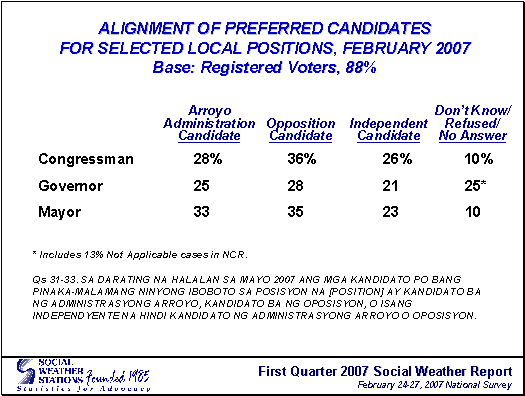
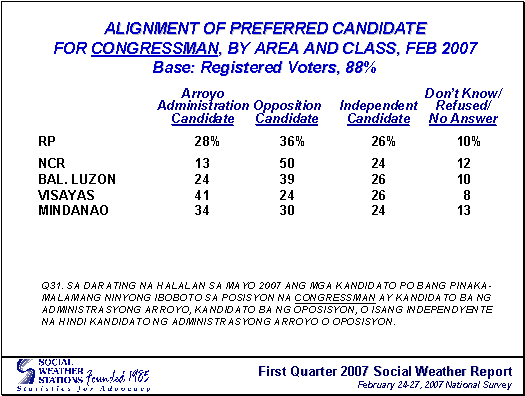
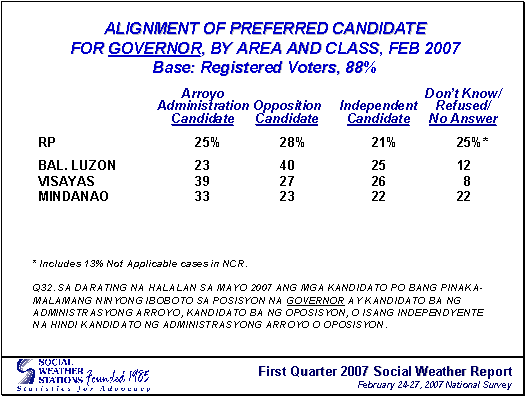
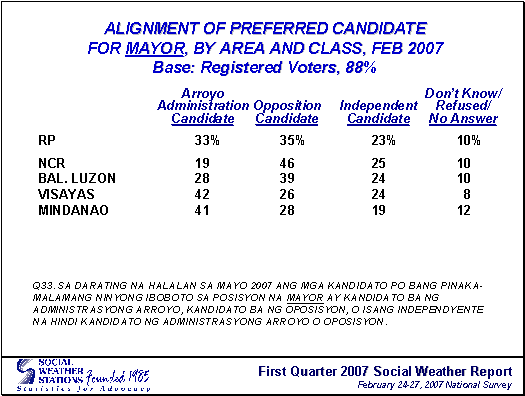
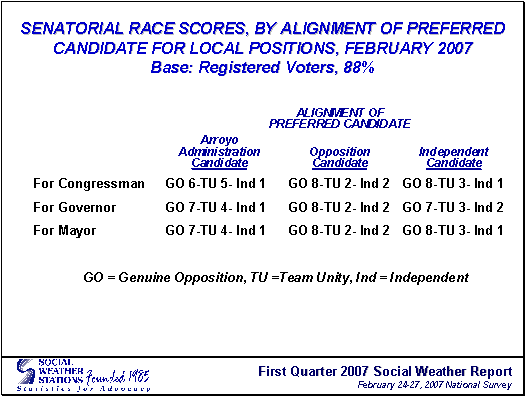
Even Billy Esposo (an administration critic) is surprised at the relative strength of voters’ opposition inclinations, at least in Luzon. Yet this seems to me a case of the surveys validating what the political pros have been saying all along. If you recall, my January 22 entry pointed out that administration people were aware local races were going to be affected by the issue of the President.
Still, what’s emerging is that the political landscape is changing, and old assumptions are being reexamined by the political pros.
My Inquirer Current entry for last night focuses on some quite interesting analyses of recent surveys, and what they mean. Things are a-changing. Even the old certainties about command votes, as John Nery pointed out in the same blog, may be up for reexamination (though old habits and assumptions die hard).
An Inquirer editorial last week pointed out the flaws in the Palace’s claims its machinery would steamroll the path to victory; the editorial for today points to an ongoing series by Winston Marbella (see part 1 on how campaigns are changing and part 2 on surveys) and thinks there are signs the electorate is getting more discriminating (I’m not sure if “maturity” is the right word).
A PCIJ Special Report on the politics of Cebu illustrates part of what’s going on. I remember reading ages ago, that President Osmeña (who married wealthy women twice), whenever a political campaign would come up, would dispose of a hacienda: that was how his generation financed campaigns unless there were wealthy supporters willing to bankroll the campaign, and even then, many candidates had to basically permanently mortgage their land to finance their political activities. The result was that for a great number of his generation’s politicians, politics was a sure path to liquidating the very basis of their status: ownership of land. It never occurred to President Osmeña or many of his peers to add to their land, which is why so many of the previously politically-prominent ended up out of politics by the 2nd or 3rd generation, when their already diminished landholdings were wiped out by selling them for campaigns or through inheritance. Others got out of politics to end the financial hemorrhage (the Laurels, I believe, are a good example of this). The rest that remained in politics either turned their back on the old ways and aggressively embarked on building up new landholdings or diversifying into other industries. The PCIJ report describes the other means for acquiring, and maintaining, political power resorted to by a new class of politicians from the professional classes without extensive holdings in land.
In other news, a potential shortfall in food supplies this year; the CPP congratulates the NPA; the possible appointment of another Comelec commissioner.
A commentary on a proposal for constitutional changes in South Korea.
Regarding the blogosphere, The Guardian has an interesting story on a 7-point proposal by some Web Gurus to restore civility to blog discussions:
Point one of the code is that anyone signing up to it would commit themselves to a “civility enforced” standard to remove unacceptable comments from their blog.
Unacceptable is defined as content that is used to abuse, harass, stalk or threaten others; is libellous or misrepresentative; or infringes copyright, confidentiality or privacy rights. Anonymous postings are also to be removed, with every comment requiring a recognised email address, even if posts are made under pseudonyms.
Point six encourages bloggers to ignore “trolls” making nasty comments that fall short of abuse or libel. “Never wrestle with a pig,” is the advice. “You both get dirty, but the pig likes it.”
To back up the code, they propose a “civility enforced” badge marking sites which subscribe to the guidelines, and an “anything goes” badge to denote those that do not. The proposed guidelines can be interactively amended by web users, until a final version is agreed.
The battles in the blogosphere may irritate some, but apparently appeal to many others. Open Culture offers its take on how newspapers are finding it difficult to compete with media outfits that make no pretenses to being objective – and it’s defiance towards old journalism standards that often fuels the intense online debates that end up messy.
In Tingog.com there’s his take on the senate race.
The Asia Foundation Blog has a piece on that corruption survey regarding the Philippines. Then laurgism.com explains why the blogger wants to leave the country, pronto. I have to agree with this commenter, and it suggests to me why some people not only thrive abroad, but need to go abroad: the country is too small for their talents or ambitions. A recent entry in The Ignatian Perspective makes for relevant reading for Filipinos eager to escape the country.
And learn English through free podcasts.
Technorati Tags: Blogging, elections, internet, journalism, media, philippines, politics, president, Senate, society, surveys

The first commenter is right. The writer is so naive to know that everything that she is complaining about is also true in other countries.
Worse.
It sure sounded uncaring, but that government administration cabinet official was correct, after all. What he said — blaming hunger on the series of typhoons.
What FAO states: “In the case of the Philippines, FAO said its projection of a possible shortfall in food supply this year was based on the losses caused by successive typhoons that battered the country especially during the last quarter of 2006.”
Does Laurganism think that she can marry in the upper strata of society without being discriminated too especially she is of color?
Talking from experience, I was married to a scion of a wealthy Caucasian family from Boston. The father was a Harvard grad- pathologist and a head of a department in a big hospital in SF before he retired and the mother who died this May while I was away, was a businesswoman who owned an art gallery. The son has a trust fund.
It was the parents who liked me very much. The father fell in love with Filipinos, having been in the Philippines and having worked with Filipino nurses in the hospital. His brother was a survivor of Death March.
The doctor/sister was a bitch. The lawyer sister was a darling but the family friends were polite bigots.
When I was introduced to my husband’s professor in his masteral, the latter ignored me as if he didn’t see me.
My husband noticed that so he started talking about stuff engaging me to join the conversation. The topics were about economy, politics and culture.
Then the professor had a hard time working in his computer. I helped him trouble shoot. And God, he spoke to me. Allelujah.
I can enumerate all other stuff and basically my only competitive edge over those women who were after my husband’s trust fund is that I have post graduate degrees.
So why I divorced? It is all culture thing and other stuff. Fidelity issue is not a monopoly of Filipino men. In-laws “thangs” are a universal phenomenon but i was just lucky with mine.
My sister is into early relationship with a man from a financially well-off family in NY. In the meet-the-parents/sibling things, financial matters came into discussion. That is how it is since marriage may tie one spouse to a liability of the other. Even in tax matters. She did not hear yet about prenups, postnups and segregation of non-community properties.
Ow, marriage in the working class is different. They live-in, they decide to marry, they decide if they want to have children, they divorce and settle for alimony or child support.
Another truth that L may find out is that the diploma in prestigious universities such as UP, Ateneo, won’t matter when she applies for a job. What they will be looking for
is local experience and a certificate from universities here in the US that also includes priorities to Harvard, Stanton and UC grads over community colleges’.
If I were Laurganism, I will settle my issues in the Philippines even before leaving.It woudl be very helpful also to identfiy your strength and arm your self with that strength rather than stuffed your self with weaknesess and negativisms.
L will be very surprised as soon as he landed here that the same issue that he is trying to avoid in the Philippines.
When I first landed in California, It was so cool and verything was so smoooth. But that was becuase it was all facilated by Intel Corp who sent me to to their research and Development Plant in Folsom.
But when I decided to resign from the company and come To New York City by my own. It was entirely a different story. Susme pag baba na pag baba ko pa lang sa JFK eh sangkatutak na warning sign about taking a cab. Reminds me so much about the taxi drivers in Manila.
I escaped Manila because I feel I m not free enough to live the lifestyle that I wanted to live. Kumbaga Im sick and tired of living in the closet. So so I came here para mag ladlad. Six year after that its still the same issue that is confronting me. I still cannot get my self into a relationship that I wanted and even worst Im still a ” virgin until now he he he he…. Now Im I belive I would be better off in Manila. Sexually that is.;)
I was strucked by L thoughts na ayaw pakilaaman sya….Unang una sa smula makikitira talaga muna sya sa kamg-anak o kaibigan . So hindi talaga mawawala yung pakialamn sya. Unless he is that super rich and he can afford to buy himself a house and pay any of the servicess that he needed. But I doubt if he really rich!
Dirty Politics? Corruption? Traffic? yeah right!
This one, “screw nationalism,” seems like, how does that go, Nagpa-praning?
rego, maraming tsikiting diyan sa NY who will only be too happy to take you on. Sa pinas marami rin dun. Kaya lang, kung di umubra sa NY di rin uubra sa pinas.
Ito secret, lighten up.
There’s a rather glaring error in the way they presented the results of that SWS survey. Take a look at the results for “Alignment for preferred candidate for Congressman”. Apparently they calculated the nationwide average by adding the results from NCR, Luzon, Visayas and Mindanao surveys, then dividing by 4. This gives undue weight to the opposition-leaning NCR’s (and, if I’m calculating right, NCR only gets around 10% of the seats in congress).
Adding to my previous comment:
They did the same thing with the mayor results, giving Metro Manila the same weight in nationwide results as Luzon or Visayas or Mindanao. But there are just 17 Metro Manila mayors, out of a total 1600+ in the country.
Realist,
Heee hindi ako pedo no. It prefer mature people. 😉
What I actually realized is that I have been in denial for sooooo long that it would be very difficult for to live that kind of life style that wanted. Sometime I feel that at my age it too late for me to practice it. I also suspect that I am a homophobic homosexual. Its alright to be gay but its not alright to be sexual about it. Confusing di ba?
Then I did not expect that the business that I manage to venture into will take up so much of my time. I have to kee up with the very high of standard of living here so I have no choice but to realy work soooooooo hard. Wala na akong panahon mag landi or go into a relatioship or really figure out what to do with my sexuality. That is why I I feel it would be better off in Philippines becuase would have more time for other areas of life.
Its not all minuses though there are some good things and even great things that came out of that decision that I made more than 5 years ago. As a matter of fact the pluses far outweighs the minuses.
The very issue that made me escape the Philippines may not have been resolve but I am more happier and fulfilled here.
All im a saying it that resolution of your personal issue is not dependent on your location. It s all within you!
That is why I believe, what ever issues Laurganism have, it would be better to personally resolve it rather than escape from it. I dont belive all his issue will be resolve by getting out of the coutry. Kasi yung mga complains nya about the country , culture and people may be worst on the place that he wanted to escape to. And definitely will not heal his angst or whatever negatives feeling he have.
My Vietnamese office roommate had this saying:
Where ever you go, that’s where you are.
And here is advice from a New Yorker careerist woman:
If someone’s bugging you, change yourself.