Last week I attended a conference on the peace process, put together by the Presidential Adviser on the Peace Process. Obviously the media was highly critical in terms of the killings of journalists impeding the ability of media people to report actual conditions in the provinces. And there is no progress in terms of the peace process with the CPP-NPA-NDF although prospects with Muslim rebels seems a bit more promising. As I understood it, though, the biggest obstacle is the “ancestral domain” issue: the demand of some Muslim groups for compensation of some kind, for natural resources in parts of Mindanao now within Christian-settled areas. The biggest breakthrough, though, in broad strokes, is a willingness to discuss a setup for Muslim areas that is, for all intents and purposes, Commonwealth status for Muslim Mindanao.

Sec. Dureza, nonetheless, was optimistic about the peace process (as he has to be) and pretty forthcoming with information, both on and off the record. He seemed unaware, however, that the government’s “left hand” and “right hand” policy for achieving peace is highly ironic, to say the least. He expressed regret that the national budget wasn’t passed, and tried to lobby for acceptance of an allocation for 600 barangays that he says are no longer war zones: however such allocations were immediately suspected of being thinly-disguised pork barrel projects by government critics. His remarks were quite helpful in understanding both the potential and the limitations of the peace process. He explained how much of the work is done behind the scenes, and that announcements of formal meetings suggest the hard work’s been done -but that it’s also difficult to remain tied to timelines as the peace process is a fluid and dynamic one.
An interesting tidbit from another official I talked to on the sidelines is that the success rate for rebel returnee programs is a miserable 30%. That means efforts to reintegrate rebels to society and provide them with a livelihood fails 7 out of 10 times. The reasons, according to the official I talked to, are many: some rebels are impatient; others belong to groups that are too small and isolated to sustain a livelihood program. Where there’s success, it’s due to funding being on a scale big enough to make an impact, on a community large enough to make a go of things. The official did say, oddly enough, that the failure of livelihood programs wasn’t held against those attempting to set them up: but that doesn’t compensate for the depressing failure rate. The dilemma is really that increased funding would open up new charges of pork barrel spending.
Paulynn Paredes Sicam, veteran journalist, sits on the panel tasked with negotiations with the CPP-NPA-NDF and readily admitted that the talks are to put it mildly, in limbo. Unlike Durera who, as a member of the cabinet, has to be a loyal partisan, she speaks her own mind. On the sidelines, I asked her why she continued to be engaged in what seems to be an exercise in futility. She replied by saying someone has to try to keep reminding the powers-that-be that peace is a priority, and not surrender the field to the hard-liners. She observed that the past twenty years has seen the disappearance of a “peace constituency” and that the urgent task at hand is to rebuild one. To this end, she appealed to the media to devote attention to peace developments, and to bear in mind that sensationalistic, or utterly cynical reportage can have a tremendously harmful effect on the prospects of peace, and be quite damaging to peace prospects in particular localities. She also said tere are many inspiring stories that are never reported or superficially reported: cases where communities rise up, and basically tell both government and rebel troops to get the hell out and leave them in peace -and then, maintain that peace.
My reaction followed hers, and I limited myself to making a few observations (our topic was, how peace reporting and commentary can best be carried out by media, including new media). If what’s needed is a peace constituency, as Sicam said, then I suggested we begin with understanding how print, radio, TV and new medias are increasingly targeting niche audiences, and how media outfits now operating on a 24 hour news cycle and with cross-platform content use in mind, have even less time and resources for reporting stories that could use depth -such as the peace process.
Government has resources that, if properly used, could help dispel the traditional -and increasing- mistrust between media and government and government and the public and the public and media. It all boils down to government providing less propaganda and more useful information, even if the information is temporarily embarrassing or inconvenient. If everyone in the news and media food chain feeds off reporters, then government should do all it can to provide useful, concise and freely-available information to reporters first, and the public second, as more and more media consumers double-check the reports they read, hear or view.
For example, the peace process involves its own language, and I had to wonder if, in the rush to hold pro- and con- press conferences, the players and reporters were all using the same language. Are the terms being flung about all understood in the same way by everyone involved? And where would one go, to find out generally-accepted definitions? A glossary of peace process related terms is something government’s in a good position to provide, and that includes contending definitions by other parties, which would help explain why negotiations bog down. Another thing is that a visual language is just as important as precision in written and oral language: where are the useful maps, and charts, to show peace areas, conflict zones, proposed autonomous or other areas?
Government has a tough job to do, because whatever happens at the top, the process has to be kept going by the bureaucrats and others who’ve made a commitment to the process. Going back to the peace constituency idea, government has to abandon the 9 to 5 mentality and realize that even as it has to analyze and break down the many fragmented but not necessarily mutually-exclusive constituencies it has to court, it also has to be make information available in a sustained and credible manner. What coordination exists is for propaganda purposes and this mentality has to be changed.

Philippine Daily Inquirer publisher Isagani Yambot then gave an impassioned plea for reporters to be spared from harassment and intimidation in conflict-ridden areas, and spoke up for the profession, which he says has become a target.

Over the weekend, a splendid evening with Dr. Victor Somsky, a far-ranging discussion on the conference he attended and his observations as a returning visitor to the country. He hopes to secure some sort of support for his two-volume work, Fiesta Filipina: Reforms, Revolutions and Active Nonviolence in a Developing Society. (Moscow, Vostochnaya Literatura Publishers, 2003). It’s a chicken and egg situation. While he has a precis of sorts, it isn’t enough for anyone to be able to decide if the book should be published in the Philippines, or not; showing the actual two volume work, complete with some highly interesting maps (something I think our books on history constantly fail to use to full advantage). Talking to him, though, quickly reveals how thoroughly he’s delved into the question of reform versus revolution, and he has some challenging views that are quite engrossing.
Particularly interesting, for me, is that most historians who tackle Philippine history come from the the United States or the Philippines; there are only a few who bother to tackle the country’s past and who come from other parts of the world (though I understand there’s a growing number of Japanese scholars who tackle some Philippine-related matters). Somsky brings to the table a European orientation and the benefits of Russian scholarship, which is rigorous and makes use of developments in Marxist and other thought in the wake of the collapse of the Soviet Union. At the very least, it’s an interesting challenge to the flavor of Marxist orthodoxy that emerged among many Philippine scholars in the 1960s and which continues to be the dominant way of interpreting things. A Russian scholar, of course, knows a thing or two about how revolutions actually take place, what the different forces involved are; and well, when you have a scholar who has studied Indonesia in depth, and then turned his attention to the Philippines, the comparisons and contrasts can be quite engrossing indeed.
One suggestion he made was that the standard view of the masses versus the elite could stand improvement by being more nuanced. He said a revolutionary situation, when it emerges, involves the interplay of contending forces, of which there are really, three: the radicals, who push on ahead, often without having fully planned out what they want to accomplish, because the situation is necessarily so dynamic and fluid; the middle, represented by the principalia (provincial political bosses, not all of whom were ilustrados, who were more urban and cosmopolitan in orientation and origin) who are in the worst position, so to speak, because they are trapped precisely in between the others; and the counterrevolutionary forces, which, however, should not be confused with purely reactionary forces.
As I understood it, Somsky views Bonifacio as the archetype of the revolutionary element; Aguinaldo, of the middle; and the counterrevolutionaries are the ilustrados. What he finds remarkable is not that the radicals precipitated the revolution, or that the ilustrados fought it tooth and nail, but that it was the middle, represented by Aguinaldo, who prevailed for much of the revolutionary period. What defeated Aguinaldo was the United States, which Somsky described as a kind of enforcer of the ilustrados’ will. However, the ilustrados’ alliance with the United States resulted in their repudiation by popular opinion, and resulted in the provincial, political principalia becoming the dominant players in the development of the Philippines as a nation.
Somsky discussed how radical movements, in a sense, by force of shock and awe define the agenda, leaving all other contending groups to adopt -and adapt- the ideas and even rhetoric of the radicals, although the radical weakness is precisely that while they can harness the growing, explosive momentum of a revolutionary situation, they arent necessarily equipped either to fully articulate, or accomplish, where the revolution is headed or what its terminal point should be. Counterrevolutionaries, on the other hand, know what they don’t want -the chaos and anarchy of a revolution- but they lack the numbers to oppose the radicals. Everyone, then, is scrambling for allies and in the Philippine context, from 1896-98 the principalia allied itself with the radicals and the counterrevolutionary ilustrados were cornered. However, the limitations of the revolutionary leadership began to take its toll: those best equipped to define what should emerge were sidelined (Mabini) or rubbed out (Luna) even after Aguinaldo had his showdown, as inevitably happens in revolutions, with Bonifacio.
He argues that the ilustrados came to the conclusion that Aguinaldo was neither equipped, mentally or politically, to establish a viable state; that therefore, since the radicals had already articulated independence as the ideal, then independence had to be achieved as the counterrevolutionaries best preferred it, in an evolutionary and not revolutionary, manner. American involvement gave the counterrevolutionaries what they’d lacked, which was, as Somsky bluntly put it, “muscle.” But at the cost of their standing before the people. I didn’t mention it at the time, but this was precisely Mabini’s thesis when he looked back at the failure of the revolution.
By 1907 the ilustrados were discredited and the principalia, ascendant, where they’ve remained until the present. Somsky’s thinking (recall his papers on Rizal and reform vs. revolution I posted last week) fully discusses how radical notions continue to have echoes in the present day, but how the dominant theme has been a kind of tie between the two ideals, which has resulted in the country being stuck, never fully achieving either. How to break the logjam? My impression is that the inability to achieve a resolution lies in the much-vaunted masses not being given enough recognition for their basically conservative, and principalia-oriented instincts, which means both the radicals and ilustrados have been frustrated in their efforts to mobilize them. Time and again, the ones who mobilize the masses are neither radicals nor ilustrados, but the principalia. And during the rare periods when a kind of national solidarity is achieved, it’s been principally along the lines of peaceful, non-violent change.
Somsky says the Philippines has made a profound impression on the world twice: in 1935, with the establishment of the Commonwealth, and in 1986. The Commonwealth, he said, came as a profound shock to the Colonial Powers who devoted great energy and resources to making sure their colonial subjects didn’t hear of it. He pointed to an interview of Mahatma Gandhi by Carlos P. Romulo (which I’d never heard of) in which Gandhi said he would be delighted with a Tydings-McDuffie Act for India! What has served to make people under-appreciate what a significant development that was, was the transformation of the United States, after World War II, from the image it had acquired because of its Philippine policies, as a “benign hegemon,” as Somsky puts it -a transformation that had its most immediate and traumatic effect in the Philippines, which was unprepared to understand the sudden shift in American policy during the Truman administration.
1986, to his mind, inaugurated an era that is still ongoing -the People Power era, which is facing its own problems as what are often unique situations end up being forced into what he calls the manufacturing of a “technology for regime change.” But as Edsa Dos showed, it’s not a method that is applicable all the time, or which will always be successful.
I do hope his views get discussed more and that his books end up published here at home.
Today, the President’s medical check-up aside (and lurid speculation; how’s this for an ambiguous statement: Arroyo as healthy as economy), and the Secretary of Justice showing the government’s nervous about protests in Cebu City during the Asean Summit, and a former Imperial Japanese Navy medic admits he conducted vivisections on Filipino prisoners.
the news is that the Speaker is dangling regional representation to entice senatorial support, and that the President is going hell-for-leather to force constitutional amendments through: regardless of public opposition as shown by the surveys. She presides over a council of war today (note prominent seat at the table for the Legion). Plan A being dead, Plan B (a Constituent Assembly) or a new Plan C (a people’s initiative path, but this time proposing simply the abolition of the Senate) are on the table:
Meanwhile, Ulap Spokesman and Eastern Samar Gov. Ben Evardone said they were prepared to embark on a second round of signature drive if their second motion for reconsideration before the Supreme Court was rejected.
He said they had already informed Mrs. Arroyo of their plan to gather again 5.6 million signatures, but this time focusing only on the shift from a bicameral congress to a unicameral congress.
“We have already told the President about this. We said that if our second motion for reconsideration is denied, then we are left with no choice but to gather again signatures, but this time avoiding the pitfalls raised by the Supreme Court when they called our signature campaign a grand deception,” he said.
Evardone said they would no longer ask in their questionnaire if people were supporting the shift to a parliamentary form of government since the Supreme Court had said the issue was so complicated for laymen to understand given the short period of time that the signatures were collected.
“We will stick to the question of whether Filipinos still want the current bicameral or if they want a unicameral Congress. I think we will in fact surpass the number of signatures we have gathered for the first petition because this time, the issue is very clear given the constant gridlock between the Senate, the House and Malacañang,” he added.
The Palace missed out on its window for opportunity: had it pushed for simply a unicameral National Assembly instead of going whole hog, it would probably have fared better and been accepted by the public. But not now.
Which brings us to a tale of two surveys: Pulse Asia released it’s latest senate race rankings, and Social Weather Stations released its findings on Constitutional change.

The Sept. 24 to Oct. 2 Third Quarter 2006 Social Weather Survey has error margins of ±3% for national percentages and ±6% for regional percentages .
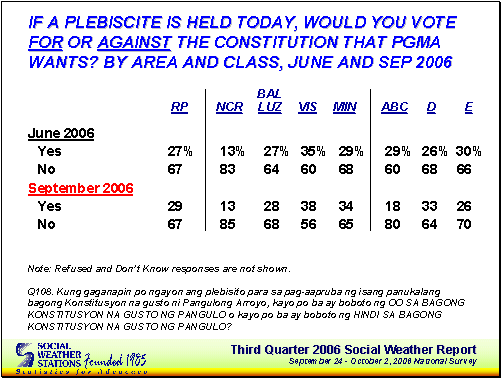
It says a majority (67%) of Filipinos would still vote “No” if a plebiscite to approve a proposed new constitution were held today, unchanged since the previous quarter,
A solid majority of 85% in Metro Manila will vote “No” in a plebiscite for a new constitution, similar to 83% recorded in the previous quarter. The “No” vote is 68% in the rest of Luzon, 65% in Mindanao and 56% in the Visayas.
Four out of five (80%) of class ABC, 70% of class E and 64% of class D will also vote “No” if a plebiscite to approve a proposed new constitution were held today.
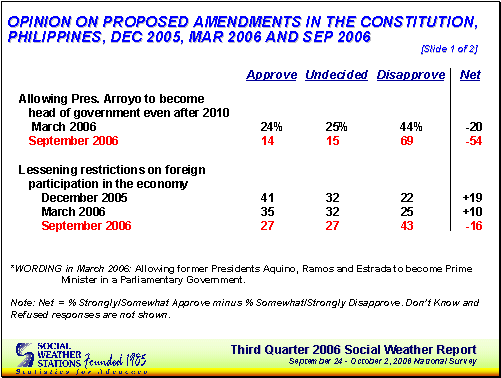
Seven out of ten (69%) reject the idea of allowing President Arroyo to become head of government even after 2010, up from 44% recorded in March 2006.
Half (51%) oppose the idea of having only one chamber of Parliament elected in each district and from Party-list, up from 38% in March, implying that most Filipinos would rather continue having a Senate.
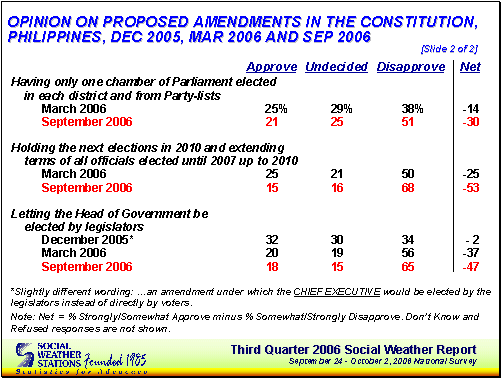
A majority (68%), compared to 50% in March, reject the idea of holding the next elections in 2010 and extending the terms of all officials. Opposition to the idea of letting the head of government be elected by legislators instead of directly by voters likewise increased from 56% in March to 65% in September.
Two out of five (43%), compared to 25% in March, oppose lessening restrictions on foreign participation in the economy.
The other survey is the topic of my column for today, They’re making a list.
The Pulse Asia survey results has some interesting things.
At present, 19 personalities — mostly from the political opposition — have a statistical chance of winning with the following being declared winners if the May 2007 elections were actually conducted today: (1) former Senator Legarda (52.9%); (2) Senator Panfilo M. Lacson (41.1%); (3) Senator Francis N. Pangilinan (36.6%); (4) Senator Manuel B. Villar, Jr. (31.4%); (5) Taguig-Pateros Representative Alan Peter S. Cayetano (30.5%); (6) former Senator Vicente C. Sotto III (30.3%); (7) Senator Ralph G. Recto (28.7%); (8) Ms. Korina Sanchez (27.0%); (9) Atty. Aquilino Pimentel III (24.8%); (10) former Senator Gregorio B. Honasan (24.1%); (11) San Juan Mayor JV Ejercito-Estrada (22.1%); and (12) Senator Edgardo J. Angara (20.3%).
Given the survey’s margin of error of +/- 3 percentage points, the following individuals also have a statistical chance of winning: (1) Tarlac Representative Benigno C. Aquino III (19.3%); (2) House Minority Floor Leader Francis G. Escudero (19.3%); (3) former Senator John Henry Osmeña (17.8%); (4) Muntinlupa Representative Rozzano Rufino B. Biazon (17.8%); (5) Ilocos Norte Representative Imee R. Marcos (17.6%); (6) Senator Joker P. Arroyo (17.0%); and (7) Senator Luisa P. Estrada (16.9%).
In the punditocracy, Amando Doronila reacts by saying what’s being ordered by the Palace is a suicide charge. Billy Esposo points out why the suicide charge is taking place. Fr. Joaquin Bernas, SJ says the way to bring back sanity to the Charter Change debate, is to pose a plebiscite question next May: does Juan de la Cruz want a Constitutional Convention, or not?
Bong Austero is shocked, shocked! By recent adverts.
Read an interesting white paper on the Thai coup.
The blogosphere buzzed in response to the passing of Max Soliven, most people like Ellygears registering shock at the news. Ruth recounts with an observant -and mordant- eye for detail, how students reacted at the school owned by Soliven’s wife. QueenBee and eLLe knew his family, personally; and he had his fair share of admirers, such as I am your THREAT and sunshine as well as cholo_the_man.
Comelec AKO pays an image-based tribute. Rodel Bañares and Toots Ople pay tribute, too. And catinthehat26 reproduces a snippet from an interview.
The Bunker Chronicles and Daily Musings and Purple Phoenix and An OFW in Hong Kong take a less adulatory look at Soliven’s passing.
History Unfolding observes that the era of large-scale industrial war has passed, and that Americans haven’t come to grips with the fact:
Vietnam was the last major industrial-age war (although the Soviets also gave something similar a go in Afghanistan), and the reaction against it has effectively ended that era, beginning in 1973 with the end of the draft in the United States. (No western nation still has conscription, although China and India do.) Personally I am inclined to regard this, on the whole, as a good thing. The wars of the 1861-1973 period were enormously destructive and their results were often equivocal and disappointing. The Civil War ended slavery, but not white supremacy; the First World War had no good long-term results and led to huge setbacks to European civilization; and even the Second World War spread Communism around much of the globe. The world’s peoples have much less to fear from war today (although Iraq is showing how destructive civil conflict can be), and that, it seems to me, is a good thing. But it means that we must acknowledge our limitations as well.
Tomorrow, on The Explainer on ANC, part 2 on the topic of automating elections. It’s really difficult trying to balance the orientation and even content of a show. There will be viewers like beabear who will like the choices made by the show, and other viewers like CAFFiend, who will detest it. Others, such as Philippine e-Legal Forum and comelec AKO find it provokes thinking further on a topic. All I can say is we’re trying our best and learning through trial and error. MakingAPoint! has a nice definition to bear in mind, though. Needless to say all observations -good, bad, constructive, dismissive- are appreciated.
Technorati Tags: books, constitution, history, ideas, journalism, media, military, people’s initiative, philippines, politics, president, Rizal, society, Washington DC

Successful public land policy in the U.S. or land reform in Japan was key to the economic takeoff of these two strongest economies today. Taiwan and South Korea also effectively defanged their landed class, and that goes with Vietnam today where farm incomes have true impact on private consumption. Indeed, Cory Aquino missed the opportunity for genuine transformation for being halfhearted in pursuing real land reform.
The market rhetoric notwithstanding, state capitalism, or state-run market system, is the other driver of the old economies of the great Western nations (France, England, Germany and the U.S.) as well as the NICs. The governments of all these successful nations have assumed active role during the infancy of their economies in defiance of laissez faire, matched only by a sense of country and vigorous entrepreneurship either by the big business model of the America’s robber barons, the Japanese’ zaibatsu and the South Korean’s chaebols or Taiwan’s countryside industrialization and now the Vietnamese’ small family enterprises.
Philippine government census states : (79.7 percent) were working in own holdings
—
Household members of the agricultural operators were asked if they were engaged in any agricultural activity, whether in their own holdings, in other holdings or both.
—
In 2002, roughly 5.5 million household members were engaged in agricultural activities. Of this total, about 4.3 million (79.7 percent) were working in own holdings, 760.8 thousand (13.9 percent) were working both in their own holdings and in the holdings of others, and 348.3 (6.4 percent) in other agricultural holdings.
—
Close to 31 percent of the household members 10 to 19 years old were engaged in an agricultural activity. Four out of five (80.5 percent) of them were working in their own holding.
What is going on? 80% of Filipino farmers now work on their own land!!!
By the way: average Filipino farm-size is 2.0 hectares, same as Japan. Average US-of-A farm-size 179 hectares (443 acres).
..98% of US-of-A farms are family-owned (vs 80% in Philippines)
..median farm income (2003-figures) is $47,600 which is 10% higher than median-income for all US-of-A households.
…US-of-A farmers will starve if they only depend on their farms. $30,000 of that $47,600 farm-income is from non-farming sources.
When all is said and done, the youth (of US-of-A, Japan, and the Philippines) just may be wise in walking away from farming.
Abe… I have never seen any textbook or US-of-A government publication which echoes your statement that “Successful public land policy in the U.S. ….was key to the economic takeoff of…” the American economy.
Abe Margallo said: “Successful public land policy in the U.S. or land reform in Japan was key to the economic takeoff of these two strongest economies today.”
I totally agree. And that doesn’t only mean distributing the land. It means laying down workable infrastructure and making available capital to make the land productive and viable. In our case, political considerations were paramount. There was a rush to make a statement without first establishing the groundwork. The results were as empty as the rhetoric and the slogans that established the program.
I still do not get Abe’s point when he strung his sentences together :
–Successful public land policy in the U.S. …key to the economic takeoff…
—effectively defanged their landed class
—farm incomes have true impact on private consumption
—Cory Aquino missed the opportunity for genuine transformation …in pursuing real land reform.
***
The USA land-public-policy closest to “land for the landless” will be the Homestead Act of 1862 (signed by Abe Lincoln) which encouraged Western migration by providing settlers 160 acresinto law by President Abraham Lincoln on May 20, 1862, the Homestead Act encouraged Western migration by providing settlers 160 acres of public land (which a homesteader gets after paying a small filing fee and completing five years of continuous residence before receiving ownership of the land.)
Or can it be FDR’s “New Deal” item for creation of Tennessee Valley Authority power grid?
UPn student, while Abe can very ably clear up his own statements, my own reading on what he said about successful U.S. land policy is that he was referring to agricultural policies in general instead of particular laws.
I take it more on the context of Abe’s statement that “governments of all these successful nations have assumed active role during the infancy of their economies in defiance of laissez faire”. My interpretation of this is that these nations had a vigorous agricultural program with adequate infrastructure and support. And that these countries protected their farmers, not only by disallowing agricultural imports, but by giving subsidies to encourage farming and increase farm incomes. Hence having “impact” on “consumption” and encouraging further production of goods, leading to economic growth and industrialization.
The farm subsidies in the US are under review. So many “farmers” are getting the subsidies even without growing a single CRAP errm crop.
The agricultural sector of the US is boosted by the underapaid illegal immigrants who do the farm work that can not be automated. No white caucasian will get these jobs that were formerly handled by the black slaves.
If and only will these rich farmers will pay the mandated minimum wage, they will not be able to compete with the cheap imported agricultural and fisheries products coming from Asia.
Farm subsidies are not awarded to farmers to help in their operations.
Farm subsidies are in the form of cash payments to buy excess production that will destabilize prices of commodities.
So years ago, the US government bought the excess milk production from farmers, processed them to milk powder and sent them to third world countries as part of US aids. (sobra lang pala). They no longer do that because it will kill the infant formula and milk products exports. So they process them to big chunk of cheese as give-away to food stampholders and SSI recepients.
I am overwhelmed by 2 statistics. (a) 80% of farm workers in the Philippines work their own lands. (b) US farmers will starve if they only rely on farming as income-source.
=== What it suggests to me is that if the FILIPINO farming family can also get income from non-farm activities (e.g. one household member clerks while the other farms) all will be well in Bulacan. But they can’t. There are not enough jobs for college-grad accountants, teachers, nurses, programmers, nor physicists. Unless Abe points me to some studies, “Land for the landless farmers” was never been an issue in the US-of-A. The contra — there is nothing in the history of US-of-A which can provide solutions to solving the issue of “Land for the Landless farmers” of the Philippines. [Ca t’s example about US practices is illustrative. The Philippines does not have the capacity to buy excess excess milk production (or excess production of any commodity) from its farmers.] There is nothing in the uS-of-A history that the Philippines can copy with regards capping the knees of the land-rich oligarchs.
..I also have the perception that the lament about land reform (be it for the Philippines or Latin American countries) may have been overtaken by the economics of the 21st century. The problem that needs to be solved is jobs, jobs, jobs… not land confiscation and redistribution.
I agree with hvrds — ‘you can’t legislate capitalism.’
I agree with carl and anna — infrastructure.
I hope all are getting into the holiday spirits. I am!!
hvrds, whether it’s considered ‘asset’ or ‘wealth’ transfer, the purpose is to assign property rights so that the these assets can enter the economic system instead of remaining ‘dead capital’. The Peruvian economist, Hernando de Soto wrote about this in his book ‘The Mystery of Capital’. In terms of living in a society where we all eat ‘tuyo’ or some eat steak while others starve to death, i think it’s a collective moral choice.
tbl, Venezuela has been ‘rich’ in oil since the 70’s. It’s just now that someone like Chavez is channeling the proceeds to directly benefit the people. As shown in Anna’s referenced article above, the Philippines is also ‘rich’ in its own way. We have resources that can be deployed for our own social programs, rather than this ‘all out war’ or charter change nonsense. You’re right to highlight corruption but i think it is both the cause and the consequence of the wrong policy decisions. It would have helped if we have a President who has the moral standing to lead an anti-corruption drive.
Carl, i think your arguments make a case for implementing agrarian reform properly rather than whether or not it is a good thing in the first place. Whatever its other elements, land reform would necessarily involve the transfer of property rights.
UPn Student, the 80% figure you cite is due in part to the ongoing implementation of the Agrarian Reform program. However, more still needs to be done according before the program is considered complete:
“As of December 2005, seventeen years after the implementation of the CARP, the total number of farmer beneficiaries (FBs) only reached 2.1 million
out of the estimated 5.7 million FBs of both DAR
and DENR.”
[Source: The Philippine Agrarian Reform Program at a Glance, Senate Economic Office, June 2006]
Venezuela, for its part, is trying to model his program after the US ‘Homestead Act’ that you referred to above, as described in this article: [Source: “counterpunch.org/delong02262005.html”]
UPn, by the way you are phrasing your questions you are probably more knowledgeable than me on such a complex issue as the U.S. publc land policies and I’m glad Carl has helped in connecting the dots, which is very insightful as usual, to further articulate my thoughts.
What I’m basically saying is that the U.S. liberal land policies, during Colonial times and somewhere to the the close of 19th century – which was essentially to dispose of lands acquired by puchase (e.g., the Louisiana Purchase of 1803), cession, dispossession, or other means ultimately into private hands for settlement and development – were key drivers for the creation of national wealth. To be sure certain resources were wasted possibly because of flawed resource management but the transfer of billions of acres of lands from the federal to state and private ownership resulted in rapid economic develpment of the growing nation. The underlying belief was that land and resources were to be improved and used, and that development would take place most efficiently through empowered individualism.
As you know there was no landed gentry in the U.S. to rein in as in Japan, Korea or Taiwan, but I agree to the view that parallel land transfer through “land reform” in these countries had similar effects in transforming their economies.
Perhaps, our historian mlq3 will enlighten us on why the U.S. somehow reversed its policy on the acquisition and redistribution of Friar lands following Philippine-American War, and perpetuated the hacienda system under which most of the lands went to American firms and enterprising businesspersons.
tbl, a more nunaced assessment of “graft and corruption,” should go beyond the pork barrel debate and pay appropriate attention to grand corruption via “state capture” by parts of the corporate sector to shape the underlying “rules of the game” including “purchase” of legislation (like “farm subsidies” in the U.S.) and court decisions.
Interesting…. Hugo Chavez has already sent in Venezuelan troops to take over private-property (idle lands, by his words). Sure does not sound like Lincoln’s Homestead Act to me.
..
http://www.csmonitor.com/2005/1101/p04s01-woam.html
.. Now my interests are really piqued as to what happens as the Heinz and Vestey groups pursue this matter with either the WTO or some court in the Hague.
Venezuelan troops sent in to take over private-property…. In the midst of expropriations, foreign direct investment fell by 43 percent in the second quarter of 2005, according to Venezuela’s central bank.
Abe, UPn Student, the ‘counterpunch.org’ article (by Seth DeLong, a Senior Research Fellow at the Council on Hemispheric Affairs) that i linked to above basically concurs with both of your assessments on the positive role of Lincoln’s Homestead Act in the US. As to its applicability to Latin America, it also makes the point that Hugo Chavez’s land reform plan which he calls “Vuelta al Campo” (“Return to the Countryside”) is patterned after Lincoln’s initiative, and not Mugabe’s land grab. Just like over here, Chavez’s toughest challenge is extending the program to cover the big land owners i.e. the ‘latifundios’ with estates more than 5,000 hectares.
UPn Student the Central Bank of Venezuela (BCV) also reported “that GDP growth in 2004 and 2005 was 17.9% and 9.3% respectively. GDP growth for the first semester of 2006 was 9.6%” [Source: redpepper.blogs.com/venezuela/2006/11/venezuelan_gdp_.html]
It still isn’t clear how history will judge Hugo Chavez. While he makes good copy by thumbing his nose at Uncle Sam and being a foil to Yankee designs on Latin America, his record as an administrator still leaves much to be desired. So far, he is perceived as a clever propagandist and publicity seeker. Aided by billions of dollars of windfall money from astronomical oil prices, he has bestowed largess on pet projects. These include selling heating oil and gasoline at discounted prices to “poor Yanquis” in the U.S. thru Citgo petrol outlets (how’s that for “in-your-face†audacity?). He has also lavished scarce petrodollars on Cuba and sold them oil at discounted prices. He has financed the candidacies of anti-American politicians all over Latin America, including Evo Morales of Bolivia, Ollanta Humala of Peru, Andres Manuel Obrador of Mexico and Correa of Ecuador.
How these lavish handouts will benefit ordinary Venezuelans is not yet clear. Chavez has, however, subsidized petrol in his home country, where gas prices are among the cheapest in the world. He has also used his petroleum windfall to provide benefits for poor Venezuelans, especially his rabid supporters. However, his vaunted land reform program has yet to take off from the rhetorical stage. Much still needs to be done. Aside from demanding a bigger share of production from oil wells, he has not yet provided a blueprint for the country’s development. He is more at home as a communicator than as an implementer. As of the moment, the perception seems more that Chavez’ bark is worse than his bite. His talents as a mover and mouthpiece so far outweigh his record as a doer.
If I were a Venezuelan, I’ll be pissed at Chavez for using the nation’s oil revenue to fund candidacies in foreign countries and especially to subsidize Yankee heating oil. I actually saw the CITGO TV ad in the metro-DC area asking the US-of-A’s “poor and downtrodden” to call some CITGO 800-number if they want home-heating oil assistance.
cvj, thanks for the link to Seth Sedong’s article. How would you imagine the conservative ideologues reacting if Wall Street carries the teaser “More Like Lincoln Than Leninâ€Â
as its banner or something like “Hugo Does the Honest Abe’s Way�
Bush is so stuck in Iraq today and hung up with bin Laden and his marauding gang that the greater challenge posed in the U.S. hemisphere (by Venezuela’s Chavez, Bolivia’s Morales, Brazil’s da Silva, Nicaragua’s Ortega, Chile’s Michelle Bachelet, Argentina’s Kirchner and most recently Ecuador’s Correa as well as the close call from Mexico’s Obrador and Peru’s Humala) is given short shrift. As a result, Latin America is taking control of itself from Washington stooges protecting U.S. corporate interests instead of working for the interests of their poor people. Yet this battle for democracy is still wrapped in Cold War rhetoric.
But here’s another dimension to a parallel challenge I have observed myself:
. . . liberating Philippines through People Power has dreadful consequences to U.S. interests either geopolitically and geoeconomically. People Power as a movement can thus be juxtaposed quite interestingly to the “wars of national liberation†without being attached to either side of the ideological divide in the “proxy wars†of the Cold War period. If it’s a war at all, it is one powered by the people or a coalition of people across the political spectrum who, like the American revolutionaries, have longed for true political sovereignty and political equality.
Losing Philippines to a real democracy – the People Power democracy – is something that Americans can ill afford: it will mean the final triumph of ordinary democracy (over elitist democracy) that the American revolutionaries came so close to achieving.
I wish I wrote the Sedong’s article; it’s a good read. And did you notice the allusion to Chomsky’s propaganda model? Well, oftentimes an almost innocuous de-legitimizing description like “leftist Venezuelan leader†would escape the uncritical eye as possibly did the “high-school dropout†appellation that the local media repeatedly attached to FPJ’s name as soon as he announced his presidential aspiration.
Anyway, UPn said: “I also have the perception that the lament about land reform (be it for the Philippines or Latin American countries) may have been overtaken by the economics of the 21st century. The problem that needs to be solved is jobs, jobs, jobs… not land confiscation and redistribution.â€Â
Certainly, land reform is not an end-all goal. I see it is a means to an economic takeoff and then to a sustainable development. Here’s a relevant post of mine on this score adopting the Rostovian model:
Many parts of the country still retain the basic features of the so-called traditional society. A traditional society is one whose structure has limited production functions because of its incapacity to manipulate the environment through science and technology. To break from the conditions of a traditional society that put a ceiling on its attainable output, new types of enterprising men willing to take risks in pursuit of profit or modernization must come forward. The risk-taking must happen in conjunction with the appearance of institutions for mobilizing capital like banks, the investment in transport, communications, and in raw materials in which other societies may have an economic interest, and the setting up of manufacturing enterprises using modern methods. These are the “preconditions for take-off,†the stage that the Philippines notwithstanding has already reached.
Takeoff however may not occur if the transition is proceeding at a limited stride in an economy still primarily typified by “traditional low-productivity methods,†by dated societal institutions and values, and by parochial political institutions.
The key to economic progress is somehow attitudinal too and this happens when economic men and political animals judge such progress to be good not only for the material comfort it brings forth for their pioneering spirit but also for national identity and dignity, the welfare of the next generation and the common good.
Historically, the decisive ingredient during the transition is the building of an “effective centralized national state†imbued with a “new nationalism†versus regional interests, the colonial power (if any), or both. When growth becomes steady and normal and institutionalized into habits and social structure and dominates the society, takeoff is said to occur.
Abe, When I said that the lament about land reform (be it for the Philippines or Latin American countries) may have been overtaken by the economics of the 21st century, my thoughts were based on pure economics.
Notice the preceding sentence — in our current century and in a country where farmers are quite successful (US-of-A), the “regular” farmer will starve if their only source of income is farming.
So the question is why make it public policy to send a segment of the population into a trade — small-scale farming — where they will starve? Sounds like a heroin-fix to me… populism at its worst!
On palay farming in the Philippines, an IRRI Sept 2006 report states:
It is not widely known, even in the Philippines, that Filipino farmers receive much higher prices for their palay than do farmers in neighboring developing countries. Further, farm prices for rice have increased faster than for other key agricultural commodities such as corn.
Lower palay and rice prices due to increased imports would, of course, hurt palay farmers…. On the other hand, lower price prices from increased imports would benefit the many poor consumers who spend more than 20% of their income on rice alone. These consumers consist of fishers, landless laborers, urban poor— in fact, most poor people in the Philippines are not rice farmers.
======
When romance meets numbers, something may have to give.
“Bush is so stuck in Iraq today and hung up with bin Laden and his marauding gang that the greater challenge posed in the U.S. hemisphere…is given short shrift.” – Abe
Abe, i think what you have pointed to above is one of the few positive side effects of the Iraq War:-) As to the new breed of leftist leaders in Latin America, all i can say is Via con Dios. If we’re lucky, a future Philippine President will look up to them as role models.
As for Seth Delong’s article, his comparison of Chavez to Lincoln exposes just how reactionary economic and political thought has become in the USA today. Beyond the panic mongering by the right, there are a lot of traditional elements in chavez’s policies. For example, just like Carl, DeLong laments the neglect of the Venezuelan agriculture sector in favor of urban infrastructural projects which largely benefited from their oil revenues in the 70’s. This is one of the imbalances Chavez’s ‘Vuelta’ program is trying to correct.
I also agree when you emphasized to UPn Student that land reform is not the end-goal. It is just a means for economically enfranchising the majority by giving them property rights. The real end goals of increasing agricultural productivity are still there.
UPn Student, speaking of ‘numbers’, as to the effect of land reform to the farmer beneficiaries here in the Philippines, the paper “Impact of Agrarian Reform on Poverty” by Celia M. Reyes dated January 2002 and published by the Philippine Institute for Development Studies (PIDS) makes the following conclusion:
“Using panel data from about 1,500 farm households and estimating from a logit model, results show that agrarian reform has had a positive impact on farmer beneficiaries. It has led to higher real per capita incomes and reduced poverty incidence between 1990 and 2000. Compared to nonagrarian reform beneficiaries, the agrarian reform beneficiaries tend to have higher incomes and lower poverty incidence. Moreover, complementary inputs such as irrigation, credit and government services tend to increase the chances of farmer-beneficiaries to be nonpoor.”
Far from being rendered obsolete by the economic realities of the 21st Century, there is a renewed imperative for Land Reform which is seen as a response to the exclusion that is an offshoot of neoliberal economic policies (aka globalization). [Source: Carmen Diana Deere, Director, Center for Latin American Studies in her foreword to “Promised Land: Competing Visions of Agrarian Reform”]
Lastly, regarding your link at 2:29am, i don’t think sending in Venezuelan troops to “seize an idle ketchup plant from H.J. Heinz Co.” will merit the Hague’s attention.
cvj… I skimmed thru that Celia Reyes article and it does say that beneficiaries of agrarian reform tend to have higher incomes. No surprise there — agrarian reform actions cost money so there should be benefits that accrue. But the study was incomplete — the author played tricks with her accounting.
The study did not do a cost-benefit analysis. The study showed that after 10 years(1990 to 2000), the average-income for non-beneficiaries rose by P37,000 per year. Agrarian reform was a positive contribution — ARBs (agrarian reform beneficiaries) average income rose by P49,000 per year. The program “can explain” P12,000 per year, ARB’s earn P49K/year, non-ARB’s earn P37K per year. The question is — at what cost? If in order to increase the household income of a segment of the population by P12,000 per year, the program-cost is P25,000 per year, most folks may suspect that graft and corruption may be going on and cry “foul!!!”. If the cost was P10,000. one may say “keep it up”, unless the P10,000-per-household-per-year investment can be routed as scholarships to fund more elementary school graduates. That is right — elementary school graduates. 51% of AgrReform-Beneficiaries were grade-school dropouts (or did not even attend elem-school) and this low number — 51% may be the full reason why ARB’s do better than non-ARB’s. An embarassing 59% (six out of 10) non-ARB’s did not even complete six years of elementary school.
..Maybe the better option is to put more money into schools and teachers so that both ARB’s and non-ARB people can complete elementary school than “land for the landless”. And the moneyed-class can re-direct their charitable donations. Instead of college scholarships, the peso-donations can be used to “bribe” families where as long as a child is in elementary school and studying, then that child’s household to receive additional sacks of rice or outright hundred-peso-bills per month. [Maybe the reason as to why the ARB’s did better than non-ARB’s is because more of the ARB households had Master’s degree-and-higher. Maybe…]
If there were an extra P200-million-per-year budget-money, maybe give only P10M for land-for-landless, or even zero, and send the bulk of the money for schools and ensuring that folks at least complete their elementary school education, along with subsidies for low-cost medicine.
UPn Student, i agree that it is important to track costs for the sake of measuring efficiencies of the program. Perhaps that should be a the subject of a separate study. However, the objective of Reyes’ study was to assess the impact of the agrarian reform program on poverty, not to undertake a ‘cost-benefit’ exercise.
It’s just as well, because when it comes to the welfare of human beings, especially those living at the threshold of poverty, any application of the ‘cost-benefit’ paradigm would not be straightforward and capital budgeting methodologies from the business-world would be too simplistic for the purpose.
As to your suggested alternatives, I have no disagreement with investing in education and health, but not at the expense of such a fundamental program of emancipation as land reform.
cvj… Don’t fall into that habit; you should not brush off arguments from the worlds of finance, accounting, law as “simplistic” or “legalistic” simply because they do not support your positions. Just say it straight-out what your goals are and then embrace the word “politics”. History is full of instances where politics (or religion) or the vision of a greater good propelled leaders or nations or movements to undertake initiatives which are uneconomic, amoral or even illegal. Some such initiatives proved downright evil — the Third Reich. Many other initiatives proved downright golden — Gandhi.
UPn Student, i’m an Accountant by training and the program in DLSU also included a fair bit of Finance subjects so i think i’d understand when these disciplines are correctly applied or not. One thing i would not do in the case of evaluating land reform program is to directly match the allocated cost per year per person with the corresponding increase in that person’s annual income. That would be a simplistic application of the matching principle. As i mentioned above, this should also not be treated as a straightforward capital budgeting exercise since we are not dealing with the economics of a single firm.
What we are aiming for is to arrive at conditions similar to Taiwan, South Korea, China and Vietnam which allowed these countries to experience sustained economic takeoff. The pattern is clear – redistribution (with investment in infrastructure of course) preceded economic take off. In this matter, it is best to use systems thinking as a guide. You can say that i’m using the land reform heuristics which has proven itself in other settings.
cvj : I have done projects directed towards saving lives, and sloganeering does not give enough ammunition to communicate with the decision-makers to fund an initiative, much less to claim that a project should receive funds for the next year, and the years after that.
I meant what I said about imploring politics to direct a Program to prefer one initiative over another, despite the economics and accounting “facts”. One such project I did was regarding reducing cardiovascular incidents for Air Force personnel. I did the systems analysis (which used statistical distributions, cost-accounting, income projections among other disciplines) to impute an economic value to (the life of) Air Force personnel. The benefits become were needed to provide justification for millions required to fund the health programs. My project VP and I then “opened” the computer-model so that the client can introduce other metrics (to reflect “political considerations”) in case they preferred the health-programs to benefit the generals more than the captains and colonels.
cvj: I have not seen any numbers to justify the statement that money spent on “land-for-landless” is money well-spent. And of course, I do not have numbers to prove the following, so I’ll just state my opinion that better-bang-for-the-buck is obtained when Philippine budget-money is directed towards getting more Filipinos to complete their elementary- and high-school education than for land-for-landless or even subsidized-medicine for the poor.
UPn Student, the methodology you have just used in your project (i.e. statistical distributions, cost-accounting, income projections etc.) while well-suited for your purposes, is exactly that which i would consider simplistic when applied to issues of poverty and exclusion. The underlying utilitarian philosophy that you have adopted does not do justice to matters that involve human suffering due to poverty and social exclusion. People are much more than line items in a spreadsheet so imputing a monetary value to human life in such a manner and treating them as profit centers impoverishes the over-all analysis.
In any case, there are already numerous studies that have been conducted to evaluate the systemic effects of land reform. One report by the World Bank, “Land Policies for Growth and Poverty Reduction”, by Klaus Deininger, released on June 19, 2003 concludes: “Strengthening poor people’s land rights and easing barriers to land transactions can set in motion a wide range of social and economic benefits including improved governance, empowerment of women and other marginalized people, increased private investment, and more rapid economic growth and poverty reduction” [as quoted in Agrarian reform: impact and controversies by D’Laarni A. Ortiz, Research Head BusinessWorld Research]
Why force a choice between land reform, education and health? All of these programs are imperatives for development and must continue to receive a level of funding sufficient to maintain their capability to meet their respective objectives.
I read with much interest this exchange of ideas between cvj and
UPn. Good rebutallas guys. If I may write my opinion:
Cvj wrote
One thing i would not do in the case of evaluating land reform program is to directly match the allocated cost per year per person with the corresponding increase in that person’s annual income. That would be a simplistic application of the matching principle.
This is possible but it is not the accounting matching principle should be used.
The correlation study still applies. To answer the question whether an increase in budget for agrarian reform and the increase in the incomes of the farmers have high correlation would lead a researcher to conclude that indeed the cost is worth the benefit.
As to the study made by Reyes:
There are some gray areas that I observed. This a study based on secondary data. The owning a TV set and some household appliances were taken as a factor of improved standard of living
of the agrarian reform beneficiaries.
The researcher should be aware that some of the practices of the beneficiaries were to buy the household appliances the moment they get the loans and or the financial assistance. The money used for the acquisition did not necessarily came from their incomes.
🙂
UPn, cvj, hope the following will be of help.
____
BENEFITS OF LAND REFORM
Decisively improving the relationship of cultivators to land through land reform has generally led the following crucial benefits.
A. Increased Crop Production and Nutritional Welfare
With regard to crop productivity gains, there is cogent international evidence on four points.
1. Smaller holdings generally produce more than larger ones, whether measured hectare for hectare or according to total factor productivity.
2. Family-operated farms generally produce more than collective farms and farms largely dependent on wage labor.
3. On any given holding, a cultivator with ownership or secure, long-term owner-like tenure is far more likely to make long-term capital and “sweat-equity†investments that improve and conserve the land than is a cultivator with insecure tenure.
4. A cultivator with ownership or owner-like tenure is more likely to use improved (and more expensive) seeds, fertilizer, and other inputs than is a tenant in the typical tenancy arrangement where the tenant pays for all inputs and receives only a portion of the output.
The highly motivated application of intensive family labor to a small piece of land owned or held securely by that family is precisely what makes economic sense. What typically makes little or no sense in such a society is large-scale mechanized farming, which requires scarce capital and displaces abundant labor that has no alternative employment.
On family nutrition, access to land through ownership or owner-like tenure has a substantial impact. Land reform in traditional settings can improve the lives of beneficiary families, typically among the poorest of the poor, by letting them keep a significant portion of the crop that would otherwise go to the landlord or plantation owner or by enabling them to produce food on land (including house-and-garden plots) to which they previously did not have access.
B. Foundation for Economic Growth
Cogent comparative evidence also demonstrates that broadening access to land and strengthening cultivators’ land rights can generate increases in overall economic activity. As a broad base of agricultural families benefiting from land reform receive
higher incomes, they enter the marketplace to purchase goods and services, ranging from improved housing to schoolbooks, from bicycles to sewing machines. This increased demand stimulates the creation of non-farm employment. Thus, a dynamic family farming sector has significant forward and backward linkages to broader societal development. Research thus confirms that a broad-based distribution of land assets not only benefits the poor, but becomes a solid basis for sustained and inclusive economic growth.
C. Facilitating Democracy
Land reform, when it is implemented effectively, removes its beneficiaries from the “power domain†of the landlord, plantation owner, local cadre, or collective-farm manager. Further, as land-reform beneficiaries increase their incomes and become more economically secure and confident, their ability to participate in the political process is strengthened. Initially, land reform beneficiaries may be empowered to make demands for a fairer share of government-administered programs and services. Land reform creates more secure and self-confident producers who are willing to challenge the inertia, elitism and neglect that frequently characterize the politics of underdevelopment. The contribution made by land reform to eventual democratization of previously authoritarian societies has perhaps been seen most dramatically in the cases of Taiwan and South Korea.
D. Reducing Instability and Conflict
In traditional developing countries, land reform has reduced political instability by eliminating basic grievances arising from the relationship between tenants or agricultural laborers and erstwhile landowners. Many of the past century’s most violent civil conflicts ensued when land issues were ignored. Land reform can address the most basic rural grievances and increase citizen commitment to a system in which economic and social demands are negotiated peacefully.
(Note: In India, landlessness is the best predictor of rural poverty – better than illiteracy or caste – and it is likely the best predictor in other settings such as Pakistan, Egypt, and Indonesia.)
E. Other Benefits
Land reform can provide at least three additional benefits. First, many landless families are driven by their poverty into the cities. Effective land-reform measures give landless agricultural families a stake in their village society, reducing pressures that lead to premature and excessive urbanization. Second, long-term, secure rights to land set the stage for environmental stewardship and sustainable farming practices. Moreover, in specific settings such as Brazil, Indonesia or the Philippines, reallocation of secure rights to existing cultivated land may also have an important environmental impact through forestalling landless peasants from descending on, cutting down, and burning the forest in the desperate search for a piece of land to farm. The latter is a form of escape parallel to the desperate flight to cities. Third, secure land rights that are transferable also acquire a predictable market value, and can be used as collateral, “cashed out” for non-agricultural investment or retirement, or passed on as wealth to the next generation. The wealth thereby created in the hands of the poor, and to the general benefit of society, can indeed be massive, as persuasively argued by Hernando de Soto in his oft-cited book, The Mystery of Capital, and as further confirmed by evidence from India on capital formation by the poor.
The benefits of land reform apply, in general, not only to land reforms carried out to benefit tenant farmers and agricultural laborers in traditional less developed countries, but also to land reforms that permit former collective farm workers in transitional economies to obtain secure rights to land of their own. They too invest, increase production, gain income, consume more, become empowered and less aggrieved, increase their stewardship, and strengthen their rural attachments. Secure long-term land rights are not, by themselves, sufficient to achieve all these multiple benefits; but in most settings – both traditional and transitional – they are a necessary precondition for the achievement of all or most of them. Perhaps no single, identifiable measure comes as close as land reform to cutting the Gordian knot of underdevelopment in so many societies.
“SECOND GENERATION†LAND REFORMS
Many countries that previously conducted failed collectivized land reforms are now undertaking “second generation” reforms aimed at reorganizing state and collective farms into family-size units and introducing market-oriented land systems. These second generation land reforms now appear to be playing a major beneficial role in many formerly collectivized countries, most notably for the approximately 210 million farm households of China.
China is now nearly halfway through completing a major new land reform (and decollectivization) that is giving these families, totaling about 850 million persons, individual land contracts to secure and transferable 30-year use rights.
Extensive decollectivization, with the granting of individual ownership or long-term use rights to farmers, has also occurred in Vietnam.
The Role of the Media
The role of the media in examining land reform and educating the public and policy makers is vital. Unless print and broadcast journalists in both developed and developing countries take the time to acquaint themselves with the crucial role that land reform can play with respect to development and political stability, it is unlikely that sufficient attention can be generated from the general public or from the political leadership to mobilize the political will or required resources.
Equally important with respect to the transitional economies, the recognition that major land reforms are going forward in countries such as China, with close linkages to successful development, empowerment of the rural population and the prospects for democratization, can help influence public (and political) attitudes toward land reform in other countries. As for traditional developing countries, the media should explore the key role of land reform with at least as much attention as they pay to other vital issues.
(Source: Land Reform in the 21st Century: New Challenges, New Responses, Report by Roy L. Prosterman and Tim Hanstad for Rural Development Institute, March 2003. Digested, with due apology, for the purpose of this post.)
Ca T, thanks. Although it’s not expressed in terms of costs allocated, the study (in page 44 Figure 2) does correlate the probability of being ‘nonpoor’ with the presence of inputs such as irrigated land, access to credit and whether the beneficiary belongs to an Agrarian Reform Community (ARC). I suppose these inputs would have been cost items in the Agrarian Reform Department’s or Department of Agriculture’s budgets.
As to using financial assistance to buy appliances, while that seems possible, the study attributes the possession of durables by the Agrarian Reform Beneficiaries (ARB’s) to higher savings from higher incomes over time:
“…a household’s chances of being non-poor increases the longer the household has been an ARB. This could be because being an ARB allows the household to accumulate savings and physical capital as manifested by higher incomes (relative to non-ARBs) and ownership of consumer durables and other assets.”
Abe, the point made by your referenced study on the higher crop productivity of family-owned versus large-scale mechanized farms or those that rely on wage labor is worth emphasizing. It refutes economies of scale arguments against land redistribution.
Considering all the real-world benefits and its adoption across the political spectrum, it’s puzzling that the media has not given attention to this matter. (Maybe to Chomsky, it won’t be as puzzling:-)
BTW, i think this land reform discussion flows well from a previous one back in May https://www.quezon.ph/?p=907
The Reyes study has so much more info for simplistic (to use cvj’s word) answers. For example, one can (humorously) say that the Reyes study argues against land-for-landless. Accountants who take time to wade through the study will find that while the Reyes study reports that Agric-reform-beneficiaries(ARB’s) income (P98.6/yr) earn 29% more than non-ARB’s (P76.1/hr), the study also says ARB’s have 55% more land under their control (4.45 hectare per ARB) vs 2.86 ha/non-ARB). Ergo : less efficient — 55%-more-land but only 29%-more-income.
…With regards a more important matter — INFRASTRUCTURE — which many people like (like Carl, Rego and Anna) seem to suggest will be a great engine for uplifting the lives of the rural poor, Reyes says “Amen to that!!!”. The Reyes study states that farmers who till IRRIGATED LANDS are thrice (2.96) more likely to be non-poor than farmers who till non-irrigated lands. As for my pet initiative — education — the same Reyes study states that the likelihood of a household being non-poor is 22 points higher for households whose head has a high level of attainment. Living in an agrarian-reform-community — 0.22 points.
…As for the World Bank, “Land Policies for Growth and Poverty Reductionâ€Â, by Klaus Deininger, the study is NOT about land-for-the-landless/confiscation/expropriation. The study is about property-rights. In particular, when the poor farmers who already own property (or the lumads who have ancestral rights to land) are aided in registering these property, then the property can be controlled by the rightful owners (against encroachment by squatters or politicians), the historical caretakers of the land live more securely and also become more productive farmers. Also, the properly-titled property can then be monetized (in particular, used as collateral for educational- or business-loans). The Deininger-study is in the spirit of “Mystery of Capital” — that a major reason that the poor (despite their natural enterprising nature and desire to work hard to better themselves).. the poor remain poor because they are to get loans and use existing property as collateral.
…poor remain poor because they are UNABLE to get loans using existing property as collateral.
UPn Student, i’m glad you’re also mining the Reyes study. Before anyone gets any ideas about confiscating ARB’s excess land because of they are not as ‘efficient’, i would like to refer you to page 41, where Reyes explicitly states that land productivity for ARB beneficiaries is higher:
“The mean land productivity of ARBs is P20,429.87 per hectare while mean land productivity of non-ARBs is P8,032.36 per hectare…The higher land productivity of ARBs could partly explain the observed lower poverty incidence among ARBs.”
That means that ARB beneficiaries are 2.5 times more efficient than their non-ARB counterparts.
Just to clarify, i haven’t encountered anyone in this thread (including me) who has argued against ‘infrastructure’. That part seems to be obvious at the outset. We are also in complete agreement as far as the need to establish property rights are concerned not the least because of the reasons stated in Hernando de Soto’s book. In fact, the key point about land reform (rural and urban) is to extend property rights to a greater part of the population.
cvj wrote:
Ca T, thanks. Although it’s not expressed in terms of costs allocated, the study (in page 44 Figure 2) does correlate the probability of being ‘nonpoor’ with the presence of inputs such as irrigated land, access to credit and whether the beneficiary belongs to an Agrarian Reform Community (ARC).
One thing that I looked into in the study when I sit in the panel for defense is the methodology, particularly what kind of data used ,whether they are primary or secondary data, the statistics applied and the scope and delimitations.
As to the data used, this study of Reyes made use of secondary data which do not specifically showed that household appliances were purchased from the savings not unless there was a follow-up questionnaire to the subject of the study which I deemed not possible since the data are for the ten-year period.
The scope and delimitations of the study stated that the benefits may have been received from previous program and not necessarily CARP alone.There is the answer. Even the incomes of the farmers have to be looked into if they were really from farming alone.
Besides, do they report the real income? As an accountant, I still have to find a farmer who reports the real income in his income tax.
It is not the outcome that I would like to see since the variables used by the researcher were the income as dependent variable and other sociodemographic factors as independent variables.
I want the changes in incomes of the Agrarian beneficiaries correlated with the costs of implementing the agrarian reform.
If the costs of agrarian reform bring about significant increase in the incomes of the farmers and if the incomes of the farmers were found to be indicators of poverty level of the farmers, then I can say that it is worth making it a priority.
This is exactly the argument of UPn, the justification of the agrarian reforms implementation with the assumption that it helps eradicate poverty in our agricultural sector.
Or the question of giving more budget to the education and other
economic sectors which benefits may not be statistically quantified.
Yes, sometimes when resources are limited there is a need for prioritizing.
Ca T, as far as the importance of looking into methodology and primary data sources is concerned, i agree. The study mentions that it used data from the following surveys:
“1. Annual Poverty Indicators Survey (APIS) for 1998 as conducted by the National Statistics Office.
2. Data from the household survey of the CARP-Impact Assessment (CARP-IA) project being conducted by Dr. Gordoncillo’s team,
3. 1990 agricultural household survey conducted by Dr. Gordoncillo.â€Â
Dr. Gordoncillo is with the Institute of Agrarian Studies (IAST) in UP Los Banos. From the UN’s FAO…”[the IAST] designed a monitoring and evaluation system that aims at keeping track of the progress of programme implementation while determining the effectiveness, impact and relevance of activities to their objectives” The following indicators were used:
– housing facilities and household assets;
– marketing and credit arrangements;
– employment;
– farm income, income inequity and farm expenditure;
– farm investment;
– ARBs’ perceptions of their socio-economic status.
According to Dr Hans Meliczek, Professor at the Institut für Rurale Entwicklung, Göttingen, Germany…”These indicators seem to be the most suitable for assessing the impact of CARP.” [Source: http://www.fao.org/docrep/X3720t/x3720t06.htm%5D
As for reporting actual income, maybe the researchers in the field have better luck than us accountants.
As i mentioned in my previous comment (at 5:00pm above), the correlation that you are looking for is partially there in the form of inputs (such as irrigated land and access to credit) and the corresponding probability of being ‘nonpoor’. What i disagreed with UPn Student’s methodology is his ‘cost-benefit’ approach that attaches a dollar value to a human life. I’m not against assessing the relative costs of different land reform implementation strategies. If there is a cheaper more efficient way to implement genuine land reform, then by alls means, let’s have it. In fact, the World Bank, in its 1996 Report ‘Philippines: A Strategy to Fight Poverty’ reached the following conclusion:
“The administrative complexity of land reform, the time consuming disputes that arise because of land valuation problems and the issues of exemptions for “efficient uses” of land probably cannot be resolved in the context of a government-sponsored and administered program being executed in a democratic society.”
The World Bank then recommended an alternative ‘market-assisted’ land reform strategy which the Kilusan Magbubukid ng Pilipinas (KMP) labeled an ‘obnoxious’ land reform ideology. [Source: The World Bank’s Market-Assisted Land Reform: Obstacle to Rural Justice, KMP, July 2000]
On the need for prioritization, i agree that this is necessary given the limited government but we have to recognize that land reform and education have different missions and one cannot be substituted for the other.
If the only matters to land-reform in the Philippines are (a) irrigation, roads and other infrastructure; (b) elementary- and high-school education, (c) credit facilities; (d) registering of alrady-owned property, (e) agriculture-science and practices, including better seeds… all will be well and very few souls will moan and groan AGAINST land reform (as long as funds for schools, hospitals, other public services are not cannibalized).
—Also part of Philippine land-reform “problems and solutions” are (i) terrorism and thuggery, (ii) land-confiscation or forced land-sales (at a discount); (iii) squatters.
— When I pointed to irrigation/infrastructure and elementary- and high-school education as “great engines”, it is because studies highlight their effectiveness (in contrast to collectivization (miserable failure in Mao’s China) and confiscation.
— Land-for-the-landless is a non-issue if the Philippine government pushes homesteading on publicly-owned lands. Land-for-landless an issue if the land given away are privately-owned property (or lumad ancestral lands).
Only the very radical — for example, Mugabe and Chavez — send in the government troops (and use mobs of squatters) to confiscate already-developed private property, and the both of them used the forced-sales more to punish their enemies (under cover of “doing right for the poor”). What is sad is that there still are romantics who buy into “land-for-the-landless and damn the costs!”. These romantics should realize how important property rights are. For example, Pope Benedict asks for property-rights (for Christian churches in Turkey, other Muslim countries) as a means to get human rights (freedom of religion/expression).
Tony… The NPA also sends in rifle-bearing militia to confiscate private property. Also interesting that they (along with Abu Sayyaf and Muslim separatists) prevent roads from being constructed notwithstanding that these roads are needed by farmers to lower their transportation costs.
UPn Student (at 6:01am), to see why land distribution is needed, you have to go back to 1988 where the World Bank report i referenced above states that:
“In 1988, 86 percent of all Philippine landowners owned farms of 7 or fewer hectares, accounting for 23 percent of agricultural land, while less than 2 percent of landholders had farms exceeding 24 hectares, but controlled 36 percent of all farmland.”
[Source: Philippines: A Strategy to Fight Poverty, World Bank, November 13, 1995]
Regarding your other comment (at 7:22am), over here, the battle lines are more complex than you describe above. As Solita Monsod describes in her column, there are cases when the landlords and the NPA form an alliance to prevent land being turned over to the rightful beneficiaries:
http://opinion.inq7.net/inquireropinion/columns/view_article.php?article_id=18562
Monsod summarizes the obstacles to land reform as follows:
“…resistance from landowners, which take the form of legal(istic) as well as extra-legal resistance; resistance from the New People’s Army (NPA); some kind of government schizophrenia where agencies ignore/defy each other or take different sides, or are either afraid to uphold the law or too weak to uphold the law or themselves ignore the law.”
IMHO, it follows from the above example and obstacles that implementation of Land Reform is one of those programs that needs to be controlled from the Central (or at least Regional) Government as local governments are more easily controlled by the landlords & warlords.
Tony, if you care to go over the previous comments (particularly the one i made at Nov 29, 11:29pm and Nov 30, 2:52am as well as the comment by Abe N. Margallo at Nov 30, 12:20pm) , you will see that there is a distinction between Chavez and Mugabe. Chavez’ program has been compared to Abe Lincoln.
mr. quezon:
first of all, it was quite a pleasant surprise to see my name mentioned in one of your blogs. 🙂 i never knew that the poem i wrote for the late great max soliven would be recognized. Thank you.
secondly, i am very happy that you have a healthy interaction with people from all sides of the political spectrum. I personally may not agree with some of your comments, but i am thankful that there is still a venue where consenting and dissenting opinions are both welcome. keep up the marvelous work, sir! we need more people like you! kudos!